

Association of non-alcoholic fatty liver disease with self-reported osteoarthritis among the US adults
Open accessThe DOI matches its Crossref record; 44 of the 44 references it cites were found in a registry or an index.
Abstract
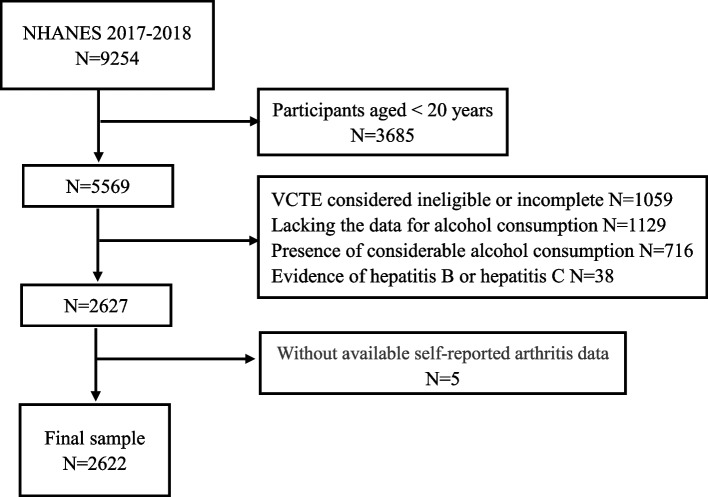
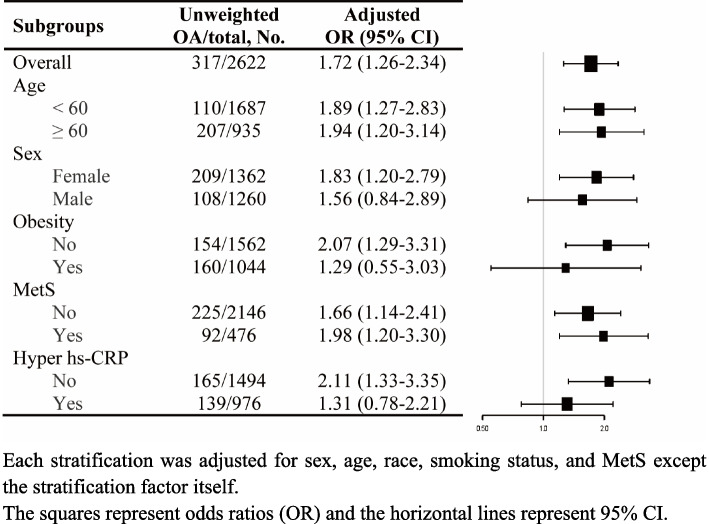
BACKGROUND: The association between non-alcoholic fatty liver disease (NAFLD) and osteoarthritis (OA) has not been well elucidated. The aim of the present study was to investigate the association between NAFLD and OA in the US adults. METHODS: A cross-sectional study was performed on participants in the 2017-2018 National Health and Nutrition Examination Survey (NHANES) cycle. NAFLD was defined by the vibration-controlled transient elastography. The diagnosis of OA was based on self-reported data. Weighted multiple logistic regression models and stratified analyses were performed to explore the relationship and verify the stability of the conclusions. Sensitivity analysis using multiple imputation for missing data and propensity score matching (PSM) were performed. RESULTS: In total, 2622 participants [Male: 1260 (47.8%)] were included in this study with a mean age of 48.1 years old (95% CI, 46.6-49.6 years old), containing 317 (12.8%) OA patients and 1140 NAFLD patients (41.5%). A logistic regression indicated a significant association between NAFLD and OA without adjustment [odds ratio (OR) = 2.05; 95% CI, 1.52-2.78]. The association remained stable after adjustment for covariates (OR = 1.72; 95% CI, 1.26-2.34). Sensitivity analysis of missing data with multiple interpolation and PSM found similar results. A significant and consistent association of NAFLD with OA was still observed in each subgroup stratified by age and metabolic syndrome (MetS). Stratified by sex, obesity, and sensitivity c-reactive protein (hs-CRP) category, a statistically significant association was only shown in females, those without obesity, and those without hyper hs-CRP. The results illustrated that the relationship between NAFLD and OA was stable in all subgroups and had no interaction. CONCLUSIONS: NAFLD was positively correlated with OA. Given the current pandemic of NAFLD and OA, clinicians should screen for NAFLD in arthritis patients and intervene early.
Overview
The claims and statistics of this paper haven’t been checked yet.
Free: it reads the open-access text and checks the first 5 claims that cite a source we can check. Create a free account to check every claim.
Integrity signals
Registry
Cites
Statistics
Figures
Verification
Claims the paper makes
The claims and statistics of this paper haven’t been checked yet.
Free: it reads the open-access text and checks the first 5 claims that cite a source we can check. Create a free account to check every claim.
Claims other papers make about this one
Each is checked against this paper’s own text: does it say what the citing paper says it does?
The source backs part of the claim, not all of it — or backs it for a different population, condition or comparison.
In the citing paper
“Nonalcoholic fatty liver disease and chronic liver disease are associated with osteoarticular disorders, probably through systemic inflammatory and metabolic pathways [119].”
From Interorgan Communications in Skeletal Pathophysiology: From Molecular Pathways to Multidisciplinary Therapies (2026) · cites this paper as [119]
Experimental — accuracy not yet measured
Self-check
Percentages, sums and reported differences re-computed from the paper’s own numbers.
The self-check needs the paper’s full text.
Citations
Cites
Grundy, S. M., Cleeman, J. I., Daniels, S. R., Donato, K. A., Eckel, R. H., Franklin, B. A., Gordon, D. J., Krauss, R. M., Savage, P. J., Smith, S. C., et al. (2005) · Circulation · doi:10.1161/circulationaha.105.169404 · Cited by 11,961 · cited 1×
“MetS was diagnosed in accordance with the National Cholesterol Education Program Adult Treatment Panel III guidelines[26].”
MethodEASL–EASD–EASO Clinical Practice Guidelines for the management of non-alcoholic fatty liver disease
(2016) · Journal of Hepatology · doi:10.1016/j.jhep.2015.11.004 · Cited by 4,836
MAFLD: a consensus-driven proposed nomenclature for metabolic associated fatty liver disease
Eslam, M., Sanyal, A. J., George, J., Sanyal, A., Neuschwander-Tetri, B., Tiribelli, C., Kleiner, D. E., Brunt, E., Bugianesi, E., Yki-Järvinen, H., et al. (2020) · Gastroenterology · doi:10.1053/j.gastro.2019.11.312 · Cited by 3,286 · cited 1×
“Besides, hs-CRP (mg/dL) status is defined according to clinically recommended high-risk thresholds for hs-CRP[23].”
Method2. Classification and Diagnosis of Diabetes: Standards of Medical Care in Diabetes—2020
American Diabetes Association (2020) · Diabetes Care · doi:10.2337/dc20-s002 · Cited by 3,187 · cited 1×
“Diabetes mellitus was determined by FBG ≥ 126 mg/dL or HbA1c level ≥ 6.5%, self-reported diabetes, or administration of anti-diabetic drugs (including insulin) [24].”
BackgroundInfluentialVernon, G., Baranova, A., & Younossi, Z. M. (2011) · Alimentary Pharmacology & Therapeutics · doi:10.1111/j.1365-2036.2011.04724.x · Cited by 3,074 · cited 2×
“Considering its close association with metabolic dysfunction, a growing body of evidence in the literature suggests that NAFLD is the hepatic manifestation of MetS[13].”
BackgroundHochberg, M. C., Altman, R. D., April, K. T., Benkhalti, M., Guyatt, G., McGowan, J., Towheed, T., Welch, V., Wells, G., & Tugwell, P. (2012) · Arthritis Care & Research · doi:10.1002/acr.21596 · Cited by 3,068 · cited 1×
“Besides, current treatments for OA have limited effectiveness, mainly focusing on relieving symptoms rather than preventing or reversing the progression of the disease[7, 8].”
BackgroundThe prevalence and incidence of NAFLD worldwide: a systematic review and meta-analysis
Riazi, K., Azhari, H., Charette, J. H., Underwood, F. E., King, J. A., Afshar, E. E., Swain, M. G., Congly, S. E., Kaplan, G. G., & Shaheen, A.-A. (2022) · The Lancet Gastroenterology & Hepatology · doi:10.1016/s2468-1253(22)00165-0 · Cited by 2,246 · cited 1×
“With a global prevalence of 32.4% which is projected to increase for the next decade, NAFLD has become a major global public health problem[10].”
BackgroundInfluentialChalasani, N., Younossi, Z., Lavine, J. E., Diehl, A. M., Brunt, E. M., Cusi, K., Charlton, M., & Sanyal, A. J. (2012) · Gastroenterology · doi:10.1053/j.gastro.2012.04.001 · Cited by 1,775 · cited 3×
“…tissue biopsy evaluation is recommended by clinical guidelines as the golden standard for diagnosing hepatic disease, it is impractical to perform liver biopsy examination to assess hepatic steatosis for large populations, given the current global prevalence of patients with NAFLD [9, 16, 17].”
BackgroundOsteoarthritis as an inflammatory disease (osteoarthritis is not osteoarthrosis!)
Berenbaum, F. (2013) · Osteoarthritis and Cartilage · doi:10.1016/j.joca.2012.11.012 · Cited by 1,718 · cited 1×
“Although obesity-related biomechanical overloading plays a predominant role in OA, it is worth noting that inflammatory mediators are also one of the crucial drivers of joint tissue destruction[28, 29].”
BackgroundNoninvasive assessment of liver disease in patients with nonalcoholic fatty liver disease
Castera, L., Friedrich-Rust, M., & Loomba, R. (2019) · Gastroenterology · doi:10.1053/j.gastro.2018.12.036 · Cited by 1,494 · cited 1×
“VCTE is a widely used non-invasive and convenient method to identify hepatic steatosis through the value of controlled attenuation parameter (CAP)[18].”
MethodLow-grade inflammation as a key mediator of the pathogenesis of osteoarthritis
Robinson, W. H., Lepus, C. M., Wang, Q., Raghu, H., Mao, R., Lindstrom, T. M., & Sokolove, J. (2016) · Nature Reviews Rheumatology · doi:10.1038/nrrheum.2016.136 · Cited by 1,438 · cited 7×
“Various factors, such as obesity, low-grade inflammation, and insulin resistance (IR), seem to have a crucial effect on the pathogenesis of OA[2, 3].”
BackgroundInfluentialEddowes, P. J., Sasso, M., Allison, M., Tsochatzis, E., Anstee, Q. M., Sheridan, D., Guha, I. N., Cobbold, J. F., Deeks, J. J., Paradis, V., et al. (2019) · Gastroenterology · doi:10.1053/j.gastro.2019.01.042 · Cited by 1,410 · cited 1×
“In the presented study, individuals were diagnosed with hepatic steatosis by CAP ≥ 274 dB/m, as this threshold showed high accuracy in identifying hepatic steatosis[19].”
BackgroundThe economic and clinical burden of nonalcoholic fatty liver disease in the United States and Europe
Younossi, Z. M., Blissett, D., Blissett, R., Henry, L., Stepanova, M., Younossi, Y., Racila, A., Hunt, S., & Beckerman, R. (2016) · Hepatology · doi:10.1002/hep.28785 · Cited by 1,285 · cited 1×
“In fact, even excluding social costs, annual direct medical costs directly attributable to NAFLD in the USA are estimated to exceed $100 billion[11].”
BackgroundAbramoff, B., & Caldera, F. E. (2020) · Medical Clinics of North America · doi:10.1016/j.mcna.2019.10.007 · Cited by 1,191
Long, H., Liu, Q., Yin, H., Wang, K., Diao, N., Zhang, Y., Lin, J., & Guo, A. (2022) · Arthritis & Rheumatology · doi:10.1002/art.42089 · Cited by 1,155 · cited 1×
“Fueled by population aging, osteoarthritis (OA) has become the most prevalent and disabling degenerative joint disease, estimated to affect at least 36 million United States (US) adults and imposing a huge disease burden[1].”
BackgroundTrends in Blood Pressure Control Among US Adults With Hypertension, 1999-2000 to 2017-2018
Muntner, P., Hardy, S. T., Fine, L. J., Jaeger, B. C., Wozniak, G., Levitan, E. B., & Colantonio, L. D. (2020) · JAMA · doi:10.1001/jama.2020.14545 · Cited by 964 · cited 1×
“Hypertension was determined by SBP ≥ 140 mmHg and/or DBP ≥ 90 mmHg or self-reported current use of antihypertensive drugs[25].”
MethodReijman, M., Pols, H. A. P., Bergink, A. P., Hazes, J. M. W., Belo, J. N., Lievense, A. M., & Bierma-Zeinstra, S. M. A. (2007) · Annals of the Rheumatic Diseases · doi:10.1136/ard.2006.053538 · Cited by 470 · cited 1×
“Although obesity-related biomechanical overloading plays a predominant role in OA, it is worth noting that inflammatory mediators are also one of the crucial drivers of joint tissue destruction[28, 29].”
BackgroundObesity, Inflammation, and Immune System in Osteoarthritis
Nedunchezhiyan, U., Varughese, I., Sun, A. R., Wu, X., Crawford, R., & Prasadam, I. (2022) · Frontiers in Immunology · doi:10.3389/fimmu.2022.907750 · Cited by 466 · cited 2×
“Various factors, such as obesity, low-grade inflammation, and insulin resistance (IR), seem to have a crucial effect on the pathogenesis of OA[2, 3].”
BackgroundEndoplasmic reticulum stress in liver diseases
Ajoolabady, A., Kaplowitz, N., Lebeaupin, C., Kroemer, G., Kaufman, R. J., Malhi, H., & Ren, J. (2023) · Hepatology · doi:10.1002/hep.32562 · Cited by 405 · cited 1×
“Besides, evidence supports the notion that the existence of ER stress can trigger the occurrence and progression of a variety of liver diseases, especially NAFLD[43, 44].”
BackgroundNonalcoholic steatohepatitis: the role of peroxisome proliferator-activated receptors
Francque, S., Szabo, G., Abdelmalek, M. F., Byrne, C. D., Cusi, K., Dufour, J.-F., Roden, M., Sacks, F., & Tacke, F. (2021) · Nature Reviews Gastroenterology & Hepatology · doi:10.1038/s41575-020-00366-5 · Cited by 316 · cited 1×
“The mechanism of NAFLD is multi-factorial involving IR and metabolic disorders that trigger low-grade inflammation in the liver and extra-hepatic organs[12].”
BackgroundNon-alcoholic fatty liver disease: A patient guideline
Francque, S. M., Marchesini, G., Kautz, A., Walmsley, M., Dorner, R., Lazarus, J. V., Zelber-Sagi, S., Hallsworth, K., Busetto, L., Frühbeck, G., et al. (2021) · JHEP Reports · doi:10.1016/j.jhepr.2021.100322 · Cited by 264 · cited 1×
“…tissue biopsy evaluation is recommended by clinical guidelines as the golden standard for diagnosing hepatic disease, it is impractical to perform liver biopsy examination to assess hepatic steatosis for large populations, given the current global prevalence of patients with NAFLD [9, 16, 17].”
BackgroundType 2 diabetes mellitus and osteoarthritis
Veronese, N., Cooper, C., Reginster, J.-Y., Hochberg, M., Branco, J., Bruyère, O., Chapurlat, R., Al-Daghri, N., Dennison, E., Herrero-Beaumont, G., et al. (2019) · Seminars in Arthritis and Rheumatism · doi:10.1016/j.semarthrit.2019.01.005 · Cited by 258
Links between metabolic syndrome and metabolic dysfunction-associated fatty liver disease
Lim, S., Kim, J.-W., & Targher, G. (2021) · Trends in Endocrinology & Metabolism · doi:10.1016/j.tem.2021.04.008 · Cited by 213 · cited 2×
“Various factors, such as obesity, low-grade inflammation, and insulin resistance (IR), seem to have a crucial effect on the pathogenesis of OA[2, 3].”
BackgroundClinical validation of self-reported osteoarthritis
March, L. M., Schwarz, J. M., Carfrae, B. H., & Bagge, E. (1998) · Osteoarthritis and Cartilage · doi:10.1053/joca.1997.0098 · Cited by 194 · cited 6×
“Various factors, such as obesity, low-grade inflammation, and insulin resistance (IR), seem to have a crucial effect on the pathogenesis of OA[2, 3].”
BackgroundInfluentialAssociation of Low-Carbohydrate and Low-Fat Diets with Mortality Among US Adults
Shan, Z., Guo, Y., Hu, F. B., Liu, L., & Qi, Q. (2020) · JAMA Internal Medicine · doi:10.1001/jamainternmed.2019.6980 · Cited by 192 · cited 1×
“The demographic information included age, sex (male, female), race, educational level (high school and below, some college and above), marital status (living with partner, single) and PIR [low income ( ≤ 1.3), middle income (> 1.3 to 3.5) and high income ( ≥ 3.5)][22].”
BackgroundInfluentialHepatic neuregulin 4 signaling defines an endocrine checkpoint for steatosis-to-NASH progression
Guo, L., Zhang, P., Chen, Z., Xia, H., Li, S., Zhang, Y., Kobberup, S., Zou, W., & Lin, J. D. (2017) · Journal of Clinical Investigation · doi:10.1172/jci96324 · Cited by 169 · cited 1×
“A preponderance of evidence has illustrated that decreased serum Neuregulin 4 (Nrg4) level is detected in NAFLD patients and it is independently correlated with NAFLD, whilst its deficiency accelerates the process of inflammation, liver injury, and fibrosis, and in NASH mice[32, 33].”
BackgroundFOXA3 induction under endoplasmic reticulum stress contributes to non-alcoholic fatty liver disease
Liu, C., Zhou, B., Meng, M., Zhao, W., Wang, D., Yuan, Y., Zheng, Y. F., Qiu, J. F., Li, Y., Li, G., et al. (2021) · Journal of Hepatology · doi:10.1016/j.jhep.2021.01.042 · Cited by 142 · cited 1×
“Besides, evidence supports the notion that the existence of ER stress can trigger the occurrence and progression of a variety of liver diseases, especially NAFLD[43, 44].”
BackgroundHamada, D., Maynard, R., Schott, E., Drinkwater, C. J., Ketz, J. P., Kates, S. L., Jonason, J. H., Hilton, M. J., Zuscik, M. J., & Mooney, R. A. (2016) · Arthritis & Rheumatology · doi:10.1002/art.39561 · Cited by 130 · cited 1×
“These metabolic disorders have been linked to OA with causal or observational evidence[36–39].”
BackgroundThe burden of metabolic syndrome on osteoarthritic joints
Dickson, B. M., Roelofs, A. J., Rochford, J. J., Wilson, H. M., & Bari, C. D. (2019) · Arthritis Research & Therapy · doi:10.1186/s13075-019-2081-x · Cited by 105 · cited 1×
“Accumulating evidence has indicated that OA was associated with several systemic diseases such as obesity, cardio-vascular disease, type 2 diabetes mellitus (T2DM), and metabolic syndrome (MetS) [4–6].”
BackgroundOsteoarthritis and risk of mortality in the USA: a population-based cohort study
Mendy, A., Park, J., & Vieira, E. R. (2018) · International Journal of Epidemiology · doi:10.1093/ije/dyy187 · Cited by 94 · cited 1×
“In epidemiological studies, self-reported OA is often used for case definition[20].”
BackgroundDai, Y.-N., Zhu, J., Fang, Z.-Y., Zhao, D., Wan, X., Zhu, H.-T., Yu, C., & Li, Y. (2015) · Metabolism · doi:10.1016/j.metabol.2015.08.013 · Cited by 91 · cited 1×
“A preponderance of evidence has illustrated that decreased serum Neuregulin 4 (Nrg4) level is detected in NAFLD patients and it is independently correlated with NAFLD, whilst its deficiency accelerates the process of inflammation, liver injury, and fibrosis, and in NASH mice[32, 33].”
BackgroundOsteoarthritis, part of life or a curable disease? A bird's‐eye view
Englund, M. (2023) · Journal of Internal Medicine · doi:10.1111/joim.13634 · Cited by 89 · cited 1×
“Accumulating evidence has indicated that OA was associated with several systemic diseases such as obesity, cardio-vascular disease, type 2 diabetes mellitus (T2DM), and metabolic syndrome (MetS) [4–6].”
BackgroundLi, H., Zhang, Y., Luo, H., & Lin, R. (2022) · Frontiers in Endocrinology · doi:10.3389/fendo.2022.977625 · Cited by 79 · cited 1×
“Secondly, NAFLD is the manifestation of complex metabolic dysfunction[13, 35].”
BackgroundSelf-citationCai, Y., Li, H., Liu, M., Pei, Y., Zheng, J., Zhou, J., Luo, X., Huang, W., Ma, L., Yang, Q., et al. (2018) · Hepatology · doi:10.1002/hep.29777 · Cited by 78 · cited 1×
“In addition to enhancing the pro-inflammatory response, A2AR deficiency can also increase fat deposition of hepatocytes[31].”
BackgroundSelf-citationHwang, H.-J., Jung, T. W., Kim, B.-H., Hong, H. C., Seo, J. A., Kim, S. G., Kim, N. H., Choi, K. M., Choi, D. S., Baik, S. H., et al. (2015) · Biochemical Pharmacology · doi:10.1016/j.bcp.2015.08.098 · Cited by 72 · cited 1×
“Recent evidence in mice demonstrated that dipeptidyl peptidase-4 (DPP-4) inhibitors could improve the degree of hepatic steatosis and IR through AMPK-depend-ent and JNK-dependent inhibition of LECT2 expression[41].”
BackgroundDyslipidemia Might Be Associated with an Increased Risk of Osteoarthritis
Xiong, J., Long, J., Chen, X., Li, Y., & Song, H. (2020) · BioMed Research International · doi:10.1155/2020/3105248 · Cited by 61 · cited 1×
“These metabolic disorders have been linked to OA with causal or observational evidence[36–39].”
BackgroundScotece, M., Koskinen-Kolasa, A., Pemmari, A., Leppänen, T., Hämäläinen, M., Moilanen, T., Moilanen, E., & Vuolteenaho, K. (2020) · Inflammation Research · doi:10.1007/s00011-020-01326-0 · Cited by 43
Patient Determinants for Histologic Diagnosis of NAFLD in the Real World: A TARGET‐NASH Study
Barritt, A. S., Watkins, S. E., Gitlin, N., Klein, S., Lok, A. S.-F., Loomba, R. S., Schoen, C., Reddy, K. R., Trinh, H. N., Mospan, A. R., et al. (2021) · Hepatology Communications · doi:10.1002/hep4.1689 · Cited by 35 · cited 1×
“Barritt AS et al. confirmed that fueled by the severity of liver disease, the prevalence of OA increased gradually[27].”
BackgroundHellevik, A. I., Johnsen, M. B., Langhammer, A., Baste, V., Furnes, O. N., Storheim, K., Zwart, J., Flugsrud, G. B., & Nordsletten, L. (2018) · Clinical Epidemiology · doi:10.2147/clep.s145823 · Cited by 34
Wen, Z., Sun, Q., Shan, Y., Xie, W., Ding, Y., Wang, W., Ye, R., Xiao, W., & Li, Y. (2022) · Aging and Disease · doi:10.14336/ad.2022.0725 · Cited by 31
The molecular structure and role of LECT2 or CHM‐II in arthritis, cancer, and other diseases
Zhu, S., Bennett, S., Li, Y., Liu, M., & Xu, J. (2021) · Journal of Cellular Physiology · doi:10.1002/jcp.30593 · Cited by 22 · cited 6×
“Various factors, such as obesity, low-grade inflammation, and insulin resistance (IR), seem to have a crucial effect on the pathogenesis of OA[2, 3].”
BackgroundInfluentialHan, A. L. (2021) · Inflammopharmacology · doi:10.1007/s10787-021-00842-7 · Cited by 21 · cited 7×
“Various factors, such as obesity, low-grade inflammation, and insulin resistance (IR), seem to have a crucial effect on the pathogenesis of OA[2, 3].”
BackgroundResultInfluentialShi, L., Xu, X., Meng, B., He, K., Sun, Y., Tong, J., Xu, J., Cheng, Y., Gan, G.-S., & Xiang, G. (2021) · Calcified Tissue International · doi:10.1007/s00223-021-00897-2 · Cited by 15 · cited 1×
“In addition, Nrg4 may alleviate the progression of OA by attenuating inflammation (IL-Iβ, IL-6, TNF-α) and protecting chondrocyte apoptosis through the MAPK/JNK signaling pathway[34].”
BackgroundPathophysiology roles for adenosine 2A receptor in obesity and related diseases
Cai, Y., Chen, X., Yi, B., Li, J., & Wen, Z. (2022) · Obesity Reviews · doi:10.1111/obr.13490 · Cited by 11 · cited 1×
“For instance, the activation of adenosine 2A receptors (A2AR) is closely related to the downregulation of OA inflammation[30].”
Background
Cited by
Wu, R., & Gong, H. (2024) · Frontiers in Nutrition · doi:10.3389/fnut.2024.1427586 · Cited by 44
Higher body roundness index (BRI) increases infertility among U.S. women aged 18–45 years
Gong, H., Duan, S., Choi, S., & Huang, S. (2024) · BMC Endocrine Disorders · doi:10.1186/s12902-024-01799-8 · Cited by 12
“We used multiple imputa-tions, based on 5 imputed data sets to account for missing baseline data [20].”
Association of waist circumference and BMI with premature death in young and middle-aged population
Hu, L., Han, X., Chen, M., & Zhang, T. (2024) · Frontiers in Public Health · doi:10.3389/fpubh.2024.1389766 · Cited by 10
Association of organs-crosstalk with the pathogenesis of osteoarthritis: cartilage as a key player
Qin, Y., Di, J., Guo, Z., Chen, S., & Xiang, C. (2025) · Frontiers in Endocrinology · doi:10.3389/fendo.2025.1593658 · Cited by 9
Cross-trait genomic modeling reveals the polygenic architecture and systemic impact of MASLD
Du, M., Yuan, H., Wu, T., Jiang, Y., Suo, C., Li, J., Zhang, T., Liu, Z., & Chen, X. (2026) · Science Advances · doi:10.1126/sciadv.aeb5665 · Cited by 7
“…conditions (e.g., liver cirrhosis and angina pectoris), the MASLD PRS was also positively associated with a broad range of disorders, including digestive, renal, endocrine, musculoskeletal, and dermatological conditions, some of which have been reported in previous studies ( 40 – 42 ).”
Metadata
- Authors
- Lu, Y., Zhang, J., Li, H., & Li, T.
- Affiliations
- Third Affiliated Hospital of Guangzhou Medical University (CN)
- Corresponding author
- Li, Ting
- Venue
- Arthritis Research & Therapy
- Published
- 2024-01-31
- Volume
- 26
- Issue
- 1
- Pages
- 40-40
- ISSN
- 1478-6354 (ISSN-L)
- 1478-6362
- PMC
- PMC10829206
- OpenAlex
- W4391401320
- Cited by
- 19
- References
- 44
- Citations by year
- 2026: 10 · 2025: 6 · 2024: 3
- FWCI
- 5.80
- Type
- journal article
- Language
- en
- Open access
- gold
- doi.org
- Licence
- cc-by
- creativecommons.org/licenses/by/4.0 (tdm)
- creativecommons.org/licenses/by/4.0 (vor)
- Locations
- Arthritis Research & Therapy (publishedVersion, cc-by)
- PubMed Central (publishedVersion, cc-by)
- PubMed (publishedVersion)
- DOAJ (DOAJ: Directory of Open Access Journals) (submittedVersion, cc-by-sa)
- Funders
- Science and Technology Projects in Guangzhou (No.202201020529)
- Medical Scientific Research Foundation of Guangdong Province (No. B2021267)
- Topics
- Health Sciences › Medicine › Hepatology › Liver Disease Diagnosis and Treatment
- Health Sciences › Medicine › Rheumatology › Osteoarthritis Treatment and Mechanisms
- Health Sciences › Medicine › Orthopedics and Sports Medicine › Bone and Joint Diseases
- Keywords
- non-alcoholic fatty liver disease, osteoarthritis, vibration-controlled transient elastography, metabolic syndrome, obesity, C-reactive protein, sex differences
- MeSH terms
- Adult, C-Reactive Protein, Cross-Sectional Studies, Female, Humans, Male, Middle Aged, Nutrition Surveys, Obesity, Osteoarthritis, Self Report, Non-alcoholic Fatty Liver Disease
About these checks
Registry, retraction, Cites and statistics results are computed, not judged, with one exception: a printed reference that no index lists is read once by a model before it counts as a citation error. Claims are extracted by a model and kept only when their quote appears verbatim in the text; each cited source is then checked, with a model’s help, for whether it says what the claim relies on. Those verdicts can be wrong — read the claim’s quote and the cited source before relying on one.
Statistics and arithmetic are recomputed, not judged.
Confidence bands are shown only for fields calibrated on our annotated test set. None is calibrated yet, so no band is shown.
What counts as a claim ›How we measure confidence ›How we check this ›
Are you an author, or do you see a problem with this page? Request a review
Data sources
Bibliographic data: Semantic Scholar, OpenAlex, Crossref.
Contains information from the Semantic Scholar Academic Graph Datasets, made available under the ODC Attribution License (ODC-BY 1.0).
Semantic Scholar’s data is described in: Kinney, R., et al. (2023). The Semantic Scholar Open Data Platform. arXiv:2301.10140.
