

Prevalence of anemia and associated factors among pregnant women in Adigrat General Hospital, Tigrai, northern Ethiopia, 2018
Open accessThe DOI matches its Crossref record; 40 of the 40 references it cites were found in a registry or an index.
Abstract
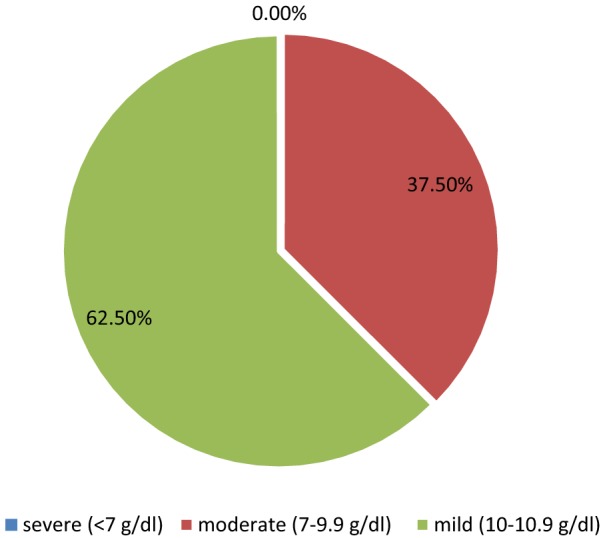
OBJECTIVES: Anemia remains a major public health problem in Ethiopia, which causes maternal and fetal severe consequences. In Tigrai, there are limited literatures on prevalence of anemia and associated factors among pregnant women. Thus, a hospital based cross-sectional study was conducted to determine the prevalence and associated factors of anemia in Adigrat General Hospital. Data was analyzed and computed using SPSS version 22. p value = 0.05 at 95% confidence interval was considered statistically significant. RESULTS: Overall prevalence of Anemia among the pregnant women attending Adigrat General Hospital was 7.9%. About 62.5% and 37.5% of the anemic women were with mild (Hgb: 10.0-10.9 g/d1) and moderate (Hgb: 7-9.9 g/dl) type respectively. Factors like, residing in rural areas increases risk of anemia by 6 times (AOR = 6, 95% CI 1.34, 27.6, p = 0.019), participants having current blood loss (AOR = 3.4, 95% CI 1.16, 10.2, p = 0.026), having history of recent abortion (AOR = 7.9, 95% CI 2.23, 28.1, p = 0.001) and gestational age in the third trimester (AOR = 4.9, 95% CI 1.39, 17.6, p = 0.013) were statistically associated with anemia. Generally, prevalence of anemia is found to be low in the study area. However, it should be given due attention. Therefore, strong endeavor is needed to control anemia among pregnant women by assessing different micronutrient deficiencies for further prevention.
Overview
The claims and statistics of this paper haven’t been checked yet.
Free: it reads the open-access text and checks the first 5 claims that cite a source we can check. Create a free account to check every claim.
Integrity signals
Registry
Cites
Statistics
Figures
Verification
Claims the paper makes
The claims and statistics of this paper haven’t been checked yet.
Free: it reads the open-access text and checks the first 5 claims that cite a source we can check. Create a free account to check every claim.
Claims other papers make about this one
Each is checked against this paper’s own text: does it say what the citing paper says it does?
The check wasn’t confident either way, so it gives no verdict — never disputed.
In the citing paper
“The questionnaire was adapted from relevant published literature and then tailored to the local context to ensure the collection of pertinent information about pregnant women [6, 11].”
From Prevalence of anemia and associated factors among pregnant women at Hargeisa Group Hospital, Somaliland (2024) · cites this paper as [6]
Experimental — accuracy not yet measured
Self-check
Percentages, sums and reported differences re-computed from the paper’s own numbers.
The self-check needs the paper’s full text.
Citations
Cites
Prevalence & consequences of anaemia in pregnancy.
Kalaivani, K. (2009) · PubMed · Cited by 604
Levy, A., Fraser, D., Katz, M., Mazor, M., & Sheiner, E. (2005) · European Journal of Obstetrics & Gynecology and Reproductive Biology · doi:10.1016/j.ejogrb.2005.02.015 · Cited by 439 · cited 1×
“Anemia is the main cause of morbidity and mortality among pregnant women in developing countries with maternal and fetal consequences [7], which leads to premature births [8], low birth weight [9], fetal cognitive impairment, and death [10, 11].”
BackgroundDistrict laboratory practice in tropical countries. Part 1
Williams, J. E. (2000) · Transactions of the Royal Society of Tropical Medicine and Hygiene · doi:10.1016/s0035-9203(00)90297-9 · Cited by 308
Stark, C., Jousi, M., & Enholm, B. (2014) · BMC Research Notes · doi:10.1186/1756-0500-7-1 · Cited by 290
CRAWLEY, J. (2004) · The American Journal of Tropical Medicine and Hygiene · doi:10.4269/ajtmh.2004.71.25 · Cited by 260
Prevalence & Consequences of Anaemia in Pregnancy
Assistant Professor of Obstetrics & Gyenecology, L. N. M. C., Dayal, D. S., Dayal, D. A., & Associate Professor, D. O. S. (2014) · International Journal of Medical Research and Review · doi:10.17511/ijmrr.2014.i04.05 · Cited by 177
Effect of Iron-Deficiency Anemia on Cognitive Skills and Neuromaturation in Infancy and Childhood
Walter, T. (2003) · Food and Nutrition Bulletin · doi:10.1177/15648265030244s207 · Cited by 164 · cited 1×
“Anemia is the main cause of morbidity and mortality among pregnant women in developing countries with maternal and fetal consequences [7], which leads to premature births [8], low birth weight [9], fetal cognitive impairment, and death [10, 11].”
BackgroundAnemia among pregnant women in Southeast Ethiopia: prevalence, severity and associated risk factors
Kefiyalew, F., Zemene, E., Asres, Y., & Gedefaw, L. (2014) · BMC Research Notes · doi:10.1186/1756-0500-7-771 · Cited by 158
Gebre, A., & Mulugeta, A. (2015) · Journal of Nutrition and Metabolism · doi:10.1155/2015/165430 · Cited by 151
Alem, M., Enawgaw, B., Gelaw, A., Kenaw, T., Seid, M., & Olkeba, Y. (2013) · Journal of Interdisciplinary Histopathology · doi:10.5455/jihp.20130122042052 · Cited by 141
Research works printed but not linked: 7
- Iron Deficiency Anemia Assessment prevention and control 2001 Geneva WHO
- Benoist B McLean E Egli I Cogswell M World Health Organization, centers for disease control and prevention: worldwide prevalence of anemia 1993–2005 2008 Geneva World Health Organization
- Ethiopia Demographic Survey Health Central statistics agency 2011 Ethiopia Addis Ababa
- WHO Hemoglobin concentrations for the diagnosis of anemia and assessment of severity, vitamin and mineral nutrition information system 2011 Geneva WHO
- Abdelgader EA Diab TA Kordofani AA Abdalla SA Hemoglobin level, RBCs Indices, and iron status in pregnant females in Sudan Basic Res J Med Clin Sci 2014 3 2 8 13
- Zekarias B Meleko A Hayder A Nigatu A Yetagessu T Prevalence of anemia and its associated factors among pregnant women attending antenatal care in Mizan-Tepi University Teaching Hospital, South West Ethiopia Health Sci J. 2017 11 5 529 10.21767/1791-809X.1000529 · DOI · Paper page
- Tadesse SE Seid O Mariam YG Fekadu A Wasihun Y Determinants of anemia among pregnant mothers attending antenatal care in Dessie town health facilities, northern central Ethiopia, unmatched case–control study PLoS ONE 2017 12 e0173173 10.1371/journal.pone.0173173 28288159 PMC5348124 · DOI · Paper page
Cited by
Items 101–109 of 109
شكورفو, م. ع., الرفاعى, ن. م., علي, ن. م., & الكوت, و. م. (2026) · Journal of Basic Sciences · doi:10.59743/jbs.v39i1.346
Abdikarim, N., Asmerom, H., Ataro, Z., & Solomon, E. T. (2026) · Anemia · doi:10.1155/anem/5067972
“This study was in agreement with studies conducted in Bangladesh [39], Eswatini [57], Ethiopia [58], and Somalia [14].”
Hammad, M., Rahman, M. H. U., & Nomani, M. A. (2026) · Reproductive Health · doi:10.1186/s12978-026-02378-x
“The high prevalence of anaemia in India can be attributed to low dietary intake of iron and folic acid, poor bioavailability of iron, and chronic blood loss due to infections [10].”
Hassan, A. M., Fiidow, O. A., Moussa, A. A., Ahmed, M. M., Dirie, A. M., Hassan, I., Abdulrahman, S. A., & Minhat, H. S. (2025) · Malaysian Journal of Public Health Medicine · doi:10.37268/mjphm/vol.25/no.1/art.2024
Forecasting Anemia Prevalence Among Women Of Reproductive Age In Iraq Using ARIMA
Jbarah, A. K., Al-Temimi, S. A. S., & AL-Shammrty, H. S. N. (2026) · journal of the college of basic education · doi:10.35950/cbej.v32i136.15399
Sharma, R., Shakya, A., Pokhrel, S., Heera, K. C., & Aryal, N. (2025) · Birat Journal of Health Sciences
Factores predictivos de anemia en gestantes de un área de salud
Hierrezuelo-Rojas, N., Jhonson-Valenciano, S., Magdariaga, A. H., Rodríguez-Consuegra, F. R., Cordovi-Hierrezuelo, M., & Neira-Hierrezuelo, N. (2023) · Revista Archivo Médico de Camagüey
แพทย์จะเกร็ง, ร., พุทธาพิทักษ์ผล, ส., & ทองคำรอด, เ. (2022) · Journal of Health Research and Innovation · Cited by 1
DETERMINAN ANEMIA PADA IBU HAMIL :TINJAUAN LITERATUR
Revinovita (2022) · Jurnal Kesehatan dan Sains Terapan
Metadata
- Authors
- Berhe, B., Mardu, F., Legese, H., Gebrewahd, A., Gebremariam, G., Tesfay, K., Kahsu, G., Negash, H., & Adhanom, G.
- Affiliations
- Adigrat University (ET)
- Corresponding author
- Berhe, Brhane
- Venue
- BMC Research Notes
- Published
- 2019-05-31
- Volume
- 12
- Issue
- 1
- Pages
- 310-310
- ISSN
- 1756-0500 (ISSN-L)
- PMC
- PMC6544916
- OpenAlex
- W2947080602
- Cited by
- 87
- References
- 40
- Citations by year
- 2026: 5 · 2025: 6 · 2024: 14 · 2023: 13 · 2022: 23 · 2021: 17 · 2020: 7 · 2019: 2
- FWCI
- 8.66
- Type
- journal article
- Language
- en
- Open access
- gold
- doi.org
- Licence
- cc-by
- creativecommons.org/licenses/by/4.0/ (tdm)
- creativecommons.org/licenses/by/4.0/ (vor)
- Locations
- BMC Research Notes (publishedVersion, cc-by)
- PubMed Central (publishedVersion, cc-by)
- PubMed (publishedVersion)
- DOAJ (DOAJ: Directory of Open Access Journals) (submittedVersion, cc-by-sa)
- Funders
- Adigrat University
- Centers for Disease Control and Prevention
- Topics
- Health Sciences › Medicine › Hematology › Iron Metabolism and Disorders
- Health Sciences › Medicine › Pediatrics, Perinatology and Child Health › Public Health and Nutrition
- Health Sciences › Medicine › Public Health, Environmental and Occupational Health › Malaria Research and Control
- Keywords
- anemia, pregnant women, prevalence, risk factors, rural residence, blood loss, abortion history, third trimester, hemoglobin, micronutrient deficiency, Tigray
- MeSH terms
- Adolescent, Adult, Anemia, Cross-Sectional Studies, Ethiopia, Female, Hospitals, General, Humans, Pregnancy, Pregnancy Complications, Hematologic, Prenatal Care, Risk Factors, Rural Population, Prevalence, Young Adult
About these checks
Registry, retraction, Cites and statistics results are computed, not judged, with one exception: a printed reference that no index lists is read once by a model before it counts as a citation error. Claims are extracted by a model and kept only when their quote appears verbatim in the text; each cited source is then checked, with a model’s help, for whether it says what the claim relies on. Those verdicts can be wrong — read the claim’s quote and the cited source before relying on one.
Statistics and arithmetic are recomputed, not judged.
Confidence bands are shown only for fields calibrated on our annotated test set. None is calibrated yet, so no band is shown.
What counts as a claim ›How we measure confidence ›How we check this ›
Are you an author, or do you see a problem with this page? Request a review
Data sources
Bibliographic data: Semantic Scholar, OpenAlex, Crossref.
Contains information from the Semantic Scholar Academic Graph Datasets, made available under the ODC Attribution License (ODC-BY 1.0).
Semantic Scholar’s data is described in: Kinney, R., et al. (2023). The Semantic Scholar Open Data Platform. arXiv:2301.10140.
