

The impact of Health Transformation Plan on natural vaginal delivery and cesarean section frequency in Iran: an interrupted time series analysis
Open accessThe DOI matches its Crossref record; 21 of the 23 references it cites were found in a registry or an index.
Abstract
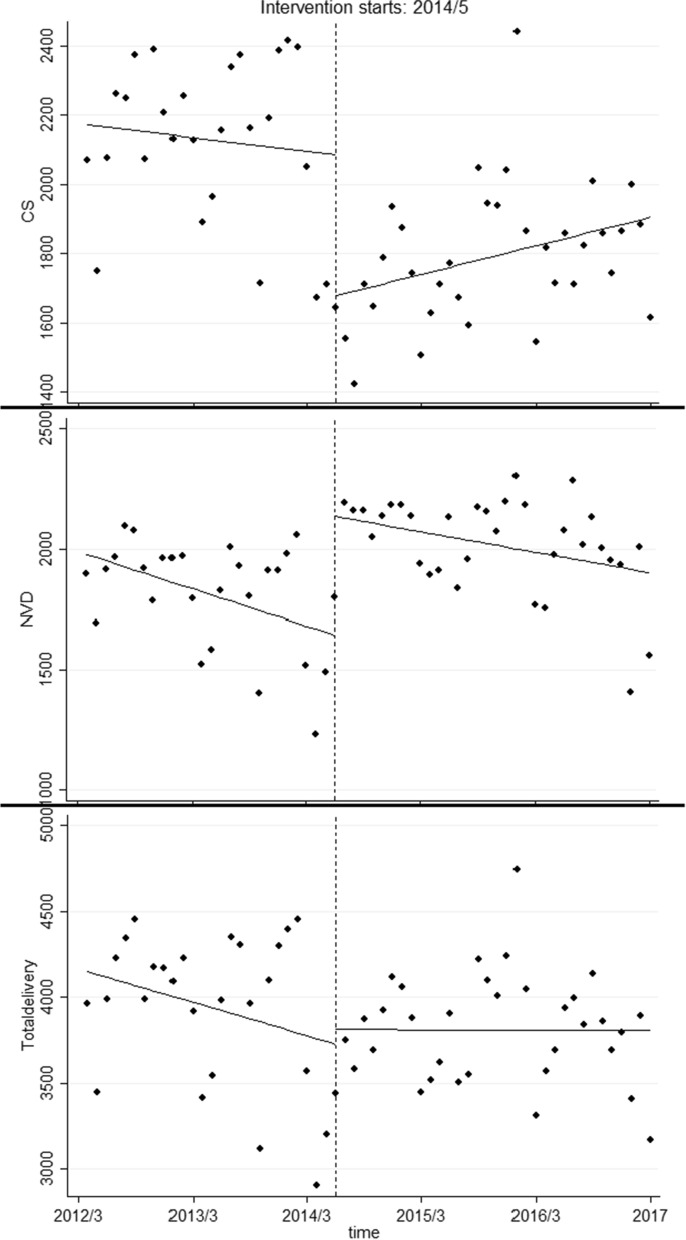
Objective: This study was conducted to evaluate the effect of the Iran’s Health Transformation Plan on the frequency of natural vaginal deliveries (NVDs), cesarean sections (CSs), and total deliveries in the Fars province of Iran. Results: Average number of total deliveries before and after the reform were 3946 and 3810, respectively (p = 0.164). The ratio of CS to total deliveries in the first study month was 54%. This rate reached 47% in the last month (p < 0.01). However, it had much fluctuation trend. The ITSA results showed that in the short-run, the NVD rate increased (β = 492.79, p < 0.01), the rate of CS decreased (β = − 407.09, p < 0.01), and total deliveries increased (β = 85.75, p < 0.724). However, in the long-run, the NVD (β = 5.74, p < 0.423), CS (β = 10.21, p < 0.189), and total deliveries (β = 15.96, p < 0.256) had no significant changes after the reform. Encouraging the NVD package was influential in the short-run but not in the longrun in Iran. Pricing and supply-side policies could not reduce the rate of non-clinical CS on their own. Therefore, paying attention to demand-side policies and changes in consumer behaviors, such as educating the women at the age of pregnancy about the advantages and disadvantages of CS and NVD and correcting misconceptions, could be helpful.
Overview
The claims and statistics of this paper haven’t been checked yet.
Free: it reads the open-access text and checks the first 5 claims that cite a source we can check. Create a free account to check every claim.
Integrity signals
Registry
Cites
Statistics
Figures
Verification
Claims the paper makes
The claims and statistics of this paper haven’t been checked yet.
Free: it reads the open-access text and checks the first 5 claims that cite a source we can check. Create a free account to check every claim.
Claims other papers make about this one
Each is checked against this paper’s own text: does it say what the citing paper says it does?
The cited source says what the claim attributes to it.
In the citing paper
“A high proportion of cesarean sections in Iran occurs for non-medical reasons, driven by socioeconomic factors, cultural norms, limited maternal awareness, misconceptions, and weak policy enforcement [62].”
From Effect of midwifery students’ continuity of care program on women’s experiences of maternity care: A randomised controlled trial (2026) · cites this paper as [62]
Self-check
Percentages, sums and reported differences re-computed from the paper’s own numbers.
The self-check needs the paper’s full text.
Citations
Cites
Béhague, D. P., Victora, C. G., & Barros, F. C. (2002) · BMJ · doi:10.1136/bmj.324.7343.942 · Cited by 362
Are Brazilian women really choosing to deliver by cesarean?
Hopkins, K. (2000) · Social Science & Medicine · doi:10.1016/s0277-9536(99)00480-3 · Cited by 278 · cited 1×
“In a study in Australia, different clinical decisions and elective CS were considered the factors that were increasing the number of CSs among pregnant women [21].”
BackgroundHealth Sector Evolution Plan in Iran; Equity and Sustainability Concerns
Moradi-Lakeh, M., & Vosoogh-Moghaddam, A. (2015) · International Journal of Health Policy and Management · doi:10.15171/ijhpm.2015.160 · Cited by 258 · cited 1×
“indicated that an effective factor in the selection of NVD by pregnant mothers in the short term was that such a kind of delivery was free [15, 16].”
BackgroundWhy do women request caesarean section in a normal, healthy first pregnancy?
Fenwick, J., Staff, L., Gamble, J., Creedy, D. K., & Bayes, S. (2010) · Midwifery · doi:10.1016/j.midw.2008.10.011 · Cited by 227
Prevalence and Causes of Cesarean Section in Iran: Systematic Review and Meta-Analysis.
(2014) · PubMed Central · Cited by 177
Indications for caesarean section
Penn, Z. J., & Ghaem‐Maghami, S. (2001) · Best Practice & Research Clinical Obstetrics & Gynaecology · doi:10.1053/beog.2000.0146 · Cited by 142 · cited 1×
“Due to elective CS, the maternal mortality rate is 2–3 times more than NVD [6].”
BackgroundStavrou, E. P., Ford, J. B., Shand, A. W., Morris, J. M., & Roberts, C. L. (2011) · BMC Pregnancy and Childbirth · doi:10.1186/1471-2393-11-8 · Cited by 137 · cited 1×
“In a study carried out in Turkey, two-third of pregnant women preferred to give birth through elective CS, and about 50% of them believed that choosing the type of delivery was the right of any woman [20].”
BackgroundThe Benefits of Antenatal Education for the Childbirth Process in Spain
Artieta-Pinedo, I., Paz-Pascual, C., Grandes, G., Remiro-Fernandezdegamboa, G., Odriozola-Hermosilla, I., Bacigalupe, A., & Payo, J. (2010) · Nursing Research · doi:10.1097/nnr.0b013e3181dbbb4e · Cited by 85 · cited 1×
“According to the rules, it is limited to cases in which NVD is impossible or has some risks for the mother or baby [4].”
BackgroundReschovsky, J. D., Rich, E. C., & Lake, T. K. (2015) · Journal of General Internal Medicine · doi:10.1007/s11606-015-3366-7 · Cited by 78 · cited 1×
“The prevention of maternal and neonatal mortality and the provision of proper conditions for safe delivery is one of the critical duties of the health system in any country [2].”
BackgroundObstetricians’ and Midwives’ Attitudes toward Cesarean Section
Monari, F., Di Mario, S., Facchinetti, F., & Basevi, V. (2008) · Birth · doi:10.1111/j.1523-536x.2008.00226.x · Cited by 76
Bagheri, A., Alavi, N. M., & Abbaszadeh, F. (2012) · Women and Birth · doi:10.1016/j.wombi.2012.09.004 · Cited by 71 · cited 1×
“Anticipating vaginal birth as a painful and lengthy process, low cultural acceptance and tariffs of different delivery procedures, were most important factors in choosing delivery methods from Iranian obstetricians points of view [25].”
BackgroundArıkan, D. C., Özer, A., Arıkan, İ., Coşkun, A., & Kıran, H. (2010) · Archives of Gynecology and Obstetrics · doi:10.1007/s00404-010-1682-z · Cited by 65
Trends of caesarean section rates in Turkey
Şantaş, G., & Şantaş, F. (2018) · Journal of Obstetrics and Gynaecology · doi:10.1080/01443615.2017.1400525 · Cited by 58 · cited 1×
“9% in 2013 was attributed to the reasons such as CS insurance coverage, living in more prosperous areas, higher economic status, and being first-pregnant [24].”
BackgroundTrends, characteristics, and outcomes of adolescent pregnancy in eastern Turkey
Edirne, T., Can, M., Kolusarı, A., Yıldızhan, R., Adalı, E., & Akdağ, B. (2010) · International Journal of Gynecology & Obstetrics · doi:10.1016/j.ijgo.2010.03.012 · Cited by 52 · cited 1×
“Some of which are clinical factors that make CS inevitable, such as high risk of NVD for mothers [17], high maternal age at first delivery [18], and undergoing CS as the first delivery.”
BackgroundPiroozi, B., Moradi, G., Nasab, N. E., Ghasri, H., Farshadi, S., & Farhadifar, F. (2016) · DOAJ (DOAJ: Directory of Open Access Journals) · Cited by 21
Influencing factors in choosing delivery method: Iranian primiparous women’s perspective
Moosavi, A., Sheikhlou, S. G., Sheikhlou, S. G., Abdolahi, K., Yaminifar, L., & Maktabi, M. (2017) · Electronic physician · doi:10.19082/4150 · Cited by 19 · cited 1×
“concluded that increasing the awareness of pregnant mothers about natural delivery and their understanding of the importance of this kind of delivery could be effective in choosing the delivery method [22].”
MethodCustomer Quality and Maternity Care in Tabriz Urban Health Centers and Health Posts
(2012) · Journal of Clinical Research & Governance · doi:10.13183/jcrg.v1i1.15 · Cited by 15 · cited 1×
“Its objectives included reducing CS by 10% by the end of 2014, increasing pregnant women’s satisfaction, reducing out-of-pocket payments to zero for natural deliveries in public health centers, optimizing the physical environment of maternity wards, and increasing the incentives for service providers to promote NVD [1…”
BackgroundGanji, F., Raeisi, R., Shahrzad, K., Soltani, P., Kasiry, K., Jafarzadeh, L., zahedi, M., Hemati, A., Imani, R., & Shojai, H. (2006) · Journal of Shahrekord University of Medical Sciences · Cited by 14
Comparison of Quality of Life between Mothers with Cesarean or Vaginal Delivery
Radnia, N., Otogara, M., Shahnavazian, S., Jafarian, F., Noori, M. K., Yoosefi, Z., Khodabandeloo, M., & Shayan, A. (2017) · Health Research Journal · doi:10.18869/acadpub.hrjbaq.2.3.177 · Cited by 12 · cited 2×
“The other major complications of CS include endomyometritis and bleeding, urinary tract infection, postpartum infections, and neonatal respiratory distress [5].”
BackgroundÉvolution du taux et de la place des accouchements par césarienne au Burkina Faso
Sombié, I., Mèda, Z. C., Savadogo, L. G. B., Sanou, G., & Dadjoari, M. (2017) · Santé Publique · doi:10.3917/spub.171.0133 · Cited by 6
[Trends in caesarean section rates and places of delivery in Burkina Faso].
Sombié, I., Mèda, Z. C., Savadogo, G. B. L., Sanou, G., & Dadjoari, M. (2017) · PubMed · Cited by 2
Research works printed but not linked: 5
- Pirdehghan A Evaluation and comparison of normal vaginal delivery and elective cesarean section burden in Isfahan city in 2009 2010 Isfahan Isfahan University of Medical Sciences
- Cunningham F Leveno K Bloom S Hauth J Rouse D Spong C Williams obstetrics 2010 23 New York McGraw Hill
- Gibbons L Belizán JM Lauer JA Betrán AP Merialdi M Althabe F The global numbers and costs of additionally needed and unnecessary caesarean sections performed per year: overuse as a barrier to universal coverage World Health Rep 2010 30 1 31
- Veghari G Rahamti R Ebadpour M Shamirzadi AR Montazeri M Hashemifard A Cesarean section and some socio-demographics related factors in the north of Iran: an epidemiologic study Int J Adv Biotechnol Res 2016 7 229 34
- Gh M Farhadifar F Piroozi B Bolbanabad M An assessment of promoting natural childbirth package in health reform plan from the opinion of stakeholders in hospitals of Kurdistan University of Medical Science, 2015 Hakim Res J 2016 19 2 103 110
Cited by
Rezaei, Z., Lotfı, F. H., Bayati, M., & Kavosi, Z. (2023) · BMC Health Services Research · doi:10.1186/s12913-023-09846-1 · Cited by 15
Self-citationSarbaz, M., Baigi, S. F. M., Monazah, F. M., Dayani, N., & Kimiafar, K. (2023) · Health Science Reports · doi:10.1002/hsr2.1131 · Cited by 10
Setoodehzadeh, F., Ansari‐Moghaddam, A., Khammarnia, M., & Barahouei, F. B. (2024) · International Journal of Preventive Medicine · doi:10.4103/ijpvm.ijpvm_69_23 · Cited by 3
Parandavar, N., Emadabadi, R., Abbasijahromi, A., Siasi, S., & Esnaasharieh, F. (2025) · Iranian Journal of Nursing and Midwifery Research · doi:10.4103/ijnmr.ijnmr_68_23 · Cited by 1
“[1,2] Statistics show that the rate of CS has increased from 7% in 1990 to 21% in 2020.”
Bayati, M., Lotfı, F. H., & Bazyar, M. (2025) · Discover Social Science and Health · doi:10.1007/s44155-025-00248-8 · Cited by 1
Self-citation
Metadata
- Authors
- Lotfi, F., Lohivash, S., Kavosi, Z., Owjimehr, S., & Bayati, M.
- Affiliations
- Shiraz University of Medical Sciences (IR)
- Shiraz University (IR)
- Corresponding author
- Bayati, Mohsen
- Venue
- BMC Research Notes
- Published
- 2021-07-03
- Volume
- 14
- Issue
- 1
- Pages
- 257-257
- ISSN
- 1756-0500 (ISSN-L)
- PMC
- PMC8254991
- OpenAlex
- W3181194206
- Cited by
- 12
- References
- 23
- Citations by year
- 2026: 2 · 2025: 6 · 2024: 1 · 2023: 3
- FWCI
- 0.91
- Type
- journal article
- Language
- en
- Open access
- gold
- doi.org
- Licence
- cc-by
- creativecommons.org/licenses/by/4.0 (tdm)
- creativecommons.org/licenses/by/4.0 (vor)
- Locations
- BMC Research Notes (publishedVersion, cc-by)
- PubMed Central (publishedVersion, cc-by)
- PubMed (publishedVersion)
- DOAJ (DOAJ: Directory of Open Access Journals) (submittedVersion, cc-by-sa)
- Funders
- Shiraz University of Medical Sciences (14958)
- Topics
- Health Sciences › Medicine › Obstetrics and Gynecology › Maternal and Perinatal Health Interventions
- Social Sciences › Economics, Econometrics and Finance › Economics and Econometrics › Healthcare Policy and Management
- Health Sciences › Medicine › Public Health, Environmental and Occupational Health › Healthcare Systems and Reforms
- Keywords
- Health Transformation Plan, cesarean section rate, health policy reform, demand-side policy, supply-side policy, maternal health, Fars Province
- MeSH terms
- Cesarean Section, Female, Health Planning, Humans, Iran, Pregnancy, Delivery, Obstetric, Interrupted Time Series Analysis
About these checks
Registry, retraction, Cites and statistics results are computed, not judged, with one exception: a printed reference that no index lists is read once by a model before it counts as a citation error. Claims are extracted by a model and kept only when their quote appears verbatim in the text; each cited source is then checked, with a model’s help, for whether it says what the claim relies on. Those verdicts can be wrong — read the claim’s quote and the cited source before relying on one.
Statistics and arithmetic are recomputed, not judged.
Confidence bands are shown only for fields calibrated on our annotated test set. None is calibrated yet, so no band is shown.
What counts as a claim ›How we measure confidence ›How we check this ›
Are you an author, or do you see a problem with this page? Request a review
Data sources
Bibliographic data: Semantic Scholar, OpenAlex, Crossref.
Contains information from the Semantic Scholar Academic Graph Datasets, made available under the ODC Attribution License (ODC-BY 1.0).
Semantic Scholar’s data is described in: Kinney, R., et al. (2023). The Semantic Scholar Open Data Platform. arXiv:2301.10140.
