

The impact of group activities and their content on persons with dementia attending them
Open accessThe DOI matches its Crossref record; 17 of the 17 references it cites were found in a registry or an index.
Abstract
BACKGROUND: Individuals suffering from dementia and residing in nursing homes often feel lonely and bored. This study examined the engagement and mood of people with dementia in group activities, and how personal characteristics, such as cognitive function, may impact on an individual's responses to group activities. METHODS: The study included 102 participants, who took part in group activities while their mood and engagement levels were observed. Participants were invited to attend 10 different types of group activities, each of which was offered twice. RESULTS: Results found improved engagement and mood during group activities as compared to control no-group times. Significant relationships between the type of activity and ratings of engagement and mood were also found. Although participants with higher levels of cognitive functioning manifested greater responsiveness to groups, the pattern of response to different contents did not differ by cognitive function. CONCLUSIONS: This study shows the potential utility of group activities for improving quality of life of persons with dementia and demonstrates a methodology that can be used for quality improvement to optimize group contents. Future research should expand the range of contents of group activities in order to enhance the options for improving mood and engagement of individuals with dementia.
Overview
The claims and statistics of this paper haven’t been checked yet.
Free: it reads the open-access text and checks the first 5 claims that cite a source we can check. Create a free account to check every claim.
Integrity signals
Registry
Cites
Statistics
Figures
Verification
Claims the paper makes
The claims and statistics of this paper haven’t been checked yet.
Free: it reads the open-access text and checks the first 5 claims that cite a source we can check. Create a free account to check every claim.
Claims other papers make about this one
Each is checked against this paper’s own text: does it say what the citing paper says it does?
The source backs part of the claim, not all of it — or backs it for a different population, condition or comparison.
In the citing paper
“The intervention did not reduce agitation symptoms, although it was cost-effective, improving quality of life.223”
From Dementia prevention, intervention, and care: 2020 report of the Lancet Commission (2020) · cites this paper as [223]
Experimental — accuracy not yet measured
Self-check
Percentages, sums and reported differences re-computed from the paper’s own numbers.
The self-check needs the paper’s full text.
Citations
Cites
MDS Cognitive Performance Scale(C)
Morris, J. N., Fries, B. E., Mehr, D. R., Hawes, C., Phillips, C., Mor, V., & Lipsitz, L. A. (1994) · Journal of Gerontology · doi:10.1093/geronj/49.4.m174 · Cited by 1,810 · cited 6×
“Baseline characteristics were collected from the MDS and medical charts: age, sex, language, education, marital status, number of children, mobility, vision, hearing, speech, number of medications, number of diagnoses, cognitive functioning (via the CPS), and activities of daily living (via the Activities of Daily Liv…”
InfluentialMorris, J. N., Fries, B. E., & Morris, S. A. (1999) · The Journals of Gerontology Series A: Biological Sciences and Medical Sciences · doi:10.1093/gerona/54.11.m546 · Cited by 1,408 · cited 8×
“Baseline characteristics were collected from the MDS and medical charts: age, sex, language, education, marital status, number of children, mobility, vision, hearing, speech, number of medications, number of diagnoses, cognitive functioning (via the CPS), and activities of daily living (via the Activities of Daily Liv…”
InfluentialHawes, C., Morris, J. N., Phillips, C. D., Mor, V., Fries, B. E., & Nonemaker, S. (1995) · The Gerontologist · doi:10.1093/geront/35.2.172 · Cited by 735
Engagement in Persons With Dementia: The Concept and Its Measurement
Cohen-Mansfield, J., Dakheel-Ali, M., & Marx, M. S. (2009) · The American Journal of Geriatric Psychiatry · doi:10.1097/jgp.0b013e31818f3a52 · Cited by 259 · cited 1×
“psychometric properties showing good inter-rater reliability and validity, are presented in [2, 15].”
Self-citationThe Resident Assessment Instrument-Minimum Data Set 2.0 quality indicators: a systematic review
Hutchinson, A. M., Milke, D. L., Maisey, S., Johnson, C., Squires, J. E., Teare, G., & Estabrooks, C. A. (2010) · BMC Health Services Research · doi:10.1186/1472-6963-10-166 · Cited by 182
Brooker, D., & Duce, L. (2000) · Aging & Mental Health · doi:10.1080/713649967 · Cited by 180 · cited 4×
“The sample sizes of four of these studies were small (fewer than 50 participants [3, 5, 7, 9]),”
InfluentialPhillips, L. J., Reid-Arndt, S. A., & Pak, Y. (2010) · Nursing Research · doi:10.1097/nnr.0b013e3181faff52 · Cited by 166 · cited 2×
“[6], who found significantly more pleasure during a group storytelling than during an unstructured control condition.”
Rusted, J., Sheppard, L., & Waller, D. (2006) · Group Analysis · doi:10.1177/0533316406071447 · Cited by 162 · cited 2×
“The sample sizes of four of these studies were small (fewer than 50 participants [3, 5, 7, 9]),”
Cooke, M., Moyle, W., Shum, D., Harrison, S., & Murfield, J. (2010) · Journal of Health Psychology · doi:10.1177/1359105310368188 · Cited by 157 · cited 2×
“The sample sizes of four of these studies were small (fewer than 50 participants [3, 5, 7, 9]),”
Vink, A. C., Zuidersma, M., Boersma, F., de Jonge, P., Zuidema, S. U., & Slaets, J. P. J. (2013) · International Journal of Geriatric Psychiatry · doi:10.1002/gps.3924 · Cited by 135 · cited 1×
“Other studies have also compared two or three group activities on outcomes other than engagement, but have not found significant differences in affect between music and reading activities [7], or in behavior when comparing a music activity versus general recreational activities, such as puzzle games and cooking [8], o…”
Cited by
Dementia prevention, intervention, and care: 2020 report of the Lancet Commission
Livingston, G., Huntley, J., Sommerlad, A., Ames, D., Ballard, C., Banerjee, S., Brayne, C., Burns, A., Cohen-Mansfield, J., Cooper, C., et al. (2020) · The Lancet · doi:10.1016/s0140-6736(20)30367-6 · Cited by 10,430
Self-citationRetractedUse of robots to encourage social engagement between older adults
Lin, Y.-C., Fan, J., Tate, J. A., Sarkar, N., & Mion, L. C. (2021) · Geriatric Nursing · doi:10.1016/j.gerinurse.2021.11.008 · Cited by 47
Orfanos, S., Gibbor, L., Carr, C. E., & Spector, A. E. (2020) · Aging & Mental Health · doi:10.1080/13607863.2020.1746740 · Cited by 35
“In line with the literature (Cohen-Mansfield, 2018), the results from this study highlight the clinical benefits of group activities for people with dementia.”
ResultGibbor, L., Forde, L., Yates, L., Orfanos, S., Komodromos, C., Page, H., Harvey, K., & Spector, A. E. (2020) · Aging & Mental Health · doi:10.1080/13607863.2020.1747048 · Cited by 38
“In addition, previous findings showing that CST benefits QoL may be explained by the general benefits of engagement in group activity for people with dementia (Cohen-Mansfield, 2018) in addition to the stimulation.”
BackgroundHoel, V., Seibert, K., Domhoff, D., Preuß, B., Heinze, F., Rothgang, H., & Wolf‐Ostermann, K. (2022) · International Journal of Environmental Research and Public Health · doi:10.3390/ijerph19041956 · Cited by 40
Chen, S., Lin, M., Jones, C., Chang, W. H., Lin, S., Chien, C.-O., Hsu, C.-F., Qiu, H.-Y., & Moyle, W. (2024) · Journal of the American Medical Directors Association · doi:10.1016/j.jamda.2024.105228 · Cited by 33
O’Sullivan, J. L., Lech, S., Gellert, P. R., Grittner, U., Voigt‐Antons, J., Möller, S., Kuhlmey, A., & Nordheim, J. (2021) · International Psychogeriatrics · doi:10.1017/s1041610221000818 · Cited by 21
Israeli nursing home staff perspectives on challenges to quality care for residents with dementia
Cohen‐Mansfield, J., & Meschiany, G. (2022) · Geriatric Nursing · doi:10.1016/j.gerinurse.2021.12.012 · Cited by 20
Self-citationThe impact of environmental factors on persons with dementia attending recreational groups
Cohen‐Mansfield, J. (2019) · International Journal of Geriatric Psychiatry · doi:10.1002/gps.5210 · Cited by 19
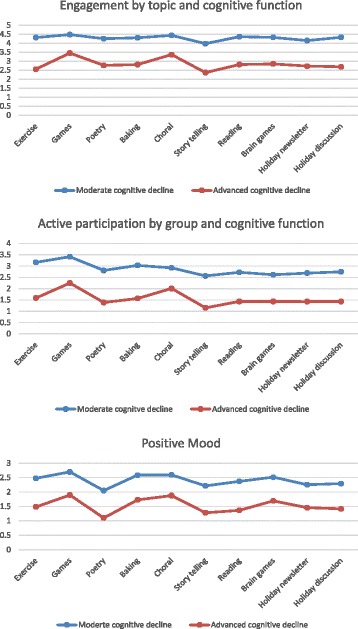
“This has been shown more directly in a comparison of groups with moderate and advanced cognitive impairment.(13) But, while overall levels of engagement were higher for those with moderate cognitive impairment, relative responses to different activity contents were similar for both groups.”
BackgroundSelf-citationHackett, K., Sabat, S. R., & Giovannetti, T. (2021) · Aging & Mental Health · doi:10.1080/13607863.2021.1931029 · Cited by 16
“…that music has an effect on neural activation and neuroplastic reorganization of networks subserving specific cognitive functions such as memory (Cuddy & Duffin, 2005) and language (Merrett et al. 2014); activation of mirror neurons and multimodal integration (Merrett et al., 2014); activation…”
BackgroundSingh, N. N., Lancioni, G. E., Medvedev, O. N., Sreenivas, S., Myers, R. E., & Hwang, Y. (2018) · Mindfulness · doi:10.1007/s12671-018-1075-0 · Cited by 19
“…interventions (such as in the Newcastle Model, Jackman and Beatty 2015) have been used for these conditions, including individual and group activities, simplifying the environment and tasks, and changing caregiver communication style and content (Cohen-Mansfield 2018; Gitlin et al. 2009).”
MethodTowards Engagement Recognition of People with Dementia in Care Settings
Steinert, L., Putze, F., Küster, D., & Schultz, T. (2020) · INTERNATIONAL CONFERENCE ON MULTIMODAL INTERACTION · doi:10.1145/3382507.3418856 · Cited by 14
The impact of COVID-19 on Therapeutic Recreation practice in long-term care homes across Canada
Genoe, M. R., & Johnstone, J. (2021) · World Leisure Journal · doi:10.1080/16078055.2021.1957011 · Cited by 14
Informal antidepressant strategies for nursing home residents: two group concept mapping studies
Knippenberg, I. A. H., Leontjevas, R., Slavi Stoyanov, A., Persoon, A., Verboon, P., Vermeulen, H., van Lankveld, J. J. D. M., & Gerritsen, D. L. (2022) · Aging & Mental Health · doi:10.1080/13607863.2022.2057427 · Cited by 13
“The clusters revealed in our GCM studies are consistent with results of previous studies that indicate that, for example, (stimulating) participation, (encouraging) social interaction, and having a positive attitude may promote positive mood in residents (Beerens et al., 2018; Choi et al., 2008; Cohen-Mansfield, 2018;…”
BackgroundResultInfluentialSpector, A. E., Wahab, N. D. A., Stott, J. C. H., Fisher, E., Hui, E. K., Perkins, L., Leung, W. G., Evans, R., Wong, G. H. Y., & Felstead, C. (2024) · The Gerontologist · doi:10.1093/geront/gnae063 · Cited by 19
“Meeting the need for social engagement can improve symptoms of distress in dementia (Cohen-Mansfield, 2018), suggesting that engagement is a relevant factor to consider for improving outcomes.”
BackgroundBarriers to the Success of Recreational Groups for Persons With Dementia
Cohen‐Mansfield, J., & Jensen, B. A. (2020) · Journal of Geriatric Psychiatry and Neurology · doi:10.1177/0891988720978816 · Cited by 16
“Exercise groups resulted in significantly more active participation, brain games in more positive mood, and baking in more positive mood and active participation thus affecting different outcomes.(3) With respect to personal characteristics, level of cognitive and functional impairment, speech impairment, number of me…”
BackgroundInfluentialSelf-citationDeploying Robot-Led Activities for People with Dementia at Aged Care Facilities: A Feasibility Study
Wu, D., Pu, L., Jo, J. H., Hexel, R., & Moyle, W. (2024) · Journal of the American Medical Directors Association · doi:10.1016/j.jamda.2024.105028 · Cited by 12
Cohen‐Mansfield, J., & Jensen, B. A. (2018) · American Journal of Alzheimer s Disease & Other Dementias® · doi:10.1177/1533317518788158 · Cited by 11
Self-citationThe Impact of Enhanced Group Activity Kits (EGAKs) on Well-being of Persons With Dementia
Cohen‐Mansfield, J. (2024) · Journal of the American Medical Directors Association · doi:10.1016/j.jamda.2024.105329 · Cited by 8
Self-citationKim, H. (2018) · Journal of Exercise Rehabilitation · doi:10.12965/jer.1836216.108 · Cited by 13
“Cohen-Mansfield (2018) applied 10 different types of group activities for improving quality of life of persons with dementia, significant relationships between the type of activity and ratings of engagement and mood were also found.”
Cohen‐Mansfield, J., & Cohen, R. (2024) · Gerontology and Geriatric Medicine · doi:10.1177/23337214241274883 · Cited by 5
“…characteristics of activity group participants on their response to diverse types of group activities (Cohen-Mansfield, 2017), the impact of environmental variables on their response (Cohen-Mansfield, 2020), and the impact of group activity content on their response (Cohen-Mansfield, 2018).”
BackgroundSelf-citationDog visits in nursing homes – increase complexity or keep it simple? A randomised controlled study
Thodberg, K., Videbech, P., Hansen, T. G. B., Pedersen, A. B., & Christensen, J. W. (2021) · PLoS ONE · doi:10.1371/journal.pone.0251571 · Cited by 13
“Furthermore, nursing home residents engage less in the actual activity with increasing impairment level–both in individual activities [41] and group activities [42, 43].”
BackgroundWhat Does Conducting a Clinical Study Teach You? Insights to Improve Care and Enhance Collaboration
Cohen‐Mansfield, J. (2019) · Journal of the American Medical Directors Association · doi:10.1016/j.jamda.2018.12.020 · Cited by 5
Self-citationVideo Analysis of Group Music Therapy for Dementia: Intervention Delivery and Treatment Fidelity
Rasing, N., Vink, A. C., Bloska, J., Nevruz, H., Bakırcı, T., Saltik, Y., Çifdalöz, B. U., Wake, J. D., Sveinsdóttir, V. Ó., Geretsegger, M., et al. (2025) · Journal of Music Therapy · doi:10.1093/jmt/thaf007 · Cited by 6
A Paradigm Shift on Deinstitutionalization and Dementia Care: A Narrative Review
Carcavilla-González, N., Adrián, G. E. S., Minobes‐Molina, E., Pàmies-Tejedor, S., Roncal‐Belzunce, V., Atarés-Rodríguez, L., & García‐Navarro, J. A. (2024) · Journal of Alzheimer s Disease · doi:10.3233/jad-231180 · Cited by 4
“Secondly, recreational services should provide opportunities for social interaction and engagement, which are vital for maintaining cognitive function and enhancing the quality of life [34, 35].”
Tate, J. A., Mion, L. C., Migovich, M., Ghosh, R., Khan, N., Kilpatrick, A., Scharre, D. W., NEWHOUSE, P. A., Maxwell, C. A., Tan, A., et al. (2025) · Contemporary Clinical Trials · doi:10.1016/j.cct.2025.107980 · Cited by 4
“Domains include physical, cognitive and/or social interactive domains; activities can have more than one domain (up to 3) [23,36,37,67].”
Cohen‐Mansfield, J. (2025) · American Journal of Geriatric Psychiatry · doi:10.1016/j.jagp.2025.12.003 · Cited by 3
Self-citationCohen‐Mansfield, J., & Cohen, R. (2026) · BMC Geriatrics · doi:10.1186/s12877-026-07027-3 · Cited by 2
Self-citationThao, M. S., Davila, H. W., & Shippee, T. P. (2024) · Journal of Applied Gerontology · doi:10.1177/07334648241271896 · Cited by 4
Jesdale, B. M., Bova, C., Mbrah, A. K., & Lapane, K. L. (2021) · The Journal of Nursing Home Research Sciences · doi:10.14283/jnhrs.2021.7 · Cited by 5
Cohen‐Mansfield, J. (2024) · Journal of the American Medical Directors Association · doi:10.1016/j.jamda.2023.11.013 · Cited by 2
Self-citationCohen‐Mansfield, J., & Cohen, R. (2025) · Journal of Alzheimer s Disease · doi:10.1177/13872877251393479 · Cited by 2
Self-citationDove, E., Sivakumaran, S., Wang, R. H., Patterson, K. K., & Astell, A. J. (2026) · Disability and Rehabilitation · doi:10.1080/09638288.2026.2641372 · Cited by 1
“…group exercises offered at the day program) may provide important benefits, such as increased opportunities for social and cognitive participation [53], participants’ responses to the topic guide questions in the present study unveiled largely negative attitudes toward physical rehabilitation for…”
Asano, T., Izumi, K., & Ishikawa, T. (2026) · Clinical Gerontologist · doi:10.1080/07317115.2026.2664051 · Cited by 1
“Regarding the relationship between activities and BPSD, previous studies have shown that participation in group activities and ADLs can reduce BPSD (Yanagida et al., 2024b; Jeong & Yoo, 2023; Mansfield, 2018).”
Cohen‐Mansfield, J. (2026) · The Gerontologist · doi:10.1093/geront/gnag080 · Cited by 1
“…for persons living with dementia constitute a critical preventive intervention that can slow functional and cognitive decline (Yamasaki, 2023) or reduce excess disability (Cohen-Mansfield, 2018; Gitlin et al., 2018; Mace, 1987; Rogers et al., 2000) and enhance well-being (Cohen-Mansfield, 2025).”
Self-citationTanney, S., Richardson, S., & Maisey, P. (2023) · FPOP Bulletin Psychology of Older People · doi:10.53841/bpsfpop.2023.1.164.55 · Cited by 1
Gillio, K. C. (2020) · doi:10.46409/sr.zhfn3134
“Small group activities, designed to stimulate cognition for individuals with dementia, have shown to increase communication and social interaction amongst the population (Cohen-Mansfield, 2018).”
BackgroundA Sensory-Based Program to Enhance Occupational Performance for Dementia
torres-Flores, I., Gantan, J., August, H., & Wong, N. (2019) · doi:10.33015/dominican.edu/2019.ot.02
“5 Current literature presents information of how participation in sensory-based programs is associated with improving BPSD (Cohen-Mansfield, 2018).”
BackgroundWongarsa, P., Chaiyasit, Y., Saowaphan, J., & Muthawan, N. (2022) · Journal of Public Health and Development · doi:10.55131/jphd/2023/210115
Kiljunen, O., Tuomikoski, A., Niemelä, K., Saarnio, R., Siira, H. J., Vähäkangas, P., & Välimäki, T. H. (2023) · Gerontologia · doi:10.23989/gerontologia.127078
Living with Dementia and Cognitive Disorders: Beyond Pharmacology
Cohen‐Mansfield, J. (2024) · Topics in Geriatric Care. · doi:10.1007/978-981-97-5995-8_9
Self-citation
Metadata
- Authors
- Cohen-Mansfield, J.
- Venue
- Alzheimer's Research & Therapy
- Published
- 2018-04-05
- Volume
- 10
- Issue
- 1
- Pages
- 37-37
- ISSN
- 1758-9193 (ISSN-L)
- PMC
- PMC5887184
- OpenAlex
- W2802883508
- Cited by
- 41
- References
- 17
- Citations by year
- 2026: 4 · 2025: 4 · 2024: 9 · 2023: 2 · 2022: 4 · 2021: 6 · 2020: 6 · 2019: 3 · 2018: 3
- FWCI
- 3.54
- Type
- journal article
- Language
- en
- Open access
- gold
- doi.org
- Licence
- cc-by
- creativecommons.org/licenses/by/4.0/ (tdm)
- Locations
- Alzheimer s Research & Therapy (publishedVersion, cc-by)
- Europe PMC (PubMed Central) (publishedVersion, cc-by)
- PubMed Central (publishedVersion, cc-by)
- PubMed (publishedVersion)
- DOAJ (DOAJ: Directory of Open Access Journals) (submittedVersion, cc-by-sa)
- Funders
- Minerva Foundation
- Topics
- Health Sciences › Medicine › Psychiatry and Mental health › Dementia and Cognitive Impairment Research
- Health Sciences › Medicine › Geriatrics and Gerontology › Geriatric Care and Nursing Homes
- Health Sciences › Medicine › Public Health, Environmental and Occupational Health › Aging, Health, and Disability
- Keywords
- dementia, group activities, nursing home residents, engagement, mood, cognitive function, quality of life, loneliness, older adults
- MeSH terms
- Activities of Daily Living, Affect, Aged, Aged, 80 and over, Attention, Cognition, Dementia, Female, Group Processes, Humans, Male, Middle Aged, Nursing Homes, Quality of Life, Sleep Wake Disorders, Outcome Assessment, Health Care
About these checks
Registry, retraction, Cites and statistics results are computed, not judged, with one exception: a printed reference that no index lists is read once by a model before it counts as a citation error. Claims are extracted by a model and kept only when their quote appears verbatim in the text; each cited source is then checked, with a model’s help, for whether it says what the claim relies on. Those verdicts can be wrong — read the claim’s quote and the cited source before relying on one.
Statistics and arithmetic are recomputed, not judged.
Confidence bands are shown only for fields calibrated on our annotated test set. None is calibrated yet, so no band is shown.
What counts as a claim ›How we measure confidence ›How we check this ›
Are you an author, or do you see a problem with this page? Request a review
Data sources
Bibliographic data: Semantic Scholar, OpenAlex, Crossref.
Contains information from the Semantic Scholar Academic Graph Datasets, made available under the ODC Attribution License (ODC-BY 1.0).
Semantic Scholar’s data is described in: Kinney, R., et al. (2023). The Semantic Scholar Open Data Platform. arXiv:2301.10140.
