

Geochemical investigation of the mixed Máriahalom vertebrate fauna at the Paleogene–Neogene boundary in the Central Paratethys: environmental conditions and age constrain
Open accessThe DOI matches its Crossref record; 125 of the 126 references it cites were found in a registry or an index, and 1 are not checked yet; none of the 133 sources its claims cite is checked for support yet.
Abstract
The fossil vertebrate fauna of Máriahalom contains remains from a wide range of ecologies including terrestrial and aquatic mammals, crocodiles, sharks, and rays among others. All these were found mixed in mollusc-rich, shallow water, coastal deposits. The aim of the study is to trace the origin of the fossils using their rare earth element (REE) content and their respective ecology with stable oxygen isotopic compositions. In addition, marine vertebrates and calcareous marine fossils were analysed for their Sr isotope composition to provide a new age estimate for the locality. The REE content and their distribution in the fossils indicate similar early diagenetic environments and possible contemporaneous fossilization for the entire vertebrate assemblage. Reworked fossils of significantly different age can be excluded. The enamel/enameloid-derived phosphate oxygen isotope composition of selected fossil taxa fit well with previously inferred habitats that include marine, brackish, and terrestrial environments. Notably, the stem-pinniped Potamotherium valletoni is best interpreted as freshwater dweller instead of marine, consistent with the sedimentology of other occurrences. Our novel 87 Sr/ 86 Sr data suggest an Aquitanian age (21.4 ± 0.5 Ma) for the Máriahalom site that is younger than the previously proposed Late Oligocene age based on biostratigraphy (MP28–30 European Mammal Paleogene Reference Levels). An Aquitanian age raises the possibility that the index fossil taxon, the anthracothere mammal Microbunodon minimum , may have vanished earlier in Western Europe than in the Central Paratethys region.
Checked 2026-11-25 · 1 reference not checked yet
Overview
CoChat Summary
TL;DR
Geochemical analyses of rare earth elements, phosphate oxygen isotopes, and strontium isotopes from the mixed Máriahalom vertebrate fauna indicate a common early diagenetic history, habitats spanning marine to freshwater/terrestrial, and an Aquitanian age of 21.4 ± 0.5 Ma. The new age is younger than the previously proposed Late Oligocene biostratigraphic age and implies that *Microbunodon minimum* may have persisted in the Central Paratethys after its Western European disappearance.
Key findings
- REE data from 16 vertebrate specimens (41 laser spots; 29 final data points) show total REE contents of 1.3–10,045 ppm (mean 1997 ppm; median 1062 ppm), with MREE-enriched and LREE-depleted PAAS-normalized patterns; no taxonomic differences among terrestrial, freshwater, and marine groups, suggesting similar early diagenetic environments and contemporaneous fossilization, excluding significantly older reworked fossils.
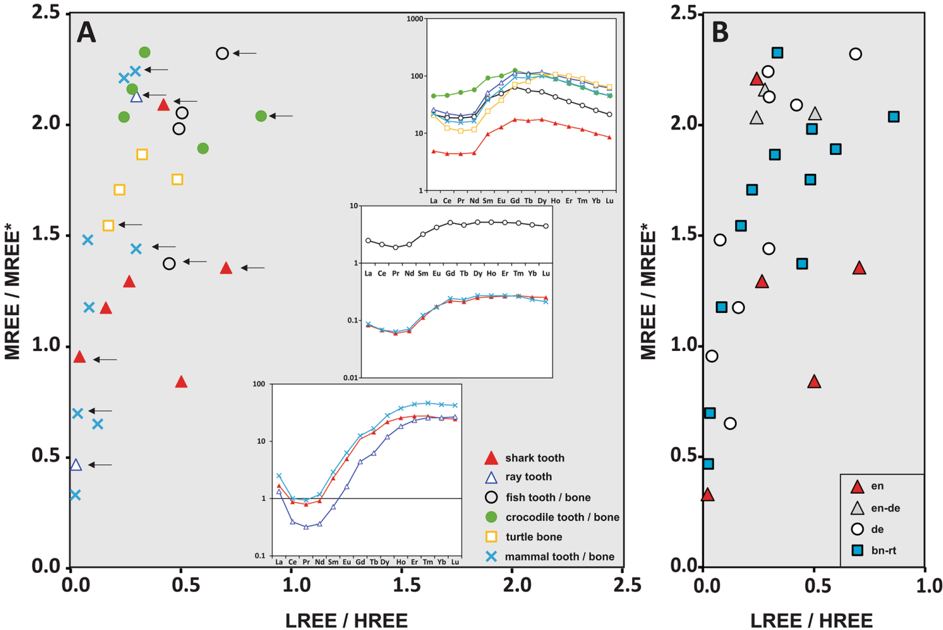
- δ18O PO4 values: shark enameloid 19.5–21.9‰ (n = 4), crocodilian enamel 19.3‰ vs dentine 18.5‰, *Microbunodon* enamel 17.4 and 16.3‰ vs dentine 15.9 and 15.4‰, *Potamotherium* enamel 15.7‰ and dentine 15.6‰, seacow rib 15.3‰; these fit marine, brackish, and terrestrial habitats, with *Potamotherium valletoni* best interpreted as a freshwater rather than marine dweller.
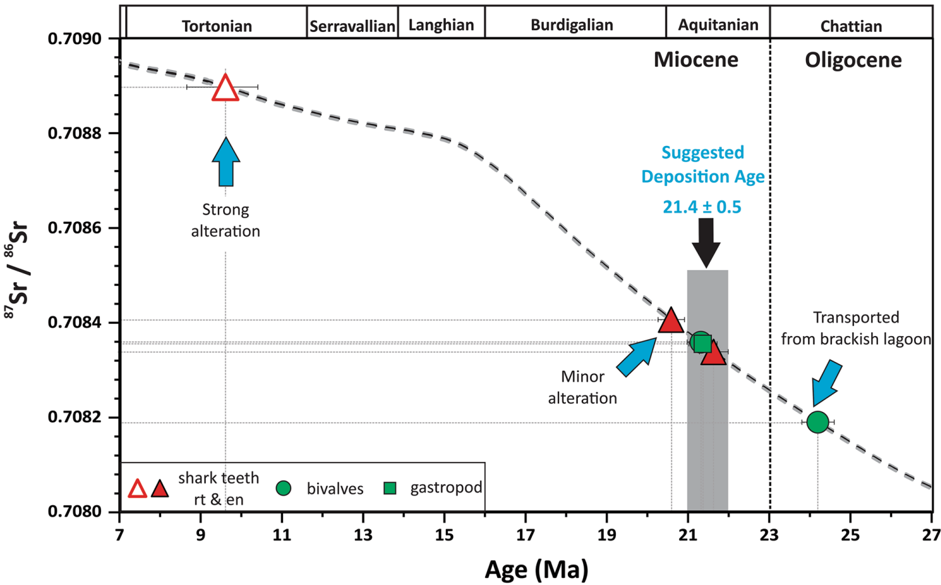
- 87Sr/86Sr from six samples ranges 0.708189–0.708898; three well-preserved samples (two aragonitic molluscs and one shark enameloid) give an average 0.708350 ± 0.00022 and an Aquitanian SIS age of 21.4 ± 0.5 Ma, younger than the previous MP28–30 Late Oligocene age. An oyster shell gave 24.2 Ma (Chattian) and a shark tooth root gave a false 9.6 Ma (Tortonian), attributed to alteration or possible reworking/brackish Sr.
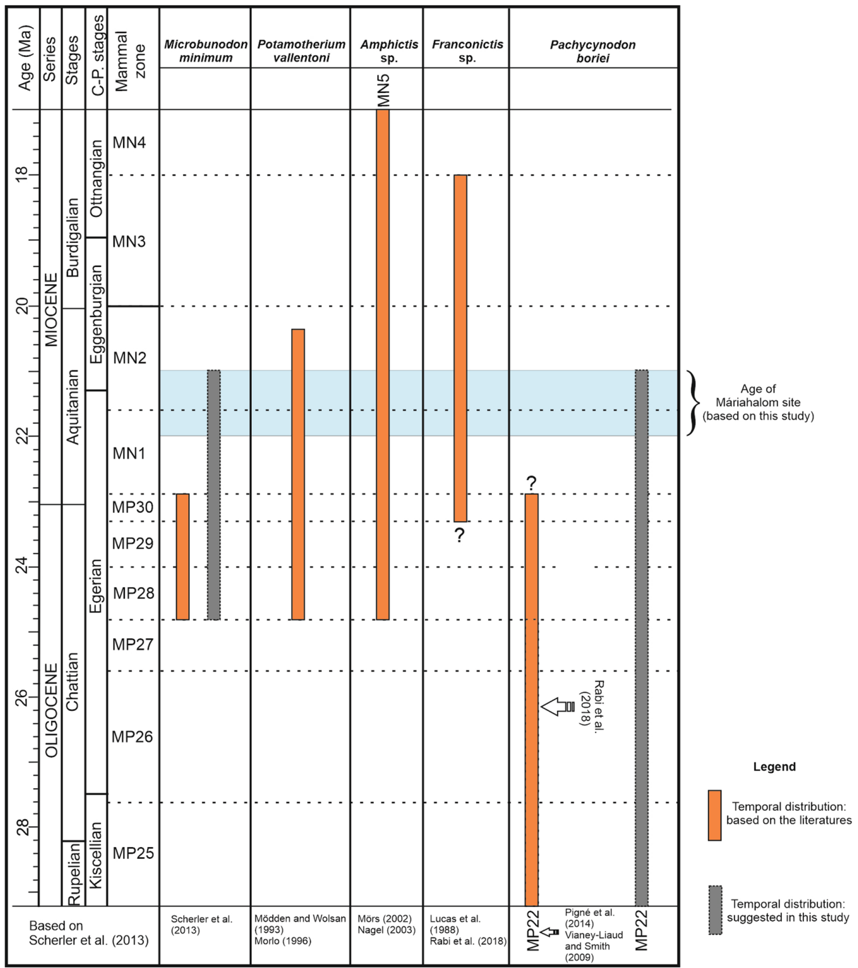
- The Aquitanian age raises the possibility that *Microbunodon minimum* vanished earlier in Western Europe than in Central Paratethys, potentially surviving to MN1–2 and extending its temporal range by at least 1–1.5 million years; *Pachycynodon boriei* may also have survived after the Oligocene–Miocene boundary.
Methods
- LA-ICP-MS trace element analyses on 16 bone/tooth chips from terrestrial, freshwater, and marine vertebrates; 100 μm spots, 1–4 ablations per specimen, NIST612 external and 42Ca internal standardization, CaO 54/50 wt%, reproducibility generally better than ±5% SE; PAAS-normalized REE patterns.
- Stable isotope analyses on selected shark teeth, a crocodilian tooth, a seacow rib, *Potamotherium*, and *Microbunodon* teeth; enameloid/enamel/dentine/bone powders leached in acetic acid buffered to pH 4.5; phosphate oxygen via Ag3PO4 TC/EA, triplicates, VSMOW, NIST SRM 120c = 21.5 ± 0.2‰ (n = 4); calcareous shells via Gasbench II–Delta Plus XL, precision ±0.1‰, VPDB.
- Sr isotope analyses on two shark enameloids, one shark root, two aragonitic molluscs, and one calcite oyster; XRD for mineralogy, ICP-OES for Mg/Sr/Mn/Fe, cation exchange, MC-ICPMS Neptune; normalized to 86Sr/88Sr = 0.1194; NIST SRM 987 external reproducibility 18 ppm (2SD, n = 14); ages from McArthur et al. (2020) with 95% confidence limits.
Limitations
- The paper states that protracted REE uptake may hinder palaeoenvironmental interpretation; dentine and bone (including the sirenian rib) have lower δ18O PO4 interpreted as at least partial diagenetic alteration, and the proportions of original versus secondary apatite are difficult to assess.
- The Sr isotope age relies on three specimens (G1, N1, SE1); one shark enameloid yielded a younger 20.6 Ma, a shark root gave a false Tortonian age, and the oyster gave a Chattian age, which the authors explain by alteration, possible reworking, or brackish/freshwater Sr sources. They also note that the upper MP30 age limit may not be precisely constrained.
- Evident from the text: some isotopic comparisons rest on very small numbers (e.g., single dentine analyses, one crocodilian tooth, one seacow rib, two *Microbunodon* teeth), and the age estimate depends on the Sr isotope curve and external reproducibility rather than an independent radiometric date.
Model-written summary. Check it against the paper before relying on it.
Integrity signals
Registry
Cites
Statistics
Figures
Verification
Claims the paper makes
0 Valid · 2 Not valid · 70 Not checked · 87 Own results and interpretations
A result the paper reports from its own data — it cites no other source for it, so there is none to check. The quote shows it is in the paper.
In the paper
“The enamel/enameloid-derived phosphate oxygen isotope composition of selected fossil taxa fit well with previously inferred habitats that include marine, brackish, and terrestrial environments.”
§ Geochemical investigation of the mixed Máriahalom vertebrate fauna at the Paleogene-Neogene boundary in the Central Paratethys: environmental conditions and age constrain > Abstract
boostedstates an association- Asserted: passes — The authors put it forward as true.
- Checkable: passes — It can be checked against evidence.
- Load-bearing: passes — The paper’s conclusions depend on it.
- Based: passes — The paper gives a reason why it holds.
A result the paper reports from its own data — it cites no other source for it, so there is none to check. The quote shows it is in the paper.
In the paper
“The lowest δ 18 O PO4 value comes from the seacow ribs with a value of 15.3 ‰.”
§ Geochemical investigation of the mixed Máriahalom vertebrate fauna at the Paleogene-Neogene boundary in the Central Paratethys: environmental conditions and age constrain > Stable isotope compositions
plainSingle case- Asserted: passes — The authors put it forward as true.
- Checkable: passes — It can be checked against evidence.
- Load-bearing: unclear — It is unclear whether the paper’s conclusions depend on it.
- Based: passes — The paper gives a reason why it holds.
A result the paper reports from its own data — it cites no other source for it, so there is none to check. The quote shows it is in the paper.
In the paper
“The suggested Sr isotope age of 21.4 ± 0.5 Ma for the Máriahalom site is based on the two aragonitic shells (G1 and N1), and the shark enameloid (SE1) (see Table 2)”
- Also stated in: § Conclusions · plain
“The suggested Sr isotope age of 21.4 ± 0.5 Ma for the Máriahalom site is based on the two aragonitic shells (G1 and N1), and the shark enameloid (SE1) (see Table2) marked by a grey rectangle”
§ Geochemical investigation of the mixed Máriahalom vertebrate fauna at the Paleogene-Neogene boundary in the Central Paratethys: environmental conditions and age constrain > Rare earth element taphonomy
plainstates a cause- Asserted: passes — The authors put it forward as true.
- Checkable: passes — It can be checked against evidence.
- Load-bearing: passes — The paper’s conclusions depend on it.
- Based: passes — The paper gives a reason why it holds.
- Rests on an assumption not shown here.
- Also stated in: § Conclusions · plain
A result the paper reports from its own data — it cites no other source for it, so there is none to check. The quote shows it is in the paper.
In the paper
“The single dentine analysis from the Araloselachus tooth shows a much lower value of 17.8 ‰ compared to the enameloid.”
§ Geochemical investigation of the mixed Máriahalom vertebrate fauna at the Paleogene-Neogene boundary in the Central Paratethys: environmental conditions and age constrain > Stable isotope compositions
plainSingle case- Asserted: passes — The authors put it forward as true.
- Checkable: passes — It can be checked against evidence.
- Load-bearing: unclear — It is unclear whether the paper’s conclusions depend on it.
- Based: passes — The paper gives a reason why it holds.
A result the paper reports from its own data — it cites no other source for it, so there is none to check. The quote shows it is in the paper.
In the paper
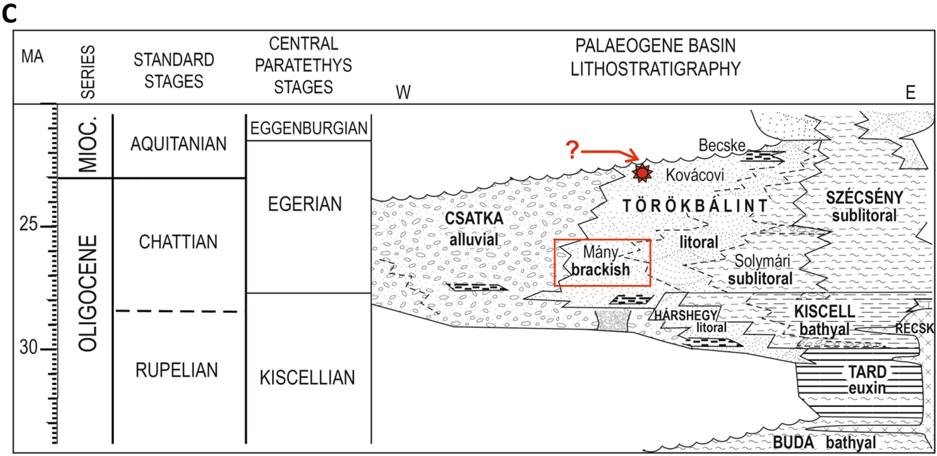
“The PAAS-normalized REE patterns and REE ratios (Fig. 3) show a trend between a middle REE-enriched and light REE-depleted patterns.”
§ Geochemical investigation of the mixed Máriahalom vertebrate fauna at the Paleogene-Neogene boundary in the Central Paratethys: environmental conditions and age constrain > Rare earth element taphonomy
plainstates an association- Asserted: passes — The authors put it forward as true.
- Checkable: passes — It can be checked against evidence.
- Load-bearing: passes — The paper’s conclusions depend on it.
- Based: passes — The paper gives a reason why it holds.
72 more claims
Create a free account to see all 159 claims and to verify the 111 references still open.
- It may state two separate claims as one. 65
- Probably not a substantial claim. 24
- The quote only partly states this claim. 1
Self-check
Percentages, sums and reported differences re-computed from the paper’s own numbers.
Each contradiction between two passages listed here was confirmed by an independent check.
Rated minor: it would not touch a result — a value no result rests on, a p-value that stays on the same side of the significance level, or a conflict that is clerical, resolved elsewhere in the paper, or outside its own findings.
In the paper
§ Geochemical investigation of the mixed Máriahalom vertebrate fauna at the Paleogene-Neogene boundary in the Central Paratethys: environmental conditions and age constrain > Rare earth element taphonomy
“The PAAS-normalized REE patterns and REE ratios (Fig. 3) show a trend between a middle REE-enriched and light REE-depleted patterns.”
§ Geochemical investigation of the mixed Máriahalom vertebrate fauna at the Paleogene-Neogene boundary in the Central Paratethys: environmental conditions and age constrain > Strontium isotope ratios and related screening methods
“Fig. 3 Oxygen isotope composition of select vertebrate fossils from the Máriahalom site as a function of water isotopic composition.”
Rated minor: it would not touch a result — a value no result rests on, a p-value that stays on the same side of the significance level, or a conflict that is clerical, resolved elsewhere in the paper, or outside its own findings.
In the paper
§ Geochemical investigation of the mixed Máriahalom vertebrate fauna at the Paleogene-Neogene boundary in the Central Paratethys: environmental conditions and age constrain > Age of the Máriahalom site
“Another shark enameloid yielded somewhat higher Sr isotope ratios (i.e.younger age of 20.6 Ma-Fig.5), that may reflect minor alteration of its 87 Sr/ 86 Sr ratio.”
§ Geochemical investigation of the mixed Máriahalom vertebrate fauna at the Paleogene-Neogene boundary in the Central Paratethys: environmental conditions and age constrain > Conclusions
“Fig. 5 Temporal range of different mammalian taxa discovered from the Máriahalom site based on the literature and the new data mentioned in this study.”
Citations
Cites
Trends, Rhythms, and Aberrations in Global Climate 65 Ma to Present
Zachos, J., Pagani, M., Sloan, L., Thomas, E., & Billups, K. (2001) · Science · doi:10.1126/science.1059412 · Cited by 10,458
Stable isotopes in precipitation
Dansgaard, W. (1964) · Tellus · doi:10.1111/j.2153-3490.1964.tb00181.x · Cited by 8,369
Proceedings of the Biological Society of Washington
(2019) · Proceedings of the Biological Society of Washington · doi:10.2988/pbsw · Cited by 3,702
Variation of seawater 87Sr/86Sr throughout Phanerozoic time
Burke, W. H., Denison, R. E., Hetherington, E. A., Koepnick, R. B., Nelson, H. F., & Otto, J. B. (1982) · Geology · doi:10.1130/0091-7613(1982)10<516:vosstp>2.0.co;2 · Cited by 1,542
McArthur, J. M., Howarth, R. J., & Bailey, T. R. (2001) · The Journal of Geology · doi:10.1086/319243 · Cited by 1,485
Zoological Journal of the Linnean Society
(2017) · Zoological Journal of the Linnean Society · doi:10.1111/(issn)1096-3642 · Cited by 1,417
Cenozoic Deep-Sea Temperatures and Global Ice Volumes from Mg/Ca in Benthic Foraminiferal Calcite
Lear, C. H., Elderfield, H., & Wilson, P. A. (2000) · Science · doi:10.1126/science.287.5451.269 · Cited by 1,098
Elderfield, H., Upstill-Goddard, R., & Sholkovitz, E. R. (1990) · Geochimica et Cosmochimica Acta · doi:10.1016/0016-7037(90)90432-k · Cited by 1,080
Longinelli, A. (1984) · Geochimica et Cosmochimica Acta · doi:10.1016/0016-7037(84)90259-x · Cited by 1,041
LITHOLOGICAL -PALEOGEOGRAPHIC MAPS OF PARATETHYS
Попов, С. В., Rögl, F., Rozanov, A. Y., Steininger, F. F., Shcherba, I. G., & Kováč, M. (2004) · Cited by 930
Miller, K. G., Browning, J. V., Schmelz, W. J., Kopp, R. E., Mountain, G. S., & Wright, J. D. (2020) · Science Advances · doi:10.1126/sciadv.aaz1346 · Cited by 918
Rare earth elements in pore waters of marine sediments
Haley, B. A., Klinkhammer, G. P., & McManus, J. (2004) · Geochimica et Cosmochimica Acta · doi:10.1016/j.gca.2003.09.012 · Cited by 801
Strontium Isotopes in Seawater through Time
Veizer, J. (1989) · Annual Review of Earth and Planetary Sciences · doi:10.1146/annurev.ea.17.050189.001041 · Cited by 737
Using stable isotope biogeochemistry to study marine mammal ecology
Newsome, S. D., Clementz, M. T., & Koch, P. L. (2010) · Marine Mammal Science · doi:10.1111/j.1748-7692.2009.00354.x · Cited by 683
Continuous‐flow isotope ratio mass spectrometric analysis of carbonate minerals
Spötl, C., & Vennemann, T. W. (2003) · Rapid Communications in Mass Spectrometry · doi:10.1002/rcm.1010 · Cited by 679 · cited 1×
“The analyses were done on a Gasbench II coupled to a Finni-gan MAT Delta Plus XL mass spectrometer via reacting the samples with phosphoric acid (Spötl & Vennemann, 2003).”
MethodA model of oxygen isotope fractionation in body water of large mammals
Daniel Bryant, J., & Froelich, P. N. (1995) · Geochimica et Cosmochimica Acta · doi:10.1016/0016-7037(95)00250-4 · Cited by 591
RADIOGENIC ISOTOPES: TRACERS OF PAST OCEAN CIRCULATION AND EROSIONAL INPUT
Frank, M. (2002) · Reviews of Geophysics · doi:10.1029/2000rg000094 · Cited by 584
Kolodny, Y., Luz, B., & Navon, O. (1983) · Earth and Planetary Science Letters · doi:10.1016/0012-821x(83)90100-0 · Cited by 500
Harzhauser, M., & Piller, W. E. (2007) · Palaeogeography Palaeoclimatology Palaeoecology · doi:10.1016/j.palaeo.2007.03.031 · Cited by 474
High-Resolution Stratigraphy with Strontium Isotopes
DePaolo, D. J., & Ingram, B. L. (1985) · Science · doi:10.1126/science.227.4689.938 · Cited by 472
Reynard, B., Lécuyer, C., & Grandjean, P. (1999) · Chemical Geology · doi:10.1016/s0009-2541(98)00169-7 · Cited by 454
Trueman, C. N. G., Behrensmeyer, A. K., Tuross, N., & Weiner, S. (2004) · Journal of Archaeological Science · doi:10.1016/j.jas.2003.11.003 · Cited by 427
Strontium Isotope Stratigraphy
McArthur, J. M., Howarth, R. J., Shields, G. A., & Zhou, Y. (2020) · Geologic Time Scale 2020 · doi:10.1016/b978-0-12-824360-2.00007-3 · Cited by 425
Terrestrial Vertebrate Accumulations
Behrensmeyer, A. K. (1991) · Topics in Geobiology · doi:10.1007/978-1-4899-5034-5_6 · Cited by 405
Crocodilian biology and evolution
Grigg, G. C., Seebacher, F., & Franklin, C. E. (2001) · Cited by 399
Seasonal stable isotope evidence for a strong Asian monsoon throughout the past 10.7 m.y
Dettman, D. L., Kohn, M. J., Quade, J., Ryerson, F. J., Ojha, T. P., & Hamidullah, S. (2001) · Geology · doi:10.1130/0091-7613(2001)029<0031:ssiefa>2.0.co;2 · Cited by 392
Revised phosphate-water isotopic temperature scale
Longinelli, A., & Nuti, S. (1973) · Earth and Planetary Science Letters · doi:10.1016/0012-821x(73)90088-5 · Cited by 390
Prothero, D. (2007) · Johns Hopkins University Press eBooks · doi:10.56021/9780801887352 · Cited by 376
Oxygen isotope analysis of phosphates: a comparison of techniques for analysis of Ag3PO4
Vennemann, T. W., Fricke, H. C., Blake, R. E., O'Neil, J. R., & Colman, A. (2002) · Chemical Geology · doi:10.1016/s0009-2541(01)00413-2 · Cited by 323
Miocene Central Paratethys stratigraphy – current status and future directions
Piller, W. E., Harzhauser, M., & Mandic, O. (2007) · Stratigraphy · doi:10.29041/strat.04.2.09 · Cited by 316
Trace Elements in Recent and Fossil Bone Apatite
Trueman, C. N., & Tuross, N. (2002) · Reviews in Mineralogy and Geochemistry · doi:10.2138/rmg.2002.48.13 · Cited by 314
Variations in the strontium isotopic composition of seawater during the Neogene
Hodell, D. A., Mueller, P. A., & Garrido, J. R. (1991) · Geology · doi:10.1130/0091-7613(1991)019<0024:vitsic>2.3.co;2 · Cited by 295
Rare earth elements in ichthyoliths: Variations with redox conditions and depositional environment
Elderfield, H., & Pagett, R. (1986) · Science of The Total Environment · doi:10.1016/0048-9697(86)90239-1 · Cited by 292
Fricke, H. C., Clyde, W. C., & O’Neil, J. R. (1998) · Geochimica et Cosmochimica Acta · doi:10.1016/s0016-7037(98)00114-8 · Cited by 255
Construction of the seawater curve for the cenozoic and cretaceous: Supporting data
Koepnick, R. B., Burke, W. H., Denison, R. E., Hetherington, E. A., Nelson, H. F., Otto, J. B., & Waite, L. E. (1985) · Chemical Geology: Isotope Geoscience section · doi:10.1016/0168-9622(85)90027-2 · Cited by 245
Preservation of seawater Sr and Nd isotopes in fossil fish teeth: bad news and good news
Martin, E. E., & Scher, H. D. (2004) · Earth and Planetary Science Letters · doi:10.1016/s0012-821x(04)00030-5 · Cited by 231
Strontium isotope stratigraphy: potential resolution and event correlation
Veizer, J., Buhl, D., Diener, A., Ebneth, S., Podlaha, O. G., Bruckschen, P., Jasper, T., Korte, C., Schaaf, M., Ala, D., et al. (1997) · Palaeogeography, Palaeoclimatology, Palaeoecology · doi:10.1016/s0031-0182(97)00054-0 · Cited by 210
Tütken, T., Vennemann, T. W., Janz, H., & Heizmann, E. P. J. (2006) · Palaeogeography, Palaeoclimatology, Palaeoecology · doi:10.1016/j.palaeo.2006.04.007 · Cited by 177
A diffusion-adsorption model of uranium uptake by archaeological bone
Millard, A. R., & Hedges, R. E. M. (1996) · Geochimica et Cosmochimica Acta · doi:10.1016/0016-7037(96)00050-6 · Cited by 176
Stable Isotope Sclerochronology of Pleistocene and Recent Oyster Shells (Crassostrea virginica)
Kirby, M. X., Soniat, T. M., & Spero, H. J. (1998) · PALAIOS · doi:10.2307/3515347 · Cited by 170
Lécuyer, C., Amiot, R., Touzeau, A., & Trotter, J. (2013) · Chemical Geology · doi:10.1016/j.chemgeo.2013.03.008 · Cited by 163
Paleogene retroarc flexural basin beneath the Neogene Pannonian Basin: A geodynamic model
Tari, G., Báldi, T., & Báldi-Beke, M. (1993) · Tectonophysics · doi:10.1016/0040-1951(93)90131-3 · Cited by 163
Oxygen isotope measurements of phosphate from fish teeth and bones
Longinelli, A., & Nuti, S. (1973) · Earth and Planetary Science Letters · doi:10.1016/0012-821x(73)90007-1 · Cited by 162
Chronostratigraphie Und Neostratotypen
Bhatia, S. B., & Kharkwal, A. D. (1986) · Journal of Geological Society of India · Cited by 128
Rare earth element geochemistry and taphonomy of terrestrial vertebrate assemblages
Trueman, C. N. (1999) · PALAIOS · doi:10.2307/3515313 · Cited by 126
Trueman, C. N., Behrensmeyer, A. K., Potts, R., & Tuross, N. (2006) · Geochimica et Cosmochimica Acta · doi:10.1016/j.gca.2006.06.1556 · Cited by 123
Models of diffusion-limited uptake of trace elements in fossils and rates of fossilization
Kohn, M. J. (2008) · Geochimica et Cosmochimica Acta · doi:10.1016/j.gca.2008.05.045 · Cited by 117
(2023) · Studia botanica hungarica · doi:10.17110/studbot · Cited by 113
Kocsis, L., Trueman, C. N., & Palmer, M. R. (2010) · Geochimica et Cosmochimica Acta · doi:10.1016/j.gca.2010.08.007 · Cited by 111
Self-citationRare earth element systematics of fossil bone revealed by LA-ICPMS analysis
Herwartz, D., Tütken, T., Jochum, K. P., & Sander, P. M. (2013) · Geochimica et Cosmochimica Acta · doi:10.1016/j.gca.2012.10.038 · Cited by 105
Timescales and mechanisms of REE and Hf uptake in fossil bones
Herwartz, D., Tütken, T., Münker, C., Jochum, K. P., Stoll, B., & Sander, P. M. (2011) · Geochimica et Cosmochimica Acta · doi:10.1016/j.gca.2010.09.036 · Cited by 99
THE ANATOMY OF POTAMOTHERIUM AN OLIGOCENE LUTRINE
Savage, R. J. (1957) · Proceedings of the Zoological Society of London · doi:10.1111/j.1096-3642.1957.tb00286.x · Cited by 99
Early diagenesis and recrystallization of bone
Keenan, S. W., & Engel, A. S. (2017) · Geochimica et Cosmochimica Acta · doi:10.1016/j.gca.2016.09.033 · Cited by 95
Kázmér, M., Dunkl, I., Frisch, W., Kuhlemann, J., & Ozsvárt, P. (2003) · Journal of the Geological Society · doi:10.1144/0016-764902-041 · Cited by 93
Isotopic Approaches to Understanding the Terrestrial-to-Marine Transition of the Earliest Cetaceans
Roe, L. J., Thewissen, J. G. M., Quade, J., O’Neil, J. R., Bajpai, S., Sahni, A., & Hussain, S. T. (1998) · Springer eBooks · doi:10.1007/978-1-4899-0159-0_14 · Cited by 90
Makarewicz, C. A., & Pederzani, S. (2017) · Palaeogeography Palaeoclimatology Palaeoecology · doi:10.1016/j.palaeo.2017.01.010 · Cited by 89
Mollusc fauna of the Hungarian Upper Oligocene(Egerian)
Báldi, T. (1973) · REAL-EOD (Library of the Hungarian Academy of Sciences and the Information Center Oriental Collection) · Cited by 89
12. Stable Isotope Compositions of Biological Apatite
Kohn, M. J., & Cerling, T. E. (2002) · Phosphates · doi:10.1515/9781501509636-015 · Cited by 82
Geochemical taphonomy of shallow marine vertebrate assemblages
Trueman, C. N., Benton, M. J., & Palmer, M. R. (2003) · Palaeogeography Palaeoclimatology Palaeoecology · doi:10.1016/s0031-0182(03)00457-7 · Cited by 79
Oxygen isotope fractionation between crocodilian phosphate and water
Amiot, R., Lécuyer, C., Escarguel, G., Billon-Bruyat, J.-P., Buffetaut, E., Langlois, C., Martin, S., Martineau, F., & Mazin, J.-M. (2007) · Palaeogeography, Palaeoclimatology, Palaeoecology · doi:10.1016/j.palaeo.2006.08.013 · Cited by 77
Kohn, M. J., & Moses, R. J. (2013) · Proceedings of the National Academy of Sciences · doi:10.1073/pnas.1209513110 · Cited by 74
Fractionation of rare earth elements within bone mineral: A natural cation exchange system
Trueman, C. N., Kocsis, L., Palmer, M. R., & Dewdney, C. (2011) · Palaeogeography, Palaeoclimatology, Palaeoecology · doi:10.1016/j.palaeo.2011.01.002 · Cited by 69
Self-citationOrogeny forced terrestrial climate variation during the late Eocene–early Oligocene in Europe
Kocsis, L., Ozsvárt, P., Becker, D., Ziegler, R., Scherler, L., & CODREA, V. A. (2014) · Geology · doi:10.1130/g35673.1 · Cited by 66
Self-citationAnderson, P. E., Benton, M. J., Trueman, C. N., Paterson, B. A., & Cuny, G. (2006) · Palaeogeography Palaeoclimatology Palaeoecology · doi:10.1016/j.palaeo.2006.07.015 · Cited by 65
Martin, J. E., Smith, T., de Broin, F. D. L., Escuillié, F., & Delfino, M. (2014) · Zoological Journal of the Linnean Society · doi:10.1111/zoj.12195 · Cited by 62
Tütken, T., Kaiser, T. M., Vennemann, T. W., & Merceron, G. (2013) · PLoS ONE · doi:10.1371/journal.pone.0074463 · Cited by 62
Kocsis, L., Gheerbrant, E., Mouflih, M., Cappetta, H., Ulianov, A., Chiaradia, M., & Bardet, N. (2016) · Chemical Geology · doi:10.1016/j.chemgeo.2015.12.001 · Cited by 61
Self-citationFragmenta mineralogica et palaeontologica
Múzeum, T. (1969) · Cited by 57
Kowal-Linka, M., Jochum, K. P., & Surmik, D. (2014) · Chemical Geology · doi:10.1016/j.chemgeo.2013.10.038 · Cited by 56
Paterson, R. S., Rybczynski, N., Kohno, N., & Maddin, H. C. (2020) · Frontiers in Ecology and Evolution · doi:10.3389/fevo.2019.00457 · Cited by 54
Botfalvai, G., Ősi, A., & Mindszenty, A. (2014) · Palaeogeography Palaeoclimatology Palaeoecology · doi:10.1016/j.palaeo.2014.09.032 · Cited by 51
Self-citationDelfino, M., & Smith, T. (2009) · Zoological Journal of the Linnean Society · doi:10.1111/j.1096-3642.2008.00478.x · Cited by 51
Evolutionary history of hoofed mammals during the Oligocene–Miocene transition in Western Europe
Scherler, L., Mennecart, B., Hiard, F., & Becker, D. (2013) · Swiss Journal of Geosciences · doi:10.1007/s00015-013-0140-x · Cited by 50
A new species of the eusuchian crocodile Diplocynodon from the Eocene of Spain
Buscalioni, Á. D., Sanz, J. L., & Casanovas, M. L. (1992) · Neues Jahrbuch für Geologie und Paläontologie - Abhandlungen · doi:10.1127/njgpa/187/1992/1 · Cited by 49
Brochu, C. A. (2001) · Unknown eBooks · Cited by 46
13. Trace Elements in Recent and Fossil Bone Apatite
Trueman, C. N., & Tuross, N. (2002) · Phosphates · doi:10.1515/9781501509636-016 · Cited by 44
Botfalvai, G., Csiki‐Sava, Z., Grigorescu, D. O., & Vasile, Ş. (2016) · Palaeogeography Palaeoclimatology Palaeoecology · doi:10.1016/j.palaeo.2016.12.003 · Cited by 43
Self-citationMörs, T., von der Hocht, F., & Wutzler, B. (2000) · Paläontologische Zeitschrift · doi:10.1007/bf02987958 · Cited by 43
Martin, J. E. (2010) · Geological Magazine · doi:10.1017/s0016756809990161 · Cited by 42
Spatial and temporal variation in European Neogene large mammals diversity
Costeur, L., & Legendre, S. (2008) · Palaeogeography, Palaeoclimatology, Palaeoecology · doi:10.1016/j.palaeo.2008.01.011 · Cited by 42
PATRICK, D., MARTIN, J., PARRIS, D., & GRANDSTAFF, D. (2004) · Palaeogeography, Palaeoclimatology, Palaeoecology · doi:10.1016/s0031-0182(04)00315-3 · Cited by 39
Piras, P., & Buscalioni, Á. D. (2006) · Journal of Vertebrate Paleontology · doi:10.1671/0272-4634(2006)26[608:dmcnao]2.0.co;2 · Cited by 38
Mörs, T. (2002) · Netherlands Journal of Geosciences - Geologie en Mijnbouw · doi:10.1017/s0016774600022411 · Cited by 37
Rio, J. P., Mannion, P. D., Tschopp, E., Martin, J. E., & Delfino, M. (2019) · Zoological Journal of the Linnean Society · doi:10.1093/zoolinnean/zlz034 · Cited by 35
Latitudinal Gradients in Greenhouse Seawater δ 18 O: Evidence from Eocene Sirenian Tooth Enamel
Clementz, M. T., & Sewall, J. O. (2011) · Science · doi:10.1126/science.1201182 · Cited by 35
Mammals and stratigraphy : the Paleogene of Europe
Russell, D. E., Hartenberger, J., Pomerol, C., Şen, Ş., Schmidt-Kittler, N., & Vianey‐Liaud, M. (1982) · HAL · Cited by 34
High-resolution dating of deep-sea clays using Sr isotopes in fossil fish teeth
Ingram, B. L. (1995) · Earth and Planetary Science Letters · doi:10.1016/0012-821x(95)00151-2 · Cited by 33
Lihoreau, F., Blondel, C., Barry, J., & Brunet, M. (2004) · Zoologica Scripta · doi:10.1111/j.1463-6409.2004.00139.x · Cited by 32
Becker, D., Bürgin, T., Oberli, U., & Scherler, L. (2009) · Neues Jahrbuch für Geologie und Paläontologie - Abhandlungen · doi:10.1127/0077-7749/2009/0002 · Cited by 32
Mennecart, B., Scherler, L., Hiard, F., Becker, D., & Berger, J.-P. (2011) · Swiss Journal of Palaeontology · doi:10.1007/s13358-011-0031-6 · Cited by 31
Kocsis, L., Ounis, A., Chaabani, F., & Neili, S. M. (2012) · International Journal of Earth Sciences · doi:10.1007/s00531-012-0845-5 · Cited by 30
Self-citationMammals and stratigraphy : the Paleocene of Europe
Russell, D. E., Hartenberger, J., Pomerol, C., Şen, Ş., Schmidt-Kittler, N., & Vianey‐Liaud, M. (1982) · Palaeovertebrata · doi:10.18563/pv.12.ext · Cited by 30
Decrée, S., Herwartz, D., Mercadier, J., Miján, I., de Buffrénil, V., Leduc, T., & Lambert, O. (2018) · Chemical Geology · doi:10.1016/j.chemgeo.2017.12.021 · Cited by 25
Mennecart, B. (2015) · PLOS ONE · doi:10.1371/journal.pone.0116830 · Cited by 24
Botfalvai, G., Csiki-Sava, Z., Kocsis, L., Albert, G., Magyar, J., Bodor, E. R., Ţabără, D., Ulyanov, A., & Makádi, L. (2021) · Cretaceous Research · doi:10.1016/j.cretres.2021.104781 · Cited by 24
Self-citationMacaluso, L., Martin, J. E., Favero, L. D., & Delfino, M. (2019) · Journal of Vertebrate Paleontology · doi:10.1080/02724634.2019.1601098 · Cited by 24
Reassessing the earliest Oligocene vertebrate assemblage of Monteviale (Vicenza, Italy)
Pandolfi, L., Carnevale, G., Costeur, L., Favero, L. D., Fornasiero, M., Ghezzo, E., Maiorino, L., Mietto, P., Piras, P., Rook, L., et al. (2016) · Journal of Systematic Palaeontology · doi:10.1080/14772019.2016.1147170 · Cited by 22
Petrik, A., Beke, B., & Fodor, L. I. (2014) · Tectonophysics · doi:10.1016/j.tecto.2014.06.029 · Cited by 22
Luján, À. H., Chroust, M., Čerňanský, A., Fortuny, J., Mazuch, M., & Ivanov, M. (2019) · Comptes Rendus Palevol · doi:10.1016/j.crpv.2019.04.002 · Cited by 21
Vianey-Liaud, M., & Schmid, B. (2009) · Geodiversitas · doi:10.5252/g2009n4a909 · Cited by 21
Geology and History of Evolution of the ALCAPA Mega-Unit
Szederkényi, T., Kovács, S., Haas, J., & Nagymarosy, A. (2012) · Springer eBooks · doi:10.1007/978-3-642-21910-8_1 · Cited by 20
Korpás, L. (1981) · repository of the Library and Information Centre, Hungarian Academy of Sciences (REAL-J) · Cited by 20
Kocsis, L., Botfalvai, G., Qamarina, Q., Razak, H., Király, E., Lugli, F., Wings, O., Lambertz, M., Raven, H., Briguglio, A., et al. (2020) · Historical Biology · doi:10.1080/08912963.2020.1819999 · Cited by 19
Self-citationTrace Element Geochemistry of Bonebeds
Trueman, C. (2007) · Bonebeds · doi:10.7208/chicago/9780226723730.003.0007 · Cited by 19
Potamotherium valletoni (Carnivora, Mammalia) aus dem Oberoligozän von Enspel im Westerwald
Mörs, T., & von Koenigswald, W. (2000) · Senckenbergiana lethaea · doi:10.1007/bf03043671 · Cited by 18
Kocsis, L., Ulianov, A., Mouflih, M., Khaldoune, F., & Gheerbrant, E. (2021) · Palaeogeography Palaeoclimatology Palaeoecology · doi:10.1016/j.palaeo.2021.110523 · Cited by 18
Self-citationHarrell, T. L., Pérez‐Huerta, A., & Phillips, G. E. (2016) · Cretaceous Research · doi:10.1016/j.cretres.2016.01.011 · Cited by 17
Isotopically anomalous metabolic oxygen in marine vertebrates as physiology and atmospheric proxy
Feng, D., Tütken, T., Löffler, N., Tröster, G., & Pack, A. (2022) · Geochimica et Cosmochimica Acta · doi:10.1016/j.gca.2022.05.008 · Cited by 16
Carnivoren aus dem Unter-Miozän des Mainzer Beckens: 2. Mustelida, Pinnipedia, Feliformia,Palaeogale
Morlo, M. (1996) · Senckenbergiana lethaea · doi:10.1007/bf03042850 · Cited by 16
Peigné, S., Vianey-Liaud, M., Pélissié, T., & Sigé, B. (2014) · Annales de Paléontologie · doi:10.1016/j.annpal.2013.11.002 · Cited by 16
Ullmann, P. V., Macauley, K., Ash, R. D., Shoup, B., & Scannella, J. B. (2021) · Biology · doi:10.3390/biology10111193 · Cited by 15
Ullmann, P. V., Grandstaff, D. E., Ash, R. D., & Lacovara, K. J. (2020) · Geochimica et Cosmochimica Acta · doi:10.1016/j.gca.2019.10.030 · Cited by 15
Chroust, M., Mazuch, M., Ivanov, M., Ekrt, B., & Luján, À. H. (2021) · Bulletin of Geosciences · doi:10.3140/bull.geosci.1803 · Cited by 14
Schroeter, E. R., Ullmann, P. V., Macauley, K., Ash, R. D., Zheng, W., Schweitzer, M. H., & Lacovara, K. J. (2022) · Biology · doi:10.3390/biology11081158 · Cited by 13 · cited 2×
“…as a diffusive process from the external REE source of the pore fluid towards the internal parts of bones and teeth, and concentration gradients along specimens are often observed (e.g. Herwartz et al., 2013; Kohn & Moses, 2012; Millard & Hedge, 1996; Schroeter et al., 2022; Trueman et al., 2011).”
BackgroundCosteur, L., Maridet, O., Peigné, S., & Heizmann, E. P. J. (2012) · Swiss Journal of Palaeontology · doi:10.1007/s13358-011-0034-3 · Cited by 12
An early Miocene manatee from Colombia and the initial Sirenian invasion of freshwater ecosystems
Suarez, C., Gelfo, J. N., Moreno-Bernal, J. W., & Velez-Juarbe, J. (2021) · Journal of South American Earth Sciences · doi:10.1016/j.jsames.2021.103277 · Cited by 12
HARRELL, T. L., & PÉREZ-HUERTA, A. (2015) · Palaios · doi:10.2110/palo.2014.031 · Cited by 11
New data on the Neogene anthracotheres (Mammalia, Artiodactyla) from central Myanmar
Tsubamoto, T., Thaung-Htike, Zin-Maung-Maung-Thein, Egi, N., Nishioka, Y., Maung-Maung, & Takai, M. (2012) · Journal of Vertebrate Paleontology · doi:10.1080/02724634.2012.670176 · Cited by 11
Botfalvai, G., Kocsis, L., Szabó, M., Király, E., & Sebe, K. (2023) · Historical Biology · doi:10.1080/08912963.2022.2049771 · Cited by 10
Self-citationA new carnivoran fauna from the late Oligocene of Hungary
Rabi, M., Bastl, K., Botfalvai, G., Evanics, Z., & Peigné, S. (2018) · Palaeobiodiversity and Palaeoenvironments · doi:10.1007/s12549-017-0308-x · Cited by 7
Self-citationSzabó, M., Botfalvai, G., Kocsis, L., Carnevale, G., Sztanó, O., Evanics, Z., & Rabi, M. (2017) · Palaeobiodiversity and Palaeoenvironments · doi:10.1007/s12549-017-0285-0 · Cited by 4
Self-citationHow were vendobiont bodies patterned?
(2001) · doi:10.1666/0094-8373(2001)027
(2020) · UCL Discovery (University College London)
(1983) · REAL-EOD (Library of the Hungarian Academy of Sciences and the Information Center Oriental Collection)
(2008) · Repository of the Academy's Library (Library of the Hungarian Academy of Sciences)
Self-citationGradstein, F. M., Ogg, J. G., Schmitz, M. D., & Ogg, G. M. (2020) · Newsletters on Stratigraphy · doi:10.1127/nos/2020/0634
Research works printed but not linked: 20
- Báld, T. (1967). A Mány-Zsámbéki-Medence Felsőoligocén Makrofaunája. Földtani Közlöny, 97, 437-446.
- Báldi, T., Less, G., & Mandic, O. (1999). Some new aspects of the lower boundary of the Egerian stage (Oligocene, chonostratigraphic scale of Parateth- yan area). Abhandlungen Der Geologischen Bundesanstalt, 56, 653-668.
- Compagno, L. J. V., Dando, M., & Fowler, S. (2005). Sharks of the world. Harper Collins Publishers.
- Gradstein, F. M., Ogg, J. G., Schmitz, M. D., & Ogg, G. M. (2020). A geologic time scale 2020. Elsevier B.V. Hably, L. (1988). Egerian fossils flora from Kesztölc, NW Hungary. Studia Botanica Hungarica, 22, 3-78.
- Hably, L. (1994). Egerian plant fossils from Pomáz, Hungary. Fragmenta Mineral- ogica Et Palaeontologica, 17, 5-70.
- Janssen, A. W. (1982). Late Oligocene molluscs from a sand-pit near Máriaha- lom (Hungary). A preliminary study. Annales Universitatis Scientiarum Sectio Geologica, 14, 109-150.
- Kirby, M. X. (2001). Differences in growth rate and environment between tertiary and quaternary Crassostrea oysters. Paleobiology, 27(1), 84-103. · doi:10.1666/0094-8373(2001)027<0084:digrae>2.0.co;2
- Koenigswald, W. v., (2020). Construction and wear of mammalian teeth in terms of heterochrony. In T. Martin & W. v. Koenigswald (Eds.), Mam- malian Teeth -Form and Function (pp. 171-186). München, Verlag Dr. Friedrich Pfeil. -https:// doi. org/ 10. 23788/ mammt eeth. 09 · doi:10.23788/mammteeth.09
- Lihoreau, F., & Ducrocq, S. (2007). Family anthtacothere. In D. R. Prothero & S. E. Foss (Eds.), The evolution of artiodactyls (pp. 89-105). Johns Hopkins University Press.
- Mödden, C., & Wolsan, M. (1993). Potamotherium valletoni (Mammalia: Car- nivora) aus dem Untermiozän von Wiesbaden-Amöneburg im Mainzer Becken. Mainzer Naturwissenschaftlicher Archiv, 31, 215-221.
- Nagel, D. (2003). Carnivora from the middle Miocene hominoid locality of Çandir (Turkey). Courier Forschungsinstitut Senckenberg, 240, 113-131.
- Nagymarosy, A. (2012). Paratethys evolution and its consequences for the Paleogene-neogene Chronostratigrapic framework. In J. Haas (Ed.), Geology of Hungary (pp. 81-99). Springer.
- Nagymarosy, A., & Gyalog, L. (1997). Mány formation. In G. Császár (Ed.), Basic litostratigraphic units of Hungary (pp. 14-15). The Geological Institute of Hungary.
- Törökbálinti Formáció. In Babinszki et al. (Eds.), Magyarország litosztratigráfiai egy- ségeinek leírása II. Kainozoos képződmények. (Lithostratigraphic units of Hungary II. -Cenozoic) (pp. 40), Budapest, SZTFH.
- O'Neil, J. R., Roe, L. J., Reinhard, E., & Blake, R. E. (1994). A rapid and precise method of oxygen isotope analysis of biogenic phosphate. Israel Jour- nal of Earth Sciences, 43, 203-212.
- Rögl, F. (1998). Paleogeographic consideration for Mediterranean and Para- tethys seaways (Oligocene to Miocene). Annalen Des Naturhistorischen Museums in Wien, 99A, 279-310.
- Sabău, I., Venczel, M., Codrea, V. A., & Bordeianu, M. (2021). Diplocynodon: A salt water Eocene crocodile from Transylvania? North-Western Journal of Zoology, 17(1), 117-121.
- Sztanó, O., Magyari, Á., & Nagymarosy, A. (1998). High-resolution stratigraphy in the Esztergom Basin, northeastern Transdanubia, Hungary: II. Oligocene sequences and their interpretation. Földtani Közlöny, 128, 455-486.
- Telegdi-Roth, K. (1927). Spuren einer infraoligozanen denudation am nord- westlichen range des Transdanubischen Mittelgebirge. Földtani Közlöny, 57, 117-128.
- Tütken, T. (2003). Die Bedeutung der Knochenfrühdiagenese für die Erhaltungs- fähigkeitin vivo erworbener Element-und Isotopen zusammensetzungen in fossilen Knochen. (Ph.D.-thesis). Naturwissenschaften der Geowissen- schaftlichen Fakultätder Eberhard-Karls-Universität Tübingen, Germany.
Cited by
Walter, J., Massonne, T., Paiva, A. L. S., Martin, J. E., Delfino, M., & Rabi, M. (2025) · Communications Biology · doi:10.1038/s42003-025-07653-4 · Cited by 14
Self-citationGórka, M., Březina, J., Chroust, M., Kowalski, R., López‐Torres, S., & Tałanda, M. (2025) · Acta Palaeontologica Polonica · doi:10.4202/app.01194.2024 · Cited by 11
Ullmann, P. V., Caputo, C., Snyder, K., Chadwick, A. V., & Ash, R. D. (2024) · Chemical Geology · doi:10.1016/j.chemgeo.2024.122501 · Cited by 5
New records of fossil bird bones from the Neogene in Hungary
Horváth, I. (2025) · Zootaxa · doi:10.11646/zootaxa.5627.2.5 · Cited by 2
Sanyal, A., & Ray, S. (2025) · Gondwana Research · doi:10.1016/j.gr.2025.11.020 · Cited by 1
Metadata
- Authors
- Kocsis, L., Rabi, M., Ulianov, A., Cipriani, A., Farkas, I. M., & Botfalvai, G.
- Affiliations
- University of Lausanne (CH)
- Martin Luther University Halle-Wittenberg (DE)
- University of Modena and Reggio Emilia (IT)
- MOL Group (Hungary) (HU)
- Eötvös Loránd University (HU)
- Corresponding author
- Kocsis, László
- Venue
- Swiss Journal of Palaeontology
- Publisher
- Pensoft Publishers
- Published
- 2023-08-23
- Volume
- 142
- Issue
- 1
- Pages
- 17
- ISSN
- 1664-2376 (ISSN-L)
- 1664-2384
- OpenAlex
- W4386099813
- Cited by
- 6
- References
- 126
- Citations by year
- 2026: 1 · 2025: 4 · 2024: 1
- FWCI
- 0.93
- Type
- journal article
- Language
- en
- Open access
- gold
- doi.org
- Licence
- cc-by
- creativecommons.org/licenses/by/4.0 (tdm)
- creativecommons.org/licenses/by/4.0 (vor)
- Locations
- Swiss Journal of Palaeontology (publishedVersion, cc-by)
- SERVAL (Université de Lausanne) (publishedVersion, cc-by)
- Repository of the Academy's Library (Library of the Hungarian Academy of Sciences) (acceptedVersion, other-oa)
- IRIS UNIMORE (University of Modena and Reggio Emilia) (submittedVersion, cc-by)
- DOAJ (DOAJ: Directory of Open Access Journals) (submittedVersion)
- IRIS (submittedVersion, cc-by)
- Zenodo (CERN European Organization for Nuclear Research) (submittedVersion, cc-by)
- Funders
- Hungarian National Research, Development and Innovation Office (NKFIH/OTKA PD 131557)
- University of Lausanne
- Topics
- Physical Sciences › Earth and Planetary Sciences › Paleontology › Paleontology and Stratigraphy of Fossils
- Physical Sciences › Earth and Planetary Sciences › Paleontology › Evolution and Paleontology Studies
- Physical Sciences › Earth and Planetary Sciences › Paleontology › Paleontology and Evolutionary Biology
- Keywords
- Central Paratethys, rare earth elements, fossil provenance, early diagenesis, stable oxygen isotopes, phosphate oxygen isotopes, strontium isotope dating, anthracotheres, Aquitanian, fossil reworking, fossilization, fossil mammals, crocodiles, elasmobranchs
About these checks
Registry, retraction, Cites and statistics results are computed, not judged, with one exception: a printed reference that no index lists is read once by a model before it counts as a citation error. Claims are extracted by a model and kept only when their quote appears verbatim in the text; each cited source is then checked, with a model’s help, for whether it says what the claim relies on. Those verdicts can be wrong — read the claim’s quote and the cited source before relying on one.
A language model drew the claims from the paper on 2026-11-23, under version 3 of the claim definition (model deepseek-v4.1-flash, prompt extract-v3).
A second model labelled each claim on 2026-11-23 (model jev-1.13-20260917, definition revision gold-guideline-v0.2).
Statistics and arithmetic are recomputed, not judged.
Confidence bands are shown only for fields calibrated on our annotated test set. None is calibrated yet, so no band is shown.
What counts as a claim ›How we measure confidence ›How we check this ›
Are you an author, or do you see a problem with this page? Request a review
Data sources
Bibliographic data: Semantic Scholar, OpenAlex, Crossref.
Contains information from the Semantic Scholar Academic Graph Datasets, made available under the ODC Attribution License (ODC-BY 1.0).
Semantic Scholar’s data is described in: Kinney, R., et al. (2023). The Semantic Scholar Open Data Platform. arXiv:2301.10140.
