

Sulfobacillus thermosulfidooxidans strain Cutipay enhances chalcopyrite bioleaching under moderate thermophilic conditions in the presence of chloride ion
Open accessThe DOI matches its Crossref record; 18 of the 18 references it cites were found in a registry or an index.
Abstract
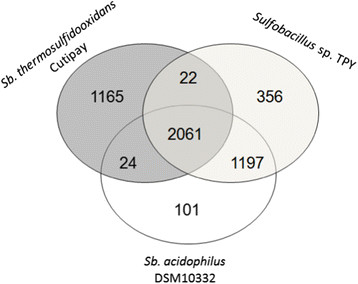
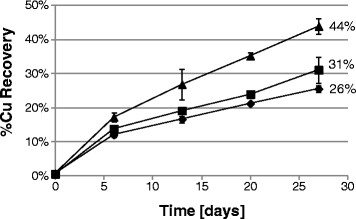
Currently more than 90% of the world's copper is obtained through sulfide mineral processing. Among the copper sulfides, chalcopyrite is the most abundant and therefore economically relevant. However, primary copper sulfide bioleaching is restricted due to high ionic strength raffinate solutions and particularly chloride coming from the dissolution of ores. In this work we describe the chalcopyrite bioleaching capacity of Sulfobacillus thermosulfidooxidans strain Cutipay (DSM 27601) previously described at the genomic level (Travisany et al. (2012) Draft genome sequence of the Sulfobacillus thermosulfidooxidans Cutipay strain, an indigenous bacterium isolated from a naturally extreme mining environment in Northern Chile. J Bacteriol 194:6327-6328). Bioleaching assays with the mixotrophic strain Cutipay showed a strong increase in copper recovery from chalcopyrite concentrate at 50°C in the presence of chloride ion, a relevant inhibitory element present in copper bioleaching processes. Compared to the abiotic control and a test with Sulfobacillus acidophilus DSM 10332, strain Cutipay showed an increase of 42 and 69% in copper recovery, respectively, demonstrating its high potential for chalcopyrite bioleaching. Moreover, a genomic comparison highlights the presence of the 2-Haloacid dehalogenase predicted-protein related to a potential new mechanism of chloride resistance in acidophiles. This novel and industrially applicable strain is under patent application CL 2013-03335.
Overview
The claims and statistics of this paper haven’t been checked yet.
Free: it reads the open-access text and checks the first 5 claims that cite a source we can check. Create a free account to check every claim.
Integrity signals
Registry
Cites
Statistics
Figures
Verification
Claims the paper makes
The claims and statistics of this paper haven’t been checked yet.
Free: it reads the open-access text and checks the first 5 claims that cite a source we can check. Create a free account to check every claim.
Claims other papers make about this one
Each is checked against this paper’s own text: does it say what the citing paper says it does?
The cited source says what the claim attributes to it.
In the citing paper
“Sulfobacillus thermosulfidooxidans strain Cutipay [67] is a bacterium involved in bioleaching processes.”
From Traceability, reproducibility and wiki-exploration for “à-la-carte” reconstructions of genome-scale metabolic models (2018) · cites this paper as [67]
Self-check
Percentages, sums and reported differences re-computed from the paper’s own numbers.
The self-check needs the paper’s full text.
Citations
Cites
OrthoMCL: Identification of Ortholog Groups for Eukaryotic Genomes
Li, L., Stoeckert, C. J., & Roos, D. S. (2003) · Genome Research · doi:10.1101/gr.1224503 · Cited by 5,707 · cited 1×
“4 (Li et al. 2003) with default parameters.”
Halocarbons produced by natural oxidation processes during degradation of organic matter
Keppler, F., Eiden, R., Niedan, V., Pracht, J., & Schöler, H. F. (2000) · Nature · doi:10.1038/35002055 · Cited by 370 · cited 2×
“2008) that reacts with organic matter such as cell products or debris (Keppler et al. 2000).”
BackgroundSuzuki, I., Lee, D., Mackay, B., Harahuc, L., & Oh, J. K. (1999) · Applied and Environmental Microbiology · doi:10.1128/aem.65.11.5163-5168.1999 · Cited by 185 · cited 1×
“(potassium or sodium) affects the inhibitory effect of anions (Suzuki et al. 1999) and therefore the MIC.”
BackgroundOsmotic stress adaptations in rhizobacteria
PAUL, D. Z. (2012) · Journal of Basic Microbiology · doi:10.1002/jobm.201100288 · Cited by 161 · cited 1×
“However these are general osmo-protection mechanisms observed in different microbial species (Zhou et al. 2013; Paul 2013).”
BackgroundMontealegre, P. A. T. (2013) · Intellectum (Universidad de La Sabana) · doi:10.1002/bit · Cited by 144
Watling, H. R., Perrot, F. A., & Shiers, D. W. (2008) · Hydrometallurgy · doi:10.1016/j.hydromet.2008.03.001 · Cited by 111 · cited 3×
“Previous results showed that both species have comparable iron oxidations rates, with same optimum pH of 1.7 and temperature (51°C) (Watling et al. 2008), so the observed effect can be attributed only to chloride ion inhibition.”
BackgroundInfluentialZammit, C. M., Mangold, S., Jonna, V. R., Mutch, L. A., Watling, H. R., Dopson, M., & Watkin, E. L. J. (2011) · Applied Microbiology and Biotechnology · doi:10.1007/s00253-011-3731-3 · Cited by 95 · cited 3×
“Previous results showed that both species have comparable iron oxidations rates, with same optimum pH of 1.7 and temperature (51°C) (Watling et al. 2008), so the observed effect can be attributed only to chloride ion inhibition.”
BackgroundInfluentialSodium sulphate and sodium chloride effects on batch culture of iron oxidising bacteria
Shiers, D. W., Blight, K. R., & Ralph, D. E. (2005) · Hydrometallurgy · doi:10.1016/j.hydromet.2005.07.001 · Cited by 89 · cited 1×
“Moreover, prolonged exposure to sodium chloride demonstrated no significant adaptation of mixed chemolithotrophic iron-oxidizing cultures, indicating the lack of an acquired resistance through adaptation (Shiers et al. 2005).”
BackgroundSilicate mineral dissolution during heap bioleaching
Dopson, M., Halinen, A., Rahunen, N., Boström, D., Sundkvist, J., Riekkola-Vanhanen, M., Kaksonen, A. H., & Puhakka, J. A. (2008) · Biotechnology and Bioengineering · doi:10.1002/bit.21628 · Cited by 87 · cited 2×
“Therefore, a possible mechanism of chloride resistance in sulfobacilli may be related to the biodegradation of toxic small chloro-organic acids formed in the presence of chloride, which are produced from the dissolution of gangue material in hydrometallurgical processes (Dopson et al. 2008) that reacts with organic ma…”
BackgroundBobadilla-Fazzini, R. A., Levicán, G. J., & Parada, P. (2010) · Applied Microbiology and Biotechnology · doi:10.1007/s00253-010-3063-8 · Cited by 72 · cited 3×
“Bioleaching assays with the mixotrophic strain Cutipay showed a strong increase in copper recovery from chalcopyrite concentrate at 50°C in the presence of chloride ion, a relevant inhibitory element present in copper bioleaching processes.”
BackgroundMethodInfluentialSelf-citationZhou, A., Baidoo, E. E. K., He, Z., Mukhopadhyay, A., Baumohl, J. K., Benke, P. I., Joachimiak, M. P., Xie, M., Song, R., Arkin, A. P., et al. (2013) · The ISME Journal · doi:10.1038/ismej.2013.60 · Cited by 65 · cited 1×
“However these are general osmo-protection mechanisms observed in different microbial species (Zhou et al. 2013; Paul 2013).”
BackgroundWang, Y., Su, L., Zhang, L., Zeng, W., Wu, J., Wan, L., Qiu, G., Chen, X., & Zhou, H. (2012) · Bioresource Technology · doi:10.1016/j.biortech.2012.06.114 · Cited by 59
Comparative Leaching of Chalcopyrite by Selected Acidophilic Bacteria and Archaea
Stott, M. B., Sutton, D. C., Watling, H. R., & Franzmann, P. D. (2003) · Geomicrobiology Journal · doi:10.1080/01490450303875 · Cited by 48 · cited 2×
“2011), moderate thermophilic (Stott et al. 2003) and thermophilic (Konishi et al.”
BackgroundGahan, C. S., Sundkvist, J., Dopson, M., & Sandström, Å. (2010) · Biotechnology and Bioengineering · doi:10.1002/bit.22709 · Cited by 47 · cited 1×
“In the case of the widely distributed acidophilic species Leptospirillum ferriphilum, ferrous ion biooxidation is completely inhibited by 12 g/L chloride (Gahan et al. 2010).”
BackgroundFerrous iron oxidation and rusticyanin in halotolerant, acidophilic ‘Thiobacillus prosperus’
Nicolle, J. L. C., Simmons, S., Bathe, S., & Norris, P. R. (2009) · Microbiology · doi:10.1099/mic.0.023192-0 · Cited by 47 · cited 1×
“4 (Li et al. 2003) with default parameters.”
Konishi, Y., Asai, S., Tokushige, M., & Suzuki, T. (1999) · Biotechnology Progress · doi:10.1021/bp9900662 · Cited by 37 · cited 2×
“Different studies have shown the enhancing effect of mesophilic (Bobadilla Fazzini et al. 2011), moderate thermophilic (Stott et al. 2003) and thermophilic (Konishi et al. 1999) microorganisms for chalcopyrite dissolution compared to abiotic assays.”
BackgroundDoebrich, J. L. (2009) · Fact sheet · doi:10.3133/fs20093031 · Cited by 35 · cited 1×
“Among the copper sulfides, chalcopyrite constitutes the vast majority of copper resources and reserves, and therefore represents a mineralogical species of great economical importance (Doebrich 2009).”
BackgroundTravisany, D., Genova, A. D., Sepúlveda, A., Bobadilla-Fazzini, R. A., Parada, P., & Maass, A. (2012) · Journal of Bacteriology · doi:10.1128/jb.01622-12 · Cited by 30 · cited 4×
“Strain Cutipay was previously described with novel copper and arsenic resistance capacities at the genomic level (Travisany et al. 2012).”
BackgroundMethodResultInfluentialSelf-citation
Research works printed but not linked: 1
- Lawson EN Nicholas CJ Pellat H Vargas T Jerez CA Wiertz JV Toledo H The toxic effects of chloride ions on Thiobacillus ferrooxidans Biohydrometall. Process. vol I, Univ. Chile 1995 165 174
Cited by
Aite, M., Chevallier, M., Frioux, C., Trottier, C., Got, J., Cortés, M. P., Mendoza, S. N., Carrier, G., Dameron, O., Guillaudeux, N., et al. (2018) · PLOS Computational Biology · doi:10.1371/journal.pcbi.1006146 · Cited by 137
“Here we designed four different pipelines for the genome-scale metabolic reconstruction of a brown alga ( Ectocarpus siliculosus ), a microalga ( Tisochrysis lutea ), and two bacteria ( Sulfoba-cillus thermosulfidooxidans strain Cutipay, used in metal extraction processes (biomining) and Enterococcus faecalis ).”
InfluentialSelf-citationBacillales: From Taxonomy to Biotechnological and Industrial Perspectives
Harirchi, S., Şar, T., Ramezani, M., Aliyu, H., Etemadifar, Z., Nojoumi, S. A., Yazdian, F. A., Awasthi, M. K., & Taherzadeh, M. J. (2022) · Microorganisms · doi:10.3390/microorganisms10122355 · Cited by 118
The bioleaching potential of a bacterial consortium
Latorre, M., Cortés, M. P., Travisany, D., Di Genova, A., Budinich, M., Reyes-Jara, A., Hödar, C., González, M., Parada, P., Bobadilla-Fazzini, R. A., et al. (2016) · Bioresource Technology · doi:10.1016/j.biortech.2016.07.012 · Cited by 80
Self-citationIrla, M., Nærdal, I., Brautaset, T., & Wendisch, V. F. (2016) · Industrial Crops and Products · doi:10.1016/j.indcrop.2016.11.050 · Cited by 62
Rivera-Araya, J., Pollender, A., Huynh, D., Schlömann, M., Chávez, R., & Levicán, G. J. (2019) · Frontiers in Microbiology · doi:10.3389/fmicb.2019.02455 · Cited by 63
Metadata
- Authors
- Bobadilla-Fazzini, R. A., Cortés, M. P., Maass, A., & Parada, P.
- Affiliations
- Centre National de la Recherche Scientifique (FR)
- Corresponding author
- Bobadilla-Fazzini, Roberto A
- Venue
- AMB Express
- Published
- 2014-12
- Volume
- 4
- Issue
- 1
- Pages
- 84-84
- ISSN
- 2191-0855 (ISSN-L)
- PMC
- PMC4884008
- OpenAlex
- W2152239923
- Cited by
- 29
- References
- 18
- Citations by year
- 2026: 1 · 2025: 3 · 2024: 2 · 2023: 3 · 2022: 2 · 2021: 2 · 2020: 5 · 2019: 4 · 2018: 2 · 2017: 1 · 2016: 4
- FWCI
- 0.87
- Type
- journal article
- Language
- en
- Open access
- gold
- doi.org
- Locations
- AMB Express (publishedVersion, cc-by)
- Europe PMC (PubMed Central) (publishedVersion, cc-by)
- PubMed Central (publishedVersion, cc-by)
- PubMed (publishedVersion)
- Americanae (AECID Library) (submittedVersion, other-oa)
- LA Referencia (Red Federada de Repositorios Institucionales de Publicaciones Científicas) (submittedVersion, other-oa)
- Funders
- Institut national de recherche en informatique et en automatique (INRIA)
- Centre National de la Recherche Scientifique
- Topics
- Physical Sciences › Materials Science › Metals and Alloys › Metal Extraction and Bioleaching
- Physical Sciences › Environmental Science › Environmental Chemistry › Mine drainage and remediation techniques
- Physical Sciences › Materials Science › Metals and Alloys › Extraction and Separation Processes
- Keywords
- Sulfobacillus thermosulfidooxidans, chalcopyrite bioleaching, copper bioleaching, chloride resistance, thermophilic bacteria, acidophiles, copper recovery, comparative genomics
About these checks
Registry, retraction, Cites and statistics results are computed, not judged, with one exception: a printed reference that no index lists is read once by a model before it counts as a citation error. Claims are extracted by a model and kept only when their quote appears verbatim in the text; each cited source is then checked, with a model’s help, for whether it says what the claim relies on. Those verdicts can be wrong — read the claim’s quote and the cited source before relying on one.
Statistics and arithmetic are recomputed, not judged.
Confidence bands are shown only for fields calibrated on our annotated test set. None is calibrated yet, so no band is shown.
What counts as a claim ›How we measure confidence ›How we check this ›
Are you an author, or do you see a problem with this page? Request a review
Data sources
Bibliographic data: Semantic Scholar, OpenAlex, Crossref.
Contains information from the Semantic Scholar Academic Graph Datasets, made available under the ODC Attribution License (ODC-BY 1.0).
Semantic Scholar’s data is described in: Kinney, R., et al. (2023). The Semantic Scholar Open Data Platform. arXiv:2301.10140.
