

Systematic analysis of the lysine acetylome reveals diverse functions of lysine acetylation in the oleaginous yeast Yarrowia lipolytica
Open accessThe DOI matches its Crossref record; 46 of the 46 references it cites were found in a registry or an index.
Abstract
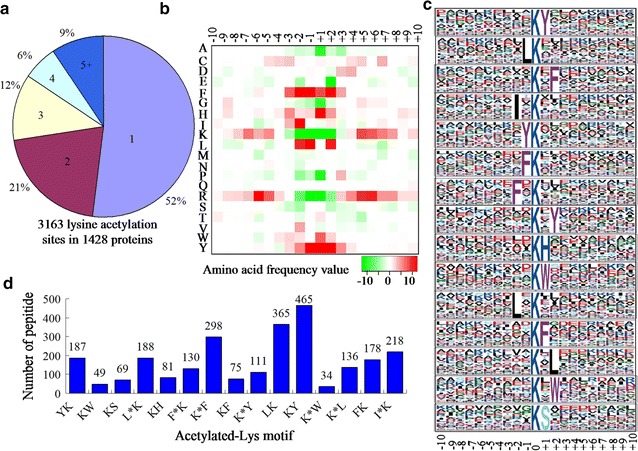
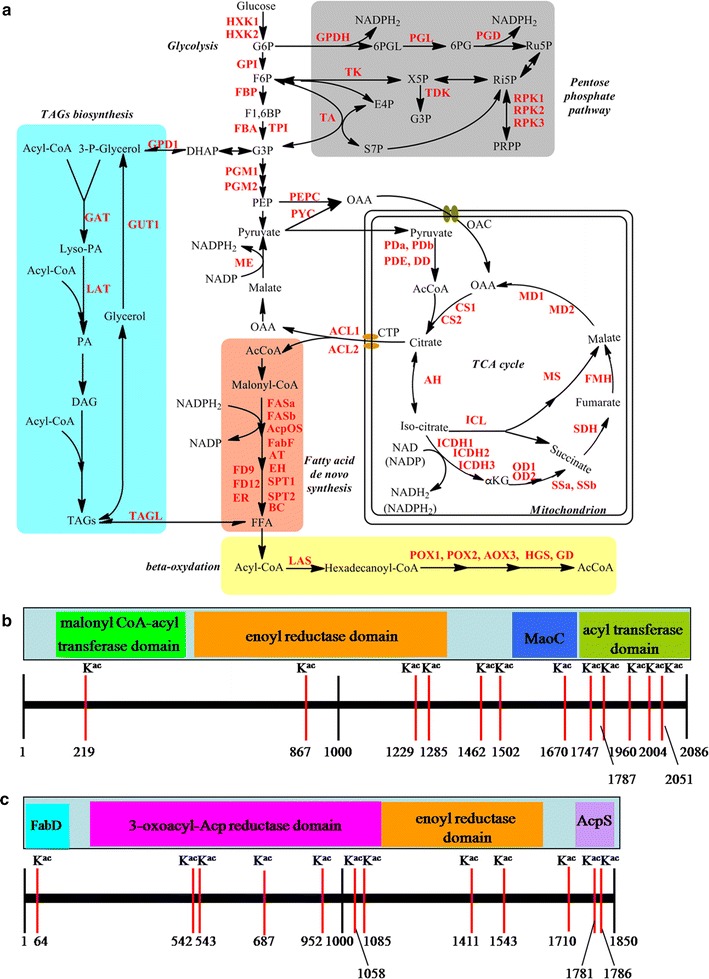
Lysine acetylation of proteins, a major post-translational modification, plays a critical regulatory role in almost every aspects in both eukaryotes and prokaryotes. Yarrowia lipolytica, an oleaginous yeast, is considered as a model for bio-oil production due to its ability to accumulate a large amount of lipids. However, the function of lysine acetylation in this organism is elusive. Here, we performed a global acetylproteome analysis of Y. lipolytica ACA-DC 50109. In total, 3163 lysine acetylation sites were identified in 1428 proteins, which account for 22.1% of the total proteins in the cell. Fifteen conserved acetylation motifs were detected. The acetylated proteins participate in a wide variety of biological processes. Notably, a total of 65 enzymes involved in lipid biosynthesis were found to be acetylated. The acetylation sites are distributed in almost every type of conserved domains in the multi-enzymatic complexes of fatty acid synthetases. The provided dataset probably illuminates the crucial role of reversible acetylation in oleaginous microorganisms, and serves as an important resource for exploring the physiological role of lysine acetylation in eukaryotes.
Overview
The claims and statistics of this paper haven’t been checked yet.
Free: it reads the open-access text and checks the first 5 claims that cite a source we can check. Create a free account to check every claim.
Integrity signals
Registry
Cites
Statistics
Figures
Verification
Claims the paper makes
The claims and statistics of this paper haven’t been checked yet.
Free: it reads the open-access text and checks the first 5 claims that cite a source we can check. Create a free account to check every claim.
Claims other papers make about this one
Each is checked against this paper’s own text: does it say what the citing paper says it does?
The source backs part of the claim, not all of it — or backs it for a different population, condition or comparison.
In the citing paper
“Previous studies have shown that most identified acetylated proteins are involved in the regulation of glucose, lipid, and amino acid metabolism (37, 38).”
From Potential role of lysine acetylation in the stepwise adaptation of Candida albicans to fluconazole (2025) · cites this paper as [37]
Experimental — accuracy not yet measured
Self-check
Percentages, sums and reported differences re-computed from the paper’s own numbers.
The self-check needs the paper’s full text.
Citations
Cites
A SIMPLE METHOD FOR THE ISOLATION AND PURIFICATION OF TOTAL LIPIDES FROM ANIMAL TISSUES
Folch, J., Lees, M., & Stanley, G. H. S. (1957) · Journal of Biological Chemistry · doi:10.1016/s0021-9258(18)64849-5 · Cited by 65,189
Cytoscape: A software Environment for integrated models of biomolecular interaction networks
Shannon, P., Markiel, A., Ozier, O., Baliga, N. S., Wang, J. T., Ramage, D., Amin, N., Schwikowski, B., & Ideker, T. (2003) · Genome Research · doi:10.1101/gr.1239303 · Cited by 51,888
Cox, J., & Mann, M. (2008) · Nature Biotechnology · doi:10.1038/nbt.1511 · Cited by 14,855 · cited 2×
“MaxQuant with integrated Andromeda search engine (v.1.4.2) was employed to process the resulting MS/MS data (Cox and Mann 2008; Cox et al.”
MethodInfluentialThe KEGG resource for deciphering the genome
Kanehisa, M. (2004) · Nucleic Acids Research · doi:10.1093/nar/gkh063 · Cited by 5,104
WoLF PSORT: protein localization predictor
Horton, P., Park, K.-J., Obayashi, T., Fujita, N., Harada, H., Adams-Collier, C. J., & Nakai, K. (2007) · Nucleic Acids Research · doi:10.1093/nar/gkm259 · Cited by 4,127
Lysine acetylation targets protein complexes and co-regulates major cellular functions
Choudhary, C., Kumar, C., Gnad, F., Nielsen, M. L., Rehman, M., Walther, T. C., Olsen, J. V., & Mann, M. (2009) · Science · doi:10.1126/science.1175371 · Cited by 4,040
ACETYLATION AND METHYLATION OF HISTONES AND THEIR POSSIBLE ROLE IN THE REGULATION OF RNA SYNTHESIS
Allfrey, V. G., Faulkner, R., & Mirsky, A. E. (1964) · Proceedings of the National Academy of Sciences · doi:10.1073/pnas.51.5.786 · Cited by 2,639 · cited 1×
“Lysine acetylation was first discovered in histone proteins (Allfrey et al. 1964; Phillips 1963) and its role has been extensively investigated in regulating gene transcription by histone acetyltransferases (HATs) or histone deacetylases (HDACs) modifying the core histone tails (Lee and Workman 2007; Yang and Seto 200…”
BackgroundInterPro: the integrative protein signature database
Hunter, S., Apweiler, R., Attwood, T. K., Bairoch, A., Bateman, A., Binns, D., Bork, P., Das, U., Daugherty, L., Duquenne, L., et al. (2009) · Nucleic Acids Research · doi:10.1093/nar/gkn785 · Cited by 2,107
Histone acetyltransferase complexes: one size doesn't fit all
Lee, K. K., & Workman, J. L. (2007) · Nature Reviews Molecular Cell Biology · doi:10.1038/nrm2145 · Cited by 1,087 · cited 1×
“1964; Phillips 1963) and its role has been extensively investigated in regulating gene transcription by histone acetyltransferases (HATs) or histone deacetylases (HDACs) modifying the core histone tails (Lee and Workman 2007; Yang and Seto 2008).”
BackgroundDAVID-WS: a stateful web service to facilitate gene/protein list analysis
Jiao, X., Sherman, B. T., Huang, D. W., Stephens, R., Baseler, M. W., Lane, H. C., & Lempicki, R. A. (2012) · Bioinformatics · doi:10.1093/bioinformatics/bts251 · Cited by 1,062
Cited by
Madzak, C. (2021) · Journal of Fungi · doi:10.3390/jof7070548 · Cited by 189
“lipolytica and possibly in other oleaginous microorganisms [196].”
BackgroundHistone deacetylases control lysine acetylation of ribosomal proteins in rice
Xu, Q., Liu, Q., Chen, Z., Yue, Y., Liu, Y., Zhao, Y. J., & Zhou, D. (2021) · Nucleic Acids Research · doi:10.1093/nar/gkab244 · Cited by 97
Wang, G., Li, D., Miao, Z., Zhang, S., Liang, W., & Liu, L. (2017) · Biochimica et Biophysica Acta (BBA) - Molecular and Cell Biology of Lipids · doi:10.1016/j.bbalip.2017.10.003 · Cited by 44
Self-citationProtein Acetylation/Deacetylation: A Potential Strategy for Fungal Infection Control
Chen, J.-Z., Liu, Q., Zeng, L., & Huang, X. (2020) · Frontiers in Microbiology · doi:10.3389/fmicb.2020.574736 · Cited by 38
Systematic analysis of the lysine succinylome in the model medicinal mushroom Ganoderma lucidum
Wang, G., Xu, L., Yu, H., Gao, J., & Guo, L. (2019) · BMC Genomics · doi:10.1186/s12864-019-5962-0 · Cited by 31
“260125–1 was extracted according to the procedures described [6, 34].”
Self-citation
Metadata
- Authors
- Wang, G., Guo, L., Liang, W., Chi, Z., & Liu, L.
- Affiliations
- Qingdao Agricultural University (CN)
- Corresponding author
- Liu, Lin
- Venue
- AMB Express
- Published
- 2017-05-12
- Volume
- 7
- Issue
- 1
- Pages
- 94-94
- ISSN
- 2191-0855 (ISSN-L)
- PMC
- PMC5427063
- OpenAlex
- W2613784420
- Cited by
- 19
- References
- 46
- Citations by year
- 2026: 1 · 2025: 2 · 2021: 4 · 2020: 4 · 2019: 3 · 2018: 3 · 2017: 2
- FWCI
- 1.62
- Type
- journal article
- Language
- en
- Open access
- gold
- doi.org
- Locations
- AMB Express (publishedVersion, cc-by)
- Europe PMC (PubMed Central) (publishedVersion, cc-by)
- PubMed Central (publishedVersion, cc-by)
- PubMed (publishedVersion)
- DOAJ (DOAJ: Directory of Open Access Journals) (submittedVersion, cc-by-sa)
- Funders
- the Project of Shandong Province Higher Educational Science and Technology Program (J16LE04, J15LE15)
- the Taishan Scholar Construction Foundation of Shandong Province (6631114314)
- the National Natural Science Foundation of China (31370779, 31401027)
- the Open Fund of Laboratory for Marine Biology and Biotechnology, Qingdao National Laboratory for Marine Science and Technology, Qingdao, China (No.OF2015NO19)
- Research Foundation for Advanced Talents of Qingdao Agricultural University (6631114335)
- Topics
- Physical Sciences › Chemistry › Spectroscopy › Advanced Proteomics Techniques and Applications
- Life Sciences › Biochemistry, Genetics and Molecular Biology › Molecular Biology › Fungal and yeast genetics research
- Life Sciences › Biochemistry, Genetics and Molecular Biology › Molecular Biology › Ubiquitin and proteasome pathways
- Keywords
- lysine acetylation, Yarrowia lipolytica, oleaginous yeast, post-translational modification, lipogenesis, fatty acid synthase, bio-oil production, lipid accumulation
About these checks
Registry, retraction, Cites and statistics results are computed, not judged, with one exception: a printed reference that no index lists is read once by a model before it counts as a citation error. Claims are extracted by a model and kept only when their quote appears verbatim in the text; each cited source is then checked, with a model’s help, for whether it says what the claim relies on. Those verdicts can be wrong — read the claim’s quote and the cited source before relying on one.
Statistics and arithmetic are recomputed, not judged.
Confidence bands are shown only for fields calibrated on our annotated test set. None is calibrated yet, so no band is shown.
What counts as a claim ›How we measure confidence ›How we check this ›
Are you an author, or do you see a problem with this page? Request a review
How to cite
Cite CoChat for the checks on this page, and the paper for its own findings.
- This page
- CoChat. (2026). Citation check: Systematic analysis of the lysine acetylome reveals diverse functions of lysine acetylation in the oleaginous yeast Yarrowia lipolytica. https://app.cochat.ai/papers/10.1186/s13568-017-0393-2
- The paper
- Wang, G., Guo, L., Liang, W., Chi, Z., & Liu, L. (2017). Systematic analysis of the lysine acetylome reveals diverse functions of lysine acetylation in the oleaginous yeast Yarrowia lipolytica. AMB Express. https://doi.org/10.1186/s13568-017-0393-2
Data sources
Bibliographic data: Semantic Scholar, OpenAlex, Crossref.
Contains information from the Semantic Scholar Academic Graph Datasets, made available under the ODC Attribution License (ODC-BY 1.0).
Semantic Scholar’s data is described in: Kinney, R., et al. (2023). The Semantic Scholar Open Data Platform. arXiv:2301.10140.
