

The DOI matches its Crossref record; 55 of the 55 references it cites were found in a registry or an index.
Inflammatory and coagulatory parameters linked to survival in critically ill children with sepsis
Open accessAbstract
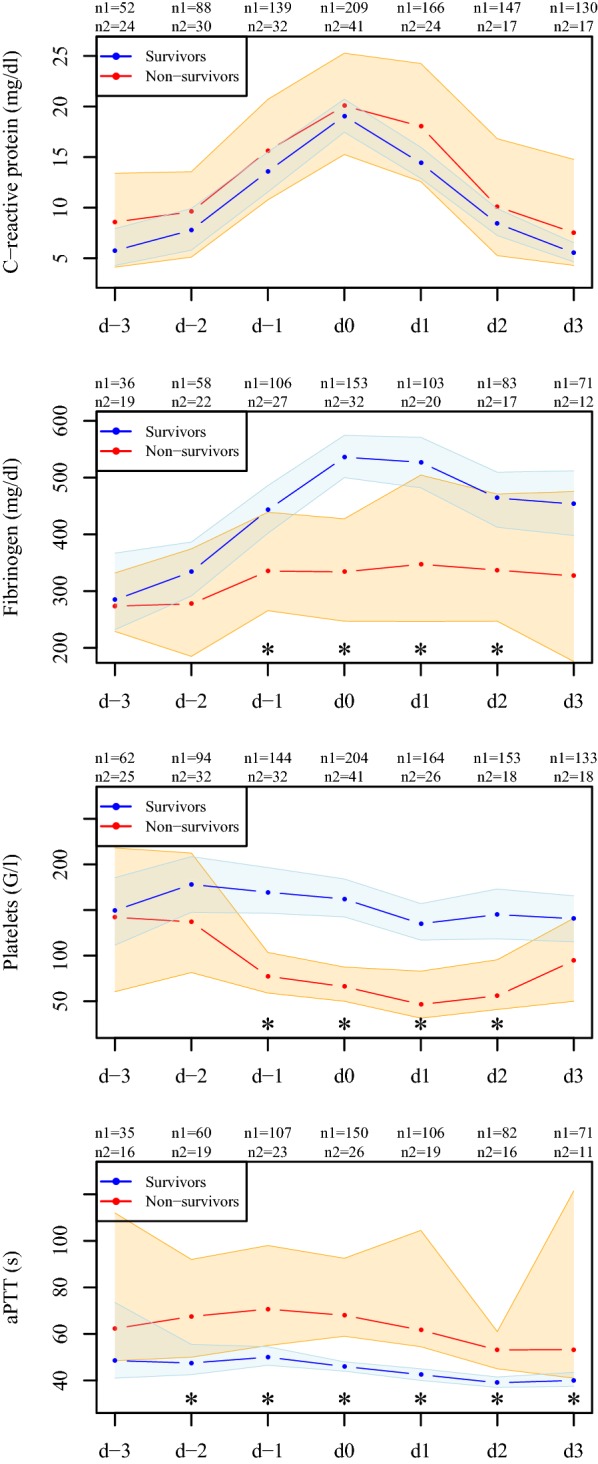
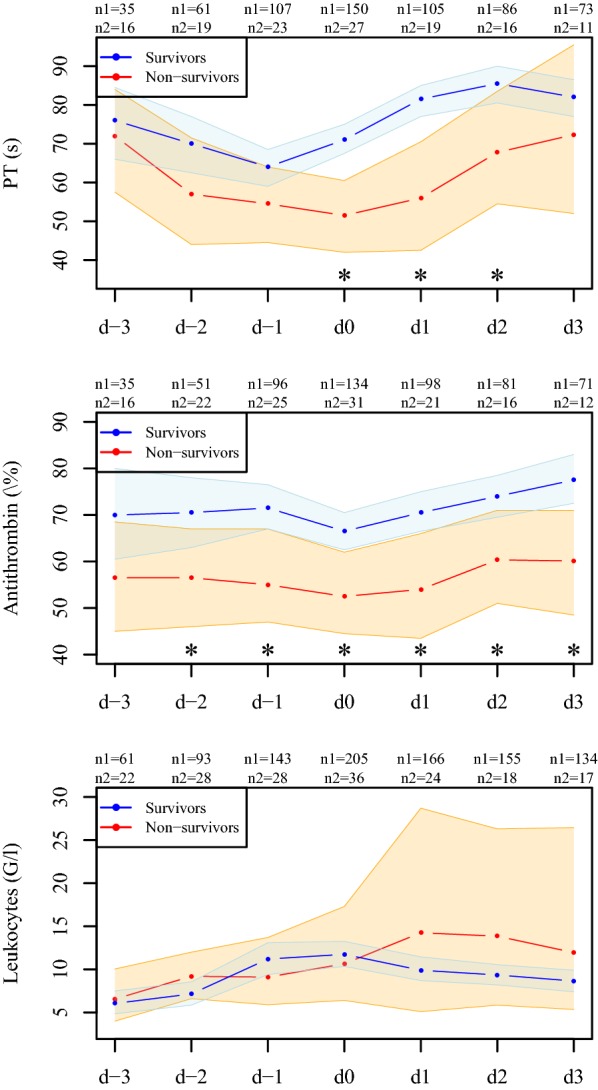
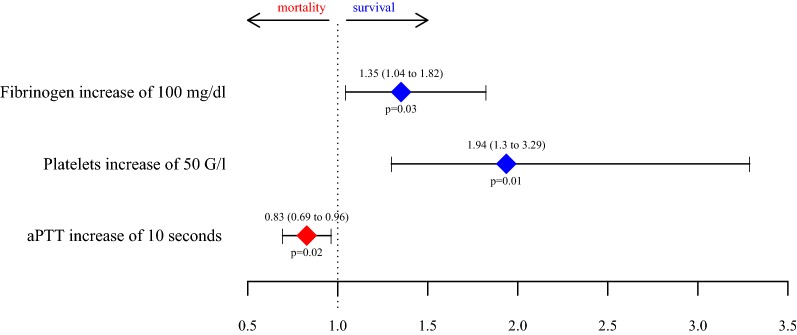
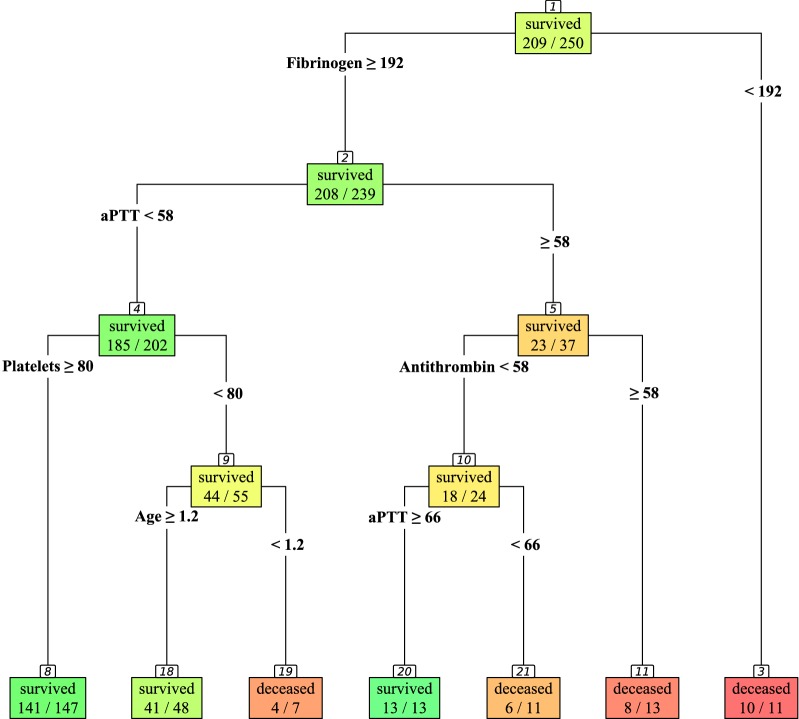
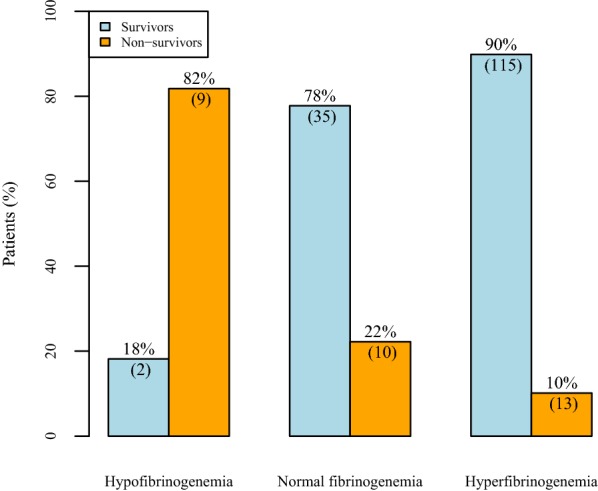
BACKGROUND: Sepsis is associated with a deflection of inflammatory and coagulative parameters, since some clotting factors are known to be involved in the host's defense against infection and inflammation. These parameters could play a crucial role in the course of sepsis and be used as prognostic markers in critically ill children. METHODS: A total of 250 critically ill pediatric patients diagnosed with sepsis were retrospectively analyzed to identify routinely measured predictors for in-hospital mortality at the peak level of C-reactive protein. Those parameters entered multivariate logistic regression analysis as well as a decision tree for survival. RESULTS: Multivariate logistic regression analysis revealed fibrinogen, platelets and activated partial thromboplastin time (aPTT) at the peak level of C-reactive protein to be predictors for survival (p = 0.03, p = 0.01 and p = 0.02, respectively). An increase in fibrinogen and platelets is linked to survival, whereas an aPTT prolongation is associated with higher mortality; adjusted odds ratios (95% CI) for an increase of 100 mg/dl in fibrinogen are 1.35 (1.04-1.82) per 50 G/l platelets 1.94 (1.3-3.29) and 0.83 (0.69-0.96) for an aPTT prolongation of 10 s. Decision tree analysis shows that a fibrinogen level below 192 mg/dl (90.9% vs. 13% mortality) is most distinctive in non-survivors. CONCLUSIONS: High levels of fibrinogen and platelets as well as a non-overshooting aPTT are associated with a higher survival rate in pediatric patients with diagnosed sepsis. In particular, hypofibrinogenemia is distinctive for a high mortality rate in septic critically ill children.
Overview
The claims and statistics of this paper haven’t been checked yet.
Run the check — free, no account needed. It reads the open-access text and checks the sources it cites.
Integrity signals
Registry
Cites
Statistics
Figures
Verification
Claims the paper makes
The claims and statistics of this paper haven’t been checked yet.
Run the check — free, no account needed. It reads the open-access text and checks the sources it cites.
Claims other papers make about this one
Each is checked against this paper’s own text: does it say what the citing paper says it does?
The source backs part of the claim, not all of it — or backs it for a different population, condition or comparison.
In the citing paper
“In addition, critical illness often results in a reduction or dysfunction of platelets as well as in plasmatic coagulopathies, often determining outcome (Munro, 2009;Niederwanger et al., 2018).”
From Iron in infection and immunity (2020) · cites this paper as Niederwanger et al., 2018
Experimental — accuracy not yet measured
Self-check
Percentages, sums and reported differences re-computed from the paper’s own numbers.
The self-check needs the paper’s full text.
Citations
Cites
A new look at the statistical model identification
Akaike, H. (1974) · IEEE Transactions on Automatic Control · doi:10.1109/tac.1974.1100705 · Cited by 51,879
2001 SCCM/ESICM/ACCP/ATS/SIS International Sepsis Definitions Conference
Levy, M. M., Fink, M. P., Marshall, J. C., Abraham, E. H., Angus, D. C., Cook, D., Cohen, J., Opal, S. M., Vincent, J., & Ramsay, G. (2003) · Critical Care Medicine · doi:10.1097/01.ccm.0000050454.01978.3b · Cited by 5,976
Goldstein, B., Giroir, B. P., & Randolph, A. G. (2005) · Pediatric Critical Care Medicine · doi:10.1097/01.pcc.0000149131.72248.e6 · Cited by 3,675
The Central Role of Endothelial Dysfunction in Cardiorenal Syndrome
Zhang, J., Bottiglieri, T., & McCullough, P. A. (2016) · Cardiorenal Medicine · doi:10.1159/000452283 · Cited by 1,084
The interactions between inflammation and coagulation
Esmon, C. T. (2005) · British Journal of Haematology · doi:10.1111/j.1365-2141.2005.05753.x · Cited by 1,018
Levi, M. M., & van der Poll, T. (2010) · Critical Care Medicine · doi:10.1097/ccm.0b013e3181c98d21 · Cited by 1,008
Fibrinogen as a key regulator of inflammation in disease
Davalos, D., & Akassoglou, K. (2011) · Seminars in Immunopathology · doi:10.1007/s00281-011-0290-8 · Cited by 943
Maturation of the hemostatic system during childhood
Andrew, M., Vegh, P., Johnston, M., Bowker, J., Ofosu, F. A., & Mitchell, L. (1992) · Blood · doi:10.1182/blood.v80.8.1998.1998 · Cited by 923
Trends in the Epidemiology of Pediatric Severe Sepsis*
Hartman, M. E., Linde‐Zwirble, W. T., Angus, D. C., & Watson, R. S. (2013) · Pediatric Critical Care Medicine · doi:10.1097/pcc.0b013e3182917fad · Cited by 532
Castelli, G. P., Pognani, C., Meisner, M., Stuani, A., Bellomi, D., & Sgarbi, L. (2004) · Critical Care · doi:10.1186/cc2877 · Cited by 411
Cited by
Sorted by citations
Iron in infection and immunity
Nairz, M., & Weiss, G. (2020) · Molecular Aspects of Medicine · doi:10.1016/j.mam.2020.100864 · Cited by 359
Menon, K., Schlapbach, L. J., Akech, S., Argent, A., Biban, P., Carrol, E. D., Chiotos, K., Chisti, M. J., Evans, I. V. R., Inwald, D. P., et al. (2021) · Critical Care Medicine · doi:10.1097/ccm.0000000000005294 · Cited by 139
Menon, K., Schlapbach, L. J., Akech, S., Argent, A. C., Biban, P., & al, E. (2021) · Zurich Open Repository and Archive (University of Zurich) · doi:10.5167/uzh-211062 · Cited by 54
Kinins and Their Receptors in Infectious Diseases
Dagnino, A. P. A., Campos, M. M., & Silva, R. B. M. (2020) · Pharmaceuticals · doi:10.3390/ph13090215 · Cited by 32
Fibrinogen as a Prognostic Predictor in Pediatric Patients with Sepsis: A Database Study
Tang, X., Shao, L., Dou, J., Zhou, Y., Chen, M., Cui, Y., Zhang, Y., & Wang, C. (2020) · Mediators of Inflammation · doi:10.1155/2020/9153620 · Cited by 23
Metadata
- Authors
- Niederwanger, C., Bachler, M., Hell, T., Linhart, C., Entenmann, A., Balog, A., Auer, K., & Innerhofer, P.
- Affiliations
- Innsbruck Medical University (AT)
- UMIT TIROL - Private University for Health Sciences and Health Technology (AT)
- Universität Innsbruck (AT)
- Corresponding author
- Bachler, Mirjam
- ORCID
- Venue
- Annals of Intensive Care
- Publisher
- Elsevier BV
- Published
- 2018
- Volume
- 8
- Issue
- 1
- Pages
- 111
- ISSN
- 2110-5820 (ISSN-L)
- PMC
- PMC6240023
- OpenAlex
- W2901510340
- Cited by
- 34
- References
- 54
- Citations by year
- 2026: 4 · 2025: 5 · 2024: 6 · 2023: 6 · 2022: 2 · 2021: 7 · 2020: 4
- FWCI
- 2.15
- Type
- journal article
- Language
- en
- Open access
- gold
- doi.org
- Licence
- Locations
- Annals of Intensive Care (publishedVersion, cc-by)
- Europe PMC (PubMed Central) (publishedVersion, other-oa)
- PubMed Central (publishedVersion, cc-by)
- PubMed (publishedVersion)
- DOAJ (DOAJ: Directory of Open Access Journals) (submittedVersion, cc-by-sa)
- Topics
- Health Sciences › Medicine › Critical Care and Intensive Care Medicine › Sepsis Diagnosis and Treatment
- Life Sciences › Immunology and Microbiology › Immunology › Inflammation biomarkers and pathways
- Health Sciences › Medicine › Nephrology › Acute Kidney Injury Research
- Keywords
- pediatric sepsis, critically ill children, in-hospital mortality, prognostic factors, fibrinogen, platelets, activated partial thromboplastin time, C-reactive protein, hypofibrinogenemia, coagulation, inflammation, survival prediction
About these checks
Registry, retraction, Cites and statistics results are computed, not judged, with one exception: a printed reference that no index lists is read once by a model before it counts as a citation error. Claims are extracted by a model and kept only when their quote appears verbatim in the text; each cited source is then checked, with a model’s help, for whether it says what the claim relies on. Those verdicts can be wrong — read the claim’s quote and the cited source before relying on one.
Statistics and arithmetic are recomputed, not judged.
Confidence bands are shown only for fields calibrated on our annotated test set. None is calibrated yet, so no band is shown.
What counts as a claim ›How we measure confidence ›How we check this ›
Are you an author, or do you see a problem with this page? Request a review
