

The DOI matches its Crossref record; 16 of the 16 references it cites were found in a registry or an index.
Evaluating Data Abstraction Assistant, a novel software application for data abstraction during systematic reviews: protocol for a randomized controlled trial
Open accessAbstract
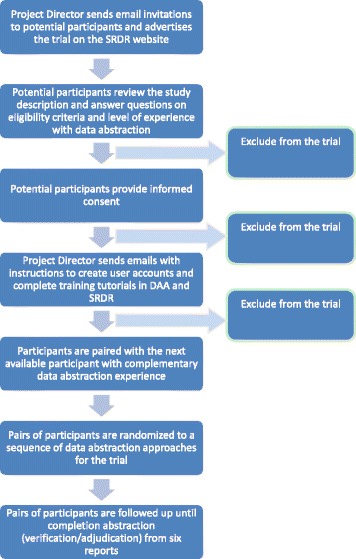
BACKGROUND: Data abstraction, a critical systematic review step, is time-consuming and prone to errors. Current standards for approaches to data abstraction rest on a weak evidence base. We developed the Data Abstraction Assistant (DAA), a novel software application designed to facilitate the abstraction process by allowing users to (1) view study article PDFs juxtaposed to electronic data abstraction forms linked to a data abstraction system, (2) highlight (or "pin") the location of the text in the PDF, and (3) copy relevant text from the PDF into the form. We describe the design of a randomized controlled trial (RCT) that compares the relative effectiveness of (A) DAA-facilitated single abstraction plus verification by a second person, (B) traditional (non-DAA-facilitated) single abstraction plus verification by a second person, and (C) traditional independent dual abstraction plus adjudication to ascertain the accuracy and efficiency of abstraction. METHODS: This is an online, randomized, three-arm, crossover trial. We will enroll 24 pairs of abstractors (i.e., sample size is 48 participants), each pair comprising one less and one more experienced abstractor. Pairs will be randomized to abstract data from six articles, two under each of the three approaches. Abstractors will complete pre-tested data abstraction forms using the Systematic Review Data Repository (SRDR), an online data abstraction system. The primary outcomes are (1) proportion of data items abstracted that constitute an error (compared with an answer key) and (2) total time taken to complete abstraction (by two abstractors in the pair, including verification and/or adjudication). DISCUSSION: The DAA trial uses a practical design to test a novel software application as a tool to help improve the accuracy and efficiency of the data abstraction process during systematic reviews. Findings from the DAA trial will provide much-needed evidence to strengthen current recommendations for data abstraction approaches. TRIAL REGISTRATION: The trial is registered at National Information Center on Health Services Research and Health Care Technology (NICHSR) under Registration # HSRP20152269: https://wwwcf.nlm.nih.gov/hsr_project/view_hsrproj_record.cfm?NLMUNIQUE_ID=20152269&SEARCH_FOR=Tianjing%20Li . All items from the World Health Organization Trial Registration Data Set are covered at various locations in this protocol. Protocol version and date: This is version 2.0 of the protocol, dated September 6, 2016. As needed, we will communicate any protocol amendments to the Institutional Review Boards (IRBs) of Johns Hopkins Bloomberg School of Public Health (JHBSPH) and Brown University. We also will make appropriate as-needed modifications to the NICHSR website in a timely fashion.
Overview
The claims and statistics of this paper haven’t been checked yet.
Run the check — free, no account needed. It reads the open-access text and checks the sources it cites.
Integrity signals
Registry
Cites
Statistics
Figures
Verification
Claims the paper makes
The claims and statistics of this paper haven’t been checked yet.
Run the check — free, no account needed. It reads the open-access text and checks the sources it cites.
Claims other papers make about this one
Each is checked against this paper’s own text: does it say what the citing paper says it does?
The source backs part of the claim, not all of it — or backs it for a different population, condition or comparison.
In the citing paper
“Similarly, a synthesis may be constrained by either selective or incomplete reporting 66,67 .”
From Meta-analysis and the science of research synthesis (2018) · cites this paper as [67]
Experimental — accuracy not yet measured
Self-check
Percentages, sums and reported differences re-computed from the paper’s own numbers.
The self-check needs the paper’s full text.
Citations
Cites
Evidence based medicine: what it is and what it isn't
Sackett, D. L., Rosenberg, W. M. C., Gray, J. A. M., Haynes, R. B., & Richardson, W. S. (1996) · BMJ · doi:10.1136/bmj.312.7023.71 · Cited by 15,769
SPIRIT 2013 Statement: Defining Standard Protocol Items for Clinical Trials
Chan, A.-W., Tetzlaff, J. M., Altman, D. G., Laupacis, A., Gøtzsche, P. C., Krleža-Jerić, K., Hróbjartsson, A., Mann, H., Dickersin, K., Berlin, J. A., et al. (2013) · Annals of Internal Medicine · doi:10.7326/0003-4819-158-3-201302050-00583 · Cited by 7,363
Self-citationYeh, M.-L. (2014) · Journal of Nursing Research · doi:10.1097/jnr.0000000000000065 · Cited by 3,829
Systematic reviews: CRD's guidance for undertaking reviews in health care
Tacconelli, E. (2010) · The Lancet Infectious Diseases · doi:10.1016/s1473-3099(10)70065-7 · Cited by 3,245
Finding What Works in Health Care: Standards for Systematic Reviews
Eden, J., Levit, L. A., Berg, A. O., & Morton, S. C. (2013) · Cited by 943
Physical activity for cancer survivors: meta-analysis of randomised controlled trials
Fong, D. Y. T., Ho, J. W. C., Hui, B. P. H., Lee, A. M., Macfarlane, D. J., Leung, S. S. K., Cerin, E., Chan, W. Y. Y., Leung, I. P. F., Lam, S. H. S., et al. (2012) · BMJ · doi:10.1136/bmj.e70 · Cited by 782
Self-citationSingle data extraction generated more errors than double data extraction in systematic reviews
Buscemi, N., Hartling, L., Vandermeer, B., Tjosvold, L., & Klassen, T. P. (2006) · Journal of Clinical Epidemiology · doi:10.1016/j.jclinepi.2005.11.010 · Cited by 464
Navarese, E. P., Kołodziejczak, M., Schulze, V., Gurbel, P. A., Tantry, U., Lin, Y., Brockmeyer, M., Kandzari, D. E., Kubica, J. M., D'Agostino, R. B., et al. (2015) · Annals of Internal Medicine · doi:10.7326/m14-2957 · Cited by 404
Finding What Works in Health Care: Standards for Systematic Reviews
Committee on Standards for Systematic Reviews of Comparative Effectiveness Research, Board on Health Care Services, & Institute of Medicine (2011) · doi:10.17226/13059 · Cited by 289
Data Extraction Errors in Meta-analyses That Use Standardized Mean Differences
Gøtzsche, P. C., Hróbjartsson, A., Marić, K., & Tendal, B. (2007) · JAMA · doi:10.1001/jama.298.4.430 · Cited by 238
Research works printed but not linked: 1
- Gresham G, Matsumura S, Li T. Faster may not be better: data abstraction for systematic reviews. In: Evidence-Informed Publich Health: Opportunities and Challenges. Abstracts of the 22nd Cochrane Colloquium; 2014 21-26 Sep; Hyderabad, India. John Wiley & Sons; 2014.
Cited by
Meta-analysis and the science of research synthesis
Gurevitch, J., Koricheva, J., Nakagawa, S., & Stewart, G. (2018) · Nature · doi:10.1038/nature25753 · Cited by 1,709
Mathes, T., Klaßen, P., & Pieper, D. (2017) · BMC Medical Research Methodology · doi:10.1186/s12874-017-0431-4 · Cited by 240
Li, T., Saldanha, I. J., Jap, J., Smith, B. T., Canner, J., Hutfless, S. M., Branch, V., Carini, S., Chan, W., de Bruijn, B., et al. (2019) · Journal of Clinical Epidemiology · doi:10.1016/j.jclinepi.2019.07.005 · Cited by 54
Self-citationImproving the conduct of systematic reviews: a process mining perspective
Pham, B., Bagheri, E., Rios, P. D. L., Pourmasoumi, A., Robson, R. C., Hwee, J., Isaranuwatchai, W., Darvesh, N., Page, M. J., & Tricco, A. C. (2018) · Journal of Clinical Epidemiology · doi:10.1016/j.jclinepi.2018.06.011 · Cited by 44
Saldanha, I. J., Smith, B. T., Ntzani, E., Jap, J., Balk, E. M., & Lau, J. (2019) · Systematic Reviews · doi:10.1186/s13643-019-1250-y · Cited by 44
Self-citation
Metadata
- Authors
- Saldanha, I. J., Schmid, C. H., Lau, J., Dickersin, K., Berlin, J. A., Jap, J., Smith, B. T., Carini, S., Chan, W., De Bruijn, B., Wallace, B. C., Hutfless, S. M., Sim, I., Murad, M. H., Walsh, S. A., Whamond, E. J., & Li, T.
- Affiliations
- Johns Hopkins University (US)
- Brown University (US)
- Johnson & Johnson (United States) (US)
- University of California, San Francisco (US)
- Kaiser Permanente (US)
- Northeastern University (US)
- Mayo Clinic (US)
- Cochrane Canada (CA)
- Corresponding author
- Saldanha, Ian J.
- ORCID
- Venue
- Systematic Reviews
- Published
- 2016-11-22
- Volume
- 5
- Issue
- 1
- Pages
- 196-196
- ISSN
- 2046-4053 (ISSN-L)
- PMC
- PMC5120497
- OpenAlex
- W2554505213
- Cited by
- 15
- References
- 16
- Citations by year
- 2026: 1 · 2025: 2 · 2023: 1 · 2021: 1 · 2020: 1 · 2019: 3 · 2018: 4 · 2017: 2
- FWCI
- 1.03
- Type
- journal article
- Language
- en
- Open access
- gold
- doi.org
- Licence
- Locations
- Systematic Reviews (publishedVersion, cc-by)
- PubMed Central (publishedVersion, cc-by)
- PubMed (publishedVersion)
- NPARC (submittedVersion, other-oa)
- DOAJ (DOAJ: Directory of Open Access Journals) (submittedVersion, cc-by-sa)
- eScholarship (California Digital Library) (submittedVersion)
- eScholarship (California Digital Library) (submittedVersion, cc-by)
- Funders
- World Health Organization
- Patient-Centered Outcomes Research Institute (ME‐1310‐07009)
- Brown University
- Johns Hopkins University
- Johns Hopkins Bloomberg School of Public Health
- Topics
- Social Sciences › Decision Sciences › Statistics, Probability and Uncertainty › Meta-analysis and systematic reviews
- Physical Sciences › Computer Science › Information Systems › Software Engineering Techniques and Practices
- Social Sciences › Sociology and Political Science › Delphi Technique in Research
- Keywords
- data abstraction, adjudication, crossover design, reproducibility
- MeSH terms
- Abstracting and Indexing, Systematic Reviews as Topic, Humans, Software, Evidence-Based Medicine
About these checks
Registry, retraction, Cites and statistics results are computed, not judged, with one exception: a printed reference that no index lists is read once by a model before it counts as a citation error. Claims are extracted by a model and kept only when their quote appears verbatim in the text; each cited source is then checked, with a model’s help, for whether it says what the claim relies on. Those verdicts can be wrong — read the claim’s quote and the cited source before relying on one.
Statistics and arithmetic are recomputed, not judged.
Confidence bands are shown only for fields calibrated on our annotated test set. None is calibrated yet, so no band is shown.
What counts as a claim ›How we measure confidence ›How we check this ›
Are you an author, or do you see a problem with this page? Request a review
How to cite
Cite CoChat for the checks on this page, and the paper for its own findings.
- This page
- CoChat. (2026). Citation check: Evaluating Data Abstraction Assistant, a novel software application for data abstraction during systematic reviews: protocol for a randomized controlled trial. https://app.cochat.ai/papers/10.1186/s13643-016-0373-7
- The paper
- Saldanha, I. J., Schmid, C. H., Lau, J., Dickersin, K., Berlin, J. A., Jap, J., Smith, B. T., Carini, S., Chan, W., De Bruijn, B., Wallace, B. C., Hutfless, S. M., Sim, I., Murad, M. H., Walsh, S. A., Whamond, E. J., & Li, T. (2016). Evaluating Data Abstraction Assistant, a novel software application for data abstraction during systematic reviews: protocol for a randomized controlled trial. Systematic Reviews. https://doi.org/10.1186/s13643-016-0373-7
Data sources
Bibliographic data: Semantic Scholar, OpenAlex, Crossref.
Contains information from the Semantic Scholar Academic Graph Datasets, made available under the ODC Attribution License (ODC-BY 1.0).
Semantic Scholar’s data is described in: Kinney, R., et al. (2023). The Semantic Scholar Open Data Platform. arXiv:2301.10140.
