

Rayyan-a web and mobile app for systematic reviews.
Open accessThe DOI matches its Crossref record; 15 of the 16 references it cites were found in a registry or an index; 5 of the 7 sources its claims cite were checked for support.
Abstract
BACKGROUND: Synthesis of multiple randomized controlled trials (RCTs) in a systematic review can summarize the effects of individual outcomes and provide numerical answers about the effectiveness of interventions. Filtering of searches is time consuming, and no single method fulfills the principal requirements of speed with accuracy. Automation of systematic reviews is driven by a necessity to expedite the availability of current best evidence for policy and clinical decision-making. We developed Rayyan ( http://rayyan.qcri.org ), a free web and mobile app, that helps expedite the initial screening of abstracts and titles using a process of semi-automation while incorporating a high level of usability. For the beta testing phase, we used two published Cochrane reviews in which included studies had been selected manually. Their searches, with 1030 records and 273 records, were uploaded to Rayyan. Different features of Rayyan were tested using these two reviews. We also conducted a survey of Rayyan's users and collected feedback through a built-in feature. RESULTS: Pilot testing of Rayyan focused on usability, accuracy against manual methods, and the added value of the prediction feature. The "taster" review (273 records) allowed a quick overview of Rayyan for early comments on usability. The second review (1030 records) required several iterations to identify the previously identified 11 trials. The "suggestions" and "hints," based on the "prediction model," appeared as testing progressed beyond five included studies. Post rollout user experiences and a reflexive response by the developers enabled real-time modifications and improvements. The survey respondents reported 40% average time savings when using Rayyan compared to others tools, with 34% of the respondents reporting more than 50% time savings. In addition, around 75% of the respondents mentioned that screening and labeling studies as well as collaborating on reviews to be the two most important features of Rayyan. As of November 2016, Rayyan users exceed 2000 from over 60 countries conducting hundreds of reviews totaling more than 1.6M citations. Feedback from users, obtained mostly through the app web site and a recent survey, has highlighted the ease in exploration of searches, the time saved, and simplicity in sharing and comparing include-exclude decisions. The strongest features of the app, identified and reported in user feedback, were its ability to help in screening and collaboration as well as the time savings it affords to users. CONCLUSIONS: Rayyan is responsive and intuitive in use with significant potential to lighten the load of reviewers.
Overview
CoChat Summary
## TL;DR
Rayyan is a free web and mobile app designed to speed up title/abstract screening in systematic reviews through semi-automation, filtering, collaboration, and a prediction model. In testing and user feedback, it was reported to save time and improve screening efficiency, with the authors highlighting 40% average time savings and model performance of AUC 0.87±0.09 and WSS@95 0.49±0.18.
## Key findings
- In pilot testing on two Cochrane reviews, Rayyan was evaluated against manual selection methods using citation sets of 273 and 1030 records; the larger review required several iterations to identify the previously selected 11 trials.
- On 15 review topics used to test the prediction algorithm, the classifier achieved AUC = 0.87±0.09 and WSS@95 = 0.49±0.18, which the authors interpret as substantial time savings.
- Survey respondents reported 40% average time savings compared with other tools, and 34% reported more than 50% time savings; in another place the paper reports 37% for >50% time savings.
- Around 75% of respondents said the most important features were screening/labeling studies and collaboration on reviews.
## Methods
- The paper describes the development of Rayyan and its iterative evaluation; the app was piloted before release and then refined using user feedback from the website, in-app messages, workshops, and surveys.
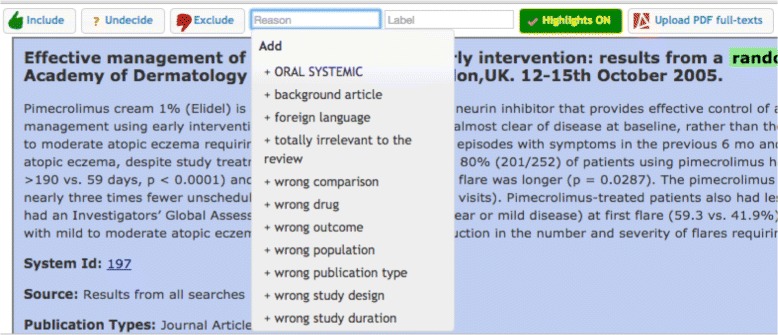
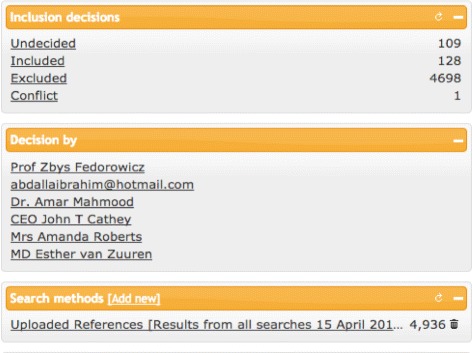
- For beta testing, the authors uploaded searches from two published Cochrane reviews (with 273 and 1030 records) into Rayyan and compared the app’s screening workflow with prior manual decisions.
- To evaluate prediction quality, they used a dataset from 15 systematic review topics, applying twofold cross-validation (50% training, 50% testing), repeated 10 times, and assessed performance with AUC and WSS@95 using an SVM classifier with unigram/bigram and MeSH features.
## Limitations
- The paper states that a comprehensive comparison with other systems would require additional studies; this is an explicit limitation of the evidence presented.
- The pilot testing was not technically blinded because the tester already knew the review results; this is stated in the text.
- Evidence is based on a small number of pilot reviews for workflow testing and on a specific 15-topic dataset for algorithm evaluation, so generalizability is limited by the study design (evident from the text).
Model-written summary. Check it against the paper before relying on it.
Integrity signals
Registry
Cites
Statistics
Figures
Verification
Claims the paper makes
4 Valid · 1 Not valid · 1 Not checked · 34 Own results and interpretations
Every source the paper cites for this claim was checked and supports it.
In the paper
“Interest in the automation of systematic reviews has been driven by a necessity to expedite the availability of current best evidence for policy and clinical decision-making”
§ Rayyan—a web and mobile app for systematic reviews > Background
What the sources say
- Supportedcites [4] Wallace BC Trikalinos TA Lau J Brodley C Schmid CH Semi-automated screening of biomedical citations for systematic reviews BMC Bioinforma 2010 11 1 55 10.1186/1471-2105-11-55 PMC2824679 20102628 source
The Background > On Systematic Reviews section says reviews inform healthcare decisions from the bedside to policy-making and describes citation screening as time-consuming. The Abstract > Background and Conclusions explain that the authors pursue semi-automation to reduce that workload without compromising review quality, supporting the claim’s stated motivation. Our copy provides section labels but no page numbers. (LLM, conf=0.83)
plainstates a cause- Asserted: passes — The authors put it forward as true.
- Checkable: passes — It can be checked against evidence.
- Load-bearing: unclear — It is unclear whether the paper’s conclusions depend on it.
- Based: passes — The paper gives a reason why it holds.
- Supported
A result the paper reports from its own data — it cites no other source for it, so there is none to check. The quote shows it is in the paper.
In the paper
“around 75% of the respondents mentioned that screening and labeling studies as well as collaborating on reviews to be the two most important features of Rayyan.”
- Also stated in: § Workshops, presentations, and user feedback · plain
“around 75% of the respondents mentioned that screening and labeling studies as well as collaborating on reviews as the two most important features of Rayyan.”
§ Rayyan—a web and mobile app for systematic reviews > Abstract > Results
plain- Asserted: passes — The authors put it forward as true.
- Checkable: passes — It can be checked against evidence.
- Load-bearing: unclear — It is unclear whether the paper’s conclusions depend on it.
- Based: passes — The paper gives a reason why it holds.
- Also stated in: § Workshops, presentations, and user feedback · plain
A result the paper reports from its own data — it cites no other source for it, so there is none to check. The quote shows it is in the paper.
In the paper
“with 37% of the respondents reporting more than 50% time savings.”
§ Rayyan—a web and mobile app for systematic reviews > Results and Discussions > Workshops, presentations, and user feedback
plain- Asserted: passes — The authors put it forward as true.
- Checkable: passes — It can be checked against evidence.
- Load-bearing: unclear — It is unclear whether the paper’s conclusions depend on it.
- Based: passes — The paper gives a reason why it holds.
A result the paper reports from its own data — it cites no other source for it, so there is none to check. The quote shows it is in the paper.
In the paper
“The survey respondents reported 40% average time savings when using Rayyan compared to others tools”
- Also stated in: § Workshops, presentations, and user feedback · plain
“Our users reported a 40% average time savings when using Rayyan compared to others tools”
- Also stated in: § Conclusion · hedged
“our survey showed that our users reported time savings in the order of 40% on average compared to other tools they have been using in the past.”
§ Rayyan—a web and mobile app for systematic reviews > Abstract > Results
plainstates a cause- Asserted: passes — The authors put it forward as true.
- Checkable: passes — It can be checked against evidence.
- Load-bearing: passes — The paper’s conclusions depend on it.
- Based: passes — The paper gives a reason why it holds.
- Also stated in: § Workshops, presentations, and user feedback · plain
A result the paper reports from its own data — it cites no other source for it, so there is none to check. The quote shows it is in the paper.
In the paper
“The second review (1030 records) required several iterations to identify the previously identified 11 trials.”
- Also stated in: § Pilot testing Rayyan · plain
“Testing of the Rayyan app on the second Cochrane review (1030 records) required a few attempts to identify the 11 trials which had been previously selected by the Cochrane review authors using “manual” methods during the process of conducting the systematic review.”
§ Rayyan—a web and mobile app for systematic reviews > Abstract > Results
plain- Asserted: passes — The authors put it forward as true.
- Checkable: passes — It can be checked against evidence.
- Load-bearing: unclear — It is unclear whether the paper’s conclusions depend on it.
- Based: passes — The paper gives a reason why it holds.
- Also stated in: § Pilot testing Rayyan · plain
9 more claims
Create a free account to see all 40 claims and every source verdict.
- Probably not a substantial claim. 14
- It may state two separate claims as one. 18
- The quote only partly states this claim. 1
Claims other papers make about this one
Each is checked against this paper’s own text: does it say what the citing paper says it does?
The source backs part of the claim, not all of it — or backs it for a different population, condition or comparison.
In the citing paper
“The search results were imported into Rayyan, a validated tool with semi-automated features enabling the detection of duplicated publications from the different databases.”
From Enablers and barriers of clinical trial participation in adult patients from minority ethnic groups: a systematic review (2025) · cites this paper as [28]
Experimental — accuracy not yet measuredThe source backs part of the claim, not all of it — or backs it for a different population, condition or comparison.
In the citing paper
“As a reviewer screens some records and labels them for either inclusion, exclusion, or “maybe” relevant to the subject of the review, the tool thrives for finding patterns and similarities to give a similarity score to each of the remaining records as a five-star rating. Higher ratings reflect the computed underlying probabilities of the record being included are higher, and vice versa.”
From Abstract screening using the automated tool Rayyan: results of effectiveness in three diagnostic test accuracy systematic reviews (2022) · cites this paper as [4]
Experimental — accuracy not yet measuredThe cited source says what the claim attributes to it.
In the citing paper
“Study selection was conducted in two stages by two independent reviewers (V. DG and D. D. T.) using Rayyan systematic review software [39]: stage 1, title, and abstract screening: All retrieved citations were independently screened by both reviewers using the prespecified eligibility criteria.”
From Genetics versus environment in the pathophysiology of sagittal synostosis (2026) · cites this paper as [39]
The cited source says what the claim attributes to it.
In the citing paper
“Title and abstract screening was conducted by one reviewer (DH) using the Rayyan (Rayyan Systems, Inc) data screening tool [33]. A random sample of 20% (491/2455) was also screened by a second reviewer (AF).”
From Older Adults’ Experiences and Perceptions of Immersive Virtual Reality: Systematic Review and Thematic Synthesis (2022) · cites this paper as [33]
The cited source says what the claim attributes to it.
In the citing paper
“Following the search, all identified studies were uploaded to the latest version of the AI systematic review software Rayyan19 and 2 authors (H.T. and A.M.) evaluated the abstracts against the PICOT framework-guided15 inclusion criteria.”
From Otoplasty for prominent ear: A systematic review of surgical techniques (2026) · cites this paper as [19]
9 more claims about this paper
Create a free account to see every claim other papers make about this one.
Self-check
Percentages, sums and reported differences re-computed from the paper’s own numbers.
Self-check results appear here once an independent check has confirmed them.
Cited works that were retracted
Works this paper cites that were later retracted, from the retraction notices publishers deposit. Major when the notice came out before this paper was published.
A note, not an issue: for example, a cited work that was retracted only after this paper was published, which its authors could not have known.
In the paper
“Pedrazzi V, Oliveira-Neto JM, Sequeira P, Fedorowicz Z, Nasser M. Hand and ultrasonic instrumentation for orthograde root canal treatment of permanent teeth. Cochrane Database Syst Rev. 2008;4(CD006384). doi: 10.1002/14651858.CD006384.pub3 .”
Cited work 10.1002/14651858.cd006384.pub3 · retracted 2019-02-07 · notice 10.1002/14651858.cd006384.pub4 · this paper published 2016-12
Citations
Cites
1 retracted
Hand and ultrasonic instrumentation for orthograde root canal treatment of permanent teeth
Pedrazzi, V., Oliveira-Neto, J. M., Sequeira, P., Fedorowicz, Z., & Nasser, M. (2008) · Cochrane Database of Systematic Reviews · doi:10.1002/14651858.cd006384.pub3 · Cited by 9
Self-citationRetractedPreferred Reporting Items for Systematic Reviews and Meta-Analyses: the PRISMA statement
Moher, D., Liberati, A., Tetzlaff, J., Altman, D. G., & for the PRISMA Group (2009) · BMJ · doi:10.1136/bmj.b2535 · Cited by 83,823
Cortes, C., & Vapnik, V. (1995) · Machine Learning · doi:10.1007/bf00994018 · Cited by 59,421
Cortes, C., & Vapnik, V. (1995) · Machine-mediated learning · doi:10.1023/a:1022627411411 · Cited by 48,445 · cited 1×
“These are then used as features by a support vector machine (SVM) classifier [15].”
MethodPreferred reporting items for systematic reviews and meta-analyses: the PRISMA Statement.
(2009) · PubMed Central · Cited by 44,859
Preferred reporting items for systematic reviews and meta-analyses: The PRISMA statement
Moher, D., Liberati, A., Tetzlaff, J., Altman, D. G., & the PRISMA Group* (2009) · Annals of Internal Medicine · doi:10.7326/0003-4819-151-4-200908180-00135 · Cited by 37,554
A method for assessing the quality of a randomized control trial
Chalmers, T. C., Smith, H., Blackburn, B., Silverman, B., Schroeder, B., Reitman, D., & Ambroz, A. (1981) · Controlled Clinical Trials · doi:10.1016/0197-2456(81)90056-8 · Cited by 1,349 · cited 1×
“Randomized controlled trials (RCTs) play a pivotal role in medical research and are widely considered to be the best way of achieving results that can genuinely increase our knowledge about treatment effectiveness [1].”
BackgroundO’Mara-Eves, A., Thomas, J., McNaught, J., Miwa, M., & Ananiadou, S. (2015) · Systematic Reviews · doi:10.1186/2046-4053-4-5 · Cited by 681
Systematic review automation technologies
Tsafnat, G., Glasziou, P., Choong, M. K., Dunn, A., Galgani, F., & Coiera, E. (2014) · Systematic Reviews · doi:10.1186/2046-4053-3-74 · Cited by 472 · cited 2×
“An increasing number of projects are underway which focus on the automation of segments of the systematic review process, and although several tools and software have been developed, so far, none of them span the entire process of review production [5].”
BackgroundReducing Workload in Systematic Review Preparation Using Automated Citation Classification
Cohen, A. M., Hersh, W. R., Peterson, K., & Yen, P.-Y. (2006) · Journal of the American Medical Informatics Association · doi:10.1197/jamia.m1929 · Cited by 411 · cited 2×
“The work saved over random sampling measured at 0.95 recall (WSS@95), introduced in [16], refers to the percentage of studies that the reviewers do not have to go through because they have been screened out by the classifier at a recall of 0.95, compared to random sampling.”
MethodResultInfluential
Cited by
Items 3,701–3,800 of 25,622
Ingman, T., Smakowski, A., Goldsmith, K., & Chalder, T. (2022) · Psychological Medicine · doi:10.1017/s0033291722002471 · Cited by 27
A Scoping Review of Intimate Partner Violence Research in Canada
Wathen, C. N., MacGregor, J. C. D., Burd, C., Naeemzadah, N., Ogunpitan, Y. A., & Canie, J. (2025) · Trauma, Violence, & Abuse · doi:10.1177/15248380241275979 · Cited by 25
Campbell, A. L., & Mogashana, D. (2025) · Innovations in Education and Teaching International · doi:10.1080/14703297.2024.2417173 · Cited by 25
“The ‘Blind On’ feature in Rayyan was used to prevent bias while we each screened records individually.”
InfluentialThe incidence of injury in male field hockey players: A systematic review and meta-analysis
Rees, H., Persson, U. M., Delahunt, E., Boreham, C. A., & Blake, C. M. (2021) · Physical Therapy in Sport · doi:10.1016/j.ptsp.2021.08.005 · Cited by 32
Factors influencing in‐hospital prescribing errors: A systematic review
Mahomedradja, R. F., Schinkel, M., Sigaloff, K., Reumerman, M. O., Otten, R. H. J., Tichelaar, J., & van Agtmael, M. A. (2023) · British Journal of Clinical Pharmacology · doi:10.1111/bcp.15694 · Cited by 35
Akondeng, C., Njamnshi, W. Y., Mandi, H. E., Agbor, V. N., Bain, L. E., & NJAMNSHI, A. K. (2022) · BMJ Open · doi:10.1136/bmjopen-2021-057922 · Cited by 34
Fricke, M., Morawietz, C., Wunderlich, A., Muehlbauer, T., Jansen, C.-P., Gramann, K., & Wollesen, B. (2022) · Frontiers in Psychology · doi:10.3389/fpsyg.2022.867987 · Cited by 31
Dorr, M. C., van Hof, K. S., Jelsma, J. G. M., Dronkers, E. A. C., de Jong, R. J. B., Offerman, M. P. J., & de Bruijne, M. C. (2022) · Health Research Policy and Systems · doi:10.1186/s12961-022-00893-4 · Cited by 38
Food safety interventions in low‐ and middle‐income countries in Asia: A systematic review
Kwoba, E. N., Oduori, D. O., Lambertini, E., Thomas, L. F., Grace, D., & Mutua, F. K. (2023) · Zoonoses and Public Health · doi:10.1111/zph.13028 · Cited by 35
The Validity of Vital Signs for Pain Assessment in Critically Ill Adults: A Narrative Review
Shiva Shahiri, T., & Gélinas, C. (2023) · Pain Management Nursing · doi:10.1016/j.pmn.2023.01.004 · Cited by 38
Franklin, C., Ding, X., Kim, J., Zhang, A., Hai, A. H., Jones, K. V., Nachbaur, M., & O’Connor, A. (2023) · Research on Social Work Practice · doi:10.1177/10497315231162611 · Cited by 41
Incidence, prevalence and nature of injuries in padel: a systematic review
Dahmen, J., Emanuel, K. S., Fontanellas, A., Verhagen, E. A. L. M., Kerkhoffs, G. M. M. J., & Pluim, B. M. (2023) · BMJ Open Sport & Exercise Medicine · doi:10.1136/bmjsem-2023-001607 · Cited by 46
Madonsela, S. G., Ware, L. J., Scott, M., & Watermeyer, J. (2023) · South African Journal of Psychology · doi:10.1177/00812463231186260 · Cited by 31
The management and outcomes of hepatocellular carcinoma in sub-Saharan Africa: a systematic review
Sobnach, S., Kotze, U. K., Spearman, C. W., Sonderup, M. W., Nashidengo, P. R., Ede, C. J., Keli, E., Chihaka, O. B., Zerbini, L. F., Li, Y. J., et al. (2023) · HPB · doi:10.1016/j.hpb.2023.09.015 · Cited by 27
Mediterranean-like diets in multiple sclerosis: A systematic review
Abbasi, H., Shakouri, F., Mosaddeghi-Heris, R., Gholipour-khalili, E., Jahanshahlou, F., Sanaie, S., Naseri, A., & Talebi, M. (2023) · Revue Neurologique · doi:10.1016/j.neurol.2023.07.017 · Cited by 33
Austin, A., Favril, L., Craft, S., Thliveri, P., & Freeman, T. P. (2023) · International Journal of Drug Policy · doi:10.1016/j.drugpo.2023.104248 · Cited by 40
Valer, T. L. M., Mujica, L. F. P., Corcuera‐Ciudad, R., Terry, F., Chevarría-Arriaga, M. J., Vasquez-Hassinger, T., & Yovera-Aldana, M. (2023) · PLoS ONE · doi:10.1371/journal.pone.0284054 · Cited by 42
Hardan, L., Bourgi, R., Łukomska−Szymańska, M., Hernández-Cabanillas, J. C., Zamarripa‐Calderón, J. E., Jorquera, G., Ghishan, S., & Cuevas‐Suárez, C. E. (2023) · The Journal of Advanced Prosthodontics · doi:10.4047/jap.2023.15.6.315 · Cited by 37
Cheng, W.-H., Quan, Y., & Thompson, W. F. (2024) · Archives of Gerontology and Geriatrics · doi:10.1016/j.archger.2024.105326 · Cited by 27
Brucchi, F., Bracchetti, G., Fugazzola, P., Viganò, J., Filisetti, C., Ansaloni, L., Mas, F. D., Cobianchi, L., & Danelli, P. (2024) · World Journal of Emergency Surgery · doi:10.1186/s13017-023-00531-6 · Cited by 41
Cortez-Vázquez, G., Adriaanse, M. C., Burchell, G. L., Ostelo, R., Panayiotou, G., & Vlemincx, E. (2024) · Applied Psychophysiology and Biofeedback · doi:10.1007/s10484-023-09611-4 · Cited by 39
Yona, T., Kamel, N., Cohen-Eick, G., Ovadia, I., & Fischer, A. G. (2024) · Gait & Posture · doi:10.1016/j.gaitpost.2024.01.018 · Cited by 47
How healthcare systems are experienced by autistic adults in the United Kingdom: A meta-ethnography
Radev, S., Freeth, M., & Thompson, A. R. (2024) · Autism · doi:10.1177/13623613241235531 · Cited by 38
Wang, J., Tozzi, F., Ashraf‐Ganjouei, A., Romero‐Hernández, F., Feng, J., Calthorpe, L. M., Castro, M., Davis, G. L., Withers, J., Zhou, C. J., et al. (2024) · Journal of Gastrointestinal Surgery · doi:10.1016/j.gassur.2024.03.006 · Cited by 38
Tong, H. L., Alnasser, A., Alshahrani, N. Z., Bawaked, R. A., AlAhmed, R. S., Alsukait, R. F., Rakić, S., Çetinkaya, V., Al-Hazzaa, H. M., & Alqahtani, S. A. (2024) · Journal of Medical Internet Research · doi:10.2196/53651 · Cited by 40
Małyszczak, A., Przeździecka-Dołyk, J., Szydełko-Paśko, U., & Misiuk‐Hojło, M. (2024) · Journal of Clinical Medicine · doi:10.3390/jcm13061797 · Cited by 30
Kolaas, K., Berman, A. H., Hedman‐Lagerlöf, E., Lindsäter, E., Hybelius, J., & Axelsson, E. (2024) · BMJ Open · doi:10.1136/bmjopen-2023-075796 · Cited by 31
Bhatt, C., Lin, E., Legere, L., Jackevicius, C. A., Ko, D. T., Lee, D. S., Schade, K., Johnston, S., Anderson, T. J., & Udell, J. A. (2024) · Journal of the American Heart Association · doi:10.1161/jaha.123.030140 · Cited by 35
Torres, A., García-Gibert, C., Gelabert, E., Mallorquí, A., Segú, X., Roca, A., Martínez, A., Giménez, Y., & Sureda, B. (2024) · Journal of Psychiatric Research · doi:10.1016/j.jpsychires.2024.04.019 · Cited by 37
Alnuaimi, S., Reljic, T., Abdulla, F. S., Memon, H., Al-Ali, S., Smith, T., Serdarević, F., Velija-Ašimi, Z., Kumar, A., & Semiz, S. (2024) · Scientific Reports · doi:10.1038/s41598-024-59390-z · Cited by 33
Henriques, H., & Pereira, L. N. (2024) · Tourism & Management Studies · doi:10.18089/tms.20240304 · Cited by 57
Contribution of nanotechnology to greater efficiency in animal nutrition and production
Almeida, C. F., Faria, M., Carvalho, J., & Pinho, E. (2024) · Journal of Animal Physiology and Animal Nutrition · doi:10.1111/jpn.13973 · Cited by 25
Ernawaty, E., Hariati, S., & Saleh, A. (2024) · International Journal of Nursing Studies Advances · doi:10.1016/j.ijnsa.2024.100214 · Cited by 53
Aminoshariae, A., Nosrat, A., Jakovljević, A., Jaćimović, J., Narasimhan, S., & Nagendrababu, V. (2024) · Journal of Endodontics · doi:10.1016/j.joen.2024.06.012 · Cited by 35
Triebl, Z., Bencze, B., Bányai, D., Rózsa, N. K., Hermann, P., & Végh, D. (2024) · BMC Oral Health · doi:10.1186/s12903-024-04516-y · Cited by 40
Cognitive reserve and cognition in mood disorders: A systematic review and meta-analysis
Camprodon‐Boadas, P., Prisco, M. D., Rabelo‐da‐Ponte, F. D., Sugranyes, G., Clougher, D., Baeza, I., Torrent, C., Castro‐Fornieles, J., Tosetti, Y., Vieta, E., et al. (2024) · Psychiatry Research · doi:10.1016/j.psychres.2024.116083 · Cited by 33
Banerjee, A., Athalye, S., Shingade, P. P., Khargekar, V., Mahajan, N., Madkaikar, M. R., & Khargekar, N. C. (2024) · EClinicalMedicine · doi:10.1016/j.eclinm.2024.102742 · Cited by 47
Thoonsen, A. C., Schoten, S. M. V., Merten, H., van Beusekom, I., Schoonmade, L. J., Delnoij, D. M. J., & de Bruijne, M. C. (2024) · Health Policy · doi:10.1016/j.healthpol.2024.105135 · Cited by 38
Public value management in digital transformation: a scoping review
Zyzak, B., Sienkiewicz-Małyjurek, K., & Jensen, M. R. (2024) · International Journal of Public Sector Management · doi:10.1108/ijpsm-02-2024-0055 · Cited by 45
Blood Biomarkers of Long COVID: A Systematic Review
Thomas, C., Faghy, M. A., Chidley, C., Phillips, B. E., Bewick, T. A., & Ashton, R. E. M. (2024) · Molecular Diagnosis & Therapy · doi:10.1007/s40291-024-00731-z · Cited by 33
Beta-blockers for the treatment of anxiety disorders: A systematic review and meta-analysis
Archer, C., Wiles, N., Kessler, D. A., Turner, K. M., & Caldwell, D. M. (2024) · Journal of Affective Disorders · doi:10.1016/j.jad.2024.09.068 · Cited by 40
Prommaban, A., Moonkayaow, S., Phinyo, P., Siviroj, P., Sirikul, W., & Lerttrakarnnon, P. (2024) · Journal of Clinical Medicine · doi:10.3390/jcm13216570 · Cited by 36
Mantovani, E., Martini, A., Dinoto, A., Zucchella, C., Ferrari, S., Mariotto, S., Tinazzi, M., & Tamburin, S. (2024) · npj Parkinson s Disease · doi:10.1038/s41531-024-00823-x · Cited by 30
Risk of Intracranial Hemorrhage Associated With Direct Oral Anticoagulation vs Antiplatelet Therapy
Coyle, M., Lynch, A., Higgins, M., Costello, M. M., Judge, C. S., O'Donnell, M. J., & Reddin, C. (2024) · JAMA Network Open · doi:10.1001/jamanetworkopen.2024.49017 · Cited by 32
Pavone, M., Innocenzi, C., Carles, E., et al. (2024) · Annals of Surgical Oncology · doi:10.1245/s10434-024-16632-8 · Cited by 25
“Rayyan software (Qatar Computing Research Institute, HBKU, Doha, Qatar) 14 was used independently by two authors (M.P. and C.I.) to screen titles and abstracts for eligibility.”
Risk Factors for Developmental Dysplasia of the Hip Before 3 Months of Age: A Meta-Analysis
Tirta, M., Rahbek, O., Kold, S., & Husum, H. (2025) · JAMA Network Open · doi:10.1001/jamanetworkopen.2024.56153 · Cited by 33
Assessing the landscape of clinical and observational trials involving bioprinting: a scoping review
Briones, Y. L., Pascua, B. P. G., Tiangco, N. M. J., Crisostomo, I. C., Casiguran, S. L., & Remenyi, R. (2025) · 3D Printing in Medicine · doi:10.1186/s41205-025-00253-2 · Cited by 33
Asresu, A. T., Furlan, E., Horneman, F., Zennaro, F., Nguyen, N. D., Torresan, S., Critto, A., & Marcomini, A. (2025) · Estuarine Coastal and Shelf Science · doi:10.1016/j.ecss.2025.109194 · Cited by 31
Kerachi, A. J., Shahlaee, M. A., Habibi, P., Ebrahimi, N. D., Ala, M., & Sadeghi, A. (2025) · BMC Medicine · doi:10.1186/s12916-025-03935-0 · Cited by 43
“Following automatic duplicate detection, the records were uploaded to the Rayyan online tool, which is specifically designed for management of systematic reviews [19].”
Daccache, N., Wu, Y., Jeffries, S. D., Zako, J., Harutyunyan, R., Pelletier, E. D., Langlois, P. L., & Hemmerling, T. M. (2025) · British Journal of Anaesthesia · doi:10.1016/j.bja.2025.02.007 · Cited by 45
Context factors in clinical decision-making: a scoping review
Schuler, K., Jung, I.-C., Zerlik, M., Hahn, W., Sedlmayr, M., & Sedlmayr, B. (2025) · BMC Medical Informatics and Decision Making · doi:10.1186/s12911-025-02965-1 · Cited by 42
“For both stages, the relevant publications were uploaded to the research collaboration platform Rayyan (Qatar Computing Research Institute and Cochrane Bah-rain) [40], with separate folders established for TAS and FTS.”
Brückner, S., Sadare, O., Fesl, S., Scheibe, M., Lang, C., & Gilbert, S. (2025) · npj Digital Medicine · doi:10.1038/s41746-025-01568-4 · Cited by 33
“After the search, all retrieved bibliographic data were imported to Rayyan 55 and duplicates were removed.”
Which Quotations to Use? Guidance on Selecting and Reporting Quotations in Qualitative Research
Yeo, S. K., & Han, S. (2025) · International Journal of Qualitative Methods · doi:10.1177/16094069251353449 · Cited by 39
“The authors independently reviewed the papers and conducted screening using Rayyan (Ouzzani et al., 2016), a web-based systematic review application, employing the blinded screening functionality.”
Papageorgiou, E., Wong, J., Liu, Q., Khalil, M., & Cabo, A. J. (2025) · Educational Psychology Review · doi:10.1007/s10648-025-10046-y · Cited by 63
“Paper management and screening were performed with the use of Rayyan software (Ouzzani et al., 2016).”
Schlie, J., Krassowski, V., & Schmidt, A. (2025) · Journal of Applied Physiology · doi:10.1152/japplphysiol.00223.2025 · Cited by 31
Khan, R., Vernooij, J. C. M., Salvatori, D. C. F., & Hierck, B. P. (2025) · Multimodal Technologies and Interaction · doi:10.3390/mti9090099 · Cited by 44
Interventions to promote work participation after ischaemic stroke: A systematic review
Brouns, R., Espinoza, A. V., Goudman, L., Moens, M., & Verlooy, J. (2019) · Clinical Neurology and Neurosurgery · doi:10.1016/j.clineuro.2019.105458 · Cited by 29
Internal fixation implants for intracapsular hip fractures in older adults
Lewis, S. R., Macey, R., Eardley, W., Dixon, J., Cook, J. A., & Griffin, X. L. (2021) · Cochrane Database of Systematic Reviews · doi:10.1002/14651858.cd013409.pub2 · Cited by 36
Bahji, A., & Altomare, J. (2019) · Canadian Medical Education Journal · doi:10.36834/cmej.57019 · Cited by 51
Managing new-onset atrial fibrillation in critically ill patients: a systematic narrative review
O’Bryan, L. J., Redfern, O., Bedford, J., Petrinic, T., Young, D., & Watkinson, P. (2020) · BMJ Open · doi:10.1136/bmjopen-2019-034774 · Cited by 34
GIUSTI, E. M., SPATOLA, C. A., BRUNANI, A., KUMBHARE, D., ORAL, A., ILIEVA, E., KIEKENS, C., PIETRABISSA, G., MANZONI, G. M., IMAMURA, M., et al. (2020) · European Journal of Physical and Rehabilitation Medicine · doi:10.23736/s1973-9087.20.06232-2 · Cited by 25
Occupational therapy interventions for multiple sclerosis: A scoping review
Quinn, É., & Hynes, S. M. (2020) · Scandinavian Journal of Occupational Therapy · doi:10.1080/11038128.2020.1786160 · Cited by 26
Sant’Ana, G., Normando, A. G. C., de Toledo, I., dos Reis, P. E. D., & Guerra, E. N. S. (2020) · Asian Pacific Journal of Cancer Prevention · doi:10.31557/apjcp.2020.21.7.1851 · Cited by 33
Joinau-Zoulovits, F., Bertille, N., Cohen, J. F., & Khoshnood, B. (2020) · Human Reproduction · doi:10.1093/humrep/deaa105 · Cited by 36
Thamminaina, A., Kanungo, P., & Mohanty, S. (2020) · Children and Youth Services Review · doi:10.1016/j.childyouth.2020.105350 · Cited by 35
Sales, P. H. D. H., Costa, F. W. G., Filho, E. L. C., et al. (2020) · International Journal of Oral and Maxillofacial Surgery · doi:10.1016/j.ijom.2020.07.030 · Cited by 25
Zaat, A. S., Derikx, J. P. M., Zwaveling‐Soonawala, N., van Trotsenburg, A. S. P., & Mooij, C. F. (2020) · European Thyroid Journal · doi:10.1159/000511345 · Cited by 29
Geuijen, P. M., van den Broek, S., Dijkstra, B. A. G., Kuppens, J. M., de Haan, H. A., de Jong, C. A. J., Schene, A. H., Atsma, F., & Schellekens, A. (2021) · Journal of Clinical Medicine · doi:10.3390/jcm10020264 · Cited by 27
Outcomes of Management of Recurrent Dupuytren Contracture: A Systematic Review and Meta-analysis
Wong, C. R., Huynh, M., Fageeh, R., & McRae, M. C. (2021) · Hand · doi:10.1177/1558944721994220 · Cited by 29
Replication studies in the clinical decision support literature–frequency, fidelity, and impact
Coiera, E. W., & Tong, H. L. (2021) · Journal of the American Medical Informatics Association · doi:10.1093/jamia/ocab049 · Cited by 29
Biswas, M., Rahaman, S., Biswas, T. K., & Ibrahim, B. (2021) · International Journal of Clinical Pharmacy · doi:10.1007/s11096-021-01261-y · Cited by 28
Dudman, D. C., Tauqeer, F., Kaur, M., Ritchey, M. E., Li, H., & López‐León, S. (2021) · Journal of Neurology · doi:10.1007/s00415-021-10534-5 · Cited by 29
Effectiveness of the serious game for learning in nursing: systematic review
do Nascimento, K. G., Ferreira, M. B. G., Félix, M. M. D. S., Nascimento, J. D. S. G., Chaváglia, S. R. R., & Barbosa, M. H. (2021) · Revista gaúcha de enfermagem · doi:10.1590/1983-1447.2021.20200274 · Cited by 52
Costs of Dementia in Low- And Middle-Income Countries: A Systematic Review
Malaha, A. K., Thébaut, C., Achille, D., Preux, P., & Guerchet, M. (2022) · Journal of Alzheimer s Disease · doi:10.3233/jad-220239 · Cited by 39
Whitehead, L., Kabdebo, I., Dunham, M., Quinn, R., Hummelshoj, J., George, C., & Denney‐Wilson, E. (2021) · Journal of Advanced Nursing · doi:10.1111/jan.14928 · Cited by 52
Furuya‐Kanamori, L., Xu, C., Doi, S. A. R., Clark, J. M., Wangdi, K., Mills, D. J., & Lau, C. L. (2021) · Vaccine · doi:10.1016/j.vaccine.2021.06.023 · Cited by 31
Kaçmaz, E., Chen, J. W., Tanis, P. J., van Dijkum, E. J. M. N., & Engelsman, A. F. (2021) · Journal of Neuroendocrinology · doi:10.1111/jne.13008 · Cited by 27
Pediatric-onset trigeminal autonomic cephalalgias: A systematic review and meta-analysis
Ghosh, A., Silva, E., & Burish, M. J. (2021) · Cephalalgia · doi:10.1177/03331024211027560 · Cited by 25
Cognitive Differences between Men and Women with HIV: A Systematic Review and Meta-Analysis
Dreyer, A. J., Munsami, A., Williams, T., Andersen, L. S., Nightingale, S., Gouse, H., Joska, J. A., & Thomas, K. G. F. (2021) · Archives of Clinical Neuropsychology · doi:10.1093/arclin/acab068 · Cited by 28
Coaching to enhance qualified surgeons’ non-technical skills: a systematic review
Granchi, N., Ting, Y. Y., Foley, K., Reid, J., Vreugdenburg, T. D., Trochsler, M., Bruening, M. H., & Maddern, G. J. (2021) · British journal of surgery · doi:10.1093/bjs/znab283 · Cited by 27
Aquino, J. P. D., Parida, S., Avila-Quintero, V. J., Flores, J. M., Compton, P. A., Hickey, T. R., Gómez, Ó., & Sofuoglu, M. (2021) · Drug and Alcohol Dependence · doi:10.1016/j.drugalcdep.2021.109097 · Cited by 28
Kaltenegger, H. C., Becker, L., Rohleder, N., Nowak, D., & Weigl, M. (2021) · Scandinavian Journal of Work Environment & Health · doi:10.5271/sjweh.3982 · Cited by 31
Jakobsen, M. U., Bysted, A., Mejborn, H., Stockmarr, A., & Trolle, E. (2021) · Nutrients · doi:10.3390/nu13103303 · Cited by 24
Reichental, Z. L., O’Brien, V., & O'Reilly, S. L. (2021) · Obesity Reviews · doi:10.1111/obr.13371 · Cited by 31
Financing of surgery and anaesthesia in sub-Saharan Africa: a scoping review
Ifeanyichi, M., Aune, E. T., Shrime, M. G., Gajewski, J., Pittalis, C., Kachimba, J. S., Borgstein, E. S., Brugha, R., Baltussen, R. M. P. M., & Bijlmakers, L. A. (2021) · BMJ Open · doi:10.1136/bmjopen-2021-051617 · Cited by 33
Featherstone, C., Sharpe, R. A., Axford, N., Asthana, S., & Husk, K. (2021) · Health & Social Care in the Community · doi:10.1111/hsc.13635 · Cited by 33
Grammatikopoulou, M. G., Gkiouras, K., Polychronidou, G., Kaparounaki, C. K., Gkouskou, K. K., Magkos, F., Donini, L. M., Eliopoulos, A. G., & Goulis, D. G. (2021) · Nutrients · doi:10.3390/nu13113823 · Cited by 30
Woodrell, C. D., Mitra, A., Hamilton, A., & Hansen, L. (2021) · Current Hepatology Reports · doi:10.1007/s11901-021-00575-9 · Cited by 30
Núñez‐Cortés, R., Cruz‐Montecinos, C., Torres‐Castro, R., Tapia, C., Püschel, T. A., & Pérez‐Alenda, S. (2021) · Archives of Physical Medicine and Rehabilitation · doi:10.1016/j.apmr.2021.10.026 · Cited by 29
Meditation: Evidence Map of Systematic Reviews
Portella, C. F. S., Ghelman, R., Abdala, V., Schveitzer, M. C., & Afonso, R. F. (2021) · Frontiers in Public Health · doi:10.3389/fpubh.2021.742715 · Cited by 38
Physiological responses to pain in cancer patients: A systematic review
Moscato, S., Cortelli, P., & Chiari, L. (2022) · Computer Methods and Programs in Biomedicine · doi:10.1016/j.cmpb.2022.106682 · Cited by 31
Parys, Q.-A., Bulck, P. V., Loos, E., & Verhaert, N. (2022) · Biomolecules · doi:10.3390/biom12040529 · Cited by 25
López-Garzón, M., Cantarero‐Villanueva, I., Postigo-Martín, P., González‐Santos, Á., Lozano‐Lozano, M., & Galiano‐Castillo, N. (2022) · Archives of Physical Medicine and Rehabilitation · doi:10.1016/j.apmr.2022.02.008 · Cited by 35
Lifestyle factors and hand eczema: A systematic review and meta‐analysis of observational studies
Loman, L., Brands, M. J., Patsea, A. A. L. M., Politiek, K., Arents, B. W. M., & Schuttelaar, M. L. A. (2022) · Contact Dermatitis · doi:10.1111/cod.14102 · Cited by 24
Cuenca, P. R., Key, S., Lindblade, K. A., Vythilingam, I., DRAKELEY, C. J., & Fornace, K. (2022) · Malaria Journal · doi:10.1186/s12936-022-04110-z · Cited by 33
Chen, J., Clarke, R. A., Haddad, A. F., Wang, E. J., Lacroix, M., Sarkar, I. N., Zand, R., Chen, E. S., & Toms, S. A. (2022) · Journal of Neuro-Oncology · doi:10.1007/s11060-021-03940-2 · Cited by 27
Kalu, M. E., Bello-Haas, V. P. M. D., Griffin, M., Boamah, S. A., Harris, J. E., Zaide, M., Rayner, D. G., Khattab, N., Abrahim, S., Richardson, T. K., et al. (2022) · Psychogeriatrics · doi:10.1111/psyg.12848 · Cited by 33
Lie, S. S., Helle, N., Sletteland, N. V., Vikman, M. D., & Bonsaksen, T. (2022) · JMIR Research Protocols · doi:10.2196/37222 · Cited by 30
Jakovljević, A., Jaćimović, J., Aminoshariae, A., & Fransson, H. (2022) · International Endodontic Journal · doi:10.1111/iej.13776 · Cited by 30
Krieckaert, C. L. M., Hernández‐Breijo, B., Gehin, J. E., Mélédo, G. L., Balsa, A., Jani, M., Mulleman, D., Navarro‐Compán, V., Wolbink, G., Isaacs, J. D., et al. (2022) · RMD Open · doi:10.1136/rmdopen-2022-002216 · Cited by 30
Metadata
- Authors
- Ouzzani, M., Hammady, H., Fedorowicz, Z., & Elmagarmid, A.
- Affiliations
- Hamad bin Khalifa University (QA)
- Corresponding author
- Ouzzani, Mourad
- Venue
- Systematic Reviews
- Published
- 2016-12
- Volume
- 5
- Issue
- 1
- Pages
- 210-210
- ISSN
- 2046-4053 (ISSN-L)
- PMC
- PMC5139140
- OpenAlex
- W2560438049
- Cited by
- 26,092
- References
- 15
- Citations by year
- 2026: 5249 · 2025: 5417 · 2024: 4818 · 2023: 3861 · 2022: 3087 · 2021: 2061 · 2020: 1022 · 2019: 395 · 2018: 144 · 2017: 27
- FWCI
- 66.17
- Type
- journal article
- Language
- en
- Open access
- gold
- doi.org
- Licence
- Locations
- Systematic Reviews (publishedVersion, cc-by)
- Europe PMC (PubMed Central) (publishedVersion, cc-by)
- PubMed Central (publishedVersion, cc-by)
- PubMed (publishedVersion)
- Figshare (submittedVersion, cc-by)
- Funders
- Qatar Foundation
- Topics
- Social Sciences › Decision Sciences › Statistics, Probability and Uncertainty › Meta-analysis and systematic reviews
- Physical Sciences › Computer Science › Information Systems › Software Engineering Techniques and Practices
- Physical Sciences › Computer Science › Information Systems › Information Retrieval and Search Behavior
- Keywords
- Rayyan, systematic review screening, semi-automation, mobile application, web application, usability, prediction model, user feedback, collaborative review, time savings, randomized controlled trials
- MeSH terms
- Feedback, Humans, Research Design, Review Literature as Topic, Time Factors, Randomized Controlled Trials as Topic, Internet, Mobile Applications
About these checks
Registry, retraction, Cites and statistics results are computed, not judged, with one exception: a printed reference that no index lists is read once by a model before it counts as a citation error. Claims are extracted by a model and kept only when their quote appears verbatim in the text; each cited source is then checked, with a model’s help, for whether it says what the claim relies on. Those verdicts can be wrong — read the claim’s quote and the cited source before relying on one.
The claim verdicts this report counts are experimental: their accuracy is not yet measured.
A language model drew the claims from the paper on 2026-09-29, under version 3 of the claim definition (model deepseek-v4.1-flash, prompt extract-v3).
A second model labelled each claim on 2026-09-29 (model jev-1.13-20260917, definition revision gold-guideline-v0.2).
Cited sources are checked with a language model’s help (gpt-6-sol).
Statistics and arithmetic are recomputed, not judged.
Confidence bands are shown only for fields calibrated on our annotated test set. None is calibrated yet, so no band is shown.
What counts as a claim ›How we measure confidence ›How we check this ›
Are you an author, or do you see a problem with this page? Request a review
Data sources
Bibliographic data: Semantic Scholar, OpenAlex, Crossref.
Contains information from the Semantic Scholar Academic Graph Datasets, made available under the ODC Attribution License (ODC-BY 1.0).
Semantic Scholar’s data is described in: Kinney, R., et al. (2023). The Semantic Scholar Open Data Platform. arXiv:2301.10140.
