

Effect of standardized training on the reliability of the Cochrane risk of bias assessment tool: a prospective study
Open accessThe DOI matches its Crossref record; 30 of the 30 references it cites were found in a registry or an index.
Abstract
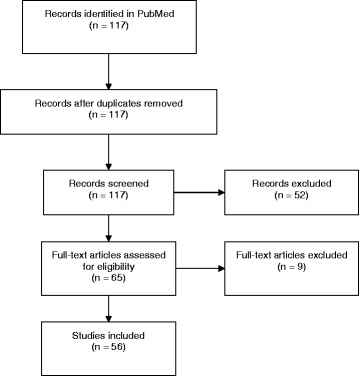
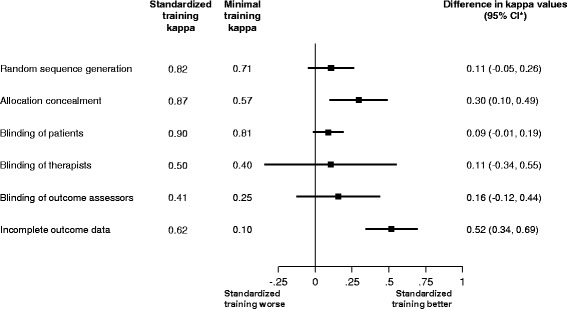
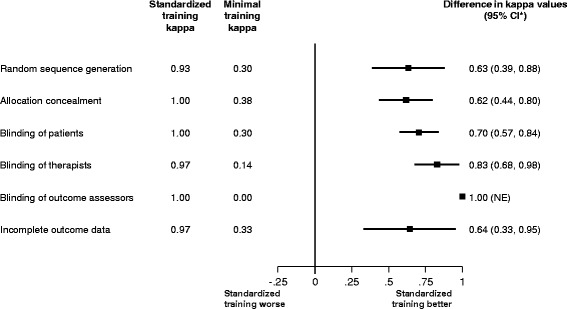
BACKGROUND: The Cochrane risk of bias tool is commonly criticized for having a low reliability. We aimed to investigate whether training of raters, with objective and standardized instructions on how to assess risk of bias, can improve the reliability of the Cochrane risk of bias tool. METHODS: In this pilot study, four raters inexperienced in risk of bias assessment were randomly allocated to minimal or intensive standardized training for risk of bias assessment of randomized trials of physical therapy treatments for patients with knee osteoarthritis pain. Two raters were experienced risk of bias assessors who served as reference. The primary outcome of our study was between-group reliability, defined as the agreement of the risk of bias assessments of inexperienced raters with the reference assessments of experienced raters. Consensus-based assessments were used for this purpose. The secondary outcome was within-group reliability, defined as the agreement of assessments within pairs of inexperienced raters. We calculated the chance-corrected weighted Kappa to quantify agreement within and between groups of raters for each of the domains of the risk of bias tool. RESULTS: A total of 56 trials were included in our analysis. The Kappa for the agreement of inexperienced raters with reference across items of the risk of bias tool ranged from 0.10 to 0.81 for the minimal training group and from 0.41 to 0.90 for the standardized training group. The Kappa values for the agreement within pairs of inexperienced raters across the items of the risk of bias tool ranged from 0 to 0.38 for the minimal training group and from 0.93 to 1 for the standardized training group. Between-group differences in Kappa for the agreement of inexperienced raters with reference always favored the standardized training group and was most pronounced for incomplete outcome data (difference in Kappa 0.52, p < 0.001) and allocation concealment (difference in Kappa 0.30, p = 0.004). CONCLUSIONS: Intensive, standardized training on risk of bias assessment may significantly improve the reliability of the Cochrane risk of bias tool.
Overview
The claims and statistics of this paper haven’t been checked yet.
Free: it reads the open-access text and checks the first 5 claims that cite a source we can check. Create a free account to check every claim.
Integrity signals
Registry
Cites
Statistics
Figures
Verification
Claims the paper makes
The claims and statistics of this paper haven’t been checked yet.
Free: it reads the open-access text and checks the first 5 claims that cite a source we can check. Create a free account to check every claim.
Claims other papers make about this one
Each is checked against this paper’s own text: does it say what the citing paper says it does?
The cited source says what the claim attributes to it.
In the citing paper
“However, intensive standardized training on risk of bias assessment may significantly improve the reliability of the RoB1 tool [12].”
From Automating risk of bias assessment in systematic reviews: a real-time mixed methods comparison of human researchers to a machine learning system (2022) · cites this paper as [12]
The cited source says what the claim attributes to it.
In the citing paper
“In practice, low inter-rater reliability means that the same RCT or RCTs may be assessed as having different levels of bias across research groups, making it possible that the same data could be translated into different recommendations [12].”
From Automating risk of bias assessment in systematic reviews: a real-time mixed methods comparison of human researchers to a machine learning system (2022) · cites this paper as [12]
Self-check
Percentages, sums and reported differences re-computed from the paper’s own numbers.
The self-check needs the paper’s full text.
Citations
Cites
The Cochrane Collaboration's tool for assessing risk of bias in randomised trials
Higgins, J. P. T., Altman, D. G., Gotzsche, P. C., Juni, P., Moher, D., Oxman, A. D., Savovic, J., Schulz, K. F., Weeks, L., Sterne, J. A. C., et al. (2011) · BMJ · doi:10.1136/bmj.d5928 · Cited by 33,817 · cited 12×
“RCTs are the gold standard design for assessing the effectiveness of treatment interventions.”
InfluentialSelf-citationCochrane Handbook for Systematic Reviews of Interventions: Cochrane Book Series
(2008) · doi:10.1002/9780470712184 · Cited by 25,048
Dermyshi, E., Wang, Y., Yan, C., Hong, W., Qiu, G., Gong, X., & Zhang, T. (2017) · Neonatology · doi:10.1159/000454668 · Cited by 24,451
Moher, D., Hopewell, S., Schulz, K. F., Montori, V., Gotzsche, P. C., Devereaux, P. J., Elbourne, D., Egger, M., & Altman, D. G. (2010) · BMJ · doi:10.1136/bmj.c869 · Cited by 8,883 · cited 1×
“To explore whether quality of reporting influences agreement, we stratified the analysis according to publication date (before the latest Consolidated Standards of Reporting Trials (CONSORT) statement revision in 2010 [16] vs 2010 and later), assuming that reporting quality of RCTs in physical therapy improved after t…”
MethodSelf-citation(2008) · Cited by 3,790
Assessing Risk of Bias in Included Studies
Higgins, J. P., & Altman, D. G. (2008) · Cochrane Handbook for Systematic Reviews of Interventions · doi:10.1002/9780470712184.ch8 · Cited by 3,396
Better Bootstrap Confidence Intervals
Efron, B. (1987) · Journal of the American Statistical Association · doi:10.1080/01621459.1987.10478410 · Cited by 3,364 · cited 1×
“We bootstrapped the difference in Kappa values using bias correction and acceleration to derive 95% confidence intervals and p values [15].”
MethodAssessing the quality of controlled clinical trials
Jüni, P., Altman, D. G., & Egger, M. (2001) · BMJ · doi:10.1136/bmj.323.7303.42 · Cited by 3,309 · cited 1×
“If results of RCTs included in a meta-analysis are biased, then the results of the metaanalysis will also be biased [3, 4].”
BackgroundSelf-citationSystematic Reviews: Synthesis of Best Evidence for Clinical Decisions
Cook, D. J., Mulrow, C. D., & Haynes, R. B. (1997) · Annals of Internal Medicine · doi:10.7326/0003-4819-126-5-199703010-00006 · Cited by 2,184 · cited 1×
“Background Systematic reviews and meta-analyses of randomized clinical trials (RCTs) are central to evidence-based clinical decision-making [1, 2].”
BackgroundThe Hazards of Scoring the Quality of Clinical Trials for Meta-analysis
Jüni, P. (1999) · JAMA · doi:10.1001/jama.282.11.1054 · Cited by 1,981 · cited 2×
“What is more relevant is whether or not their risk of bias assessment after discussion is accurate, and whether assessments are similar to those from other research groups, since low agreement of risk of bias assessments between research groups can have repercussions on decision-making and quality of patient care [11,…”
BackgroundResultSelf-citation
Cited by
Considering bias and conflicts of interest among the included studies
Boutron, I., Page, M. J., Higgins, J. P., Altman, D. G., Lundh, A., Hróbjartsson, A., & on behalf of the Cochrane Bias Methods Group (2019) · Cochrane Handbook for Systematic Reviews of Interventions · doi:10.1002/9781119536604.ch7 · Cited by 258
Mathes, T., Klaßen, P., & Pieper, D. (2017) · BMC Medical Research Methodology · doi:10.1186/s12874-017-0431-4 · Cited by 240
Karam, G., Agarwal, A., Sadeghirad, B., Jalink, M., Hitchcock, C. L., Ge, L., Kiflen, R., Ahmed, W., Zea, A. M., Milenkovic, J., et al. (2023) · BMJ · doi:10.1136/bmj-2022-072003 · Cited by 197
Self-citationCochrane’s risk of bias tool in the context of psychotherapy outcome research
Munder, T., & Barth, J. (2018) · Psychotherapy Research · doi:10.1080/10503307.2017.1411628 · Cited by 174
“…an introduction by a senior researcher, training coders should include coding 5–10 similar studies from a related field and a discussion of differences in ratings. da Costa et al. (2017) showed that even a standardized one hour training of raters substantially increased the quality of rating.”
BackgroundMoseley, A. M., Rahman, P., Wells, G. A., Zadro, J. R., Sherrington, C., Toupin-April, K., & Brosseau, L. (2019) · PLOS ONE · doi:10.1371/journal.pone.0222770 · Cited by 174
Pieper, D., Puljak, L., González‐Lorenzo, M., & Minozzi, S. (2018) · Journal of Clinical Epidemiology · doi:10.1016/j.jclinepi.2018.12.004 · Cited by 130
“Thus, the only study we can compare our results with is the source publication [23].”
ResultBabic, A., Tokalic, R., Amílcar Silva Cunha, J., Novak, I., Suto, J., Vidak, M., Miosic, I., Vuka, I., Poklepovic Pericic, T., & Puljak, L. (2019) · BMC Medical Research Methodology · doi:10.1186/s12874-019-0717-9 · Cited by 80
Robson, R. C., Pham, B., Hwee, J., Thomas, S. M., Rios, P., Page, M. J., & Tricco, A. C. (2019) · Journal of Clinical Epidemiology · doi:10.1016/j.jclinepi.2018.10.003 · Cited by 86
The Robustness of Trials That Guide Evidence-Based Orthopaedic Surgery
Checketts, J. X., Scott, J., Meyer, C. L., Horn, J. G., Jones, J. M., & Vassar, M. B. (2018) · Journal of Bone and Joint Surgery · doi:10.2106/jbjs.17.01039 · Cited by 75
The development of a new generic risk-of-bias measure for systematic reviews of surveys
Nudelman, G., & Otto, K. (2020) · Methodology · doi:10.5964/meth.4329 · Cited by 74
“The lower reliability of inexperienced raters compared to experienced ones has been previously reported (da Costa et al., 2017).”
BackgroundJardim, P. S. J., Rose, C. J., Ames, H. M., Echavez, J. F. M., Van de Velde, S., & Muller, A. E. (2022) · BMC Medical Research Methodology · doi:10.1186/s12874-022-01649-y · Cited by 68
“In practice, low interrater reliability means that the same RCT or RCTs may be assessed as having different levels of bias across research groups, making it possible that the same data could be translated into different recommendations [12].”
BackgroundA Scoping Review: The Impact of Housing Systems and Environmental Features on Beef Cattle Welfare
Park, R. M., Foster, M., & Daigle, C. L. (2020) · Animals · doi:10.3390/ani10040565 · Cited by 69
Barčot, O., Borić, M., Peričić, T. P., Ćavar, M., Došenović, S., Vuka, I., & Puljak, L. (2019) · BMC Medical Research Methodology · doi:10.1186/s12874-019-0804-y · Cited by 65
Pega, F., Norris, S. L., Backes, C., Bero, L. A., Descatha, A., Gagliardi, D., Godderis, L., Loney, T., Modenese, A., Morgan, R. L., et al. (2019) · Environment International · doi:10.1016/j.envint.2019.105039 · Cited by 62
Improving the conduct of systematic reviews: a process mining perspective
Pham, B., Bagheri, E., Rios, P., Pourmasoumi, A., Robson, R. C., Hwee, J., Isaranuwatchai, W., Darvesh, N., Page, M. J., & Tricco, A. C. (2018) · Journal of Clinical Epidemiology · doi:10.1016/j.jclinepi.2018.06.011 · Cited by 40
Bertizzolo, L., Bossuyt, P., Atal, I., Ravaud, P., & Dechartres, A. (2019) · BMJ Open · doi:10.1136/bmjopen-2018-028382 · Cited by 35
Inter-review agreement of risk-of-bias judgments varied in Cochrane reviews
Könsgen, N., Barčot, O., Heß, S., Puljak, L., Gooßen, K., Rombey, T., & Pieper, D. (2019) · Journal of Clinical Epidemiology · doi:10.1016/j.jclinepi.2019.12.016 · Cited by 37
Oxman, A. D., & García, L. M. (2020) · F1000Research · doi:10.12688/f1000research.21858.1 · Cited by 35
Barčot, O., Ivanda, M., Buljan, I., Pieper, D., & Puljak, L. (2021) · Research Synthesis Methods · doi:10.1002/jrsm.1499 · Cited by 29
“In 2017, da Costa et al have reported results of their pilot study about standardized training for the reliability of RoB assessments.(14) They used four raters inexperienced in RoB assessments and allocated them randomly to minimal or intensive standardized training for making RoB assessments.”
BackgroundResearch Note: Evaluating risk of bias in randomised controlled trials
Moseley, A. M., & Pinheiro, M. B. (2022) · Journal of physiotherapy · doi:10.1016/j.jphys.2022.02.003 · Cited by 27
Miyahara, M., Lagisz, M., Nakagawa, S., & HENDERSON, S. E. (2020) · Child Care Health and Development · doi:10.1111/cch.12763 · Cited by 23
Li, M., Cheng, A., Sun, J., Fan, C., & Meng, R. (2021) · Brain Circulation · doi:10.4103/bc.bc_64_20 · Cited by 20
“Selection bias, performing bias, detection bias, attrition bias and reporting bias were evaluated by Cochrane Risk of Bias Tool.[23] All analyses were performed using Review Manager (RevMan, version 5.”
MethodKaiser, I., Pfahlberg, A. B., Mathes, S., Uter, W. J. C., Diehl, K., Steeb, T., Heppt, M. V., & Gefeller, O. (2023) · Journal of Clinical Medicine · doi:10.3390/jcm12051976 · Cited by 19
The fragility of statistically significant results in otolaryngology randomized trials
Skinner, M., Tritz, D., Farahani, C., Ross, A., Hamilton, T., & Vassar, M. B. (2018) · American Journal of Otolaryngology · doi:10.1016/j.amjoto.2018.10.011 · Cited by 19
Goerke, K., Parke, M., Horn, J. G., Meyer, C. L., Dormire, K., White, B. A., Bright, T., Walters, C. G., & Vassar, M. B. (2019) · International Journal of Evidence-Based Healthcare · doi:10.1097/xeb.0000000000000200 · Cited by 16
“This training was structured to be consistent with the intensive risk of bias training outlined by da Costa et al.(20,21) which was found to have improved interrater reliability over other training methods.”
MethodInter-rater reliability of risk of bias tools for non-randomized studies
Kalaycioglu, I., Rioux, B., Briard, J. N., Nehme, A., Touma, L., Dansereau, B., Carpentier, A. V., & Keezer, M. R. (2023) · Systematic Reviews · doi:10.1186/s13643-023-02389-w · Cited by 14
Dorneles, G. P., Stein, C., de Araújo, C. L. P., Parahiba, S. M., Rosa, B. D., Gräf, D. D., Belli, K. C., Basmaji, J., Maior, M. D. C. L. S., Vidal, Á. T., et al. (2024) · Journal of Clinical Epidemiology · doi:10.1016/j.jclinepi.2024.111407 · Cited by 12
Improving the Innate Immune Response in Diabetes by Modifying the Renin Angiotensin System
Soto, M., Gaffney, K. J., & Rodgers, K. E. (2019) · Frontiers in Immunology · doi:10.3389/fimmu.2019.02885 · Cited by 12
Tonin, F. S., Lopes, L. A. A., Rotta, I., Bonetti, A. D. F., Pontarolo, R., Correr, C. J., & Fernández-Llimós, F. (2019) · International Journal of Clinical Pharmacy · doi:10.1007/s11096-019-00818-2 · Cited by 9
Koster, A., Stevens, M. J., van Keeken, H. G., Westerveld, S., & Seeber, G. H. (2023) · European Review of Aging and Physical Activity · doi:10.1186/s11556-023-00317-4 · Cited by 8
Wang, Y., Zhou, Z., Gao, Z., & Gu, Y. (2025) · Healthcare · doi:10.3390/healthcare13070765 · Cited by 7
Johnston, B. C., Zeraatkar, D., Steen, J. P., Rada, D., Zhu, H., Sun, M., Cooper, M. A., Maraj, M., Prokop‐Dorner, A., Reyes, B. C., et al. (2023) · Systematic Reviews · doi:10.1186/s13643-023-02209-1 · Cited by 7
“Strengths and limitations The strengths of this systematic review will include an extensive search for relevant systematic reviews of RCTs and RCTs; duplicate screening and extraction of data; the assessment of the RoB of studies using rigorous criteria aligned with advances in the methodology of bias assessment [28,…”
MethodSelf-citationTokalić, R., Peričić, T. P., & Marušić, A. (2023) · Journal of Medical Internet Research · doi:10.2196/43928 · Cited by 7
Yao, Y., Shen, J., Luo, J., Li, N., Liao, X., & Zhang, Y. (2024) · Trials · doi:10.1186/s13063-024-08145-2 · Cited by 6
Saltaji, H., Armijo-Olivo, S. L., Cummings, G. G., Amin, M. S., Major, P. W., da Costa, B. R., & Flores‐Mir, C. (2021) · Journal of Evidence Based Dental Practice · doi:10.1016/j.jebdp.2021.101544 · Cited by 6
Self-citationKanukula, R., McKenzie, J. E., Cashin, A. G., Korevaar, E., McDonald, S., Mello, A. T., Nguyen, P., Saldanha, I. J., Wewege, M. A., & Page, M. J. (2023) · Journal of Clinical Epidemiology · doi:10.1016/j.jclinepi.2023.111244 · Cited by 5
Gupta, A. K., Zaka, A., Lombardo, A., Tsimiklis, J., Stretton, B., Kovoor, J. G., Bacchi, S., Ramponi, F., Chan, J. C. Y., Thiagalingam, A., et al. (2024) · Surgery · doi:10.1016/j.surg.2024.109003 · Cited by 4
Zhao, P., Yu, Y., Du, M., Xu, J., & Lü, W. (2023) · International Journal of Gynecology & Obstetrics · doi:10.1002/ijgo.15140 · Cited by 4
“The risk of bias were assessed using the Newcastle-Ottawa Scale (NOS) for assessing the quality of nonrandomized studies in meta-analyses 9 and the Cochrane Risk of Bias assessment tool for RCTs. 10 The subgroup analysis was conducted based on the study design, study location and the development status of the study lo…”
MethodMorselli, N., Puglia, M., Mason, J., Parenti, M., Ottani, F., & Tartarini, P. (2020) · Journal of Physics Conference Series · doi:10.1088/1742-6596/1599/1/012034 · Cited by 4
Jin, J., Zhuo, X., Xiao, M., Jiang, Z., Chen, L., & Shamloll, Y. D. (2021) · Medicine · doi:10.1097/md.0000000000025185 · Cited by 3
“The methodological qualities of the trials were assessed by the authors based on the recommendations suggested by the Cochrane Collaboration tool.([20]) Grades were allotted; grade A being associated with a low risk of bias, grade B with a moderate risk, and grade C with a high risk of bias.”
MethodBertizzolo, L., Bossuyt, P. M., Atal, I., Ravaud, P., & Dechartres, A. (2020) · Journal of Clinical Epidemiology · doi:10.1016/j.jclinepi.2020.03.008 · Cited by 3
Meyer, C. L., Bowers, A., Jaiswal, D. D., Checketts, J. X., Engheta, M., Severns, C., Cook, S., Walters, C. G., & Vassar, M. B. (2019) · The American Journal of Emergency Medicine · doi:10.1016/j.ajem.2019.03.038 · Cited by 3
“[30,31], which was found to improve inter-rater reliability over other training methods.”
BackgroundAssessment of the Risk of Bias
Moon, K., & Rao, S. C. (2021) · Springer eBooks · doi:10.1007/978-3-030-71921-0_4 · Cited by 2
Savage, A. J., Shafik, C. G., Savage, S. A., Catalano, J. D., Tee, J., Akhlaghi, H., Dhillon, R., & O’Donohoe, T. J. (2024) · Journal of Clinical Neuroscience · doi:10.1016/j.jocn.2024.110916 · Cited by 1
Guo, W., Kim, Y., Wu, C., & Kim, S. (2025) · Molecular & cellular biomechanics · doi:10.62617/mcb347 · Cited by 1
“Ultimately, the overall classification resulted in one article being categorized as high risk and eleven as medium risk, contributing to an overall assessment of low risk of bias in the literature [32].”
Lechterbeck, L., & Sönnichsen, A. C. (2020) · Zeitschrift für Evidenz Fortbildung und Qualität im Gesundheitswesen · doi:10.1016/j.zefq.2020.03.005 · Cited by 1
How to make a systematic review live up to its name: perspectives from journal editors
Shang, B., Lin, Y., Yang, F., & Zhang, K. (2023) · Annals of Translational Medicine · doi:10.21037/atm-22-6305 · Cited by 1
“A study found that the inter-rater reliability was improved after intensive training in Cochrane’s risk of bias assessment (19).”
BackgroundVeterinarian Knowledge Translation and Synthesis of Influenza Vaccine Research in Swine
Keay, S. (2022) · The Atrium (University of Guelph) · doi:10.1186/s12917-020-02617-8
Response to Dr. Livia Puljak's letter about our published article
Gates, A., Vandermeer, B., & Hartling, L. (2018) · Journal of Clinical Epidemiology · doi:10.1016/j.jclinepi.2018.03.001
WITHDRAWN: Inter-rater Reliability of Risk of Bias Tools for Non-Randomized StudiesPreprint
(2023) · Research Square · doi:10.21203/rs.3.rs-2206790/v2
Improving risk of bias assessment and quality of reporting in clinical research
Bertizzolo, L. (2021) · theses.fr (ABES) · doi:10.70675/7c89a3e9zfac2z4b5bza6a5z77fb27b5a29b
Ahern, E., Adedeji, T., Whiston, A., Dillon, S., & Lynn, F. A. (2025) · HRB Open Research · doi:10.12688/hrbopenres.14129.1
Albarqouni, L. (2020) · Bond University · doi:10.5256/f1000research.24099.r73961
Keay, S., Sargeant, J. M., O’Connor, A., Friendship, R. M., O’Sullivan, T., & Poljak, Z. (2020) · Figshare · doi:10.6084/m9.figshare.13181779
Additional file 1 of Inter-rater reliability of risk of bias tools for non-randomized studies
Kalaycioglu, I., Rioux, B., Briard, J. N., Nehme, A., Touma, L., Dansereau, B., Carpentier, A. V., & Keezer, M. R. (2024) · Figshare · doi:10.6084/m9.figshare.26650587
Keay, S., Sargeant, J. M., O’Connor, A., Friendship, R. M., O’Sullivan, T., & Poljak, Z. (2020) · Figshare · doi:10.6084/m9.figshare.13181773
Jardim, P. S. J., Rose, C. J., Ames, H. M., Echávez, J. F. M., Van de Velde, S., & Muller, A. E. (2022) · Figshare · doi:10.6084/m9.figshare.20033145
Yao, Y., Shen, J., Luo, J., Li, N., Liao, X., & Zhang, Y. (2024) · Figshare · doi:10.6084/m9.figshare.26737467
Keay, S., Sargeant, J. M., O’Connor, A., Friendship, R. M., O’Sullivan, T., & Poljak, Z. (2020) · Figshare · doi:10.6084/m9.figshare.13181776
Yao, Y., Shen, J., Luo, J., Li, N., Liao, X., & Zhang, Y. (2024) · Figshare · doi:10.6084/m9.figshare.26737470
Yao, Y., Shen, J., Luo, J., Li, N., Liao, X., & Zhang, Y. (2024) · Figshare · doi:10.6084/m9.figshare.26737473
Shoesmith, G. (2024) · Open Access at Essex (University of Essex)
Dhrangadhariya, A., Hilfiker, R., Sattelmayer, M., Naderi, N., Giacomino, K., Caliesch, R., Higgins, J. P. T., Marchand‐Maillet, S., & Müller, H. (2026) · JMIR Formative Research · doi:10.2196/55127
“Several other papers explored the subjectivity and reliability of Cochrane RoB 1 and 2 tools [35, 36].”
Chalmers, H., Baird, J., Meadows, M., Kay, J., Chen, N., & Miller, S. J. (2026) · Review of Education · doi:10.1002/rev3.70211
Li, L., Song, X., Meng, Y., & Feng, X. (2026) · Noise and Health · doi:10.4103/nah.nah_87_26
Kampman, S. L., Braun, K. P. J., & Otte, W. M. (2026) · medRxiv · doi:10.64898/2026.09.09.26362643
Huang, M., Huang, X., Ni, F.-L., Huang, L., & 沈小叶 (2026) · BMJ Open · doi:10.1136/bmjopen-2026-119577
“This study will employ the Cochrane Risk of Bias assessment tool (RoB 2) 28 to evaluate the methodological quality of the included studies.”
Bornman, C., Visser, M., Kruger, A. J., & Nel, M. (2026) · OTJR Occupational Therapy Journal of Research · doi:10.1177/15394492261490098
Metadata
- Authors
- da Costa, B. R., Beckett, B., Diaz, A., Resta, N. M., Johnston, B. C., Egger, M., Jüni, P., & Armijo-Olivo, S.
- Affiliations
- Florida International University (US)
- University of Toronto (CA)
- University of Bern (CH)
- St. Michael's Hospital (CA)
- University of Alberta (CA)
- Venue
- Systematic Reviews
- Published
- 2017-03-03
- Volume
- 6
- Issue
- 1
- Pages
- 44-44
- ISSN
- 2046-4053 (ISSN-L)
- PMC
- PMC5335785
- OpenAlex
- W2592866053
- Cited by
- 62
- References
- 29
- Citations by year
- 2026: 2 · 2025: 3 · 2024: 7 · 2023: 11 · 2022: 3 · 2021: 5 · 2020: 10 · 2019: 11 · 2018: 8 · 2017: 2
- FWCI
- 7.58
- Type
- journal article
- Language
- en
- Open access
- gold
- doi.org
- Licence
- cc-by
- Locations
- Systematic Reviews (publishedVersion, cc-by)
- PubMed Central (publishedVersion, cc-by)
- PubMed (publishedVersion)
- TSpace (University of Toronto) (submittedVersion, cc-by)
- Florida International University Digital Commons (Florida International University) (submittedVersion, cc-by)
- BORIS (University Library Bern) (submittedVersion, cc-by)
- Topics
- Social Sciences › Decision Sciences › Statistics, Probability and Uncertainty › Meta-analysis and systematic reviews
- Social Sciences › Decision Sciences › Statistics, Probability and Uncertainty › Reliability and Agreement in Measurement
- Social Sciences › Sociology and Political Science › Delphi Technique in Research
- Keywords
- Cochrane risk of bias tool, risk of bias assessment, rater training, inter-rater reliability, standardized training, physiotherapy, allocation concealment
- MeSH terms
- Humans, Pilot Projects, Prospective Studies, Review Literature as Topic, Risk Factors, Statistics as Topic, Reproducibility of Results, Bias, Randomized Controlled Trials as Topic
About these checks
Registry, retraction, Cites and statistics results are computed, not judged, with one exception: a printed reference that no index lists is read once by a model before it counts as a citation error. Claims are extracted by a model and kept only when their quote appears verbatim in the text; each cited source is then checked, with a model’s help, for whether it says what the claim relies on. Those verdicts can be wrong — read the claim’s quote and the cited source before relying on one.
Statistics and arithmetic are recomputed, not judged.
Confidence bands are shown only for fields calibrated on our annotated test set. None is calibrated yet, so no band is shown.
What counts as a claim ›How we measure confidence ›How we check this ›
Are you an author, or do you see a problem with this page? Request a review
Data sources
Bibliographic data: Semantic Scholar, OpenAlex, Crossref.
Contains information from the Semantic Scholar Academic Graph Datasets, made available under the ODC Attribution License (ODC-BY 1.0).
Semantic Scholar’s data is described in: Kinney, R., et al. (2023). The Semantic Scholar Open Data Platform. arXiv:2301.10140.
