

Evaluation of a prototype machine learning tool to semi-automate data extraction for systematic literature reviews
Open accessThe DOI matches its Crossref record; 34 of the 36 references it cites were found in a registry or an index.
Abstract
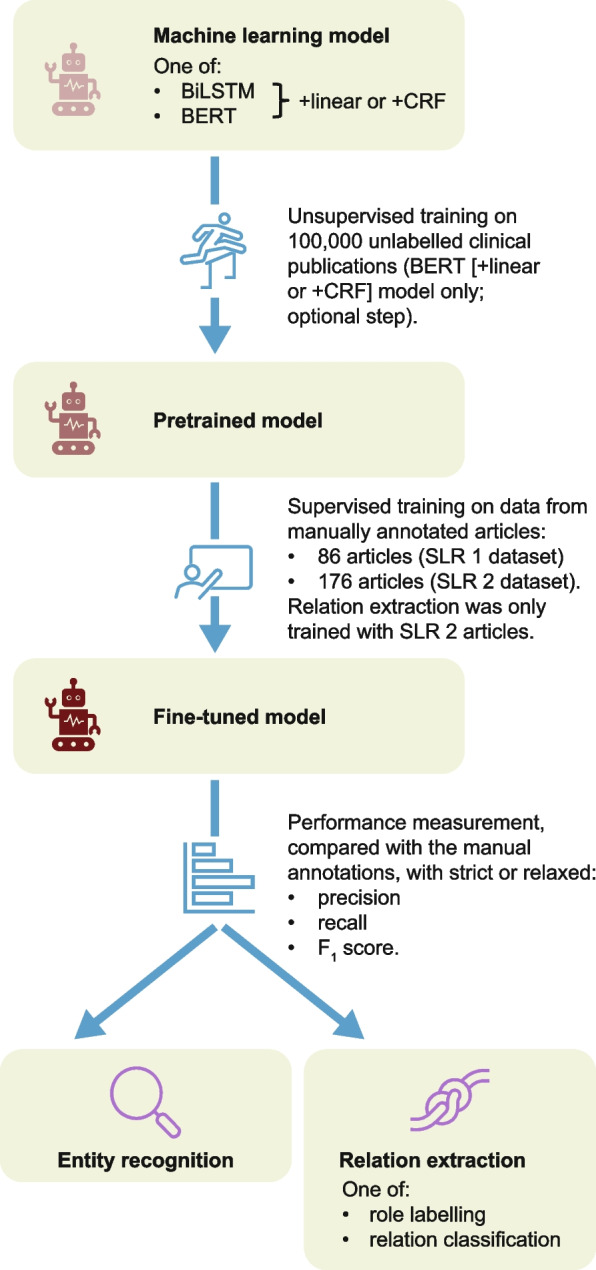
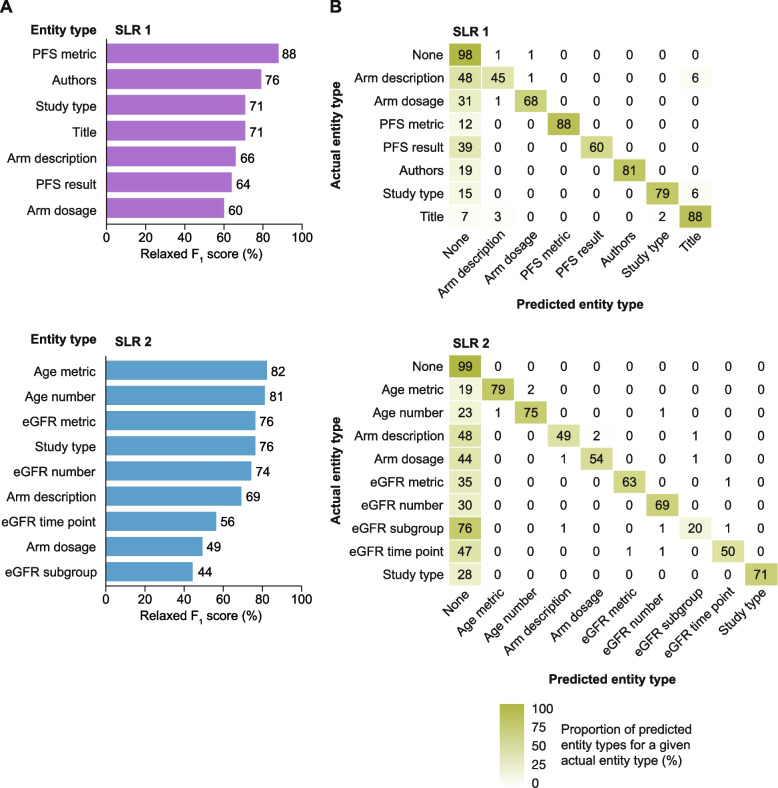
Background: Evidence-based medicine requires synthesis of research through rigorous and time-intensive systematic literature reviews (SLRs), with significant resource expenditure for data extraction from scientific publications. Machine learning may enable the timely completion of SLRs and reduce errors by automating data identification and extraction. Methods: We evaluated the use of machine learning to extract data from publications related to SLRs in oncology (SLR 1) and Fabry disease (SLR 2). SLR 1 predominantly contained interventional studies and SLR 2 observational studies. Predefined key terms and data were manually annotated to train and test bidirectional encoder representations from transformers (BERT) and bidirectional long-short-term memory machine learning models. Using human annotation as a reference, we assessed the ability of the models to identify biomedical terms of interest (entities) and their relations. We also pretrained BERT on a corpus of 100,000 open access clinical publications and/or enhanced context-dependent entity classification with a conditional random field (CRF) model. Performance was measured using the F 1 score, a metric that combines precision and recall. We defined successful matches as partial overlap of entities of the same type. Results: For entity recognition, the pretrained BERT+CRF model had the best performance, with an F 1 score of 73% in SLR 1 and 70% in SLR 2. Entity types identified with the highest accuracy were metrics for progression-free survival (SLR 1, F 1 score 88%) or for patient age (SLR 2, F 1 score 82%). Treatment arm dosage was identified less successfully (F 1 scores 60% [SLR 1] and 49% [SLR 2]). The best-performing model for relation extraction, pretrained BERT relation classification, exhibited F 1 scores higher than 90% in cases with at least 80 relation examples for a pair of related entity types. Conclusions: The performance of BERT is enhanced by pretraining with biomedical literature and by combining with a CRF model. With refinement, machine learning may assist with manual data extraction for SLRs.
Overview
The claims and statistics of this paper haven’t been checked yet.
Free: it reads the open-access text and checks the first 5 claims that cite a source we can check. Create a free account to check every claim.
Integrity signals
Registry
Cites
Statistics
Figures
Verification
Claims the paper makes
The claims and statistics of this paper haven’t been checked yet.
Free: it reads the open-access text and checks the first 5 claims that cite a source we can check. Create a free account to check every claim.
Self-check
Percentages, sums and reported differences re-computed from the paper’s own numbers.
The self-check needs the paper’s full text.
Citations
Cites
BERT: Pre-training of Deep Bidirectional Transformers for Language Understanding
Devlin, J., Chang, M.-W., Lee, K., & Toutanova, K. (2018) · arXiv · doi:10.48550/arxiv.1810.04805 · Cited by 73,173 · cited 3×
“The state of the art in NLP is centred on the use of language models called transformers, and a popular such model is the bidirectional encoder representations from transformers (BERT) [15].”
BackgroundMethodInfluentialBioBERT: a pre-trained biomedical language representation model for biomedical text mining
Lee, J., Yoon, W., Kim, S., Kim, D., Kim, S., So, C. H., & Kang, J. (2020) · Bioinformatics · doi:10.1093/bioinformatics/btz682 · Cited by 7,218 · cited 3×
“The performance of our named-entity recognition was slightly lower than that achieved by Mutinda et al., probably owing to their use of the newer BioBERT [17] and Longformer [33] models; however, our model very rarely misclassified entities (Fig.”
BackgroundForney, G. D. (1973) · Proceedings of the IEEE · doi:10.1109/proc.1973.9030 · Cited by 5,647
Google's Neural Machine Translation System: Bridging the Gap between Human and Machine Translation
Wu, Y., Schuster, M., Chen, Z., Le, Q. V., Norouzi, M., Macherey, W., Krikun, M., Cao, Y., Gao, Q., Macherey, K., et al. (2016) · arXiv · doi:10.48550/arxiv.1609.08144 · Cited by 5,319 · cited 2×
“…criteria: evidence of rigorous methodology (e.g. adherence to best-practice guidelines, including risk of bias analysis), a large associated dataset (i.e. review of a sufficient number of references [> 25] for model training), and a clear description of results and data extraction processes.”
MethodSciBERT: A Pretrained Language Model for Scientific Text
Beltagy, I., Lo, K., & Cohan, A. (2019) · Proceedings of the 2019 Conference on Empirical Methods in Natural Language Processing and the 9th International Joint Conference on Natural Language Processing (EMNLP-IJCNLP) · doi:10.18653/v1/d19-1371 · Cited by 3,218
Longformer: The Long-Document Transformer
Beltagy, I., Peters, M. E., & Cohan, A. (2020) · arXiv · doi:10.48550/arxiv.2004.05150 · Cited by 2,281 · cited 2×
“The performance of our named-entity recognition was slightly lower than that achieved by Mutinda et al., probably owing to their use of the newer BioBERT [17] and Longformer [33] models; however, our model very rarely misclassified entities (Fig.”
MethodText Chunking Using Transformation-Based Learning
Ramshaw, L. A., & Marcus, M. P. (1999) · Text, Speech and Language Technology · doi:10.1007/978-94-017-2390-9_10 · Cited by 1,460
Murad, M. H., Asi, N., Alsawas, M., & Alahdab, F. (2016) · Evidence Based Medicine · doi:10.1136/ebmed-2016-110401 · Cited by 1,388 · cited 1×
“Evidence-based medicine is the use of the best evidence in making decisions about the care of patients [1], and high-quality SLRs provide the highest level of research evidence; they are commonly used to assess the clinical efficacy of medications or to determine burden of disease [2].”
BackgroundNational Institute for Health Research
Evans, R. (2014) · Nursing Standard · doi:10.7748/ns.28.49.32.s37 · Cited by 1,350 · cited 1×
“The total number of SLRs conducted has grown substantially in recent years: the International Prospective Register of Systematic Reviews (PROSPERO) registered 284 SLRs in 2011, rising to over 100,000 by the end of 2020 [3].”
BackgroundBorah, R., Brown, A. W., Capers, P. L., & Kaiser, K. A. (2017) · BMJ Open · doi:10.1136/bmjopen-2016-012545 · Cited by 737 · cited 1×
“In a study of 195 records analysed in the PROSPERO registry, the mean length of time taken to conduct an SLR was 67.3 weeks (standard deviation [SD] 31.0 weeks, range 6–186 weeks) [4], with an economic analysis estimating the cost of each SLR at US $141,195 [5].”
BackgroundInfluentialMarshall, I. J., & Wallace, B. C. (2019) · Systematic Reviews · doi:10.1186/s13643-019-1074-9 · Cited by 638 · cited 2×
“…of SLR development lend themselves to the use of artificial intelligence, such as search-string development, classification of study type, title and abstract screening, extraction of text describing PICO information, risk of bias analysis, data extraction, and data synthesis [7, 9, 11, 35–38].”
MethodClinicalBERT: Modeling Clinical Notes and Predicting Hospital Readmission
Huang, K., Altosaar, J., & Ranganath, R. (2019) · arXiv · doi:10.48550/arxiv.1904.05342 · Cited by 618 · cited 1×
“This approach would have saved significant resources [17, 30–32].”
BackgroundPROSPERO: an international prospective register of systematic reviews
Wright, K. E. (2014) · Cited by 568
Deploying an interactive machine learning system in an evidence-based practice center: abstrackr
Wallace, B. C., Small, K., Brodley, C. E., Lau, J., & Trikalinos, T. A. (2012) · Proceedings of the 2nd ACM SIGHIT International Health Informatics Symposium · doi:10.1145/2110363.2110464 · Cited by 532 · cited 1×
“…of SLR development lend themselves to the use of artificial intelligence, such as search-string development, classification of study type, title and abstract screening, extraction of text describing PICO information, risk of bias analysis, data extraction, and data synthesis [7, 9, 11, 35–38].”
MethodEvidence Based Medicine - New Approaches and Challenges
Masic, I., Miokovic, M., & Muhamedagic, B. (2008) · Acta Informatica Medica · doi:10.5455/aim.2008.16.219-225 · Cited by 495 · cited 1×
“Evidence-based medicine is the use of the best evidence in making decisions about the care of patients [1], and high-quality SLRs provide the highest level of research evidence; they are commonly used to assess the clinical efficacy of medications or to determine burden of disease [2].”
BackgroundLiving systematic reviews: 2. Combining human and machine effort
Thomas, J., Noel-Storr, A., Marshall, I., Wallace, B., McDonald, S., Mavergames, C., Glasziou, P., Shemilt, I., Synnot, A., Turner, T., et al. (2017) · Journal of Clinical Epidemiology · doi:10.1016/j.jclinepi.2017.08.011 · Cited by 355
RobotReviewer: evaluation of a system for automatically assessing bias in clinical trials
Marshall, I. J., Kuiper, J., & Wallace, B. C. (2016) · Journal of the American Medical Informatics Association · doi:10.1093/jamia/ocv044 · Cited by 317 · cited 2×
“…of SLR development lend themselves to the use of artificial intelligence, such as search-string development, classification of study type, title and abstract screening, extraction of text describing PICO information, risk of bias analysis, data extraction, and data synthesis [7, 9, 11, 35–38].”
MethodQureshi, R., Shaughnessy, D., Gill, K. A. R., Robinson, K. A., Li, T., & Agai, E. (2023) · Systematic Reviews · doi:10.1186/s13643-023-02243-z · Cited by 201 · cited 1×
“However, these tasks are not trivial, and current tools (including conversational tools like ChatGPT) are not mature [39].”
BackgroundExaCT: automatic extraction of clinical trial characteristics from journal publications
Kiritchenko, S., de Bruijn, B., Carini, S., Martin, J., & Sim, I. (2010) · BMC Medical Informatics and Decision Making · doi:10.1186/1472-6947-10-56 · Cited by 188 · cited 4×
“Unlike the previously published tools that extract data from clinical trials [9, 10, 12–14], our method identified relations between entities, for example relating the outcomes of a trial arm to its description.”
MethodInfluentialMichelson, M., & Reuter, K. (2019) · Contemporary Clinical Trials Communications · doi:10.1016/j.conctc.2019.100443 · Cited by 152
Prioritising references for systematic reviews with RobotAnalyst: A user study
Przybyła, P., Brockmeier, A. J., Kontonatsios, G., Le Pogam, M., McNaught, J., von Elm, E., Nolan, K., & Ananiadou, S. (2018) · Research Synthesis Methods · doi:10.1002/jrsm.1311 · Cited by 148 · cited 1×
“…of SLR development lend themselves to the use of artificial intelligence, such as search-string development, classification of study type, title and abstract screening, extraction of text describing PICO information, risk of bias analysis, data extraction, and data synthesis [7, 9, 11, 35–38].”
Method(2016) · PubMed · Cited by 134
BioMegatron: Larger Biomedical Domain Language Model
Shin, H.-C., Zhang, Y., Bakhturina, E., Puri, R., Patwary, M., Shoeybi, M., & Mani, R. (2020) · Proceedings of the 2020 Conference on Empirical Methods in Natural Language Processing (EMNLP) · doi:10.18653/v1/2020.emnlp-main.379 · Cited by 121
Jones, A. P., Remmington, T., Williamson, P. R., Ashby, D., & Smyth, R. L. (2005) · Journal of Clinical Epidemiology · doi:10.1016/j.jclinepi.2004.11.024 · Cited by 114 · cited 1×
“In addition, SLRs rely on manual data extraction, which makes them prone to errors despite best-practice methods: for example, an analysis of 34 Cochrane SLRs found that 20 contained errors [6].”
MethodAutomated Chemical Reaction Extraction from Scientific Literature
Guo, J., Ibanez-Lopez, A. S., Gao, H., Quach, V., Coley, C. W., Jensen, K. F., & Barzilay, R. (2022) · Journal of Chemical Information and Modeling · doi:10.1021/acs.jcim.1c00284 · Cited by 104 · cited 1×
“SLR 1 was annotated with a tool adapted from ChemIE Turk [19] (itself adapted from Amazon Mechanical Turk [20]) that previously proved successful for the annotation of chemical reaction data [21].”
MethodSelf-citationCervellini, F. (2019) · Advances in intelligent systems and computing · doi:10.1007/978-3-030-12240-9_46 · Cited by 72
Schmitz, S., Maguire, Á., Morris, J., Ruggeri, K., Haller, E., Kuhn, I., Leahy, J., Homer, N., Khan, A., Bowden, J., et al. (2018) · BMC Medical Research Methodology · doi:10.1186/s12874-018-0509-7 · Cited by 48 · cited 1×
“Based on this process, the first SLR [18] was selected; this SLR compared the PFS outcomes that were achieved with treatments for relapsed or refractory multiple myeloma.”
Deep Reference Mining From Scholarly Literature in the Arts and Humanities
Alves, D. R., Colavizza, G., & Kaplan, F. (2018) · Frontiers in Research Metrics and Analytics · doi:10.3389/frma.2018.00021 · Cited by 33 · cited 1×
“A key characteristic of models such as BERT is their ability to learn the meanings of a word based on its surrounding words (i.e. its context), encoding meanings that can be used as inputs for other models, such as linear or conditional random field (CRF) models [16].”
BackgroundMutinda, F. W., Liew, K., Yada, S., Wakamiya, S., & Aramaki, E. (2022) · BMC Medical Informatics and Decision Making · doi:10.1186/s12911-022-01897-4 · Cited by 27 · cited 4×
“Unlike the previously published tools that extract data from clinical trials [9, 10, 12–14], our method identified relations between entities, for example relating the outcomes of a trial arm to its description.”
BackgroundMethodResultInfluentialNejadgholi, I., Fraser, K., & de Bruijn, B. (2020) · Workshop on Biomedical Language Processing (BioNLP) · doi:10.18653/v1/2020.bionlp-1.19 · Cited by 26
Golinelli, D., Nuzzolese, A. G., Sanmarchi, F., Bulla, L., Mongiovì, M., Gangemi, A., & Rucci, P. (2022) · Information · doi:10.3390/info13030117 · Cited by 16
Modernizing Evidence Synthesis for Evidence-Based Medicine
Wallace, B., Dahabreh, I. J., Schmid, C. H., Lau, J., & Trikalinos, T. A. (2014) · Elsevier eBooks · doi:10.1016/b978-0-12-398476-0.00012-9 · Cited by 14
BioMegatron: Larger Biomedical Domain Language ModelPreprint
Shin, H.-C., Zhang, Y., Bakhturina, E., Puri, R., Patwary, M. A., Shoeybi, M., & Mani, R. (2020) · arXiv (Cornell University) · doi:10.48550/arxiv.2010.06060 · Cited by 11 · cited 1×
“This approach would have saved significant resources [17, 30–32].”
BackgroundStrippel, C., Laugwitz, L. L., Paasch‐Colberg, S., Esau, K., & Heft, A. (2022) · Medien & Kommunikationswissenschaft · doi:10.5771/1615-634x-2022-4-446 · Cited by 9
Unlocking the Power of Deep PICO Extraction: Step-wise Medical NER Identification
Zhang, T., Yu, Y., Mei, J., Tang, Z., Zhang, X., & Li, S. (2020) · arXiv · doi:10.48550/arxiv.2005.06601 · Cited by 6 · cited 3×
“Zhang et al. [12] and Golinelli et al. [13] used newer methods to classify whole sentences as relating to categories such as participants, interventions, comparators, or outcomes (PICO).”
MethodPretraining without Wordpieces: Learning Over a Vocabulary of Millions of WordsPreprint
Feng, Z., Tang, D., Zhou, C., et al. (2022) · arXiv (Cornell University) · doi:10.48550/arxiv.2202.12142 · Cited by 4 · cited 2×
“Using an alternative approach to represent words may improve performance [29].”
Method
Research works printed but not linked: 3
- 8. Li T, Higgins JPT, Deeks JJ. Chapter 5. Collecting data. In: Higgins JPT, et al. (editors). Cochrane Handbook for Systematic Reviews of Interventions version 6․3 (updated February 2022). Cochrane, 2022. Available from: https:// train ing. cochr ane. org/ handb ook/ curre nt/ chapt er-05.
- 22. Stenetorp P, Pyysalo S, Topić G, et al. brat: a web-based tool for NLP- assisted text annotation. Proceedings of the Demonstrations at the 13th Conference of the European Chapter of the Association for Computa- tional Linguistics; April 2012, Avignon, France. Stroudsburg: Association for Computational Linguistics; 2012. p. 102-7.
- 27. Segura-Bedmar I, Martínez Fernández P, Herrero Zazo M. SemEval-2013 Task 9: extraction of drug-drug interactions from biomedical texts (DDIExtraction 2013). In: Second Joint Conference on Lexical and Compu- tational Semantics (*SEM), Volume 2: Proceedings of the Seventh Inter- national Workshop on Semantic Evaluation (SemEval 2013); June 2013, Atlanta, GA, USA. Stroudsburg: Association for Computational Linguistics; 2013. p. 341-50.
Cited by
Scherbakov, D., Hubig, N., Jansari, V., Bakumenko, A., & Lenert, L. A. (2024) · arXiv · doi:10.48550/arxiv.2409.04600 · Cited by 156
Scherbakov, D., Hubig, N., Jansari, V., Bakumenko, A., & Lenert, L. A. (2025) · Journal of the American Medical Informatics Association · doi:10.1093/jamia/ocaf063 · Cited by 154
Data extraction methods for systematic review (semi)automation: a living systematic review
Schmidt, L., Olorisade, B. K., McGuinness, L. A., Thomas, J., & Higgins, J. P. T. (2021) · F1000Research · doi:10.12688/f1000research.51117.1 · Cited by 106
Artificial Intelligence–Assisted Data Extraction With a Large Language Model: A Study Within Reviews
Gartlehner, G., Kugley, S., Crotty, K., Viswanathan, M., Dobrescu, A., Nussbaumer-Streit, B., Booth, G., Treadwell, J. R., Han, J. M., Wagner, J., et al. (2025) · Annals of Internal Medicine · doi:10.7326/annals-25-00739 · Cited by 36
Data extraction methods for systematic review (semi)automation: Update of a living systematic review
Schmidt, L., Finnerty Mutlu, A. N., Elmore, R., Olorisade, B. K., Thomas, J., & Higgins, J. P. T. (2025) · F1000Research · doi:10.12688/f1000research.51117.3 · Cited by 27
Metadata
- Authors
- Panayi, A., Ward, K., Benhadji-Schaff, A., Ibanez-Lopez, A. S., Xia, A., & Barzilay, R.
- Affiliations
- Takeda (Switzerland) (CH)
- Massachusetts Institute of Technology (US)
- Corresponding author
- Panayi, Antonia
- Venue
- Systematic Reviews
- Published
- 2023-10-06
- Volume
- 12
- Issue
- 1
- Pages
- 187-187
- ISSN
- 2046-4053 (ISSN-L)
- PMC
- PMC10557215
- OpenAlex
- W4387404938
- Semantic Scholar
- 02d7fe5ffc543b8d16e87fdd37bedcd00716117d
- Cited by
- 23
- References
- 28
- Citations by year
- 2026: 9 · 2025: 11 · 2024: 3
- FWCI
- 0.61
- Type
- journal article
- Language
- en
- Open access
- gold
- doi.org
- Licence
- cc-by
- creativecommons.org/licenses/by/4.0 (tdm)
- creativecommons.org/licenses/by/4.0 (vor)
- Locations
- Systematic Reviews (publishedVersion, cc-by)
- PubMed Central (publishedVersion, cc-by)
- PubMed (publishedVersion)
- DSpace@MIT (Massachusetts Institute of Technology) (submittedVersion, cc-by-nc)
- DOAJ (DOAJ: Directory of Open Access Journals) (submittedVersion, cc-by-sa)
- Funders
- Takeda Pharmaceuticals International
- Topics
- Health Sciences › Medicine › Health Informatics › Biomedical Text Mining and Ontologies
- Social Sciences › Decision Sciences › Statistics, Probability and Uncertainty › Meta-analysis and systematic reviews
- Physical Sciences › Computer Science › Artificial Intelligence › Topic Modeling
- Keywords
- automated data extraction, systematic reviews, BERT, bidirectional LSTM, entity recognition, relation extraction, conditional random fields, biomedical text mining, Fabry disease, pre-trained language models, clinical trial data
- MeSH terms
- Machine Learning, Health Expenditures, Humans, Medical Oncology, Evidence-Based Medicine
About these checks
Registry, retraction, Cites and statistics results are computed, not judged, with one exception: a printed reference that no index lists is read once by a model before it counts as a citation error. Claims are extracted by a model and kept only when their quote appears verbatim in the text; each cited source is then checked, with a model’s help, for whether it says what the claim relies on. Those verdicts can be wrong — read the claim’s quote and the cited source before relying on one.
Statistics and arithmetic are recomputed, not judged.
Confidence bands are shown only for fields calibrated on our annotated test set. None is calibrated yet, so no band is shown.
What counts as a claim ›How we measure confidence ›How we check this ›
Are you an author, or do you see a problem with this page? Request a review
Data sources
Bibliographic data: Semantic Scholar, OpenAlex, Crossref.
Contains information from the Semantic Scholar Academic Graph Datasets, made available under the ODC Attribution License (ODC-BY 1.0).
Semantic Scholar’s data is described in: Kinney, R., et al. (2023). The Semantic Scholar Open Data Platform. arXiv:2301.10140.
