

Impact of psychological inflexibility on depressive symptoms and sleep difficulty in a Japanese sample
Open accessThe DOI matches its Crossref record; 66 of the 66 references it cites were found in a registry or an index.
Abstract
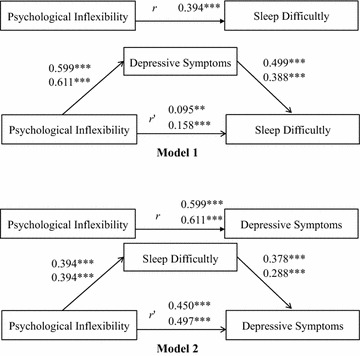
BACKGROUND: Psychological inflexibility is a core concept in the acceptance and commitment therapy (ACT) model. The current study hypothesized and tested two models in which psychological inflexibility was linked with higher levels of depressive symptoms and sleep difficulty. RESULTS: To attain data, Japanese university students (N = 633) completed questionnaires related to psychological inflexibility, depressive symptoms, and sleep difficulty. Psychological inflexibility was significantly correlated with higher levels of both depressive symptoms (r = 0.61) and sleep difficulty (r = 0.39). Structural equation modeling showed that psychological inflexibility was associated with higher levels of depressive symptoms after controlling for the effect of sleep difficulty. Additionally, psychological inflexibility was correlated with higher levels of sleep difficulty after controlling for the effect of depressive symptoms. These findings might assist with motivating clinicians to use ACT for insomnia. CONCLUSIONS: The current study found that greater psychological inflexibility was linked with high levels of depressive symptoms and sleep difficulties. These findings might assist with motivating clinicians to use ACT for insomnia.
Overview
The claims and statistics of this paper haven’t been checked yet.
Free: it reads the open-access text and checks the first 5 claims that cite a source we can check. Create a free account to check every claim.
Integrity signals
Registry
Cites
Statistics
Figures
Verification
Claims the paper makes
The claims and statistics of this paper haven’t been checked yet.
Free: it reads the open-access text and checks the first 5 claims that cite a source we can check. Create a free account to check every claim.
Claims other papers make about this one
Each is checked against this paper’s own text: does it say what the citing paper says it does?
The source backs part of the claim, not all of it — or backs it for a different population, condition or comparison.
In the citing paper
“may be a transdiagnostic factor underlying sleep problems (Kato, 2016; McCracken et al., 2011; Zakiei et al., 2022)”
From Associations between psychological inflexibility processes, pre‐sleep arousal and sleep quality. (2025) · cites this paper as Kato, 2016
Experimental — accuracy not yet measuredThe cited source says what the claim attributes to it.
In the citing paper
“First, self-report measures are exposed to bias, owing to common method variance (CMV; (73)).”
From The contribution of transdiagnostic vulnerability factors in patients with chronic insomnia (2023) · cites this paper as [73]
The cited source says what the claim attributes to it.
In the citing paper
“Negative associations between global measures of PI and sleep quality have been observed in both clinical and non‐clinical populations (Kato, 2016; McCracken et al., 2011)”
From Associations between psychological inflexibility processes, pre‐sleep arousal and sleep quality. (2025) · cites this paper as Kato, 2016
Self-check
Percentages, sums and reported differences re-computed from the paper’s own numbers.
The self-check needs the paper’s full text.
Citations
Cites
Hu, L., & Bentler, P. M. (1999) · Structural Equation Modeling A Multidisciplinary Journal · doi:10.1080/10705519909540118 · Cited by 108,788
Baron, R. M., & Kenny, D. A. (1986) · Journal of Personality and Social Psychology · doi:10.1037/0022-3514.51.6.1173 · Cited by 91,532 · cited 1×
“According to Baron and Kenny (1986), four conditions are necessary to establish mediation, including a significant (a) relationship between the predictor and outcome, (b) relationship between the predictor and mediator, (c) relationship between the mediator and outcome, and (d) reduction in the…”
BackgroundThe PHQ-9: Validity of a brief depression severity measure
Kroenke, K., Spitzer, R. L., & Williams, J. B. W. (2001) · Journal of General Internal Medicine · doi:10.1046/j.1525-1497.2001.016009606.x · Cited by 44,910
The Pittsburgh Sleep Quality Index: a new instrument for psychiatric practice and research
Buysse, D. J., Reynolds, C. F., Monk, T. H., Berman, S. R., & Kupfer, D. J. (1989) · Psychiatry Research · doi:10.1016/0165-1781(89)90047-4 · Cited by 35,234
Sources of method bias in social science research and recommendations on how to control it
Podsakoff, P. M., MacKenzie, S. B., & Podsakoff, N. P. (2012) · Annual Review of Psychology · doi:10.1146/annurev-psych-120710-100452 · Cited by 15,744
A comparison of methods to test mediation and other intervening variable effects
MacKinnon, D. P., Lockwood, C. M., Hoffman, J. M., West, S. G., & Sheets, V. (2002) · Psychological Methods · doi:10.1037/1082-989x.7.1.83 · Cited by 9,406 · cited 1×
“Mediating effects of depressive symptoms or sleep difficulty were examined using a combination procedure based on MacKinnon and colleagues’ study (MacKinnon et al.”
MethodAcceptance and commitment therapy: model, processes and outcomes
Hayes, S. C., Luoma, J. B., Bond, F. W., Masuda, A., & Lillis, J. (2006) · Behaviour Research and Therapy · doi:10.1016/j.brat.2005.06.006 · Cited by 6,587
(1999) · Cited by 5,934
Responses to depression and their effects on the duration of depressive episodes
Nolen-Hoeksema, S. (1991) · Journal of Abnormal Psychology · doi:10.1037/0021-843x.100.4.569 · Cited by 4,529
Equivalence of the Mediation, Confounding and Suppression Effect
MacKinnon, D. P., Krull, J. L., & Lockwood, C. M. (2000) · Prevention Science · doi:10.1023/a:1026595011371 · Cited by 4,188
Research works printed but not linked: 1
- Sobel ME Leinhardt S Asymptotic confidence intervals for indirect effects in structural models Sociological methodology 1982 San Francisco Jossey-Bass 290 312
Cited by
Examination of the Coping Flexibility Hypothesis Using the Coping Flexibility Scale-Revised
Kato, T. (2020) · Frontiers in Psychology · doi:10.3389/fpsyg.2020.561731 · Cited by 97
Self-citationLi, H., Wong, C. L., Jin, X., Chen, J., Chong, Y. Y., & Bai, Y. (2021) · International Journal of Nursing Studies · doi:10.1016/j.ijnurstu.2021.103876 · Cited by 81
Trindade, I. A., Mendes, A. L., & Ferreira, N. B. (2020) · Journal of Contextual Behavioral Science · doi:10.1016/j.jcbs.2019.12.001 · Cited by 74
Shen, Q., Wang, S., Liu, Y., Wang, Z., Bai, C., & Zhang, T. (2024) · Scientific Reports · doi:10.1038/s41598-024-75919-8 · Cited by 62
Paulos-Guarnieri, L., Linares, I. M. P., & El Rafihi-Ferreira, R. (2022) · Journal of Contextual Behavioral Science · doi:10.1016/j.jcbs.2021.11.001 · Cited by 48
Metadata
- Authors
- Kato, T.
- Affiliations
- Toyo University (JP)
- Corresponding author
- Kato, Tsukasa
- ORCID
- Kato, Tsukasa
- Venue
- SpringerPlus
- Published
- 2016-06-14
- Volume
- 5
- Issue
- 1
- Pages
- 712-712
- ISSN
- 2193-1801 (ISSN-L)
- PMC
- PMC4908084
- OpenAlex
- W2430728887
- Cited by
- 63
- References
- 65
- Citations by year
- 2026: 7 · 2025: 8 · 2024: 12 · 2023: 9 · 2022: 6 · 2021: 10 · 2020: 6 · 2019: 5
- FWCI
- 2.23
- Type
- journal article
- Language
- en
- Open access
- diamond
- doi.org
- Locations
- SpringerPlus (publishedVersion, cc-by)
- PubMed Central (publishedVersion, cc-by)
- PubMed (publishedVersion)
- Funders
- Japan Society for the Promotion of Science London (Grant-in-Aid for Scientific Research C-25380948)
- Topics
- Social Sciences › Psychology › Clinical Psychology › Mindfulness and Compassion Interventions
- Social Sciences › Psychology › Experimental and Cognitive Psychology › Sleep and related disorders
- Social Sciences › Psychology › Experimental and Cognitive Psychology › Anxiety, Depression, Psychometrics, Treatment, Cognitive Processes
- Keywords
- psychological inflexibility, depressive symptoms, sleep disorders, insomnia, acceptance and commitment therapy, university students, Japanese adults
About these checks
Registry, retraction, Cites and statistics results are computed, not judged, with one exception: a printed reference that no index lists is read once by a model before it counts as a citation error. Claims are extracted by a model and kept only when their quote appears verbatim in the text; each cited source is then checked, with a model’s help, for whether it says what the claim relies on. Those verdicts can be wrong — read the claim’s quote and the cited source before relying on one.
Statistics and arithmetic are recomputed, not judged.
Confidence bands are shown only for fields calibrated on our annotated test set. None is calibrated yet, so no band is shown.
What counts as a claim ›How we measure confidence ›How we check this ›
Are you an author, or do you see a problem with this page? Request a review
How to cite
Cite CoChat for the checks on this page, and the paper for its own findings.
- This page
- CoChat. (2026). Citation check: Impact of psychological inflexibility on depressive symptoms and sleep difficulty in a Japanese sample. https://app.cochat.ai/papers/10.1186/s40064-016-2393-0
- The paper
- Kato, T. (2016). Impact of psychological inflexibility on depressive symptoms and sleep difficulty in a Japanese sample. SpringerPlus. https://doi.org/10.1186/s40064-016-2393-0
Data sources
Bibliographic data: Semantic Scholar, OpenAlex, Crossref.
Contains information from the Semantic Scholar Academic Graph Datasets, made available under the ODC Attribution License (ODC-BY 1.0).
Semantic Scholar’s data is described in: Kinney, R., et al. (2023). The Semantic Scholar Open Data Platform. arXiv:2301.10140.
