

The DOI matches its Crossref record.
Studies on the laccase-mediated decolorization, kinetic, and microtoxicity of some synthetic azo dyes
Open accessAbstract
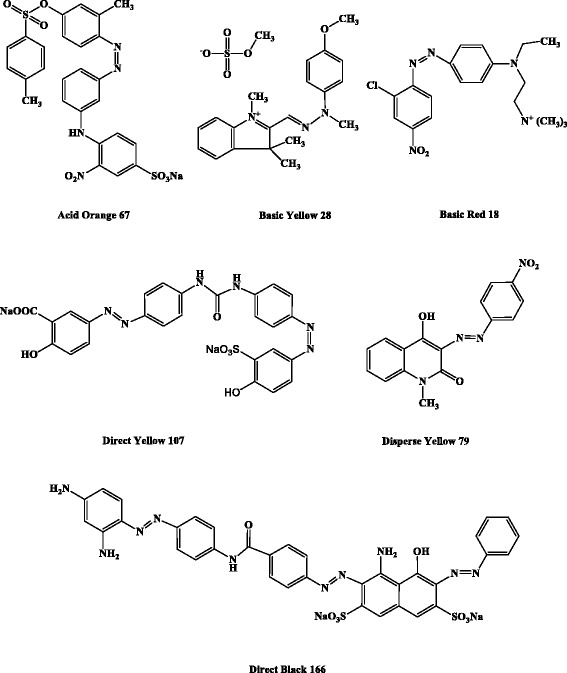
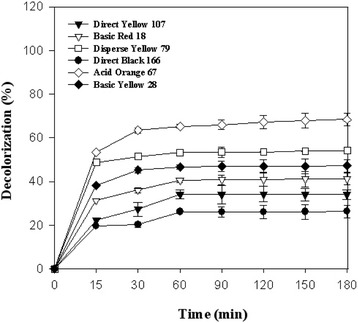
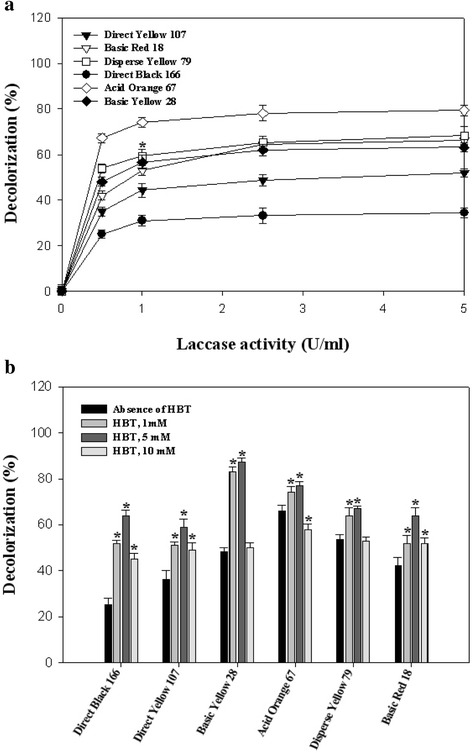
BACKGROUND: Enzymatic elimination of synthetic dyes, one of the most environmentally hazardous chemicals, has gained a great interest during the two last decades. The present study was performed to evaluate the decolorization and detoxification potential of the purified laccase of Paraconiothyrium variabile in both non-assisted and hydroxybenzotriazole-aided form against six azo dyes. RESULTS: The obtained results showed that Acid Orange 67, Disperse Yellow 79, Basic Yellow 28, Basic Red 18, Direct Yellow 107, and Direct Black 166 were decolorized up to 65.3, 53.3, 46.7, 40.7, 34, and 26.2 %, respectively, after 1 h treatment with laccase (0.5 U/mL). Addition of HBT up to 5 mM enhanced decolorization percent of all the investigated dyes. The results of kinetic study introduced the monoazo dye of Acid Orange 67 as the most suitable substrate for laccase with K m of 0.49 mM and V max of 189 mmol/min/mg. Evaluation the toxic effect of laccase-treated dye sample based on the growth inhibition of standard bacterial strains revealed decrease in toxicity of all applied dyes after treatment by laccase. CONCLUSIONS: Application of the P. variabile laccase as biocatalyst efficiently decreased the toxicity of all studied synthetic azo dyes.
Overview
The claims and statistics of this paper haven’t been checked yet.
Run the check — free, no account needed. It reads the open-access text and checks the sources it cites.
Integrity signals
Registry
Cites
Statistics
Figures
Verification
Claims the paper makes
The claims and statistics of this paper haven’t been checked yet.
Run the check — free, no account needed. It reads the open-access text and checks the sources it cites.
Claims other papers make about this one
Each is checked against this paper’s own text: does it say what the citing paper says it does?
The source backs part of the claim, not all of it — or backs it for a different population, condition or comparison.
In the citing paper
“For the above reasons, laccases are valuable in the delignification of lignocellulosic compounds, bio-pulping, bio-bleaching, the transformation of dyestuffs from the textile industry, dyestuff removal, wastewater treatment and degradation of different recalcitrant compounds [22,23,24,25,26,262].”
From A Brief History of Colour, the Environmental Impact of Synthetic Dyes and Removal by Using Laccases (2021) · cites this paper as [23]
Experimental — accuracy not yet measuredThe source backs part of the claim, not all of it — or backs it for a different population, condition or comparison.
In the citing paper
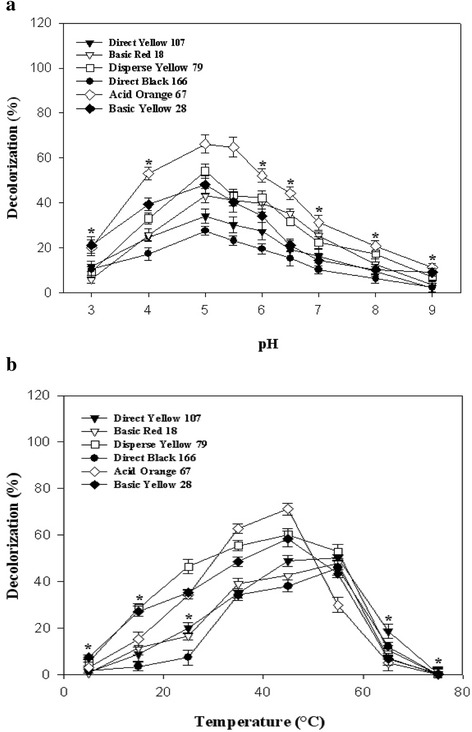
“When evaluating pH and temperature independently of the dye class, the optimum pH was 5.0 ± 0.2 affecting the discolouration percentage. When evaluating the temperature, they found that the optimum for the dyes DY-79 (60%), AO (71.3%) and BY (58.4%) was 45 °C and for the dyes BR (48%), DY-107 (50%) and for DB it was 55 °C [23].”
From A Brief History of Colour, the Environmental Impact of Synthetic Dyes and Removal by Using Laccases (2021) · cites this paper as [23]
Experimental — accuracy not yet measured
Self-check
Percentages, sums and reported differences re-computed from the paper’s own numbers.
The self-check needs the paper’s full text.
Citations
Cites
Still being checked.
Research works printed but not linked: 42
- Saratale RG, Saratale GD, Chang JS, Govindwar SP. Bacterial decolorization and degradation of azo dyes: a review. J Taiwan Inst Chem Eng. 2011;42:138–57. · DOI · Paper page
- Forootanfar H, Moezzi A, Aghaie-Khouzani M, Mahmoudjanlou Y, Ameri A, Niknejad F, Faramarzi MA. Synthetic dye decolorization by three sources of fungal laccase. J Environ Health Sci Eng. 2012;9:27. · DOI
- Rezaie S, Tahmasbi H, Mogharabi M, Firuzyar S, Ameri A, Khoshayand MR, Faramarzi MA. Efficient decolorization and detoxification of reactive orange 7 using laccase isolated from paraconiothyrium variabile, kinetics and energetics. J Taiwan Inst Chem Eng. 2015;56:1–9. · DOI
- Rezaie S, Tahmasbi H, Mogharabi M, Ameri A, Forootanfar H, Khoshayand MR, Faramarzi MA. Laccase-catalyzed decolorization and detoxification of Acid Blue 92: statistical optimization, microtoxicity, kinetics, and energetics. J Environ Health Sci Eng. 2015;13:31. · DOI
- Ashrafi SD, Rezaei S, Forootanfar H, Mahvi AH, Faramarzi MA. The enzymatic decolorization and detoxification of synthetic dyes by the laccase from a soil-isolated ascomycete, Paraconiothyrium variabile. Int Biodeter Biodegr. 2013;85:173–81. · DOI
- Maalej-Kammoun M, Zouari-Mechichi H, Belbahri L, Woodward S, Mechichi T. Malachite green decolourization and detoxification by the laccase from a newly isolated strain of Trametes sp. Int Biodeter Biodegr. 2009;63:600–6. · DOI
- Shirmardi M, Mesdaghinia A, Mahvi AH, Nasseri S, Nabizadeh R. Kinetics and equilibrium studies on adsorption of acid red 18 (Azo-Dye) using multiwall carbon nanotubes (MWCNTs) from aqueous solution. E-J Chem. 2012;9:2371–83. · DOI
- Grassi E, Scodeller P, Filiel N, Carballo R, Levin L. Potential of Trametes trogii culture fluids and its purified laccase for the decolorization of different types of recalcitrant dyes without the addition of redox mediators. Int Biodeter Biodegr. 2011;65:635–43. · DOI
- Pereira L, Coelho AV, Viegas CA, Santos MM C d, Robalo MP, Martins LO. Enzymatic biotransformation of the azo dye Sudan orange G with bacterial CotA-laccase. J Biotechnol. 2009;139:68–77. · DOI
- Mirzadeh SS, Khezri SM, Rezaei S, Forootanfar H, Mahvi AH, Faramarzi MA. Decolorization of two synthetic dyes using the purified laccase of Paraconiothyrium variabile immobilized on porous silica beads. J Environ Health Sci Eng. 2014;12:6. · DOI
- Maleki A, Mahvi AH, Ebrahimi R, Zandsalimi Y. Study of photochemical and sonochemical processes efficiency for degradation of dyes in aqueous solution. Korean J Chem Eng. 2010;27:1805–10. · DOI
- Mahvi AH, Ghanbarian M, Nasseri S, Khairi A. Mineralization and discoloration of textile wastewater by TiO2 nanoparticles. Desalination. 2009;239:309–16. · DOI
- Younes SB, Bouallagui Z, Sayadi S. Catalytic behavior and detoxifying ability of an atypical homotrimeric laccase from the thermophilic strain Scytalidium thermophilum on selected azo and triarylmethane dyes. J Mol Catal B Enzym. 2012;79:41–8. · DOI
- Mendes S, Farinha A, Ramos CG, Leitao JH, Viegas CA, Martins LO. Synergistic action of azoreductase and laccase leads to maximal decolourization and detoxification of model dye-containing wastewaters. Bioresour Technol. 2011;102:9852–9. · DOI
- Asadgol Z, Forootanfar H, Rezaie S, Mahvi AH, Faramarzi MA. Removal of phenol and bisphenol-A catalyzed by laccase in aqueous solution. J Environ Health Sci Eng. 2014;12:93. · DOI · Paper page
- Faramarzi MA, Forootanfar H. Biosynthesis and characterization of gold nanoparticles produced by laccase from Paraconiothyrium variabile. Colloid Surf B. 2011;87:23–7. · DOI
- Mogharabi M, Faramarzi MA. Laccase and laccase-mediated systems in the synthesis of organic compounds. Adv Synth Catal. 2014;356:897–927. · DOI
- Forootanfar H, Faramarzi MA. Insights into laccase producing organisms, fermentation states, purification strategies, and biotechnological applications. Biotechnol Prog. 2015;31:1443–63. · DOI
- Forootanfar H, Movahednia MM, Yaghmaei S, Tabatabaei-Sameni M, Rastegar H, Sadighi A, Faramarzi MA. Removal of chlorophenolic derivatives by soil isolated ascomycete of Paraconiothyrium variabile and studying the role of its extracellular laccase. J Hazard Mater. 2012;209–210:199–203. · DOI
- Dehghanifard E, Jafari AJ, Kalantary RR, Mahvi AH, Faramarzi MA, Esrafili A. Biodegradation of 2,4-dinitrophenol with laccase immobilized on nano-porous silica beads. J Environ Health Sci Eng. 2013;10:25. · DOI
- Rahmani K, Faramarzi MA, Mahvi AH, Gholami M, Esrafili A, Forootanfar H, Farzadkia M. Elimination and detoxification of sulfathiazole and sulfamethoxazole assisted by laccase immobilized on porous silica beads. Int Biodeter Biodegr. 2015;97:107–14. · DOI
- Canas AI, Camarero S. Laccases and their natural mediators: biotechnological tools for sustainable eco-friendly processes. Biotechnol Adv. 2010;28:694–705. · DOI
- Ashrafi SD, Nasseri S, Alimohammadi M, Mahvi AH, Faramarzi MA. Optimization of the enzymatic elimination of flumequine by laccase-mediated system using response surface methodology. Desalin Water Treat doi: 10.1080/19443994.2015.1063462 . · DOI
- Aghaie-Khouzani M, Forootanfar H, Moshfegh M, Khoshayand MR, Faramarzi MA. Decolorization of some synthetic dyes using optimized culture broth of laccase producing ascomycete Paraconiothyrium variabile. Biochem Eng J. 2012;60:9–15. · DOI · Paper page
- Forootanfar H, Faramarzi MA, Shahverdi AR, Tabatabaei Yazdi M. Purification and biochemical characterization of extracellular laccase from the ascomycete Paraconiothyrium variabile. Bioresour Technol. 2011;102:1808–14. · DOI
- Mendoza L, Jonstrup M, Hatti-Kaul R, Mattiasson B. Azo dye decolorization by a laccase/mediator system in a membrane reactor: enzyme and mediator reusability. Enzyme Microb Technol. 2011;49:478–84. · DOI
- Yan J, Chen D, Yang E, Niu J, Chen Y, Chagan I. Purification and characterization of a thermotolerant laccase isoform in Trametes trogii strain and its potential in dye decolorization. Int Biodeter Biodegr. 2014;93:186–94. · DOI
- Sadighi A, Faramarzi MA. Congo red decolorization by immobilized laccase through chitosan nanoparticles on the glass beads. J Taiwan Inst Chem Eng. 2013;44:156–62. · DOI
- Zeinvand-Lorestani H, Sabzevari O, Setayesh N, Amini M, Nili-Ahmadabadi A, Faramarzi MA. Comparative study of in vitro prooxidative properties and genotoxicity induced by aflatoxin B1 and its laccase-mediated detoxification products. Chemosphere. 2015;135:1–6. · DOI
- Alberts JF, Gelderblom WCA, Botha A, Vanzyl WH. Degradation of flatoxin B1 by fungal laccase enzymes. Int J Food Microbiol. 2009;135:47–52. · DOI
- Tahmasbi H, Khoshayand MR, Bozorgi-Koushalshahi M, Heidary M, Ghazi-Khansari M, Faramarzi MA. Biocatalytic conversion and detoxification of imipramine by the laccase-mediated system. Int Biodeter Biodegr. 2016;108:1–8. · DOI
- Couto SR. Decolouration of industrial azo dyes by crude laccase from Trametes hirsuta. J Hazard Mater. 2007;148:768–70. · DOI
- Khlifi R, Belbahri L, Woodward S, Ellouz M, Dhouib A, Sayadi S, Mechichi T. Decolourization and detoxification of textile industry wastewater by the laccase-mediator system. J Hazard Mater. 2010;175:802–8. · DOI
- Annuar MSM, Adnan S, Vikineswary S, Chisti Y. Kinetics and energetics of azo dye decolorization by Pycnoporus sanguineus. Water Air & Soil Poll. 2009;202:179–88. · DOI
- Roriz MS, Osma JF, Teixeira JA, Couto SR. Application of response surface methodological approach to optimize reactive black 5 decolouration by crude laccase from trametes pubescens. J Hazard Mater. 2009;169:691–6. · DOI
- Gholami-Borujeni F, Mahvi AH, Nasseri S, Faramarzi MA, Nabizadeh R, Alimohammadi M. Enzymatic treatment and detoxification of acid orange 7 from textile wastewater. Appl Biochem Biotechnol. 2011;165:1274–84. · DOI
- Gholami-Borujeni F, Faramarzi MA, Nabizadeh-Barandozi R, Mahvi AH. Oxidative degradation and detoxification of textile azo dye by horseradish peroxidase enzyme. Fresen Environ Bull. 2013;22:739–44.
- Zeng X, Cai Y, Liao X, Zeng X, Li W, Zhang D. Decolorization of synthetic dyes by crude laccase from a newly isolated Trametes trogii strain cultivated on solid agro-industrial residue. J Hazard Mater. 2011;187:517–25. · DOI
- Baldrian P. Fungal laccases –occurrenceand properties. FEMS Microbiol Rev. 2006;30:215–42. · DOI
- Ostadhadi-Dehkordi S, Tabatabaei-Sameni M, Forootanfar H, Kolahdouz S, Ghazi-Khansari M, Faramarzi MA. Degradation of some benzodiazepines by a laccase-mediated system in aqueous solution. Bioresour Technol. 2012;125:344–7. · DOI
- Zhuo R, Ma L, Fan F, Gong Y, Wan X, Jiang M, Zhang X, Yang Y. Decolorization of different dyes by a newly isolated white-rot fungi strain Ganoderma sp. En3 and cloning and functional analysis of its laccase gene. J Hazard Mater. 2011;192:855–73. · DOI
- Gholami-Borujeni F, Mahvi AH, Nasseri S, Faramarzi MA, Nabizadeh R, Alimohammadi M. Application of immobilized horseradish peroxidase for removal and detoxification of azo dye from aqueous solution. Res J Chem Environ. 2011;15:217–22.
Cited by
Sorted by citations
A Brief History of Colour, the Environmental Impact of Synthetic Dyes and Removal by Using Laccases
Ardila-Leal, L. D., Poutou-Piñales, R. A., Pedroza-Rodríguez, A. M., & Quevedo-Hidalgo, B. E. (2021) · Molecules · doi:10.3390/molecules26133813 · Cited by 544
Metadata
- Authors
- Forootanfar, H., Rezaei, S., Zeinvand-Lorestani, H., Tahmasbi, H., Mogharabi, M., Ameri, A., & Faramarzi, M. A.
- Affiliations
- Kerman University of Medical Sciences (IR)
- Tehran University of Medical Sciences (IR)
- Corresponding author
- Faramarzi, Mohammad Ali
- Venue
- Journal of Environmental Health Science and Engineering
- Published
- 2016-05-13
- Volume
- 14
- Issue
- 1
- Pages
- 7-7
- ISSN
- 1735-1979 (ISSN-L)
- 2052-336X
- PMC
- PMC4866392
- OpenAlex
- W2375758357
- Cited by
- 61
- References
- 0
- Citations by year
- 2026: 4 · 2025: 6 · 2024: 8 · 2023: 6 · 2022: 6 · 2021: 5 · 2020: 4 · 2019: 7 · 2018: 10 · 2017: 4 · 2016: 1
- FWCI
- 8.59
- Type
- journal article
- Language
- en
- Open access
- hybrid
- doi.org
- Licence
- Locations
- Journal of Environmental Health Science and Engineering (publishedVersion, cc-by)
- PubMed Central (publishedVersion, cc-by)
- PubMed (publishedVersion)
- Funders
- Tehran University of Medical Sciences and Health Services
- Topics
- Life Sciences › Immunology and Microbiology › Applied Microbiology and Biotechnology › Enzyme-mediated dye degradation
- Physical Sciences › Environmental Science › Water Science and Technology › Adsorption and biosorption for pollutant removal
- Physical Sciences › Chemical Engineering › Process Chemistry and Technology › Lignin and Wood Chemistry
- Keywords
- laccase, azo dyes, dye decolorization, hydroxybenzotriazole, enzyme kinetics, bacterial growth inhibition, Basic Yellow 28, dye detoxification
About these checks
Registry, retraction, Cites and statistics results are computed, not judged, with one exception: a printed reference that no index lists is read once by a model before it counts as a citation error. Claims are extracted by a model and kept only when their quote appears verbatim in the text; each cited source is then checked, with a model’s help, for whether it says what the claim relies on. Those verdicts can be wrong — read the claim’s quote and the cited source before relying on one.
Statistics and arithmetic are recomputed, not judged.
Confidence bands are shown only for fields calibrated on our annotated test set. None is calibrated yet, so no band is shown.
What counts as a claim ›How we measure confidence ›How we check this ›
Are you an author, or do you see a problem with this page? Request a review
