

Prevalence of pediatric acute-onset neuropsychiatric syndrome (PANS) in children and adolescents with eating disorders
Open accessThe DOI matches its Crossref record; 28 of the 28 references it cites were found in a registry or an index.
Abstract
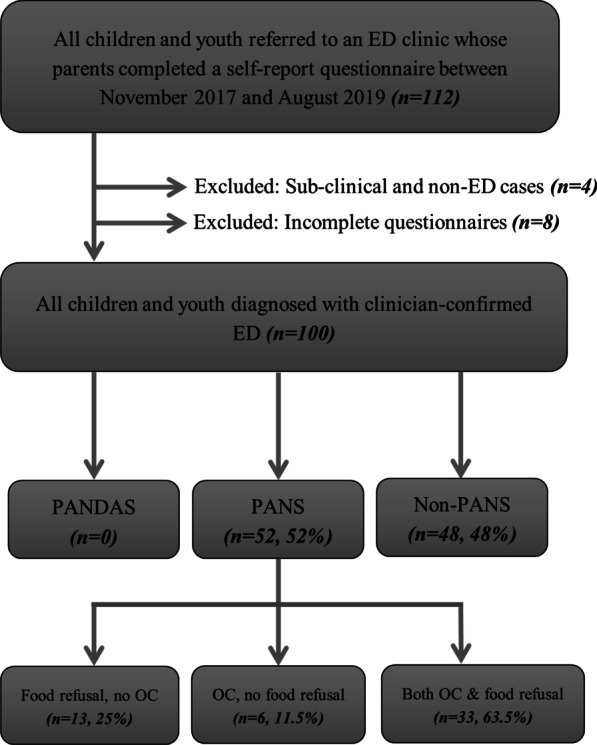
Background: Pediatric obsessive–compulsive disorder (OCD) and eating disorder symptoms frequently overlap, clouding diagnostic certainty and hypothesized etiologic factors. Pediatric acute-onset neuropsychiatric syndrome (PANS) is defined by abrupt emergence of core obsessive–compulsive behaviours and/or food restriction with concurrent, ancillary cognitive and behavioral symptoms. Inflammatory and immune processes have putative roles in both PANS and a related described condition with cardinal obsessive–compulsive or tic symptoms, known as pediatric autoimmune neuropsychiatric disorders associated with streptococcal infection (PANDAS). While prevalence of PANS and PANDAS has been examined in tic, movement disorder and OCD populations, this has not yet been systematically examined in a pediatric eating disorder sample. Objectives: To identify the lifetime prevalence of those meeting PANS and/or PANDAS criteria within a pediatric eating disorder cohort. Methods: Convenience sampling method was utilized to select consecutive youth (ages 8–18-years) presenting to an interdisciplinary pediatric eating disorder subspecialty program with a confirmed eating disorder and completed parent-report PANS/PANDAS questionnaire (n = 100). A parent-reported measure was used to establish lifetime prevalence rates for PANS and PANDAS. Descriptive and exploratory comparative analyses were conducted between PANS and non-PANS groups. Continuous measures were analyzed using two-tailed independent sample t-tests and categorical measures were analyzed using two-tailed Fisher’s exact tests. Results: Among participants, 52% (n = 52) met PANS criteria and 0% (n = 0) met PANDAS diagnostic criteria. Core, abrupt-onset PANS symptoms included both food restriction and obsessive–compulsive symptoms in 63.5% (n = 33), food restriction only in 25% (n = 13), and obsessive–compulsive symptoms only in 11.5% (n = 6) of participants. In comparison to those who did not meet PANS criteria, those in the PANS subgroup were less likely to be male and more commonly prescribed a selective serotonin reuptake inhibitor medication. Significant group differences did not emerge for onset age, body mass index, eating disorder type or comorbid psychiatric/medical/autoimmune illness. Conclusion: Lifetime prevalence of symptoms in keeping with PANS diagnostic criteria within a pediatric eating disorder cohort was notably higher than that previously reported in OCD or tic disorder cohorts. The overlap between starvation effects and ancillary PANS symptoms may challenge the practical utility of this putative syndrome within the eating disorder population.
Overview
The claims and statistics of this paper haven’t been checked yet.
Free: it reads the open-access text and checks the first 5 claims that cite a source we can check. Create a free account to check every claim.
Integrity signals
Registry
Cites
Statistics
Figures
Verification
Claims the paper makes
The claims and statistics of this paper haven’t been checked yet.
Free: it reads the open-access text and checks the first 5 claims that cite a source we can check. Create a free account to check every claim.
Claims other papers make about this one
Each is checked against this paper’s own text: does it say what the citing paper says it does?
The source backs part of the claim, not all of it — or backs it for a different population, condition or comparison.
In the citing paper
“A more recent study assessing children and adolescents with eating disorders revealed that 52% of the 52 participants met the IAE criteria.8”
From An updated review of pediatric autoimmune neuropsychiatric disorders associated with Streptococcus/pediatric acute-onset neuropsychiatric syndrome, also known as idiopathic autoimmune encephalitis: What the allergist should know (2023) · cites this paper as [8]
Experimental — accuracy not yet measured
Self-check
Percentages, sums and reported differences re-computed from the paper’s own numbers.
The self-check needs the paper’s full text.
Citations
Cites
Diagnostic and Statistical Manual of Mental Disorders
American Psychiatric Association (2013) · doi:10.1176/appi.books.9780890425596 · Cited by 116,369
Development of a WHO growth reference for school-aged children and adolescents
de Onis, M. (2007) · Bulletin of the World Health Organization · doi:10.2471/blt.07.043497 · Cited by 8,826 · cited 1×
“BMI was calculated using height measured at assessment (or, if not available at assessment, within 2 months of assessment), and is reported as percent median BMI (% mBMI) according to World Health Organization reference values [23].”
MethodThe Biology of Human Starvation: Volume I
KEYS, A., BROŽEK, J., HENSCHEL, A., MICKELSEN, O., & TAYLOR, H. L. (1950) · doi:10.5749/j.ctv9b2tqv · Cited by 2,039
Analysis of shared heritability in common disorders of the brain
The Brainstorm Consortium, Anttila, V., Bulik-Sullivan, B., Finucane, H. K., Walters, R. K., Bras, J., Duncan, L., Escott-Price, V., Falcone, G. J., Gormley, P., et al. (2018) · Science · doi:10.1126/science.aap8757 · Cited by 1,924
Swedo, S. E., Leonard, H. L., Garvey, M., Mittleman, B., Allen, A. J., Perlmutter, S., Dow, S., Zamkoff, J., Dubbert, B. K., & Lougee, L. (1998) · American Journal of Psychiatry · doi:10.1176/ajp.155.2.264 · Cited by 1,534 · cited 3×
“Within pediatric OCD, a subgroup of youth present with a dramatic, sudden onset of symptoms that appear to follow a streptococcal infection [11].”
BackgroundMethodInfluentialGenomic Relationships, Novel Loci, and Pleiotropic Mechanisms across Eight Psychiatric Disorders
Lee, P. H., Anttila, V., Won, H., Feng, Y.-C. A., Rosenthal, J., Zhu, Z., Tucker-Drob, E. M., Nivard, M. G., Grotzinger, A. D., Posthuma, D., et al. (2019) · Cell · doi:10.1016/j.cell.2019.11.020 · Cited by 1,381
Academy for eating disorders position paper: Eating disorders are serious mental illnesses
Klump, K. L., Bulik, C. M., Kaye, W. H., Treasure, J., & Tyson, E. (2009) · International Journal of Eating Disorders · doi:10.1002/eat.20589 · Cited by 477 · cited 1×
“Eating disorders are associated with a high risk of mortality, functional impairment, and high rate of comorbidity [3, 4].”
BackgroundE. Swedo, S. (2012) · Pediatrics & Therapeutics · doi:10.4172/2161-0665.1000113 · Cited by 421 · cited 2×
“[11] b As proposed by Swedo et al.[12] c Such as sleep disturbances, enuresis, or urinary frequency d Such as Sydenham chorea, systemic lupus erythematosus, or Tourette’s disorder I.”
BackgroundEating Disorders in Children and Adolescents: State of the Art Review
Campbell, K., & Peebles, R. (2014) · Pediatrics · doi:10.1542/peds.2014-0194 · Cited by 382 · cited 1×
“Eating disorders are also common in youth and young adults, representing the third most common chronic illness in adolescents [2].”
BackgroundWomen Are at Greater Risk of OCD Than Men: A Meta-Analytic Review of OCD Prevalence Worldwide
Fawcett, E. J., Power, H., & Fawcett, J. M. (2020) · The Journal of Clinical Psychiatry · doi:10.4088/jcp.19r13085 · Cited by 344 · cited 1×
“3% in the general population, peaking in preadolescence and early adulthood [1].”
BackgroundSwinbourne, J., Hunt, C., Abbott, M., Russell, J., St Clare, T., & Touyz, S. (2012) · Australian & New Zealand Journal of Psychiatry · doi:10.1177/0004867411432071 · Cited by 316 · cited 1×
“Single studies report a high proportion of individuals with eating disorders presenting with co-occurring anxiety disorders and OCD, including reports of an estimated 64% of individuals with eating disorders diagnosed with at least one anxiety disorder, and 41% meeting criteria for OCD [5].”
BackgroundAnxiety in the eating disorders: Understanding the overlap
Pallister, E., & Waller, G. (2008) · Clinical Psychology Review · doi:10.1016/j.cpr.2007.07.001 · Cited by 315 · cited 1×
“Eating disorders are associated with a high risk of mortality, functional impairment, and high rate of comorbidity [3, 4].”
BackgroundCederlöf, M., Thornton, L. M., Baker, J., Lichtenstein, P., Larsson, H., Rück, C., Bulik, C. M., & Mataix‐Cols, D. (2015) · World Psychiatry · doi:10.1002/wps.20251 · Cited by 146
Drakes, D. H., Fawcett, E. J., Rose, J., Carter, J. C., & Fawcett, J. M. (2021) · Journal of Psychiatric Research · doi:10.1016/j.jpsychires.2021.06.035 · Cited by 78
A systematic scoping review of diagnostic validity in avoidant/restrictive food intake disorder
Strand, M., von Hausswolff‐Juhlin, Y., & Welch, E. (2018) · International Journal of Eating Disorders · doi:10.1002/eat.22962 · Cited by 77 · cited 3×
“PANS: Pediatric acute‑onset neuropsychiatric syndrome; PANDAS: Pediat‑ ric autoimmune neuropsychiatric disorder associated with streptococcal infections; BMI: Body mass index; ED: Eating disorder; AN: Anorexia nervosa; BN: Bulimia nervosa; ARFID: Avoidant restrictive food intake disorder; OCD: Obsessive compulsive dis…”
BackgroundInfluentialInfection: a stimulus for tic disorders
Singer, H. S., Giuliano, J. D., Zimmerman, A. M., & Walkup, J. T. (2000) · Pediatric Neurology · doi:10.1016/s0887-8994(00)00131-4 · Cited by 72 · cited 1×
“Similarly, in a sample of 80 children with tic disorders, none of the 11% reporting rapid/abrupt symptom onset met criteria for PANDAS; PANS diagnosis had not yet been described at the time of study [19].”
BackgroundDisordered Eating and Food Restrictions in Children with PANDAS/PANS
Toufexis, M. D., Hommer, R., Gerardi, D. M., Grant, P., Rothschild, L., D'Souza, P., Williams, K., Leckman, J., Swedo, S. E., & Murphy, T. K. (2015) · Journal of Child and Adolescent Psychopharmacology · doi:10.1089/cap.2014.0063 · Cited by 66 · cited 2×
“Since then, additional case studies have described youth with sudden onset obsessional fears of contamination, fears of poisoning, choking, or vomiting, and/or sensory concerns based on texture, taste or smell [15].”
BackgroundPediatric Autoimmune Neuropsychiatric Disorders Associated with Streptococcal Infections (PANDAS)
Orefici, G., Cardona, F., Cox, C. J., & Cunningham, M. W. (2016) · IRIS Research product catalog (Sapienza University of Rome) · Cited by 65
Prevalence of acute-onset subtypes in pediatric obsessive-compulsive disorder
Jaspers-Fayer, F., Han, S. H. J., Chan, E., McKenney, K., Simpson, A., Boyle, A., Ellwyn, R., & Stewart, S. E. (2017) · Journal of Child and Adolescent Psychopharmacology · doi:10.1089/cap.2016.0031 · Cited by 60 · cited 3×
“In a sample of 136 pediatric OCD patients, only 3% were found to meet PANS criteria, using the same parent report measure as the current study [21].”
BackgroundMethodInfluentialSelf-citationAssociation of Exposure to Infections in Childhood With Risk of Eating Disorders in Adolescent Girls
Breithaupt, L. E., Köhler‐Forsberg, O., Larsen, J. T., Benros, M. E., Thornton, L. M., Bulik, C. M., & Petersen, L. V. (2019) · JAMA Psychiatry · doi:10.1001/jamapsychiatry.2019.0297 · Cited by 56 · cited 1×
“Data from a population-based cohort have suggested the importance of immunologic factors in eating disorders, with childhood infections associated with later onset of an eating disorder [30].”
BackgroundMas, S., Plana, M. T., Castro‐Fornieles, J., Gassó, P., Lafuente, A., Moreno, E., Martinez, E., Milà, M., & Lázaro, L. (2013) · Journal of Psychiatric Research · doi:10.1016/j.jpsychires.2012.12.015 · Cited by 46
Case Study: An Infection-Triggered, Autoimmune Subtype of Anorexia Nervosa
Sokol, M. S., & Gray, N. S. (1997) · Journal of the American Academy of Child & Adolescent Psychiatry · doi:10.1097/00004583-199708000-00021 · Cited by 45 · cited 1×
“The inclusion of eating-related behaviors in the proposed PANS criteria were based on clinical observations of acute onset of restrictive eating behavior that was first described in a case study of a prepubescent youth with weight gain fears as a result of body dysmorphia, and symptoms temporally related to a GAS infe…”
BackgroundCiao, A. C., Lebow, J. R., VandenLangenberg, E., Ohls, O. C., & Berg, K. C. (2020) · Eating Disorders · doi:10.1080/10640266.2020.1805960 · Cited by 36 · cited 1×
“Parents have previously reported slow recognition of eating disorder symptoms [28], which can impact parental interpretations about the nature of onset of food refusal or other symptoms.”
BackgroundCoelho, J. S., Lee, T. A., Karnabi, P., Burns, A., Marshall, S. K., Geller, J., & Lam, P. (2018) · Journal of Eating Disorders · doi:10.1186/s40337-018-0226-y · Cited by 32 · cited 1×
“Diagnostic assessments Physician-referred assessments were conducted between November 2017 and August 2019 at British Columbia Children’s Hospital Provincial Specialized Eating Disorders Program for Children and Adolescents (for details about this program, please refer to [22].”
MethodSelf-citationPANDAS anorexia nervosa—Endangered, extinct or nonexistent?
Puxley, F., Midtsund, M., Iosif, A., & Lask, B. D. (2007) · International Journal of Eating Disorders · doi:10.1002/eat.20462 · Cited by 27 · cited 1×
“difficulties in diagnosing cases, relatively low prevalence, and calls to refine diagnostic criteria for this clinical condition [17].”
BackgroundWestwell-Roper, C. Y., & Stewart, S. E. (2020) · Frontiers in Psychiatry · doi:10.3389/fpsyt.2020.00264 · Cited by 18 · cited 1×
“Further exploration of autoimmune disorder concurrence in the eating disorder population, and of the utility of salivary biomarkers of inflammation, as proposed by WestwellRoper and Stewart [29], is also warranted to elucidate potential pathways to the emergence of PANS symptoms in the context of eating disorders.”
BackgroundSelf-citationNo Cases of PANDAS on Follow-Up of Patients Referred to a Pediatric Movement Disorders Clinic
Kilbertus, S., Brannan, R., Sell, E., & Doja, A. (2014) · Frontiers in Pediatrics · doi:10.3389/fped.2014.00104 · Cited by 12 · cited 1×
“Low rates of PANS/PANDAS have also been reported in pediatric motor disorders, in which less than 1% of 284 patients met PANS criteria [20].”
BackgroundAjueze, P., Shivakumar, K., & Saroka, K. S. (2018) · Springer eBooks · doi:10.1007/978-3-319-70311-4_21 · Cited by 4 · cited 1×
“A separate case report also highlighted a case of anorexia nervosa and sudden onset OCD symptoms that were preceded by a GAS infection [16].”
Background
Research works printed but not linked: 2
- IBM Spss Statistics for Macintosh Armonk 2013 New York IBM Corporation
- Fairburn CG Cooper Z O’Connor M The eating disorder examination Int J Eat Disord 1993 6 1 8
Cited by
Lerman, K., Chu, Bickham, C., Luceri, L., & Ferrara, E. (2025) · EPJ Data Science · doi:10.1140/epjds/s13688-025-00575-5 · Cited by 28
“Eating disorders have a complex biopsychosocial etiology, with contributing biological factors [37] and psychological comorbidities, such as anxiety and perfectionism.”
Yu, L., Xu, H., Jiang, Z., Yang, H., Cui, Y., & Li, Y. (2024) · Frontiers in Neurology · doi:10.3389/fneur.2024.1397766 · Cited by 12
Goren, R., Bitnun, A., Doja, A., Gill, P. J., Laxer, R. M., Levy, D. M., Pringsheim, T. M., Sandor, P., Yeh, E. A., Wilbur, C., et al. (2024) · Paediatrics & Child Health · doi:10.1093/pch/pxae092 · Cited by 9
Hardin, H., Shao, W., & Bernstein, J. A. (2023) · Annals of Allergy, Asthma & Immunology · doi:10.1016/j.anai.2023.08.022 · Cited by 10
PANS and PANDAS – symptoms beyond OCD and tics – a systematic review
Łojek, P., & Rzeszutek, M. (2025) · Journal of Psychiatric Research · doi:10.1016/j.jpsychires.2025.05.001 · Cited by 7
Metadata
- Authors
- Aman, M., Coelho, J. S., Lin, B., Lu, C., Westwell-Roper, C., Best, J. R., & Stewart, S. E.
- Affiliations
- University of British Columbia (CA)
- Corresponding author
- Stewart, S. Evelyn
- Venue
- Journal of Eating Disorders
- Published
- 2022-12-13
- Volume
- 10
- Issue
- 1
- Pages
- 194-194
- ISSN
- 2050-2974 (ISSN-L)
- PMC
- PMC9749211
- OpenAlex
- W4311315216
- Cited by
- 17
- References
- 28
- Citations by year
- 2026: 2 · 2025: 4 · 2024: 9 · 2023: 2
- FWCI
- 3.43
- Type
- journal article
- Language
- en
- Open access
- gold
- doi.org
- Licence
- cc-by
- creativecommons.org/licenses/by/4.0 (tdm)
- creativecommons.org/licenses/by/4.0 (vor)
- Locations
- Journal of Eating Disorders (publishedVersion, cc-by)
- PubMed Central (publishedVersion, cc-by)
- PubMed (publishedVersion)
- cIRcle (University of British Columbia) (submittedVersion, cc-by)
- DOAJ (DOAJ: Directory of Open Access Journals) (submittedVersion, cc-by-sa)
- Funders
- Health Professional-Investigator award from Michael Smith Health Research British Columbia.
- Topics
- Social Sciences › Psychology › Clinical Psychology › Eating Disorders and Behaviors
- Health Sciences › Medicine › Psychiatry and Mental health › Child Nutrition and Feeding Issues
- Social Sciences › Psychology › Clinical Psychology › Obsessive-Compulsive Spectrum Disorders
- Keywords
- PANS, PANDAS, eating disorders in children, obsessive-compulsive symptoms, dietary restriction, lifetime prevalence, selective serotonin reuptake inhibitors, comorbidities, autoimmune neuropsychiatric disorders
About these checks
Registry, retraction, Cites and statistics results are computed, not judged, with one exception: a printed reference that no index lists is read once by a model before it counts as a citation error. Claims are extracted by a model and kept only when their quote appears verbatim in the text; each cited source is then checked, with a model’s help, for whether it says what the claim relies on. Those verdicts can be wrong — read the claim’s quote and the cited source before relying on one.
Statistics and arithmetic are recomputed, not judged.
Confidence bands are shown only for fields calibrated on our annotated test set. None is calibrated yet, so no band is shown.
What counts as a claim ›How we measure confidence ›How we check this ›
Are you an author, or do you see a problem with this page? Request a review
Data sources
Bibliographic data: Semantic Scholar, OpenAlex, Crossref.
Contains information from the Semantic Scholar Academic Graph Datasets, made available under the ODC Attribution License (ODC-BY 1.0).
Semantic Scholar’s data is described in: Kinney, R., et al. (2023). The Semantic Scholar Open Data Platform. arXiv:2301.10140.
