

Association between problematic social networking use and anxiety symptoms: a systematic review and meta-analysis
Open accessThe DOI matches its Crossref record; 171 of the 172 references it cites were found in a registry or an index.
Abstract
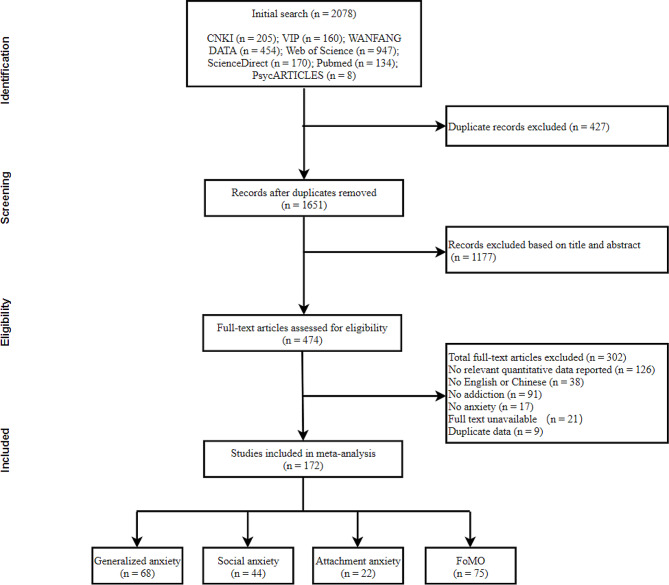
A growing number of studies have reported that problematic social networking use (PSNU) is strongly associated with anxiety symptoms. However, due to the presence of multiple anxiety subtypes, existing research findings on the extent of this association vary widely, leading to a lack of consensus. The current meta-analysis aimed to summarize studies exploring the relationship between PSNU levels and anxiety symptoms, including generalized anxiety, social anxiety, attachment anxiety, and fear of missing out. 209 studies with a total of 172 articles were included in the meta-analysis, involving 252,337 participants from 28 countries. The results showed a moderately positive association between PSNU and generalized anxiety (GA), social anxiety (SA), attachment anxiety (AA), and fear of missing out (FoMO) respectively (GA:r = 0.388, 95%CI[0.362, 0.413]; SA:r = 0.437, 95%CI[0.395, 0.478]; AA:r = 0.345, 95%CI[0.286, 0.402]; FoMO:r = 0.496, 95%CI[0.461, 0.529]), and there were different regulatory factors between PSNU and different anxiety subtypes. This study provides the first comprehensive estimate of the association of PSNU with multiple anxiety subtypes, which vary by time of measurement, region, gender, and measurement tool.
Overview
The claims and statistics of this paper haven’t been checked yet.
Free: it reads the open-access text and checks the first 5 claims that cite a source we can check. Create a free account to check every claim.
Integrity signals
Registry
Cites
Statistics
Figures
Verification
Claims the paper makes
The claims and statistics of this paper haven’t been checked yet.
Free: it reads the open-access text and checks the first 5 claims that cite a source we can check. Create a free account to check every claim.
Claims other papers make about this one
Each is checked against this paper’s own text: does it say what the citing paper says it does?
The source backs part of the claim, not all of it — or backs it for a different population, condition or comparison.
In the citing paper
“Factors such as social comparison, information overload, and privacy concerns during social media use can significantly increase an individual’s anxiety level (22).”
From Anxiety mediates the effect of social media addiction on negative attentional bias: the moderating role of impulsivity (2025) · cites this paper as [22]
Experimental — accuracy not yet measured
Self-check
Percentages, sums and reported differences re-computed from the paper’s own numbers.
The self-check needs the paper’s full text.
Citations
Cites
Bias in meta-analysis detected by a simple, graphical test
Egger, M., Smith, G. D., Schneider, M., & Minder, C. (1997) · BMJ · doi:10.1136/bmj.315.7109.629 · Cited by 56,722
The Hospital Anxiety and Depression Scale
Zigmond, A. S., & Snaith, R. P. (1983) · Acta Psychiatrica Scandinavica · doi:10.1111/j.1600-0447.1983.tb09716.x · Cited by 47,139
Preferred reporting items for systematic reviews and meta-analyses: The PRISMA statement
Moher, D., Liberati, A., Tetzlaff, J., Altman, D. G., & the PRISMA Group* (2009) · Annals of Internal Medicine · doi:10.7326/0003-4819-151-4-200908180-00135 · Cited by 37,554
Quantifying heterogeneity in a meta‐analysis
Higgins, J. P. T., & Thompson, S. G. (2002) · Statistics in Medicine · doi:10.1002/sim.1186 · Cited by 36,763
A Brief Measure for Assessing Generalized Anxiety Disorder: The GAD-7
Spitzer, R. L., Kroenke, K., Williams, J. B. W., & Löwe, B. (2006) · Archives of Internal Medicine · doi:10.1001/archinte.166.10.1092 · Cited by 31,765
Lovibond, P. F., & Lovibond, S. H. (1995) · Behaviour Research and Therapy · doi:10.1016/0005-7967(94)00075-u · Cited by 14,523
Depression and quality of life in older persons: A review
Sivertsen, H., Bjørkløf, G. H., Engedal, K., Selbæk, G., & Helvik, A.-S. (2015) · Dementia and Geriatric Cognitive Disorders · doi:10.1159/000437299 · Cited by 14,152
Duval, S., & Tweedie, R. (2000) · Biometrics · doi:10.1111/j.0006-341x.2000.00455.x · Cited by 14,099 · cited 1×
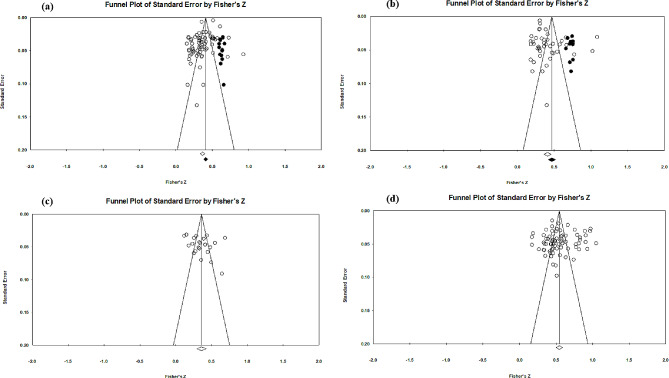
“If there was no significant change in the effect size, it was assumed that there was no serious publication bias [47].”
BackgroundBorenstein, M., Hedges, L. V., Higgins, J. P. T., & Rothstein, H. R. (2021) · doi:10.1002/9781119558378 · Cited by 9,799
Attachment styles among young adults: A test of a four-category model.
Bartholomew, K., & Horowitz, L. M. (1991) · Journal of Personality and Social Psychology · doi:10.1037//0022-3514.61.2.226 · Cited by 8,384 · cited 1×
“…a l I n t e r a c t i o n A n x i e t y S c a l e [ 216 , 217 ] ; E C R = E x p e r i e n c e s i n C l o s e R e l a t i o n s h i p S c a l e [ 218 , 219 ] ; R Q = r e l a t i o n s h i p q u e s t i o nn a i r e [ 220 ] ; F o M O S = F e a r o f M i ss i n g O u t S c a l e [ 221 ] ; F o M O S -”
Research works printed but not linked: 30
- Yuan Y Zhong Y A survey on the use of social networks and mental health of college students during the COVID-19 pandemic J Campus Life Mental Health\ 2021 19 3 209 12
- Zhang L Wu Y Jin T Jia Y Revision and validation of the Chinese short version of social media disorder Mod Prev Med 2021 48 8 1350 3
- Zhang X Fan L The influence of anxiety on colleges’ life satisfaction Chin J Health Educ 2021 37 5 469 72
- Zhao M Wang H Dong Y Niu Y Fang Y The relationship between self-esteem and wechat addiction among undergraduate students: the multiple mediating roles of state anxiety and online interpersonal trust J Psychol Sci 2021 44 1 104 10
- Chen B Zheng X Sun X The relationship between problematic social media use and online social anxiety: the roles of social media cognitive overload and dispositional mindfulness Psychol Dev Educ 2023 39 5 743 51
- She R Kit Han Mo P Li J Liu X Jiang H Chen Y Ma L Tak Fai Lau J The double-edged sword effect of social networking use intensity on problematic social networking use among college students: the role of social skills and social anxiety Comput Hum Behav 2023 140 107555 10.1016/j.chb.2022.107555 · DOI
- Teng X Lei H Li J Wen Z The influence of social anxiety on social network site addiction of college students: the moderator of intentional self-regulation Chin J Clin Psychol 2021 29 3 514 7
- Tong W Influence of boredom on the problematic mobile social networks usage in adolescents: multiple chain mediator Chin J Clin Psychol 2019 27 5 932 6
- Zhang J Chang F Huang D Wen X The relationship between neuroticism and the problematic mobile social networks use in adolescents: the mediating role of anxiety and positive self-presentation Chin J Clin Psychol 2021 29 3 598 602
- Chen Y Zhong S Dai L Deng Y Liu X Attachment anxiety and social networking sites addiction in college students: a moderated mediating model Chin J Clin Psychol 2019 27 3 497 500
- Mo S Huang W Xu Y Tang Z Nie G The impact of medical students’ attachment anxiety on the use of problematic social networking sites during the epidemic Psychol Monthly 2022 17 9 1 4
- Chen Y Zhang Y Zhang S Wang K Effect of fear of’ missing out on college students negative social adaptation: Chain¬ - mediating effect of rumination and problematic social media use China J Health Psychol 2022 30 4 581 6
- Cheng S Zhang X Han Y Relationship between fear of missing out and phubbing on college students: the chain intermediary effect of intolerance of uncertainty and problematic social media use China J Health Psychol 2022 30 9 1296 300
- Cui Q Wang J Zhang J Li W Li Q The relationship between loneliness and negative emotion in college students: the chain-mediating role of fear of missing out and social network sites addiction J Jining Med Univ 2022 45 4 248 51
- Ding Q Wang Z Zhang Y Zhou Z The more gossip, the more addicted: the relationship between interpersonal curiosity and social networking sites addiction tendencies in college students Psychol Dev Educ 2022 38 1 118 25
- Hu R Zhang B Yang Y Mao H Peng Y Xiong S Relationship between college students’ fear of missing and wechat addiction: a cross-lagged analysis J Bio-education 2022 10 5 369 73
- Jiang Y, Jin T. The relationship between adolescents’ narcissistic personality and their use of problematic mobile social networks: the effects of fear of missing out and positive self-presentation. Chin J Special Educ 2018(11):64–70.
- Li J Zhang Y Zhang X The impact of Freshmen Social Exclusion on problematic Social Network Use: a Moderated Mediation Model J Heilongjiang Vocat Inst Ecol Eng 2023 36 1 118 22
- Li R, Dong X, Wang M, Wang R. A study on the relationship between fear of missing out and social network addiction. New Educ Era 2021(52):122–3.
- Ma J Liu C The effect of fear of missing out on social networking sites addiction among college students: the mediating roles of social networking site integration use and social support Psychol Dev Educ 2019 35 5 605 14
- Pi L Li X Research on the relationship between loneliness and problematic mobile social media usage: evidence from variable-oriented and person-oriented analyses China J Health Psychol 2023 31 6 936 42
- Wang M Yin Z Xu Q Niu G The relationship between shyness and adolescents’ social network sites addiction: Moderated mediation model Chin J Clin Psychol 2020 28 5 906 9
- Zhang Y Chen Y Jin J Yu G The relationship between fear of missing out and social media addiction: a cross-lagged analysis Chin J Clin Psychol 2021 29 5 1082 5
- Zhang Y Jiang W Ding Q Hong M Social comparison orientation and social network sites addiction in college students: the mediating role of fear of missing out Chin J Clin Psychol 2019 27 5 928 31
- Zhou J Fang J Social network sites support and addiction among college students: a moderated mediation model Psychology: Techniques Appl 2021 9 5 293 9
- Andreassen CS Billieux J Griffiths MD Kuss DJ Demetrovics Z Mazzoni E Pallesen S The relationship between addictive use of social media and video games and symptoms of psychiatric disorders: a large-scale cross-sectional study Psychol Addict Behav 2016 30 2 252 10.1037/adb0000160 26999354 · DOI · Paper page
- Jiang Y Development of problematic mobile social media usage assessment questionnaire for adolescents Psychology: Techniques Appl 2018 6 10 613 21
- Wang X. College students’ social network addiction tendency: Questionnaire construction and correlation research. Master’s thesis Southwest University; 2016.
- Spielberger CD, Gonzalez-Reigosa F, Martinez-Urrutia A, Natalicio LF, Natalicio DS. The state-trait anxiety inventory. Revista Interamericana de Psicologia/Interamerican Journal of Psychology 1971, 5(3&4).
- Xiaokang S Yuxiang Z Xuanhui Z Developing a fear of missing out (FoMO) measurement scale in the mobile social media environment Libr Inform Service 2017 61 11 96
Cited by
Moretta, T., & Wegmann, E. (2025) · Addictive Behaviors Reports · doi:10.1016/j.abrep.2025.100603 · Cited by 67
Wang, J., & Wang, S. (2025) · Behavioral Sciences · doi:10.3390/bs15050665 · Cited by 26
Nguyen, T. T., Nguyen, D. C., Nguyen, C. T., Vu, T. M. T., Ngo, T., Pham, A. B. G., Tran, T. Q., Hoang, L. P., Dang, H., Boyer, L., et al. (2025) · BMC Public Health · doi:10.1186/s12889-025-22337-8 · Cited by 31
Fioravanti, G., Benucci, S. B., & Ghinassi, S. (2025) · Addictive Behaviors Reports · doi:10.1016/j.abrep.2025.100600 · Cited by 26
David, L., Ismaiel, A., Foucambert, P., Leucuta, D., Popa, S., Stănculete, M. F., & Dumitrascu, D. L. (2024) · Journal of Clinical Medicine · doi:10.3390/jcm13154475 · Cited by 20
Metadata
- Authors
- Du, M., Zhao, C., Hu, H., Ding, N., He, J., Tian, W., Zhao, W., Lin, X., Liu, G., Chen, W., Wang, S., Wang, P., Xu, D., Shen, X., & Zhang, G.
- Affiliations
- Wenzhou Medical University (CN)
- Renmin University of China (CN)
- Shanghai Jiao Tong University (CN)
- Third People's Hospital of Huzhou (CN)
- Corresponding author
- Shen, Xinhua
- Zhang, Guohua
- Venue
- BMC Psychology
- Published
- 2024-05-12
- Volume
- 12
- Issue
- 1
- Pages
- 263-263
- ISSN
- 2050-7283 (ISSN-L)
- PMC
- PMC11089718
- OpenAlex
- W4396844830
- Cited by
- 47
- References
- 172
- Citations by year
- 2026: 18 · 2025: 27 · 2024: 2
- FWCI
- 4.91
- Type
- journal article
- Language
- en
- Open access
- gold
- doi.org
- Licence
- cc-by
- creativecommons.org/licenses/by/4.0 (tdm)
- creativecommons.org/licenses/by/4.0 (vor)
- Locations
- BMC Psychology (publishedVersion, cc-by)
- PubMed Central (publishedVersion, cc-by)
- PubMed (publishedVersion)
- DOAJ (DOAJ: Directory of Open Access Journals) (submittedVersion, cc-by-sa)
- Funders
- the Social Science Foundation of China (23BSH135)
- Topics
- Social Sciences › Sociology and Political Science › Impact of Technology on Adolescents
- Social Sciences › Psychology › Experimental and Cognitive Psychology › Anxiety, Depression, Psychometrics, Treatment, Cognitive Processes
- Social Sciences › Psychology › Clinical Psychology › Body Image and Dysmorphia Studies
- Keywords
- anxiety symptoms, generalized anxiety disorder, social anxiety, attachment anxiety, fear of missing out, social media use, anxiety subtypes
- MeSH terms
- Internet Addiction Disorder, Anxiety, Humans, Social Networking
About these checks
Registry, retraction, Cites and statistics results are computed, not judged, with one exception: a printed reference that no index lists is read once by a model before it counts as a citation error. Claims are extracted by a model and kept only when their quote appears verbatim in the text; each cited source is then checked, with a model’s help, for whether it says what the claim relies on. Those verdicts can be wrong — read the claim’s quote and the cited source before relying on one.
Statistics and arithmetic are recomputed, not judged.
Confidence bands are shown only for fields calibrated on our annotated test set. None is calibrated yet, so no band is shown.
What counts as a claim ›How we measure confidence ›How we check this ›
Are you an author, or do you see a problem with this page? Request a review
Data sources
Bibliographic data: Semantic Scholar, OpenAlex, Crossref.
Contains information from the Semantic Scholar Academic Graph Datasets, made available under the ODC Attribution License (ODC-BY 1.0).
Semantic Scholar’s data is described in: Kinney, R., et al. (2023). The Semantic Scholar Open Data Platform. arXiv:2301.10140.
