

Quantum annealing-aided design of an ultrathin-metamaterial optical diode
Open accessPublished version of a preprint
The DOI matches its Crossref record; 46 of the 47 references it cites were found in a registry or an index.
Abstract
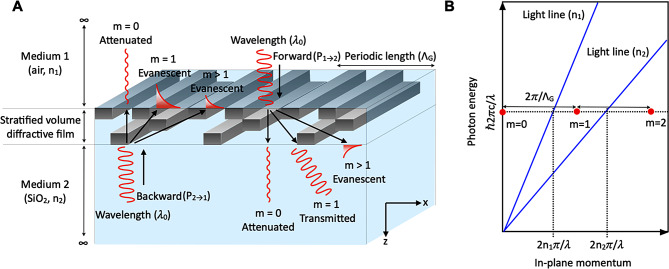
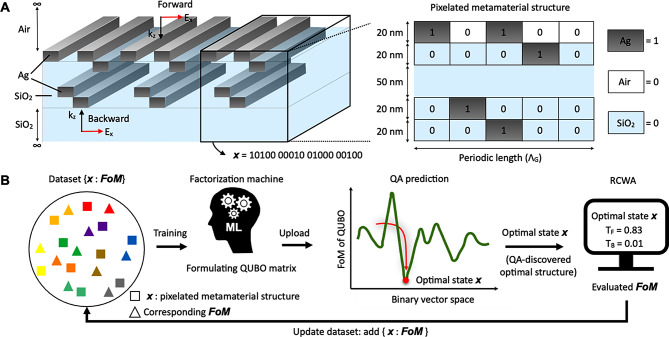
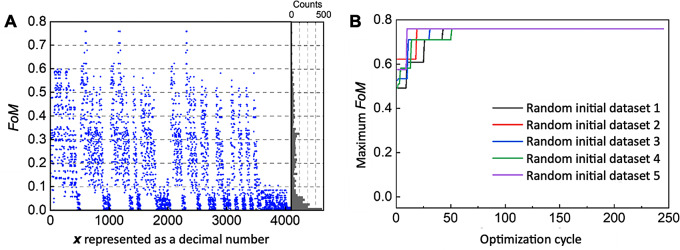
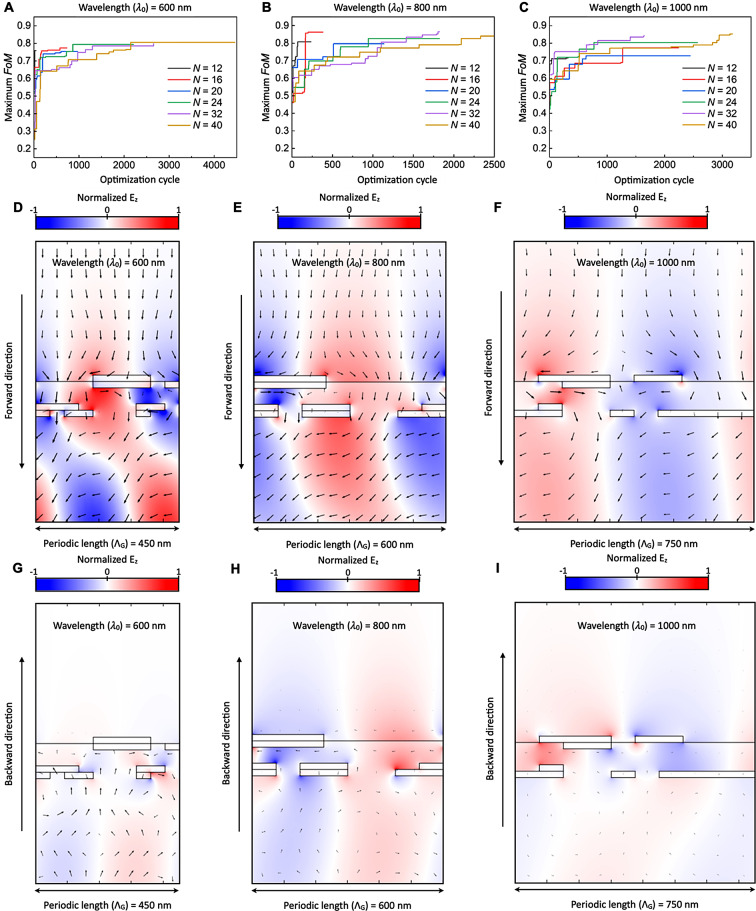
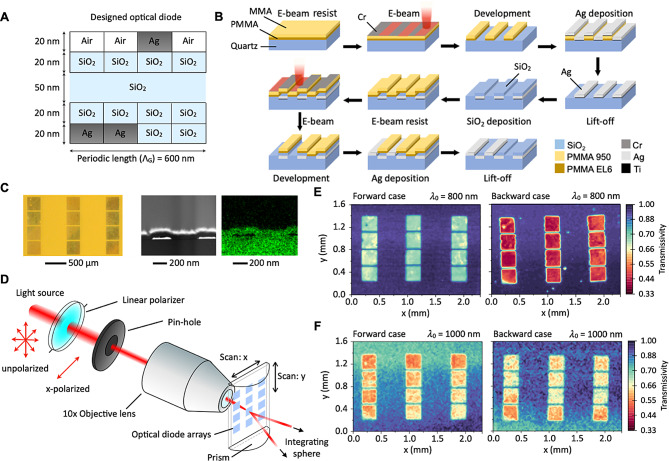
Thin-film optical diodes are important elements for miniaturizing photonic systems. However, the design of optical diodes relies on empirical and heuristic approaches. This poses a significant challenge for identifying optimal structural models of optical diodes at given wavelengths. Here, we leverage a quantum annealing-enhanced active learning scheme to automatically identify optimal designs of 130 nm-thick optical diodes. An optical diode is a stratified volume diffractive film discretized into rectangular pixels, where each pixel is assigned to either a metal or dielectric. The proposed scheme identifies the optimal material states of each pixel, maximizing the quality of optical isolation at given wavelengths. Consequently, we successfully identify optimal structures at three specific wavelengths (600, 800, and 1000 nm). In the best-case scenario, when the forward transmissivity is 85%, the backward transmissivity is 0.1%. Electromagnetic field profiles reveal that the designed diode strongly supports surface plasmons coupled across counterintuitive metal–dielectric pixel arrays. Thereby, it yields the transmission of first-order diffracted light with a high amplitude. In contrast, backward transmission has decoupled surface plasmons that redirect Poynting vectors back to the incident medium, resulting in near attenuation of its transmission. In addition, we experimentally verify the optical isolation function of the optical diode.
Overview
The claims and statistics of this paper haven’t been checked yet.
Free: it reads the open-access text and checks the first 5 claims that cite a source we can check. Create a free account to check every claim.
Integrity signals
Registry
Cites
Statistics
Figures
Verification
Claims the paper makes
The claims and statistics of this paper haven’t been checked yet.
Free: it reads the open-access text and checks the first 5 claims that cite a source we can check. Create a free account to check every claim.
Claims other papers make about this one
Each is checked against this paper’s own text: does it say what the citing paper says it does?
The source backs part of the claim, not all of it — or backs it for a different population, condition or comparison.
In the citing paper
“For example, in our previous QA optimization of one-dimensional and two-dimensional optical metamaterials, the QUBO matrices exhibit these properties (Fig. S1) 4,5,16,20 .”
From Quantum annealing for combinatorial optimization: a benchmarking study (2025) · cites this paper as [20]
Experimental — accuracy not yet measuredThe source backs part of the claim, not all of it — or backs it for a different population, condition or comparison.
In the citing paper
“By mapping these learned coef fi cients into a QUBO formulation, we effectively represent an energy function of a material system or other real-world optimization problem.”
From Quantum annealing for combinatorial optimization: a benchmarking study (2025) · cites this paper as [37]
Experimental — accuracy not yet measuredThe cited source says what the claim attributes to it.
In the citing paper
“These coef fi cients can be learned using machine learning models, such as the factorization machine (FM), trained on datasets containing input structures and their corresponding performance metrics.”
From Quantum annealing for combinatorial optimization: a benchmarking study (2025) · cites this paper as [37]
Self-check
Percentages, sums and reported differences re-computed from the paper’s own numbers.
The self-check needs the paper’s full text.
Citations
Cites
Moharam, M. G., Gaylord, T. K., Grann, E. B., & Pommet, D. A. (1995) · Journal of the Optical Society of America A · doi:10.1364/josaa.12.001068 · Cited by 2,687
Moharam, M. G., Gaylord, T. K., Pommet, D. A., & Grann, E. B. (1995) · Journal of the Optical Society of America A · doi:10.1364/josaa.12.001077 · Cited by 1,594
Analysis of heat flow in layered structures for time-domain thermoreflectance
Cahill, D. G. (2004) · Review of Scientific Instruments · doi:10.1063/1.1819431 · Cited by 1,543
All-optical spiking neurosynaptic networks with self-learning capabilities
Feldmann, J., Youngblood, N., Wright, C. D., Bhaskaran, H., & Pernice, W. H. P. (2019) · Nature · doi:10.1038/s41586-019-1157-8 · Cited by 1,529
On-chip optical isolation in monolithically integrated non-reciprocal optical resonators
Bi, L., Hu, J., Jiang, P., Kim, D. H., Dionne, G. F., Kimerling, L. C., & Ross, C. A. (2011) · Nature Photonics · doi:10.1038/nphoton.2011.270 · Cited by 1,026
New formulation of the Fourier modal method for crossed surface-relief gratings
Li, L. (1997) · Journal of the Optical Society of America A · doi:10.1364/josaa.14.002758 · Cited by 1,005
What is — and what is not — an optical isolator
Jalas, D., Petrov, A., Eich, M., Freude, W., Fan, S., Yu, Z., Baets, R., Popović, M., Melloni, A., Joannopoulos, J. D., et al. (2013) · Nature Photonics · doi:10.1038/nphoton.2013.185 · Cited by 987
Evidence for quantum annealing with more than one hundred qubits
Boixo, S., Rønnow, T. F., Isakov, S. V., Wang, Z., Wecker, D., Lidar, D. A., Martinis, J. M., & Troyer, M. (2014) · Nature Physics · doi:10.1038/nphys2900 · Cited by 810
Quantum annealing: A new method for minimizing multidimensional functions
Finnila, A. B., Gomez, M. A., Sebenik, C., Stenson, C., & Doll, J. D. (1994) · Chemical Physics Letters · doi:10.1016/0009-2614(94)00117-0 · Cited by 644
Defining and detecting quantum speedup
Rønnow, T. F., Wang, Z., Job, J., Boixo, S., Isakov, S. V., Wecker, D., Martinis, J. M., Lidar, D. A., & Troyer, M. (2014) · Science · doi:10.1126/science.1252319 · Cited by 601
Research works printed but not linked: 2
- Hu R Iwamoto S Feng L Ju S Hu S Ohnishi M Nagai N Hirakawa K Shiomi J Phys. Rev. X 2020 10 021050
- B. Zhou, F. Gao, J. Pan, S. Shen, 2020 IEEE International Conference on Robotics and Automation (ICRA), 1208–1214 (2020)
Cited by
Quantum annealing for combinatorial optimization: a benchmarking study
Kim, S., Ahn, S.-W., Suh, I.-S., Dowling, A. W., Lee, E., & Luo, T. (2025) · npj Quantum Information · doi:10.1038/s41534-025-01020-1 · Cited by 46
“This QUBO then describes the optimization space, enabling the identi fi cation of the optimal state with the best performance 36,37 .”
Self-citationQuantum-inspired genetic algorithm for designing planar multilayer photonic structure
Xu, Z., Shang, W., Kim, S., Bobbitt, A., Lee, E., & Luo, T. (2024) · npj Computational Materials · doi:10.1038/s41524-024-01438-9 · Cited by 35
“Kitai et al. 45 and Kim et al. 24 utilized quantum annealing (QA) and factorization machine (FM) for the design of PML.”
Self-citationQuantum annealing-assisted lattice optimization
Xu, Z., Shang, W., Kim, S., Lee, E., & Luo, T. (2025) · npj Computational Materials · doi:10.1038/s41524-024-01505-1 · Cited by 41
“Kitai et al. 44 , Guo et al. 45 and Kim et al. 46,47 utilized QA and factorization machine (FM) for designing planar multilayer (PML) and diodes for optical applications.”
Self-citationA review on machine learning-guided design of energy materials
Kim, S., Xu, J., Shang, W., Xu, Z., Lee, E., & Luo, T. (2024) · Progress in Energy · doi:10.1088/2516-1083/ad7220 · Cited by 19
“To overcome this limitation, one can transform material design tasks into quadratic unconstrained binary optimization (QUBO) problems, where QUBO can be efficiently solved by a quantum computer [134, 135].”
Self-citationConformal Antireflective Multilayers for High‐Numerical‐Aperture Deep‐Ultraviolet Lenses
Park, G., Kim, J., Lee, S., Kim, D. I., An, K., Lee, E., Yim, S., & Kim, S. (2024) · Advanced Optical Materials · doi:10.1002/adom.202401040 · Cited by 14
Self-citationHarnessing quantum power: Revolutionizing materials design through advanced quantum computation
Guo, Z., Li, R., He, X., Guo, J., & Ju, S. (2024) · Materials Genome Engineering Advances · doi:10.1002/mgea.73 · Cited by 12
Yu, J.-S., Jung, S., Cho, J.-W., Park, G., Kats, M. A., Kim, S., & Lee, E. (2024) · Nanophotonics · doi:10.1515/nanoph-2024-0360 · Cited by 12
“…(or binary) optimization problems [29], [31]–[36], identifying optimal designs in applications such as monochromatic antireflective coatings for deep-ultraviolet photolithography [33], ultrathin optical diodes [34], radiative coolers [35], and digital metasur-faces for 5G telecommunications [36].”
Self-citationW‐band frequency selective digital metasurface using active learning‐based binary optimization
Kim, Y., Park, J., Kim, J.-H., Seo, S.-B., Kim, S., & Lee, E. (2025) · Nanophotonics · doi:10.1515/nanoph-2024-0628 · Cited by 9
Self-citationComputation and machine learning for materials: Past, present, and future perspectives
Alosious, S., Jiang, M., & Luo, T. (2025) · MRS Bulletin · doi:10.1557/s43577-025-00959-y · Cited by 17
Self-citationAsymmetric Transmission and Diffraction Engineering in Ultrathin media via Coupled Metasurfaces
Ansari, A. S., Mandal, A., Iyer, A. K., & Gholipour, B. (2025) · Advanced Optical Materials · doi:10.1002/adom.202500230 · Cited by 8
Park, J., Xu, Z., Park, G.-M., Luo, T., & Lee, E. (2025) · Scientific Reports · doi:10.1038/s41598-025-99570-z · Cited by 5
Self-citationImproving the efficiency of quantum annealing with controlled diagonal catalysts
Hattori, T., & Tanaka, S. (2026) · Physical Review A · doi:10.1103/vff6-cf7c · Cited by 4
Simulations of Quantum Approximate Optimization Algorithm on HPC-QC Integrated Systems
Kim, S., & Suh, I. (2024) · IEEE International Conference on Quantum Computing and Engineering (QCE) · doi:10.1109/qce60285.2024.10357 · Cited by 3
“A. QUBO Generation: Given that QUBOs are represented by upper-triangular matrices [4], [5], we generate matrices where elements are confined to the upper-triangular region which are filled with random numbers (from -1 to 1).”
Self-citationJung, S., & Lee, E. (2025) · Machine Learning Science and Technology · doi:10.1088/2632-2153/adf68d · Cited by 2
“In prior work, its structure was optimized using a fixed scheme in which the periodic length Λ G was empirically fixed at 600 nm for a target wavelength λ = 800 nm, satisfying the diffraction order constraints [49].”
Self-citationSeo, S.-B., Kang, R., Lee, E. H., Ju, S.-Y., Lee, M. J., Lee, B., & Kim, S.-K. (2026) · Opto-Electronic Advances · doi:10.29026/oea.2026.250218 · Cited by 1
Self-citationPark, G., He, J., Zhao, W., Hu, R., Lee, E., & Kim, S. (2026) · Applied Optics · doi:10.1364/ao.585906 · Cited by 1
Self-citationKim, S., & Suh, I. (2025) · Advanced Intelligent Discovery · doi:10.1002/aidi.202500136 · Cited by 2
Self-citationHigher-order factorization machine for accurate surrogate modeling in material design
Hwang, S., Kim, S., Xu, Z., Luo, T., & Lee, E. (2025) · Scientific Reports · doi:10.1038/s41598-025-19270-6 · Cited by 7
“While the 2 nd -order FM has been widely employed in photonic structure design by employing individual features and pairwise interactions 4,5,9,17,36,37 , our results highlight the importance of considering higher-order interactions.”
Self-citationWang, A., Cai, D., Zhang, Y., Huang, Y., Feng, X., & Zhang, Z. (2025) · Physical Review Research · doi:10.1103/knt1-yd9s
Quantum annealing–based black-box optimization for aerodynamic shape design
Kuya, Y., & Tanaka, R. (2026) · Aerospace Science and Technology · doi:10.1016/j.ast.2026.112976
Metadata
- Authors
- Kim, S., Park, S.-J., Moon, S., Zhang, Q., Hwang, S., Kim, S.-K., Luo, T., & Lee, E.
- Affiliations
- University of Notre Dame (US)
- Kyung Hee University (KR)
- Corresponding author
- Kim, Sun-Kyung
- Luo, Tengfei
- Lee, Eungkyu
- Venue
- Nano Convergence
- Published
- 2024-05-09
- Volume
- 11
- Issue
- 1
- Pages
- 16-16
- ISSN
- 2196-5404 (ISSN-L)
- PMC
- PMC11082120
- OpenAlex
- W4396764670
- Cited by
- 20
- References
- 47
- Citations by year
- 2026: 4 · 2025: 10 · 2024: 6
- FWCI
- 1.56
- Type
- journal article
- Language
- en
- Open access
- gold
- doi.org
- Licence
- cc-by
- creativecommons.org/licenses/by/4.0 (tdm)
- creativecommons.org/licenses/by/4.0 (vor)
- Locations
- Nano Convergence (publishedVersion, cc-by)
- Research Square (acceptedVersion, cc-by)
- PubMed Central (publishedVersion, cc-by)
- PubMed (publishedVersion)
- DOAJ (DOAJ: Directory of Open Access Journals) (submittedVersion, cc-by-sa)
- OSTI OAI (U.S. Department of Energy Office of Scientific and Technical Information) (submittedVersion)
- Funders
- National Research Foundation of Korea (RS-2023-00255442, RS-2023-00207966)
- The U.S. Department of Energy (DE-AC05-00OR22725)
- Topics
- Physical Sciences › Materials Science › Electronic, Optical and Magnetic Materials › Metamaterials and Metasurfaces Applications
- Physical Sciences › Physics and Astronomy › Atomic and Molecular Physics, and Optics › Plasmonic and Surface Plasmon Research
- Physical Sciences › Materials Science › Surfaces, Coatings and Films › Optical Coatings and Gratings
- Keywords
- optical isolator, quantum annealing, active learning (machine learning), metamaterial design, ultrathin films, optical isolation, surface plasmons, automated design optimization
About these checks
Registry, retraction, Cites and statistics results are computed, not judged, with one exception: a printed reference that no index lists is read once by a model before it counts as a citation error. Claims are extracted by a model and kept only when their quote appears verbatim in the text; each cited source is then checked, with a model’s help, for whether it says what the claim relies on. Those verdicts can be wrong — read the claim’s quote and the cited source before relying on one.
Statistics and arithmetic are recomputed, not judged.
Confidence bands are shown only for fields calibrated on our annotated test set. None is calibrated yet, so no band is shown.
What counts as a claim ›How we measure confidence ›How we check this ›
Are you an author, or do you see a problem with this page? Request a review
Data sources
Bibliographic data: Semantic Scholar, OpenAlex, Crossref.
Contains information from the Semantic Scholar Academic Graph Datasets, made available under the ODC Attribution License (ODC-BY 1.0).
Semantic Scholar’s data is described in: Kinney, R., et al. (2023). The Semantic Scholar Open Data Platform. arXiv:2301.10140.
