

Progression of intervention-focused research for Gulf War illness
Open accessThe DOI matches its Crossref record; 145 of the 145 references it cites were found in a registry or an index.
Abstract
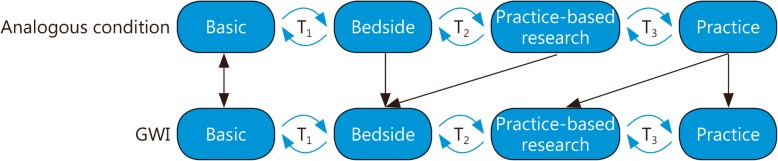
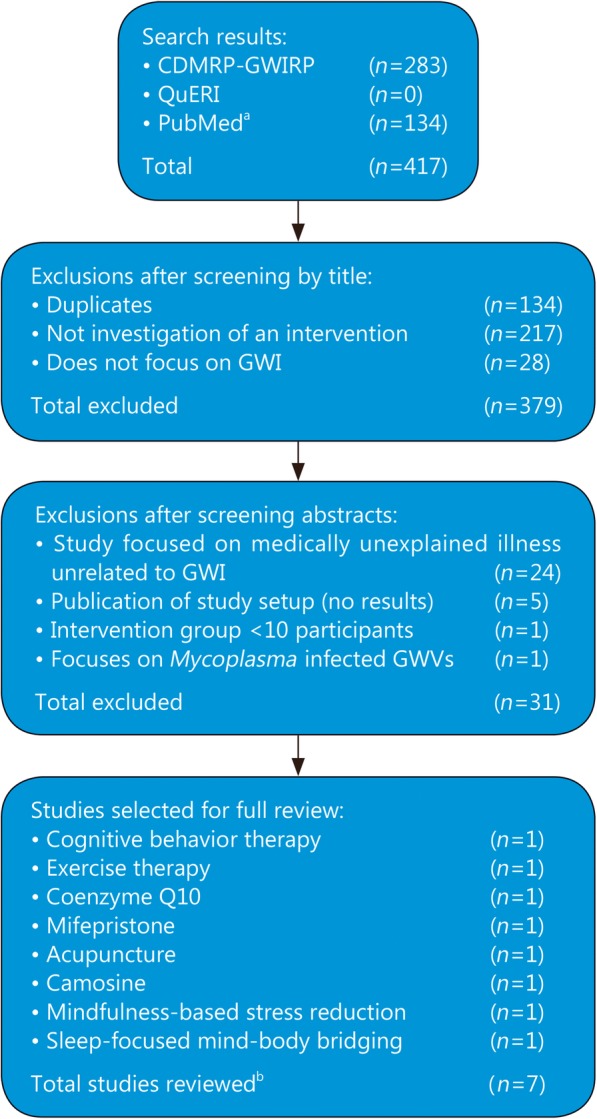
The Persian Gulf War of 1990 to 1991 involved the deployment of nearly 700,000 American troops to the Middle East. Deployment-related exposures to toxic substances such as pesticides, nerve agents, pyridostigmine bromide (PB), smoke from burning oil wells, and petrochemicals may have contributed to medical illness in as many as 250,000 of those American troops. The cluster of chronic symptoms, now referred to as Gulf War Illness (GWI), has been studied by many researchers over the past two decades. Although over $500 million has been spent on GWI research, to date, no cures or condition-specific treatments have been discovered, and the exact pathophysiology remains elusive. Using the 2007 National Institute of Health (NIH) Roadmap for Medical Research model as a reference framework, we reviewed studies of interventions involving GWI patients to assess the progress of treatment-related GWI research. All GWI clinical trial studies reviewed involved investigations of existing interventions that have shown efficacy in other diseases with analogous symptoms. After reviewing the published and ongoing registered clinical trials for cognitive-behavioral therapy, exercise therapy, acupuncture, coenzyme Q10, mifepristone, and carnosine in GWI patients, we identified only four treatments (cognitive-behavioral therapy, exercise therapy, CoQ10, and mifepristone) that have progressed beyond a phase II trial. We conclude that progress in the scientific study of therapies for GWI has not followed the NIH Roadmap for Medical Research model. Establishment of a standard case definition, prioritized GWI research funding for the characterization of the pathophysiology of the condition, and rapid replication and adaptation of early phase, single site clinical trials could substantially advance research progress and treatment discovery for this condition.
Overview
The claims and statistics of this paper haven’t been checked yet.
Free: it reads the open-access text and checks the first 5 claims that cite a source we can check. Create a free account to check every claim.
Integrity signals
Registry
Cites
Statistics
Figures
Verification
Claims the paper makes
The claims and statistics of this paper haven’t been checked yet.
Free: it reads the open-access text and checks the first 5 claims that cite a source we can check. Create a free account to check every claim.
Claims other papers make about this one
Each is checked against this paper’s own text: does it say what the citing paper says it does?
The cited source says what the claim attributes to it.
In the citing paper
“There are currently few effective treatments for GWI.”
From Yoga is effective for treating chronic pain in veterans with Gulf War Illness at long-term follow-up (2023) · cites this paper as [5]
The cited source says what the claim attributes to it.
In the citing paper
“A 2019 review of GWI treatments [5], which found four treatments that had moved beyond Phase II trial, reported only modest efficacy of pharmacological [6], rehabilitation [7, 8], and psychological interventions [7].”
From Yoga is effective for treating chronic pain in veterans with Gulf War Illness at long-term follow-up (2023) · cites this paper as [5]
Self-check
Percentages, sums and reported differences re-computed from the paper’s own numbers.
The self-check needs the paper’s full text.
Citations
Cites
1 retracted
RETRACTED: Screening for novel central nervous system biomarkers in veterans with Gulf War Illness
Abou-Donia, M. B., Conboy, L. A., Kokkotou, E. G., Jacobson, E., EL-Masry, E. M., Elkafrawy, P., Neely, M. L., Bass, C. R., & Sullivan, K. A. (2017) · Neurotoxicology and Teratology · doi:10.1016/j.ntt.2017.03.002 · Cited by 85
RetractedThe Physical Activity Guidelines for Americans
Piercy, K. L., Troiano, R. P., Ballard, R. M., Carlson, S. A., Fulton, J. E., Galuska, D. A., George, S. M., & Olson, R. D. (2018) · JAMA · doi:10.1001/jama.2018.14854 · Cited by 9,755
Mindfulness-based stress reduction and health benefits
Grossman, P., Niemann, L., Schmidt, S., & Walach, H. (2004) · Journal of Psychosomatic Research · doi:10.1016/s0022-3999(03)00573-7 · Cited by 3,958
Innovation in the pharmaceutical industry: New estimates of R&D costs
DiMasi, J. A., Grabowski, H. G., & Hansen, R. W. (2016) · Journal of Health Economics · doi:10.1016/j.jhealeco.2016.01.012 · Cited by 3,359
Managing Clinical Knowledge for Health Care Improvement
Balas, E. A., & Boren, S. A. (2000) · Yearbook of Medical Informatics · doi:10.1055/s-0038-1637943 · Cited by 1,479
2008 Physical activity guidelines for Americans: (525412010-001)
(2008) · PsycEXTRA Dataset · doi:10.1037/e525412010-001 · Cited by 1,466
Mindfulness-based stress reduction and health benefits: A meta-analysis
Grossman, P., Niemann, L., Schmidt, S., & Walach, H. (2003) · Focus on Alternative and Complementary Therapies · doi:10.1111/j.2042-7166.2003.tb04008.x · Cited by 1,394 · cited 7×
“* Correspondence: Jeremy.Chester@VA.gov 1War Related Illness and Injury Study Center, Veterans Affairs New Jersey Healthcare System, 385 Tremont Avenue, East Orange, NJ 07018, USA 2War Related Illness and Injury Study Center, Veterans Affairs Medical Center, 50 Irving St., Washington, DC, NW 20422, USA Full list of au…”
BackgroundInfluentialPractice-based research--“Blue Highways” on the NIH roadmap
Westfall, J. M., Mold, J., & Fagnan, L. (2007) · JAMA · doi:10.1001/jama.297.4.403 · Cited by 1,209
Mrazek, M. D., Franklin, M. S., Phillips, D. T., Baird, B., & Schooler, J. W. (2013) · Psychological Science · doi:10.1177/0956797612459659 · Cited by 1,063
Cognitive Therapy vs Medications in the Treatment of Moderate to Severe Depression
DeRubeis, R. J., Hollon, S. D., Amsterdam, J. D., Shelton, R. C., Young, P. R., Salomon, R. M., O’Reardon, J. P., Lovett, M. L., Gladis, M. M., Brown, L. L., et al. (2005) · Archives of General Psychiatry · doi:10.1001/archpsyc.62.4.409 · Cited by 989
Research works printed but not linked: 10
- Committee on the Development of a Consensus Case Definition for Chronic Multisymptom Illness in 1990-1991 Gulf War Veterans Board on the health of select populations, Institute of Medicine 2014 Washington (DC) National Academies Press (US) 25590117
- ClinicalTrials.gov Identifier NCT00129454, telemedicine treatment for veterans with Gulf War illness; 2005 august 11 2000 Bethesda National Library of Medicine (US)
- ClinicalTrials.gov Identifier NCT02161133, cognitive rehabilitation for Gulf War illness; 2014 June 11 2000 Bethesda National Library of Medicine (US)
- ClinicalTrials.gov Identifier NCT02782780, cognitive behavioral therapy for insomnia for Gulf War illness (CBTi GWI); 2016 may 25 2000 Bethesda National Library of Medicine (US)
- ClinicalTrials.gov Identifier NCT03058952, groups for regaining our wellbeing (GROW); 2018 Sep 27 2000 Bethesda National Library of Medicine (US)
- Trussell J Cleland K Dedicated emergency contraceptive pills worldwide 2013 Princeton Office of Population Research, Princeton University
- Corcept Therapeutics Korlym prescribing information 2013 Menlo Park Corcept Therapeutics
- ClinicalTrials.gov Identifier: NCT02180243, CAM in veterans with Gulf War illnesses (GW-CAM) 2000 Bethesda National Library of Medicine (US)
- Cairns MT Miller DJ O'Dowd JJ Detection and estimation of carnosine, homocarnosine, N-acetylhistidine and its methyl derivative in rat brain by analytical HPLC J Physiol 1988 398 74
- ClinicalTrials.gov University of Pittsburgh; National Alliance for research on schizophrenia and depression. Identifier: NCT00177463, L-carnosine for bipolar I disorder 2000 Bethesda National Library of Medicine (US)
Cited by
Recent Research Trends in Neuroinflammatory and Neurodegenerative Disorders
Cohen, J., Mathew, A., Dourvetakis, K. D., Sanchez-Guerrero, E., Pangeni, R. P., Gurusamy, N., Aenlle, K. K., Ravindran, G., Twahir, A., Isler, D., et al. (2024) · Cells · doi:10.3390/cells13060511 · Cited by 103
“…therapeutic agent, Bacopa monnieri, anti-inflammatory flavonoid concord grade juice (CGJ), and mifepristone therapies beyond Phase II clinical trials for GWI patients have shown some progresses for therapeutic interventions in addition to cognitive and behavioral therapies in place [115–117].”
BackgroundGulf War Illness: Mechanisms Underlying Brain Dysfunction and Promising Therapeutic Strategies
Dickey, B., Madhu, L. N., & Shetty, A. K. (2021) · Pharmacology & Therapeutics · doi:10.1016/j.pharmthera.2020.107716 · Cited by 73
Bjørklund, G., Pivina, L. M., Dadar, M., Semenova, Y. M., Rahman, M. M., Chirumbolo, S., & Aaseth, J. (2019) · Environmental Research · doi:10.1016/j.envres.2019.108927 · Cited by 44
Miller, J. V., LeBouf, R. F., Kelly, K. A., Michalovicz, L. T., Ranpara, A. C., Locker, A. R., Miller, D. B., & O'Callaghan, J. P. (2018) · Toxicological Sciences · doi:10.1093/toxsci/kfy130 · Cited by 41
Trageser, K. J., Sebastian-Valverde, M., Naughton, S. X., & Pasinetti, G. M. (2020) · Frontiers in Psychiatry · doi:10.3389/fpsyt.2020.00704 · Cited by 36
“acupuncture, cognitive behavioral therapy) and nutritional supplementation studies have been performed in patients with GWI (98).”
Background
Metadata
- Authors
- Chester, J. E., Rowneki, M., Van Doren, W., & Helmer, D. A.
- Affiliations
- United States Department of Veterans Affairs (US)
- VA New Jersey Health Care System (US)
- Rutgers, The State University of New Jersey (US)
- Corresponding author
- Chester, Jeremy E.
- Venue
- Military Medical Research
- Publisher
- Elsevier BV
- Published
- 2019-10-18
- Volume
- 6
- Issue
- 1
- Pages
- 31-31
- ISSN
- 2054-9369 (ISSN-L)
- PMC
- PMC6798371
- OpenAlex
- W2980321845
- Cited by
- 38
- References
- 145
- Citations by year
- 2026: 1 · 2025: 3 · 2024: 6 · 2023: 6 · 2022: 5 · 2021: 10 · 2020: 5 · 2019: 1
- FWCI
- 0.89
- Type
- journal article
- Language
- en
- Open access
- diamond
- doi.org
- Licence
- cc-by
- creativecommons.org/licenses/by/4.0/ (tdm)
- creativecommons.org/licenses/by/4.0/ (vor)
- Locations
- Military Medical Research (publishedVersion, cc-by)
- PubMed Central (publishedVersion, cc-by)
- PubMed (publishedVersion)
- DOAJ (DOAJ: Directory of Open Access Journals) (submittedVersion, cc-by-sa)
- Topics
- Health Sciences › Medicine › Psychiatry and Mental health › Fibromyalgia and Chronic Fatigue Syndrome Research
- Health Sciences › Medicine › Clinical Neurology › Traumatic Brain Injury Research
- Health Sciences › Medicine › Clinical Neurology › Long-Term Effects of COVID-19
- Keywords
- Gulf War illness, cognitive behavioral therapy, exercise therapy, acupuncture, coenzyme Q10, mifepristone, carnosine, chronic symptoms, pathophysiology, case definition, research funding priorities
- MeSH terms
- Exercise Therapy, Humans, Middle East, Ubiquinone, United States, Veterans, Mifepristone, Cognitive Behavioral Therapy, Randomized Controlled Trials as Topic, Occupational Exposure, Persian Gulf Syndrome, Biomedical Research, Gulf War
About these checks
Registry, retraction, Cites and statistics results are computed, not judged, with one exception: a printed reference that no index lists is read once by a model before it counts as a citation error. Claims are extracted by a model and kept only when their quote appears verbatim in the text; each cited source is then checked, with a model’s help, for whether it says what the claim relies on. Those verdicts can be wrong — read the claim’s quote and the cited source before relying on one.
Statistics and arithmetic are recomputed, not judged.
Confidence bands are shown only for fields calibrated on our annotated test set. None is calibrated yet, so no band is shown.
What counts as a claim ›How we measure confidence ›How we check this ›
Are you an author, or do you see a problem with this page? Request a review
Data sources
Bibliographic data: Semantic Scholar, OpenAlex, Crossref.
Contains information from the Semantic Scholar Academic Graph Datasets, made available under the ODC Attribution License (ODC-BY 1.0).
Semantic Scholar’s data is described in: Kinney, R., et al. (2023). The Semantic Scholar Open Data Platform. arXiv:2301.10140.
