

Do elite athletes live longer? a systematic review of mortality and longevity in elite athletes.
Open accessThe DOI matches its Crossref record; 90 of the 91 references it cites were found in a registry or an index.
Abstract
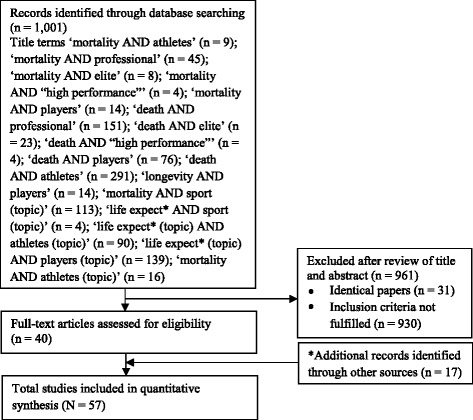
BACKGROUND: Understanding of an athlete's lifespan is limited with a much more sophisticated knowledge of their competitive careers and little knowledge of post-career outcomes. In this review, we consider the relationship between participation at elite levels of sport and mortality risk relative to other athletes and age- and sex-matched controls from the general population. Our objective was to identify, collate, and disseminate a comprehensive list of risk factors associated with longevity and trends and causes of mortality among elite athletes. METHODS: were used to locate research articles. Seventeen additional articles were retrieved from reference lists found in these papers and a general web search. The inclusion criteria were the following: (1) publication year 1980 or later; (2) the study examined elite-level athletes; and (3) outcome data measured mortality/longevity trends and/or causes. RESULTS: Fifty-four peer-reviewed publications and three articles from online sources met the criteria for inclusion. Baseball, football, soccer, basketball, and cycling had the most reported data on elite athletes' lifespan longevities. A variety of mechanisms have attempted to explain mortality risk (e.g., handedness, playing position, achievement, etc.). Considerable support was found for superior longevity outcomes for elite athletes, particularly those in endurance and mixed sports. CONCLUSIONS: Future research into the mechanisms that may affect mortality risk is important for a better understanding of life expectancies in both eminent and non-eminent populations. Participation in elite sport is generally favorable to lifespan longevity. KEY POINTS: A majority of studies included in this review reported superior lifespan longevity outcomes for elite athletes compared to age- and sex-matched controls from the general population and other athletes.Several mechanisms within and between sports may have powerful effects on the overall lifespan longevities of players (e.g., type of sport, playing position, race, and energy system).Future research on mortality in elite athletes would benefit from more comprehensive statistical measures and reliable databases to determine potential mechanisms that may influence mortality trends and causes in both athlete and non-athlete samples.
Overview
The claims and statistics of this paper haven’t been checked yet.
Free: it reads the open-access text and checks the first 5 claims that cite a source we can check. Create a free account to check every claim.
Integrity signals
Registry
Cites
Statistics
Figures
Verification
Claims the paper makes
The claims and statistics of this paper haven’t been checked yet.
Free: it reads the open-access text and checks the first 5 claims that cite a source we can check. Create a free account to check every claim.
Claims other papers make about this one
Each is checked against this paper’s own text: does it say what the citing paper says it does?
The source backs part of the claim, not all of it — or backs it for a different population, condition or comparison.
In the citing paper
“These results are in concordance with previous observational studies35,36,37,38 of highly active cohorts and other large, longitudinal studies4,6 of CRF and mortality but are notably discrepant from population-based studies24,25,26 of physical activity and exercise.”
From Association of Cardiorespiratory Fitness with Long-term Mortality Among Adults Undergoing Exercise Treadmill Testing (2018) · cites this paper as [35]
Experimental — accuracy not yet measured
Self-check
Percentages, sums and reported differences re-computed from the paper’s own numbers.
The self-check needs the paper’s full text.
Citations
Cites
Preferred Reporting Items for Systematic Reviews and Meta-Analyses: the PRISMA statement
Moher, D., Liberati, A., Tetzlaff, J., Altman, D. G., & for the PRISMA Group (2009) · BMJ · doi:10.1136/bmj.b2535 · Cited by 83,823
Preferred reporting items for systematic reviews and meta-analyses: the PRISMA Statement.
(2009) · PubMed Central · Cited by 44,859
(2014) · Medical Entomology and Zoology · Cited by 17,633
The Epidemiologic Transition: A Theory of the Epidemiology of Population Change
OMRAN, A. R. (2005) · The Milbank Quarterly · doi:10.1111/j.1468-0009.2005.00398.x · Cited by 3,823
Physical Activity and Mental Health: Current Concepts
Paluska, S. A., & Schwenk, T. L. (2000) · Sports Medicine · doi:10.2165/00007256-200029030-00003 · Cited by 1,722
Okorodudu, D. O., Jumean, M. F., Montori, V. M., Romero-Corral, A., Somers, V. K., Erwin, P. J., & Lopez-Jimenez, F. (2010) · International Journal of Obesity · doi:10.1038/ijo.2010.5 · Cited by 1,028 · cited 1×
“, [71]), particularly in NFL players [19].”
Neurodegenerative causes of death among retired National Football League players
Lehman, E. J., Hein, M. J., Baron, S. L., & Gersic, C. M. (2012) · Neurology · doi:10.1212/wnl.0b013e31826daf50 · Cited by 638
Löllgen, H., Böckenhoff, A., & Knapp, G. (2009) · International Journal of Sports Medicine · doi:10.1055/s-0028-1128150 · Cited by 529
Potential Adverse Cardiovascular Effects From Excessive Endurance Exercise
O'Keefe, J. H., Patil, H. R., Lavie, C. J., Magalski, A., Vogel, R. A., & McCullough, P. A. (2012) · Mayo Clinic Proceedings · doi:10.1016/j.mayocp.2012.04.005 · Cited by 471
Novel Metabolic Risk Factors for Incident Heart Failure and Their Relationship With Obesity
Bahrami, H., Bluemke, D. A., Kronmal, R., Bertoni, A. G., Lloyd-Jones, D. M., Shahar, E., Szklo, M., & Lima, J. A. C. (2008) · Journal of the American College of Cardiology · doi:10.1016/j.jacc.2007.12.048 · Cited by 367
Cited by
Items 101–117 of 117
Soloaga, A. O., Cruz, A. D. F. C., Spreafico, E. V. P., Spreafico, M. V. P., dos Reis, C. P., Boullosa, D. A., & Coelho‐Ravagnani, C. D. F. (2025) · Ciência & Saúde Coletiva · doi:10.1590/1413-81232025301.16862023esp
Do Brazilian Olympic athletes live longer than the general population? A retrospective cohort study
Soloaga, A. O., Cruz, A. D. F. C., Spreafico, E. V. P., Spreafico, M. V. P., dos Reis, C. P., Boullosa, D. A., & Coelho‐Ravagnani, C. D. F. (2025) · Ciência & Saúde Coletiva · doi:10.1590/1413-81232025301.16862023 · Cited by 2
Sellers, M., Orchard, J. W., Orchard, J. J., & Batty, P. (2025) · Science and Medicine in Football · doi:10.1080/24733938.2025.2533791
“Elite athlete cohorts in most sports tend to outlive the general population (Kettunen et al. 2015; Lemez and Baker 2015; Altulea et al. 2025), with only minimal exceptions.”
Knechtle, B., Đurić, S., Scheer, V., Nikolaidis, P. Τ., Chlíbková, D., Leite, L. B., Čuk, I., Forte, P. M., Wilhelm, M., Weiss, K., et al. (2025) · Sports Medicine and Health Science · doi:10.1016/j.smhs.2025.07.011
“18 21 – 23 This fact is most likely due to genetic difference, aerobic training for endurance elite sports, and a healthier lifestyle of athletes compared to the general population.”
Luan, S., Li, H., Zhao, Q., Cong, J., He, H., Xu, J., Ren, J., & Qian, J. (2025) · BMJ Open · doi:10.1136/bmjopen-2025-104901
Shen, S., Suzuki, K., Kohmura, Y., Fuku, N., Someya, Y., & Naito, H. (2021) · Figshare · doi:10.6084/m9.figshare.14266767
Training im mittleren und höheren Lebensalter
Ferrauti, A., & Hottenrott, L. (2025) · Springer eBooks · doi:10.1007/978-3-662-69524-1_12
Orchard, J. W., Harmon, K. G., Orchard, N. D., Chang, C. J., Sardelich, D., & Orchard, J. J. (2026) · American Journal of Lifestyle Medicine · doi:10.1177/15598276261418585
Survival and longevity in professional wrestlers: a retrospective cohort study
Shean, J., Vedantam, S., & Lystad, R. P. (2026) · Occupational and Environmental Medicine · doi:10.1136/oemed-2025-110428
Wang, T., & Abdullah, M. F. B. (2026) · PeerJ Computer Science · doi:10.7717/peerj-cs.3855
Vitality capacity preservation through lifelong aerobic exercise: a pathway to healthy ageingPreprint
Mercier, J. G., Guérin, O., Michel, É., Chorin, F., Loubat, A., Gautier, N., Rousseau, A., & Colson, S. S. (2026) · bioRxiv (Cold Spring Harbor Laboratory) · doi:10.64898/2026.06.04.728174
Fernández-Lorenzo, S., Marín‐Pagán, C., Ruiz, L. P., Gambini, J., Lupu, R. I., Martínez-Noguera, F. J., & Escobar, J. (2026) · Biomedicines · doi:10.3390/biomedicines14081705
“…[25], the causal effect of muscle weakness on frailty demonstrated by Jones et al. [26], and the epidemiological longevity gains observed in elite endurance athletes [4,5], is compatible with the hypothesis of a shared biological architecture, but a coherent integrative framework is still lacking.”
Incidence of Concussion in a Cadet and Junior National Wrestling Tournament from 2013 to 2025
Bretzin, A. C., McLaughlin, M. R., Moyer, M., Cooper, L., Joyner, D., Wiebe, D. J., Collins, C. L., Porter, J., & Covassin, T. (2026) · Clinical Journal of Sport Medicine · doi:10.1097/jsm.0000000000001509
Vitality capacity association with lifelong aerobic physical activity in older adults
Mercier, J., Guérin, O., Michel, É., Chorin, F., Loubat, A., Gautier, N., Rousseau, A., & Colson, S. S. (2026) · GeroScience · doi:10.1007/s11357-026-02504-4
Metadata
- Authors
- Lemez, S., & Baker, J.
- Affiliations
- York University (CA)
- Corresponding author
- Lemez, Srdjan
- Venue
- Sports Medicine - Open
- Published
- 2015-08-13
- Volume
- 1
- Issue
- 1
- Pages
- 16-16
- ISSN
- 2198-9761 (ISSN-L)
- 2199-1170
- PMC
- PMC4534511
- OpenAlex
- W1937179302
- Cited by
- 117
- References
- 89
- Citations by year
- 2026: 9 · 2025: 13 · 2024: 9 · 2023: 11 · 2022: 13 · 2021: 17 · 2020: 16 · 2019: 11 · 2018: 10 · 2017: 6 · 2016: 2
- FWCI
- 1.04
- Type
- journal article
- Language
- en
- Open access
- gold
- doi.org
- Locations
- Sports Medicine - Open (publishedVersion, cc-by)
- Europe PMC (PubMed Central) (publishedVersion, cc-by)
- PubMed Central (publishedVersion, cc-by)
- PubMed (publishedVersion)
- Topics
- Health Sciences › Medicine › Cardiology and Cardiovascular Medicine › Cardiovascular Effects of Exercise
- Health Sciences › Medicine › Public Health, Environmental and Occupational Health › Physical Activity and Health
- Health Sciences › Medicine › Orthopedics and Sports Medicine › Sports injuries and prevention
- Keywords
- elite athletes, mortality, longevity, lifespan, causes of death, endurance sports, playing position, handedness, sports participation, life expectancy
About these checks
Registry, retraction, Cites and statistics results are computed, not judged, with one exception: a printed reference that no index lists is read once by a model before it counts as a citation error. Claims are extracted by a model and kept only when their quote appears verbatim in the text; each cited source is then checked, with a model’s help, for whether it says what the claim relies on. Those verdicts can be wrong — read the claim’s quote and the cited source before relying on one.
Statistics and arithmetic are recomputed, not judged.
Confidence bands are shown only for fields calibrated on our annotated test set. None is calibrated yet, so no band is shown.
What counts as a claim ›How we measure confidence ›How we check this ›
Are you an author, or do you see a problem with this page? Request a review
Data sources
Bibliographic data: Semantic Scholar, OpenAlex, Crossref.
Contains information from the Semantic Scholar Academic Graph Datasets, made available under the ODC Attribution License (ODC-BY 1.0).
Semantic Scholar’s data is described in: Kinney, R., et al. (2023). The Semantic Scholar Open Data Platform. arXiv:2301.10140.
