

The Role of Aerobic Training Variables Progression on Glycemic Control of Patients with Type 2 Diabetes: a Systematic Review with Meta-analysis
Open accessThe DOI matches its Crossref record; 53 of the 53 references it cites were found in a registry or an index.
Abstract
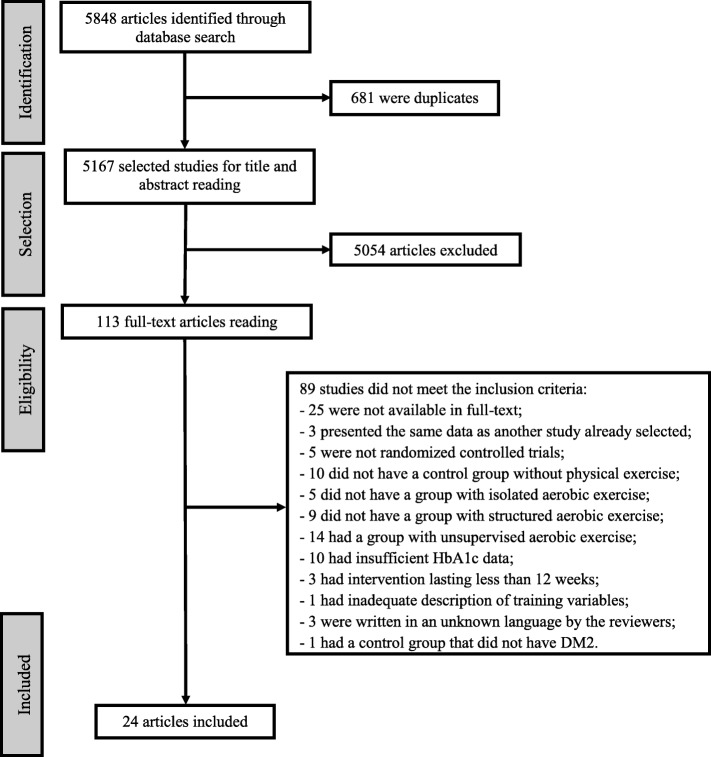
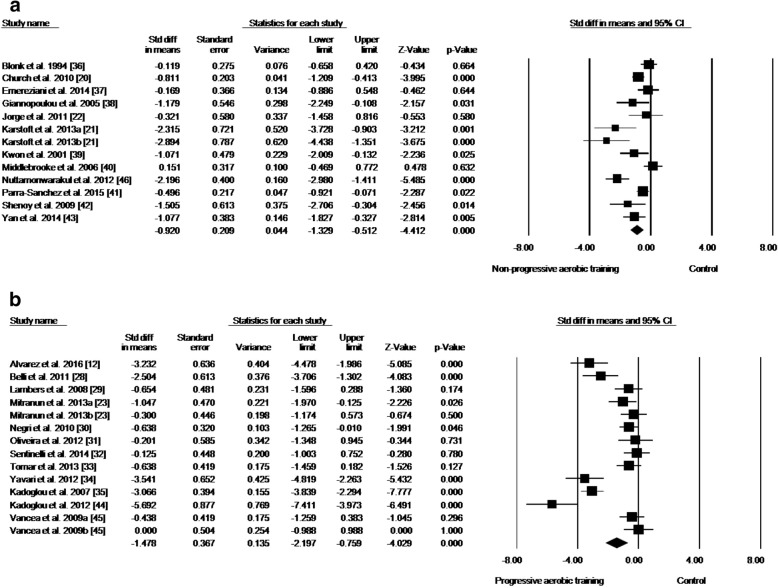
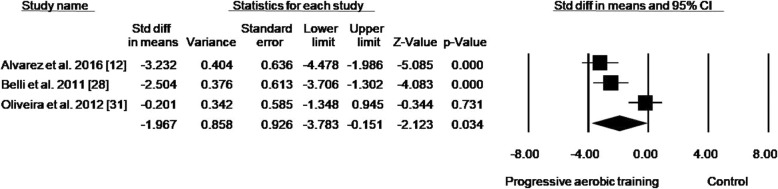
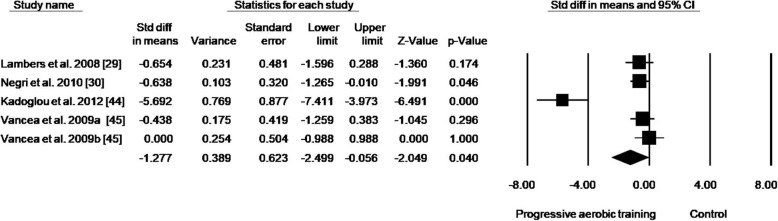
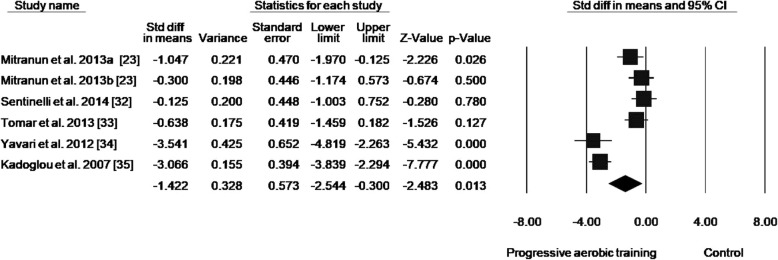
BACKGROUND: Aerobic training (AT) improves glycemic control in patients with type 2 diabetes. However, the role of the progression of training variables remains unclear. The objective of this review was to analyze the effects of progressive AT (PAT) and non-progressive AT (NPAT) on glycated hemoglobin (HbA1c) in patients with type 2 diabetes. METHODS: Data sources used were PubMed, Cochrane Central, Embase, SPORTDiscus, and LILACS. Studies that evaluated the effect of at least 12 weeks of PAT and NPAT compared to a control condition on HbA1c levels in type 2 diabetes patients were eligible for analysis. Two independent reviewers screened the search results, extracted the data, and assessed the risk of bias. Effect sizes (ESs) were calculated using the standardized mean difference in HbA1c levels between the intervention and control groups using a random-effect model. RESULTS: Of 5848 articles retrieved, 24 randomized clinical trials (825 participants) were included. Among the included studies, 92% reported to have performed a randomization process, 8% presented allocation concealment, 21% reported blinding of outcome assessment, and 38% reported complete outcome data. AT reduced HbA1c levels by 0.65% (ES: - 1.037; 95% confidence interval [CI]: - 1.386, - 0.688; p < 0.001). The reduction in HbA1c induced by PAT was 0.84% (ES: - 1.478; 95% CI - 2.197, - 0.759; p < 0.001), and NPAT was 0.45% (ES: - 0.920; 95% CI - 1.329, - 0.512; p < 0.001). Subgroup analysis of the different forms of progression showed a reduction in HbA1c levels of 0.94% (ES: - 1.967; 95% CI - 3.783, - 0.151; p = 0.034) with progression in volume, 0.41% (ES: - 1.277; 95% CI - 2.499, - 0.056; p = 0.040) with progression in intensity, and 1.27% (ES: - 1.422; 95% CI - 2.544, - 0.300; p = 0.013) with progression in both volume and intensity. Subgroup analysis of the different modalities of AT showed a reduction of 0.69% (ES: - 1.078; 95% CI - 1.817, - 0.340; p = 0.004) with walking and/or running and of 1.12% (ES: - 2.614; 95% CI - 4.206, - 1.022; p = 0.001) with mixed protocols while progressive training was adopted. In non-progressive protocols, a significant HbA1c reduction was only found with walking and/or running (- 0.43%; ES: - 1.292; 95% CI - 1.856, - 0.72; p < 0.001). CONCLUSION: The effect of PAT on glycemic control was greater than that of NPAT, especially when volume and intensity were progressively incremented throughout the interventions.
Overview
The claims and statistics of this paper haven’t been checked yet.
Free: it reads the open-access text and checks the first 5 claims that cite a source we can check. Create a free account to check every claim.
Integrity signals
Registry
Cites
Statistics
Figures
Verification
Claims the paper makes
The claims and statistics of this paper haven’t been checked yet.
Free: it reads the open-access text and checks the first 5 claims that cite a source we can check. Create a free account to check every claim.
Claims other papers make about this one
Each is checked against this paper’s own text: does it say what the citing paper says it does?
The source backs part of the claim, not all of it — or backs it for a different population, condition or comparison.
In the citing paper
“Regular aerobic exercise (i.e., involving large muscle groups and rhythmic in nature) improves glycemic management in adults with type 2 diabetes, resulting in less daily time in hyperglycemia and reductions of 7 mmol/mol ( 0.6%) in HbA1c (118)”
From Management of Hyperglycemia in Type 2 Diabetes, 2022. A Consensus Report by the American Diabetes Association (ADA) and the European Association for the Study of Diabetes (EASD) (2022) · cites this paper as [118]
Experimental — accuracy not yet measuredThe cited source says what the claim attributes to it.
In the citing paper
“Progressively increasing the duration and intensity of aerobic exercise can lead to further improvements in A1c.”
From The Impact of Physical Activity in Patients With Type 2 Diabetes (2025) · cites this paper as [42]
In the citing paper
“a meta-analysis evaluating progression of aerobic training in duration and intensity, initially from 20-60 minutes and increased to 30-90 minutes by the end of the intervention, noted an improvement in A1c of 0.84% compared to the no exercise group after an average of 12-16 weeks, while no change in aerobic training yielded a significant decrease in A1c of 0.45% compared to the control group.”
From The Impact of Physical Activity in Patients With Type 2 Diabetes (2025) · cites this paper as [42]
Self-check
Percentages, sums and reported differences re-computed from the paper’s own numbers.
The self-check needs the paper’s full text.
Citations
Cites
Preferred Reporting Items for Systematic Reviews and Meta-Analyses: the PRISMA statement
Moher, D., Liberati, A., Tetzlaff, J., Altman, D. G., & for the PRISMA Group (2009) · BMJ · doi:10.1136/bmj.b2535 · Cited by 83,823
Bias in meta-analysis detected by a simple, graphical test
Egger, M., Smith, G. D., Schneider, M., & Minder, C. (1997) · BMJ · doi:10.1136/bmj.315.7109.629 · Cited by 56,722
Preferred reporting items for systematic reviews and meta-analyses: the PRISMA Statement.
(2009) · PubMed Central · Cited by 44,859
Preferred reporting items for systematic reviews and meta-analyses: The PRISMA statement
Moher, D., Liberati, A., Tetzlaff, J., Altman, D. G., & the PRISMA Group* (2009) · Annals of Internal Medicine · doi:10.7326/0003-4819-151-4-200908180-00135 · Cited by 37,554
The metabolic syndrome—a new worldwide definition
Alberti, K. G. M., Zimmet, P., & Shaw, J. (2005) · The Lancet · doi:10.1016/s0140-6736(05)67402-8 · Cited by 9,352
Physical activity/exercise and diabetes: A position statement of the American Diabetes Association
Colberg, S. R., Sigal, R. J., Yardley, J. E., Riddell, M. C., Dunstan, D. W., Dempsey, P. C., Horton, E. S., Castorino, K., & Tate, D. F. (2016) · Diabetes Care · doi:10.2337/dc16-1728 · Cited by 2,991
Umpierre, D. (2011) · JAMA · doi:10.1001/jama.2011.576 · Cited by 1,358
Booth, G., & Cheng, A. Y. Y. (2013) · Canadian Journal of Diabetes · doi:10.1016/j.jcjd.2013.01.010 · Cited by 1,220
Church, T. S., Blair, S. N., Cocreham, S., Johannsen, N., Johnson, W., Kramer, K., Mikus, C. R., Myers, V., Nauta, M., Rodarte, R. Q., et al. (2010) · JAMA · doi:10.1001/jama.2010.1710 · Cited by 944
Cheng, A. Y. Y. (2013) · Canadian Journal of Diabetes · doi:10.1016/j.jcjd.2013.01.009 · Cited by 728
Research works printed but not linked: 1
- Nuttamonwarakul A Amatyakul S Suksom D Twelve weeks of aqua-aerobic exercise improve physiological adaptations and glycemic control in elderly patients with type 2 diabetes JEP Online 2012 15 2 64 70
Cited by
Davies, M. J., Aroda, V. R., Collins, B. S., Gabbay, R. A., Green, J., Maruthur, N. M., Rosas, S. E., Del Prato, S., Mathieu, C., Mingrone, G., et al. (2022) · Diabetes Care · doi:10.2337/dci22-0034 · Cited by 2,104
Davies, M. J., Aroda, V. R., Collins, B. S., Gabbay, R. A., Green, J., Maruthur, N. M., Rosas, S. E., Del Prato, S., Mathieu, C., Mingrone, G., et al. (2022) · Diabetologia · doi:10.1007/s00125-022-05787-2 · Cited by 1,048
Jayedi, A., Emadi, A., & Shab-Bidar, S. (2022) · Sports Medicine · doi:10.1007/s40279-022-01673-4 · Cited by 47
Sarcopenia and type 2 diabetes: Pathophysiology and potential therapeutic lifestyle interventions
Marcotte‐Chénard, A., Oliveira, B., Little, J. P., & Candow, D. G. (2023) · Diabetes & Metabolic Syndrome Clinical Research & Reviews · doi:10.1016/j.dsx.2023.102835 · Cited by 47
Mengidentifikasi Faktor Gizi Pada Pasien Diabetes Mellitus Tipe 2 Di Kota Depok Tahun 2019
Istianah, I., Septiani, S., & Dewi, G. K. (2020) · Jurnal Kesehatan Indonesia · Cited by 33
de Lima, W. P., Lima, C. A., dos Santos, R. B., Soares, W. J. D. S., & Perracini, M. R. (2020) · Revista Brasileira de Geriatria e Gerontologia · doi:10.1590/1981-22562020023.190255 · Cited by 25
Impact of metformin treatment on cobalamin status in persons with type 2 diabetes
Fituri, S., Akbar, Z., & Ganji, V. (2023) · Nutrition Reviews · doi:10.1093/nutrit/nuad045 · Cited by 27
Lecce, E., Bellini, A., Greco, G., Martire, F., di Palumbo, A. S., Sacchetti, M., & Bazzucchi, I. (2025) · The Journal of Physiology · doi:10.1113/jp287589 · Cited by 25
Heberle, I., de Barcelos, G. T., Silveira, L. M. P., Costa, R. R., Gerage, A. M., & Delevatti, R. S. (2020) · Diabetes Research and Clinical Practice · doi:10.1016/j.diabres.2020.108581 · Cited by 24
Self-citationAbdollahi, M., Marandi, S. M., Ghaedi, K., Safaeinejad, Z., Kazeminasab, F., Shirkhani, S., Sanei, M. H., Rezvanian, P., & Nasr‐Esfahani, M. H. (2022) · Oxidative Medicine and Cellular Longevity · doi:10.1155/2022/5318245 · Cited by 21
Magkos, F., Reeds, D. N., & Mittendorfer, B. (2022) · Physiological Reviews · doi:10.1152/physrev.00015.2022 · Cited by 21
Nemati, S., Tadıbı, V., & Hoseini, R. (2022) · BMC Nutrition · doi:10.1186/s40795-022-00538-3 · Cited by 18
The Impact of Physical Activity in Patients With Type 2 Diabetes
Bassin, S. R., & Srinath, R. (2025) · American Journal of Lifestyle Medicine · doi:10.1177/15598276231180541 · Cited by 17
Hodgson, W., Kirk, A. F., Lennon, M., & Paxton, G. (2021) · International Journal of Environmental Research and Public Health · doi:10.3390/ijerph182111598 · Cited by 16
Delevatti, R. S., Reichert, T. L., Bracht, C. G., Lisboa, S. C., Marson, E. C., Costa, R. R., Kanitz, A. C., Bones, V., Stein, R., & Kruel, L. F. M. (2022) · Journal of Physical Activity and Health · doi:10.1123/jpah.2022-0016 · Cited by 15
Self-citationType 2 Diabetes: Etiology, Epidemiology, Pathogenesis, and Treatment
Burns, C., & Francis, N. (2023) · Springer eBooks · doi:10.1007/978-3-031-40116-9_34 · Cited by 14
Are strategies to increase muscle mass and strength as effective in people with type 2 diabetes?
Al-Awadi, A. A., Gray, S. R., & Al‐Ozairi, E. (2025) · Reviews in Endocrine and Metabolic Disorders · doi:10.1007/s11154-025-09947-8 · Cited by 12
Igarashi, Y., Akazawa, N., & Maeda, S. (2021) · Endocrine · doi:10.1007/s12020-021-02817-8 · Cited by 12
Kujala, U. M. (2021) · medRxiv · doi:10.1101/2021.02.11.21251608 · Cited by 11
Igarashi, Y., Akazawa, N., & Maeda, S. (2023) · International Journal of Sport Nutrition and Exercise Metabolism · doi:10.1123/ijsnem.2022-0217 · Cited by 10
Guo, X., Guo, S., Zhang, H., & Li, Z. (2022) · Journal of Clinical Medicine · doi:10.3390/jcm11154257 · Cited by 8
Sheraz, S., Malik, A. N., Ferraro, F., & Siddiqi, F. A. (2024) · Physiotherapy Research International · doi:10.1002/pri.2127 · Cited by 6
Sutiono, A., & Purwito, D. (2021) · Adi Husada Nursing Journal · doi:10.37036/ahnj.v6i2.170 · Cited by 6
Delevatti, R. S., Santiago, É., Kanitz, A. C., Marson, E. C., Reichert, T. L., Bones, V., & Kruel, L. F. M. (2024) · The Journal of Sports Medicine and Physical Fitness · doi:10.23736/s0022-4707.24.15918-x · Cited by 5
Self-citationChoi, N. G., DiNitto, D. M., Sullivan, J. E., & Choi, B. Y. (2020) · Journal of Aging and Physical Activity · doi:10.1123/japa.2019-0338 · Cited by 5
Delevatti, R. S., Leonel, L. D. S., Silveira-Rodrigues, J. G., Kanitz, A. C., Alberton, C. L., Lovatel, G. A., Siqueira, I. R., & Kruel, L. F. M. (2024) · International Journal of Environmental Research and Public Health · doi:10.3390/ijerph21070938 · Cited by 5
Self-citationDelevatti, R. S., Leonel, L. D. S., & Wolin, I. A. V. (2024) · Medical Hypotheses · doi:10.1016/j.mehy.2024.111379 · Cited by 5
Self-citationDelevatti, R. S., Leonel, L. D. S., Schuch, F. B., Marson, E. C., Lisboa, S. C., Reichert, T. L., Kanitz, A. C., Bones, V., & Kruel, L. F. M. (2025) · Mental health and physical activity · doi:10.1016/j.mhpa.2025.100670 · Cited by 4
Self-citationStrohacker, K. A., & Beaumont, C. T. (2020) · Kinesiology Review · doi:10.1123/kr.2019-0051 · Cited by 4
Larsen, A. T., Melander, S. A., Mohamed, K. E., Petersen, E. A., Benmarce, M., Karsdal, M. A., & Henriksen, K. (2025) · Biomedicine & Pharmacotherapy · doi:10.1016/j.biopha.2025.118388 · Cited by 3
Type 2 Diabetes-Etiology, Epidemiology, Pathogenesis, Treatment
Burns, C., & Francis, N. (2023) · Springer eBooks · doi:10.1007/978-3-319-12125-3_34-3 · Cited by 3
Hodgson, W., Kirk, A. F., Lennon, M., Janssen, X., & Kennedy, D. (2026) · JMIR Diabetes · doi:10.2196/91073 · Cited by 2
Prado, A. K. G., Delevatti, R. S., & Monteiro, E. P. (2022) · Corpoconsciência · doi:10.51283/rc.v26i3.14445 · Cited by 2
Self-citationShen, Y., Yu, L., Hua, Z., Jia, N., Zhou, Y., Dong, X., & Ding, M. (2021) · Medicine · doi:10.1097/md.0000000000023963 · Cited by 2
Editorial: Type 2 diabetes therapeutics: weight loss and other strategies
Magkos, F., & Mittendorfer, B. (2022) · Current Opinion in Clinical Nutrition & Metabolic Care · doi:10.1097/mco.0000000000000839 · Cited by 2
Seok, J., & Lee, Y. (2024) · Nutrition Research and Practice · doi:10.4162/nrp.2024.18.2.239 · Cited by 1
Mortensen, S. R., Mork, P. J., Skou, S. T., Kongsvold, A., Åsvold, B. O., Nilsen, T. I. L., & Skarpsno, E. S. (2024) · Journal of Activity Sedentary and Sleep Behaviors · doi:10.1186/s44167-024-00066-4 · Cited by 1
Hodgson, W., Kirk, A. F., Lennon, M., & Janssen, X. (2024) · JMIR Diabetes · doi:10.2196/60066 · Cited by 1
Costa, R. R., Barroso, B. M., Buttelli, A. C. K., Vieira, A., da Rocha, V. D. M. B., Reichert, T. L., Delevatti, R. S., Kanitz, A. C., & Kruel, L. F. M. (2025) · Scientific Reports · doi:10.1038/s41598-025-28533-1 · Cited by 1
Self-citationLourenço, C. L. M. (2024) · LA Referencia (Red Federada de Repositorios Institucionales de Publicaciones Científicas) · doi:10.5281/zenodo.13765704 · Cited by 1
Amin, U., Adnan, Q. U. A., Ahmad, T., & Farooqui, S. I. (2024) · Journal of College of Physicians And Surgeons Pakistan · doi:10.29271/jcpsp.2024.11.1613 · Cited by 1
Gonçalves, M. P. D. F. (2021) · Portuguese National Funding Agency for Science, Research and Technology (RCAAP Project by FCT) · Cited by 1
Rodrigues, S. N. (2023) · LA Referencia (Red Federada de Repositorios Institucionales de Publicaciones Científicas) · Cited by 1
Bracht, C. G. (2019) · Americanae (AECID Library)
Self-citationInvestigation of Genetic and Behavioural Determinants of Type 2 diabetes and Glycaemic Traits
Cai, L. (2021) · Apollo (University of Cambridge) · doi:10.17863/cam.76395
Salavati, S., & Shariati, M. (2024) · doi:10.32592/jsmj.23.6.560
O Estudo ELSA-Brasil e a Atividade Física na Proteção Contra o Desenvolvimento de Diabetes Tipo 2
Delevatti, R. S., Leonel, L. D. S., & Franzoni, L. T. (2025) · Arquivos Brasileiros de Cardiologia · doi:10.36660/abc.20250464
Self-citationThe ELSA-BRASIL Study and Physical Activity in Protecting Against the Development of Type 2 Diabetes
Delevatti, R. S., Leonel, L. D. S., & Franzoni, L. T. (2025) · Arquivos Brasileiros de Cardiologia · doi:10.36660/abc.20250464i
Self-citationVerch, R. (2024) · publish.UP (University of Potsdam) · doi:10.25932/publishup-63424
Bracht, C. G. (2023) · LA Referencia (Red Federada de Repositorios Institucionales de Publicaciones Científicas)
Self-citationDelevatti, R. S., Rodrigues, S. N., & Alberton, C. L. (2026) · Chronic Diseases and Translational Medicine · doi:10.1002/cdt3.70039
Self-citationMisytė, G. (2024) · Lithuanian University of Health Sciences
Vidor, R. B. (2025) · DSpace (Federal University of Santa Catarina)
The Effect of Aerobic Exercises on Pain in Patients with Painful Diabetic Peripheral Neuropathy
Kanwal, S., Waqas, M. S., Afzal, H., Masood, M. A. H., Rafiq, S., & Mehmood, S. (2025) · Esculapio · doi:10.51273/esc25.251321243
do Amaral, M. B. (2025) · DSpace (Federal University of Santa Catarina)
Ren, W., Chen, Z., Wang, J., & Yang, S. (2026) · Diabetes Research and Clinical Practice · doi:10.1016/j.diabres.2026.113393
Tam, K., & Lund, H. (2026) · Springer eBooks · doi:10.1007/978-3-031-90919-1_22-1
Exercise and physical activity interventions in type 2 diabetes mellitus
Su, W., Li, X., Gou, H., Yuan, L., Lin, L., Lin, X., Wang, X., Xiong, Y., & Luan, Y. (2026) · Frontiers in Endocrinology · doi:10.3389/fendo.2026.1887543
Schneider, V. M., Silva, L. D. L., Carvalho, G., Lemes, G., Pereira, D. M., & Ferrari, R. (2026) · Journal of Human Hypertension · doi:10.1038/s41371-026-01217-7
Metadata
- Authors
- Delevatti, R. S., Bracht, C. G., Lisboa, S. D. C., Costa, R. R., Marson, E. C., Netto, N., & Kruel, L. F. M.
- Affiliations
- Universidade Federal do Rio Grande do Sul (BR)
- Corresponding author
- Delevatti, Rodrigo Sudatti
- ORCID
- Venue
- Sports Medicine - Open
- Published
- 2019-06-07
- Volume
- 5
- Issue
- 1
- Pages
- 22-22
- ISSN
- 2198-9761 (ISSN-L)
- 2199-1170
- PMC
- PMC6555839
- OpenAlex
- W2948688072
- Cited by
- 46
- References
- 53
- Citations by year
- 2026: 7 · 2025: 7 · 2024: 7 · 2023: 6 · 2022: 10 · 2021: 5 · 2020: 4
- FWCI
- 0.56
- Type
- journal article
- Language
- en
- Open access
- gold
- doi.org
- Licence
- cc-by
- creativecommons.org/licenses/by/4.0 (tdm)
- creativecommons.org/licenses/by/4.0 (vor)
- Locations
- Sports Medicine - Open (publishedVersion, cc-by)
- Europe PMC (PubMed Central) (publishedVersion, cc-by)
- PubMed Central (publishedVersion, cc-by)
- PubMed (publishedVersion)
- Topics
- Health Sciences › Medicine › Public Health, Environmental and Occupational Health › Physical Activity and Health
- Health Sciences › Medicine › Physiology (medical) › Cardiovascular and exercise physiology
- Health Sciences › Medicine › Endocrinology, Diabetes and Metabolism › Diabetes Management and Research
- Keywords
- aerobic exercise, type 2 diabetes, glycemic control, HbA1c, exercise progression, training volume, exercise intensity, exercise intervention, blood glucose variability, insulin sensitivity, glycemic variability, HOMA-IR, blood pressure, heart rate variability, blood pressure variability
About these checks
Registry, retraction, Cites and statistics results are computed, not judged, with one exception: a printed reference that no index lists is read once by a model before it counts as a citation error. Claims are extracted by a model and kept only when their quote appears verbatim in the text; each cited source is then checked, with a model’s help, for whether it says what the claim relies on. Those verdicts can be wrong — read the claim’s quote and the cited source before relying on one.
Statistics and arithmetic are recomputed, not judged.
Confidence bands are shown only for fields calibrated on our annotated test set. None is calibrated yet, so no band is shown.
What counts as a claim ›How we measure confidence ›How we check this ›
Are you an author, or do you see a problem with this page? Request a review
Data sources
Bibliographic data: Semantic Scholar, OpenAlex, Crossref.
Contains information from the Semantic Scholar Academic Graph Datasets, made available under the ODC Attribution License (ODC-BY 1.0).
Semantic Scholar’s data is described in: Kinney, R., et al. (2023). The Semantic Scholar Open Data Platform. arXiv:2301.10140.
