

Ecological understanding of foreign language speaking anxiety: emerging patterns and dynamic systems
Open accessThe DOI matches its Crossref record; 70 of the 72 references it cites were found in a registry or an index; none of the 19 sources its claims cite is checked for support yet.
Abstract
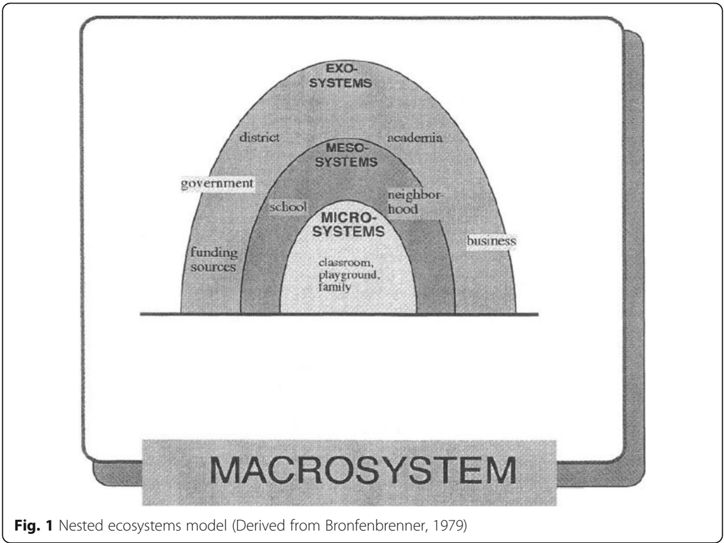
Anxiety in speaking English is a critical affective reaction to second language acquisition. Moreover, language learning is an emotionally dynamic process which produces fluctuations in learners’ speaking anxiety. Therefore, this case study was designed to investigate English as a foreign language (EFL) learners’ speaking anxiety from an ecological perspective based on nested ecosystems model and complex dynamic system theory. Four intermediate level female students with an average age of 15 were selected and participated in this study. Data were collected via semi-structured interviews recorded by the researchers over five classroom sessions, non-participant classroom observation and Motometers to provide information regarding the dynamics of students’ anxiety during these 5 sessions. The data were qualitatively content analyzed. Based on (Bronfenbrenner, The ecology of human development, 1979; Bronfenbrenner, The ecology of cognitive development: Research models and fugitive findings, 1993 ) nested ecosystems model, the emergence of learners’ speaking anxiety were categorized and analyzed first at the level of microsystem in terms of learners’ beliefs, motivation, cognitive factors, linguistic factors, affective factors, and classroom environment. Afterwards, the participants’ anxiety within three ecosystems including meso-, exo-, and macrosystems were also discussed as they were offered by the collected data. Learners’ anxiety was also analyzed based on the dynamic patterns of stability and variation in the participants’ micro development. The findings contributed evidence to the ecological understanding of the patterns and variables involved in learners’ speaking anxiety variation in light of the interaction of the individual and environmental factors.
Overview
CoChat Summary
TL;DR
This case study uses Bronfenbrenner’s nested ecosystems model and complex dynamic systems theory to examine four Iranian EFL learners’ speaking anxiety across five 90-minute classroom sessions. It finds that speaking anxiety emerges from interacting micro-, meso-, exo-, and macrosystem factors and fluctuates within sessions, with speaking tests acting as a strong attractor state.
Key findings
- At the microsystem level, cognitive, linguistic, affective, and classroom-environment factors shaped anxiety: lack of topical knowledge, vocabulary gaps, public speaking and peer judgment, teacher style/methods, task enjoyment, and peer work. All four participants showed high anxiety when speaking in public and facing peers’ judgment; Parisa reported classmates laughing at her mistakes, while Yasaman said she did not care and would not give up.
- Mesosystem factors included past learning experiences and family pressure: Parisa’s high-school classmates made fun of her mistakes, and Maryam and Parisa reported high family pressure to study English; Yasaman and Sara reported lower speaking anxiety because they loved English. Exosystem/macrosystem factors included curriculum design, course assessment, speaking tests by the supervisor, prevention of L1 use, Iranian university entrance exam priorities, and competition-based schooling. Speaking tests were the most anxiety-producing activity, and all participants agreed they preferred tests by their own teacher.
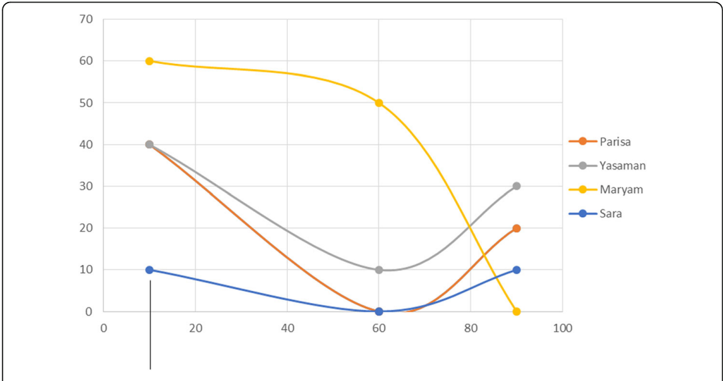
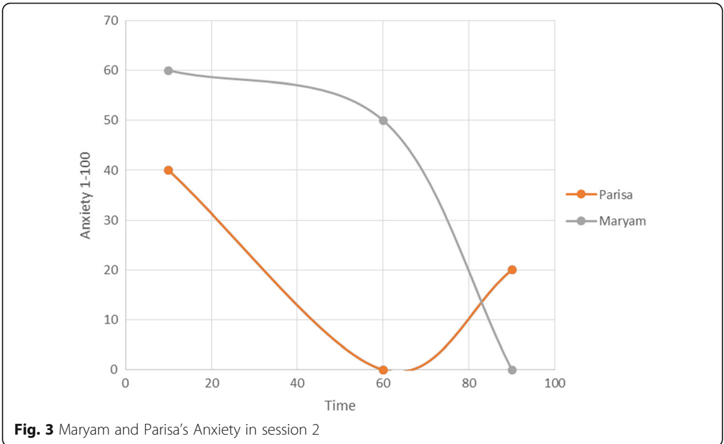
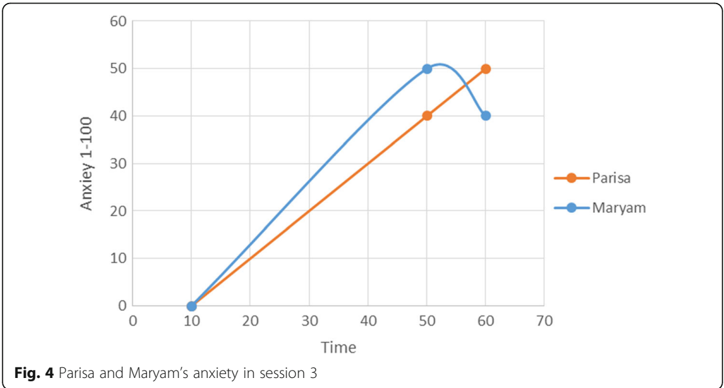
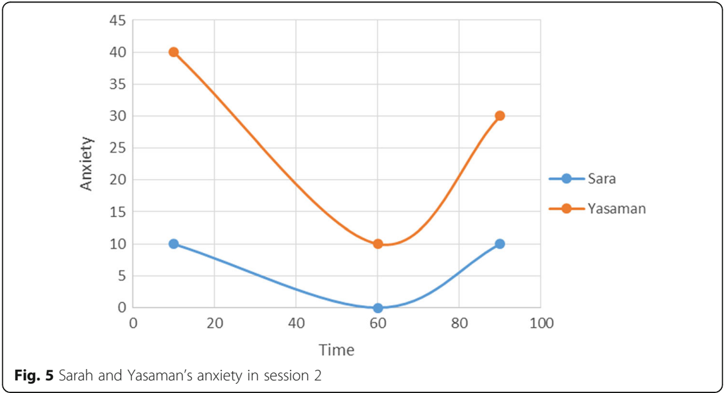
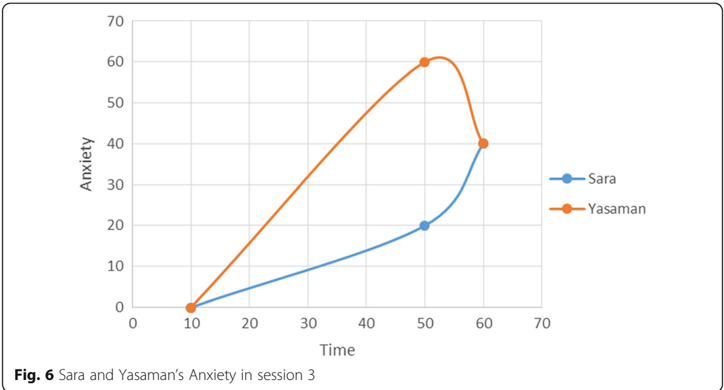
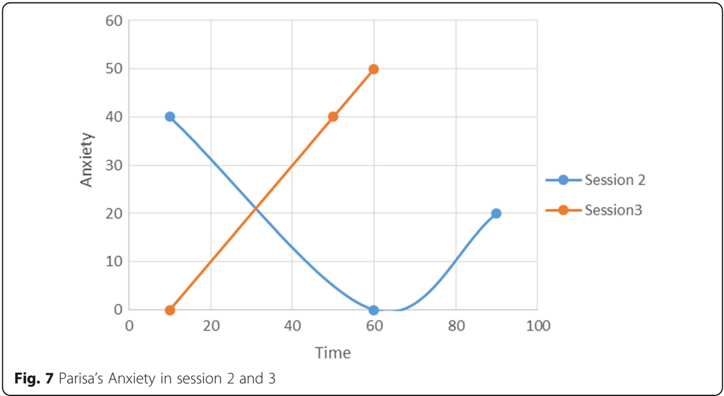
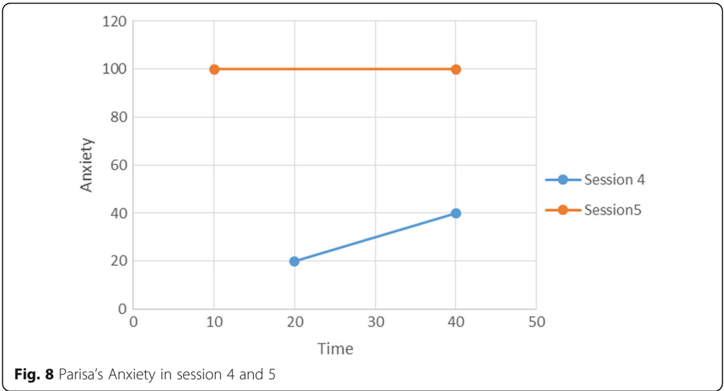
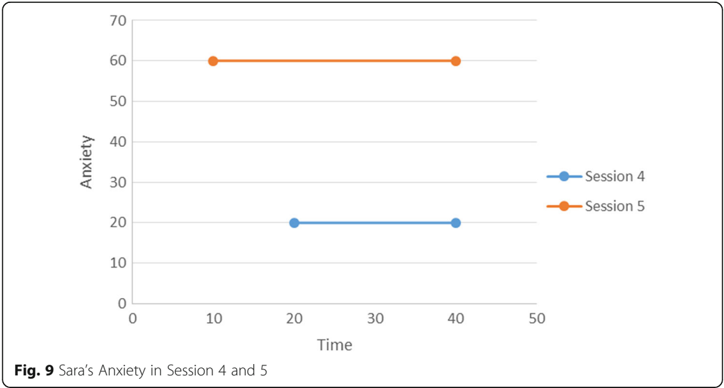
- Dynamic patterns showed within-session fluctuations: in session 2, Parisa and Maryam began with high anxiety, decreased, then Parisa had a sudden rise at minute 65 while Maryam showed a falling trend; in session 3, both started at zero anxiety but rose with the new unreal conditional grammar, and Maryam’s anxiety fell at minute 52 after success and positive teacher feedback. In session 5, a speaking test produced stable high anxiety for all participants, acting as an attractor state; high-anxious students could be relaxed when low-anxious students were anxious, supporting nonlinearity.
Methods
- Case study of four intermediate female EFL learners, average age 15, selected from a group of sixteen learners in an Iranian English institute in Mashhad after three sessions of class observation and consultation with the teacher.
- Data collected January–February 2016 via semi-structured interviews after each of five 90-minute classroom sessions, non-participant classroom observation, and motometers: 0–100 self-rated anxiety marked every 10 minutes, with a comment section for reasons. Interviews were conducted in Persian, digitally recorded, transcribed, and translated by the authors.
- Qualitative content analysis using MAXQDA; coding and themes were based on Bronfenbrenner’s ecosystem model and CDST. Motometer data were entered into Excel graphs with time in 10-minute steps on the horizontal axis and anxiety level on the vertical axis; observation notes and participant comments provided context.
Limitations
- The paper states it aimed to provide an exploratory, emic analysis rather than a “short-cut generalizable solution” to reduce speaking anxiety, and it argues four cases were sufficient for the ecological purpose because a bounded case is investigated over time.
- Evident from the text: the sample is very small (four female learners, average age 15, from one Iranian English institute and one intermediate course), so findings are not generalizable to other learners or contexts.
- Evident from the text: the study relies on self-report motometer ratings, interviews, and non-participant observation over five sessions in January–February 2016, with no quantitative statistical testing or discussion of possible self-report/reactivity bias.
Model-written summary. Check it against the paper before relying on it.
Integrity signals
Registry
Cites
Statistics
Figures
Verification
Claims the paper makes
0 Valid · 0 Not valid · 18 Not checked · 49 Own results and interpretations
A result the paper reports from its own data — it cites no other source for it, so there is none to check. The quote shows it is in the paper.
In the paper
“Linguistic factors such as lack of rich vocabulary box were reported in some cases to increase anxiety.”
§ Ecological understanding of foreign language speaking anxiety: emerging patterns and dynamic systems > At the microsystem level
hedgedstates a cause- Asserted: passes — The authors put it forward as true.
- Checkable: passes — It can be checked against evidence.
- Load-bearing: unclear — It is unclear whether the paper’s conclusions depend on it.
- Based: passes — The paper gives a reason why it holds.
A result the paper reports from its own data — it cites no other source for it, so there is none to check. The quote shows it is in the paper.
In the paper
“Teachers' factor containing styles, methods, and classroom procedures were reported to have an influence on the classroom environment.”
§ Ecological understanding of foreign language speaking anxiety: emerging patterns and dynamic systems > Classroom environment
plainstates a possible cause- Asserted: passes — The authors put it forward as true.
- Checkable: passes — It can be checked against evidence.
- Load-bearing: unclear — It is unclear whether the paper’s conclusions depend on it.
- Based: passes — The paper gives a reason why it holds.
A result the paper reports from its own data — it cites no other source for it, so there is none to check. The quote shows it is in the paper.
In the paper
“The context which learners speak in seems to be very effective as reflected in Sara's interview”
§ Ecological understanding of foreign language speaking anxiety: emerging patterns and dynamic systems > Classroom environment
boostedstates an associationSingle case- Asserted: passes — The authors put it forward as true.
- Checkable: passes — It can be checked against evidence.
- Load-bearing: unclear — It is unclear whether the paper’s conclusions depend on it.
- Based: passes — The paper gives a reason why it holds.
A result the paper reports from its own data — it cites no other source for it, so there is none to check. The quote shows it is in the paper.
In the paper
“Also, in line with the principles of dynamic systems, EFL learners' general or trait anxiety cannot always predict their level of anxiety patterns.”
§ Ecological understanding of foreign language speaking anxiety: emerging patterns and dynamic systems > Discussion
plain- Asserted: passes — The authors put it forward as true.
- Checkable: passes — It can be checked against evidence.
- Load-bearing: passes — The paper’s conclusions depend on it.
- Based: passes — The paper gives a reason why it holds.
- Rests on an assumption not shown here.
A result the paper reports from its own data — it cites no other source for it, so there is none to check. The quote shows it is in the paper.
In the paper
“The learners expressed that speaking tests are the most anxiety raising activities every semester.”
§ Ecological understanding of foreign language speaking anxiety: emerging patterns and dynamic systems > At the exosystem level
plain- Asserted: passes — The authors put it forward as true.
- Checkable: passes — It can be checked against evidence.
- Load-bearing: passes — The paper’s conclusions depend on it.
- Based: passes — The paper gives a reason why it holds.
15 more claims
Create a free account to see all 67 claims and to verify the 14 references still open.
- Probably not a substantial claim. 30
- It may state two separate claims as one. 24
- The quote only partly states this claim. 7
Self-check
Percentages, sums and reported differences re-computed from the paper’s own numbers.
Each contradiction between two passages listed here was confirmed by an independent check.
Rated major: it would touch a result — a value a result rests on, reported and recomputed p-values on opposite sides of the significance level, two passages that conflict with no sign which is right, or a cited work retracted before this paper was published.
In the paper
§ Ecological understanding of foreign language speaking anxiety: emerging patterns and dynamic systems > Discussion
“In addition, using new expressions and words is another linguistic factor which appeared progressive for low-anxious students and debilitating for the highly anxious ones.”
§ Ecological understanding of foreign language speaking anxiety: emerging patterns and dynamic systems > At the microsystem level
“Applying new expressions and words as another linguistic factor was reported to raise anxiety; Maryam, a low-anxious participant, called them speaking-improvement leaders but their use produces anxiety (Interview 4, January, 2016).However, Parisa, a highly anxious student, asserted that using non-repetitive expressions and ideas increases her self-confidence and; as a consequence, reduces her anxiety”
Rated minor: it would not touch a result — a value no result rests on, a p-value that stays on the same side of the significance level, or a conflict that is clerical, resolved elsewhere in the paper, or outside its own findings.
In the paper
§ Ecological understanding of foreign language speaking anxiety: emerging patterns and dynamic systems > At the microsystem level
“The most prevalent one was speaking in public and peers' judgment.All four participants showed high anxiety in this case.”
§ Ecological understanding of foreign language speaking anxiety: emerging patterns and dynamic systems > At the microsystem level
“In contrast, Yasaman who revealed no anxiety while observing, reported: "I don't care, let them laugh, I won't give up"”
Rated minor: it would not touch a result — a value no result rests on, a p-value that stays on the same side of the significance level, or a conflict that is clerical, resolved elsewhere in the paper, or outside its own findings.
In the paper
§ Ecological understanding of foreign language speaking anxiety: emerging patterns and dynamic systems > Stability
“at the beginning of session 2, all the participants' anxiety was high as the teacher started the class with review questions of the previous session.”
§ Ecological understanding of foreign language speaking anxiety: emerging patterns and dynamic systems > Between participants' change
“Initiating the class with low levels of anxiety, she ended up the oral activities in this session with slight rise in anxiety.”
Rated minor: it would not touch a result — a value no result rests on, a p-value that stays on the same side of the significance level, or a conflict that is clerical, resolved elsewhere in the paper, or outside its own findings.
In the paper
§ Ecological understanding of foreign language speaking anxiety: emerging patterns and dynamic systems > Participants
“we selected four female participants with an average age of 15 from a group of sixteen adults”
§ Ecological understanding of foreign language speaking anxiety: emerging patterns and dynamic systems > Conclusion
“| Age: 15 | | |”
Citations
Cites
The Ecology of Human Development: Experiments by Nature and Design
Bronfenbrenner, U. (1979) · Harvard University Press eBooks · doi:10.4159/9780674028845 · Cited by 26,084
Corsaro, W. A., & Bourdieu, P. (1992) · Social Forces · doi:10.2307/2579985 · Cited by 9,964
Foreign Language Classroom Anxiety
HORWITZ, E. K., HORWITZ, M. B., & COPE, J. (1986) · The Modern Language Journal · doi:10.1111/j.1540-4781.1986.tb05256.x · Cited by 9,773
The Ecology of Human Development: Experiments by Nature and Design
Bronfenbrenner, U. (1981) · Harvard University Press eBooks · doi:10.2307/j.ctv26071r6 · Cited by 8,044
(2017) · Macat Library eBooks · doi:10.4324/9781912281732 · Cited by 4,703
Course in General Linguistics: Ferdinand de Saussure
(2013) · Bloomsbury Publishing Plc eBooks · doi:10.5040/9781350284968 · Cited by 2,695
Complexity: The Emerging Science at the Edge of Order and Chaos
Waldrop, M. M., & Stein, D. (1992) · Physics Today · doi:10.1063/1.2809917 · Cited by 2,622
Life in schools: an introduction to critical pedagogy in the foundations of education
(1989) · Choice Reviews Online · doi:10.5860/choice.26-6389 · Cited by 2,384
Complexity: The emerging science at the edge of order and chaos
(1996) · Long Range Planning · doi:10.1016/0024-6301(96)85336-2 · Cited by 2,052
Talk at Work: Interaction in Institutional Settings.
Hopper, R., Drew, P., & Heritage, J. (1994) · Contemporary Sociology · doi:10.2307/2076431 · Cited by 1,872
Research works printed but not linked: 5
- Arndt, H., & Janney‚ R. W. (1983). The duck-rabbit phenomenon: Notes on the disambiguation ofambiguous utterances.
- Cao, Y. (2009). An ecological view of situational willingness to communicate in a second language classroom. In H. Chen & K. Cruickshank (Eds.), Making a Difference: Challenges for Applied Linguistics (pp. 199-218). Newcastle: Cambridge Scholar Press.
- Humphries, R. (2011). Language anxiety in international students. Griffith Working Papers in Pragmatics and Intercultural Communication, 4(1/2), 65-77.
- Reeve, J. (2009). Understanding motivation and emotion (5th ed.). Toronto: Wiley.
- Saussure‚ F. (1983). Course in general linguistics. La Salle: Open Court.
Cited by
Factors generating anxiety when learning EFL speaking skills
Hanifa, R. (2018) · Studies in English Language and Education · doi:10.24815/siele.v5i2.10932 · Cited by 233
Elahi Shirvan, M., & Taherian, T. (2021) · International Journal of Bilingual Education and Bilingualism · doi:10.1080/13670050.2018.1441804 · Cited by 171
Derakhshan, A., & Associate Professor of Applied Linguistics, D. O. E. L. A. L. (2022) · Language Related Research · doi:10.52547/lrr.13.5.2 · Cited by 158
“In classroom contexts, the ecological approach addresses the relationships between the learners and all the psychological and emotional elements embedded in the ecology of the classroom (Kasbi & Elahi Shirvan, 2017).”
Exploring livestream English teaching anxiety in the Chinese context: An ecological perspective
Liu, H., Yan, C., & Fu, J. (2022) · Teaching and Teacher Education · doi:10.1016/j.tate.2021.103620 · Cited by 133
A Systematic Overview of Issues for Developing EFL Learners’ Oral English Communication Skills
Seraj, P. M. I., & Habil, H. (2021) · Journal of language and Education · doi:10.17323/jle.2021.10737 · Cited by 108
Zheng, C., Wang, L., & Chai, C. S. (2021) · Computer Assisted Language Learning · doi:10.1080/09588221.2021.1946562 · Cited by 98
Xu, W., Zhang, H., Sukjairungwattana, P., & Wang, T. (2022) · Frontiers in Psychology · doi:10.3389/fpsyg.2022.962492 · Cited by 94
A Review of Foreign Language Learners’ Emotions
Yu, Q. (2022) · Frontiers in Psychology · doi:10.3389/fpsyg.2021.827104 · Cited by 83
Ma, Y. (2022) · Frontiers in Psychology · doi:10.3389/fpsyg.2022.1002492 · Cited by 70
Shirvan, M. E., & Talebzadeh, N. (2020) · Eurasian Journal of Applied Linguistics · doi:10.32601/ejal.710194 · Cited by 68
Llerena, C. L. Á., Tamayo, M. R., & dos Santos, J. C. (2024) · Indonesian Journal of Applied Linguistics · doi:10.17509/ijal.v14i2.74889 · Cited by 47
Students’ Strategies to Overcome Public Speaking Anxiety
Martiningsih, I., Susilawati, E., & Rezeki, Y. S. (2024) · Inspiring English Education Journal · doi:10.35905/inspiring.v7i1.8766 · Cited by 41
An Ecological Study of Foreign Language Writing Anxiety in English as a Foreign Language Classroom
Saghafi, K., Adel, S. M. R., & Zareian, G. (2017) · Journal of Intercultural Communication Research · doi:10.1080/17475759.2017.1367954 · Cited by 39
AI-Powered Gamified Scaffolding: Transforming Learning in Virtual Learning Environment
Jiang, X., Wang, R., Hoang, T. N., Ranaweera, C., Dong, C., & Myers, T. (2025) · Electronics · doi:10.3390/electronics14132732 · Cited by 39
STRATEGIES TO OVERCOME FOREIGN LANGUAGE SPEAKING ANXIETY IN INDONESIAN EFL LEARNING CONTEXTS
Wijaya, K. F. (2023) · LLT Journal A Journal on Language and Language Teaching · doi:10.24071/llt.v26i1.4450 · Cited by 39
Abrar, M., Fajaryani, N., Habizar, H., Miftahudin, M., & Sokoy, M. (2022) · Indonesian Journal of EFL and Linguistics · doi:10.21462/ijefl.v7i1.457 · Cited by 34
Effects of Collaborative Learning on Young ESL Learners’ L2 Anxiety and Speaking Performance
Nhi, H. T. Y., Nguyen, T. B. N., Nguyen, N. L. D., & Tran, T. N. (2022) · International Journal of Asian Education · doi:10.46966/ijae.v3i2.286 · Cited by 32
THE STUDENTS’ SPEAKING ANXIETY ON THE YOUTUBE VIDEO PROJECT IN EFL LEARNING IN INDONESIA
Sari, A. B. P., & Iswahyuni, D. (2019) · Premise Journal of English Education · doi:10.24127/pj.v8i2.2179 · Cited by 31
Entrepreneurial anxiety: an empirical investigation in Bangladesh
Ukil, M. I. (2022) · Journal of Entrepreneurship in Emerging Economies · doi:10.1108/jeee-05-2022-0143 · Cited by 26
Is foreign language anxiety malleable? A systematic review of longitudinal observation studies
Sun, Q., Alhowail, A. M., & Beckmann, N. (2025) · System · doi:10.1016/j.system.2025.103782 · Cited by 25
Exploring Gender Differences in Public Speaking Anxiety
Hz, B. I. R. (2022) · Sawwa Jurnal Studi Gender · doi:10.21580/sa.v17i2.14295 · Cited by 23
Puyod, J. V., Sharma, S., Ajah, S., Chaisanrit, M., & Skuldee, B. (2020) · Human Behavior, Development and Society · Cited by 23
Ramdani, J. M., & Rahmat, R. (2018) · Indonesian Journal of Applied Linguistics · doi:10.17509/ijal.v8i2.13304 · Cited by 22
Changes in Language Learners’ Affect: A Complex Dynamic Systems Theory Perspective
Piniel, K., & Albert, Á. (2024) · Language Learning · doi:10.1111/lang.12686 · Cited by 21
Building beginners� self-confidence in speaking at private high school in Makassar
Rosmayanti, V., Ramli, R., & Rafiqa, R. (2023) · EduLite Journal of English Education Literature and Culture · doi:10.30659/e.8.1.192-208 · Cited by 21
Huang, F., Ge, X., Li, Y., & Tang, Z.-Q. (2025) · Innovation in Language Learning and Teaching · doi:10.1080/17501229.2025.2458638 · Cited by 19
Bailey, D., Almusharraf, N., & Bennett, F. (2023) · Education and Information Technologies · doi:10.1007/s10639-023-11986-0 · Cited by 18
Pérez, M. L., & Retamar, G. D. L. M. (2022) · DELTA Documentação de Estudos em Lingüística Teórica e Aplicada · doi:10.1590/1678-460x202238249046 · Cited by 16
Fekete, A. (2021) · Educational Role of Language Journal · doi:10.36534/erlj.2020.02.10 · Cited by 15
Oteir, I. N., & Al‐Otaibi, A. N. (2022) · International Journal of Innovative Research and Scientific Studies · doi:10.53894/ijirss.v5i4.1005 · Cited by 14
Muhsinin, M., Haerazi, H., & Rahman, A. N. (2025) · Indonesian Journal of EFL and Linguistics · doi:10.21462/ijefl.v10i1.850 · Cited by 14
Shirvan, M. E., Taherian, T., Kruk, M., & Pawlak, M. (2025) · Studies in Second Language Learning and Teaching · doi:10.14746/ssllt.45784 · Cited by 13
Students Anxiety in Speaking a Foreign Language. The Case of Eleventh Graders
Syahrani, A., Mastiyah, I., Martina, M., Asfar, D. A., Cakranegara, P. A., Lubna, S., & Anwar, S. (2024) · Journal of Education Culture and Society · doi:10.15503/jecs2024.1.201.212 · Cited by 13
Reducing Anxiety among EFL Learners through Gamification: An Empirical Study of Instructional Impact
Amnouychokanant, V. (2025) · International Journal of Learning Teaching and Educational Research · doi:10.26803/ijlter.24.9.5 · Cited by 13
Saying ‘au revoir’ to anxiety in a heartbeat: the benefits of virtual reality for language learning.
Thrasher, T. (2022) · Illinois Digital Environment for Access to Learning and Scholarship (University of Illinois at Urbana-Champaign) · Cited by 13
Muftah, M. Y. A., & Alhazmi, A. A. (2024) · Humanities and Social Sciences Communications · doi:10.1057/s41599-024-04006-0 · Cited by 11
Applying Non-Linguistic Frameworks for Investigating the Language Transfer
Nghi, T. T. (2020) · International Journal of English Language and Literature Studies · doi:10.18488/journal.23.2020.94.231.243 · Cited by 11
Altoeriqi, E. A. (2020) · International Journal of English Language and Literature Studies · doi:10.18488/journal.23.2020.94.276.285 · Cited by 11
AKKUŞ, Ş. (2021) · Language Teaching and Educational Research · doi:10.35207/later.892775 · Cited by 9
Maru, M. G., & Pajow, C. N. (2021) · Celt A Journal of Culture English Language Teaching & Literature · doi:10.24167/celt.v19i2.1118 · Cited by 9
Fekete, A. (2022) · Educational Role of Language Journal · doi:10.36534/erlj.2021.02.05 · Cited by 9
Ebadi, S., Aliabadi, R. B., & Ajabshir, Z. F. (2024) · Current Psychology · doi:10.1007/s12144-024-06143-w · Cited by 9
Firdaus, S. (2024) · Al-Ta rib Jurnal Ilmiah Program Studi Pendidikan Bahasa Arab IAIN Palangka Raya · doi:10.23971/altarib.v12i1.7353 · Cited by 8
Rahimi, M. (2023) · Vision Journal for Language and Foreign Language Learning · doi:10.21580/vjv13i118058 · Cited by 8
Kumari, S., & Rahman, M. M. (2024) · International Journal of English Language and Literature Studies · doi:10.55493/5019.v13i2.5042 · Cited by 7
Nhi, H. T. Y., Pham, H. H., & Tran, T. N. (2023) · International Journal of Asian Education · doi:10.46966/ijae.v4i2.335 · Cited by 7
Yazid, A., Ahmad, G., & Dewi, H. I. (2024) · International Journal of Educational Narratives · doi:10.70177/ijen.v2i5.1499 · Cited by 7
FLSP STUDENTS’ ANXIETY AND THEIR LEARNING STRATEGIES IN SPEAKING CLASS
Ghaniy, R. M. A. (2023) · Celtic A Journal of Culture English Language Teaching Literature and Linguistics · doi:10.22219/celtic.v10i1.25739 · Cited by 6
Ming-yan, M., Noordin, N. B., & Razali, A. B. (2024) · International Journal of Academic Research in Progressive Education and Development · doi:10.6007/ijarped/v13-i4/23894 · Cited by 6
Doğan, D. N., Doğan, D. N., & Dogan, S. (2023) · European Journal of English Language Teaching · doi:10.46827/ejel.v8i5.5039 · Cited by 6
Noorashid, N., & Jamil, H. (2024) · Electronic Journal of Foreign Language Teaching · doi:10.56040/nnhj2123 · Cited by 6
UNDERSTANDING STUDENTS’ LEARNING EXPERIENCES IN THE DIGITAL AGE
Shabir, M., & Umam, A. (2020) · ELTIN JOURNAL Journal of English Language Teaching in Indonesia · doi:10.22460/eltin.v8i2.p112-122 · Cited by 6
Fekete, A. (2022) · Advances in educational technologies and instructional design book series · doi:10.4018/978-1-6684-5034-5.ch022 · Cited by 5
Language Anxiety for Non-Native Speakers: A Review Paper
Sad-ayan-Lacambra, J., & Busbus, S. O. (2022) · International Journal of Linguistics Literature & Translation · doi:10.32996/ijllt.2022.5.7.8 · Cited by 5
A Comparative Study of Gamified Scaffolding Modes in Virtual Language Learning EnvironmentPreprint
Jiang, X., Wang, R., Hoang, T. N., Ranaweera, C., & Myers, T. (2023) · SSRN Electronic Journal · doi:10.2139/ssrn.4625862 · Cited by 3
Candra, N. N. P. (2025) · RETAIN Journal of Research in English Language Teaching · doi:10.26740/rt.v13i02.63327 · Cited by 3
Othman, M. M. E. M. (2023) · Maǧallaẗ Kulliyyaẗ Al-Tarbiyyaẗ Bil-Manṣūraẗ · doi:10.21608/maed.2023.328691 · Cited by 3
Challenges of Developing Communicative Competence among Iraqi EFL Undergraduate Student
Aldahhan, N. A. R. A. (2023) · Journal for ReAttach Therapy and Developmental Diversities · Cited by 3
AN ANALYSIS OF INHIBITING FACTORS AFFECTING STUDENTS’ ENGLISH- SPEAKING PERFORMANCE
Azizah, Y., Muni, & Nur Aeni (2022) · Performance. · doi:10.26858/performance.v1i2 · Cited by 3
Arndt, H. L., & Krstic, O. M. (2025) · Studies in Second Language Learning and Teaching · doi:10.14746/ssllt.47115 · Cited by 2
Aziz, S., Ibrahim, R., & Abubaker, B. Q. (2023) · Evaluation Study of Three Diagnostic Methods for Helicobacter pylori Infection · doi:10.24271/garmian.2023.10285 · Cited by 2
Tewelde, M., Moate, J., & Posti-Ahokas, H. (2023) · Apples - Journal of Applied Language Studies · doi:10.47862/apples.120265 · Cited by 2
Ding, M. (2023) · Enlighten: Theses (The University of Glasgow) · doi:10.5525/gla.thesis.84029 · Cited by 2
Matyakhan, T. (2021) · An Online Journal of Education · doi:10.14456/ojed.2021.30 · Cited by 2
Speaking Anxiety and Self-Confidence in Physical and Virtual Poem Recitation
Juned, A. M., Aziz, A. A. A., Razali, N. A., Mohamad, N. A., Azhar, S. B. H. J., & Zaini, N. (2023) · European Proceedings of Educational Sciences · doi:10.15405/epes.23097.56 · Cited by 1
“It makes my whole body hurt”: Foreign language anxiety through the ages
Bassetti, A. (2023) · Journal of Language Teaching · doi:10.54475/jlt.2023.013 · Cited by 1
Hridoy, M. R. I., & Ahmed, S. M. (2026) · Japanese Studies · doi:10.1080/10371397.2026.2649889 · Cited by 1
Yabancı Dil Kaygısının Bazı Değişkenler Açısından İncelenmesi: Mardin Yeşilli İlçesi Örneklemi
Akif, A. K. T. O., SERİM, A. M., & Bindak, R. (2023) · Gazi Journal of Education Sciences · doi:10.30855/gjes.2023.09.02.004 · Cited by 1
Multidimensional interaction of L2 writing fluency and cohesion: A complexity theory perspective
Zhang, C. (2022) · Southern African Linguistics and Applied Language Studies · doi:10.2989/16073614.2022.2075773 · Cited by 1
Communication and Language Learning in Virtual Environments through an Eco-semiotic Lens
Urlica, A.-A. D., Kamberi, L., Tetovo, U. O., & Bogusławska-Tafelska, M. (2022) · Lumen Proceedings · doi:10.18662/wlc2021/19 · Cited by 1
Retamar, G. D. L. M., & Pérez, M. L. (2022) · Calidoscópio · doi:10.4013/cld.2022.201.06 · Cited by 1
Matyakhan, T. (2020) · Chula Digiverse · doi:10.58837/chula.the.2020.441 · Cited by 1
Exploring aspects of EFL Speaking Anxiety from the perspectives of Iraqi medical undergraduates
Al-Tameemi, N. S. N. (2023) · UUM Electronic Theses and Dissertation [eTheses] (Northern University of Malaysia) · Cited by 1
Razaki, M. M., Nasir, N. A. M., Yaacob, N. H., Arifin, R. M., Ramanan, B., & Razak, C. S. C. A. (2024) · International Journal of Education Psychology and Counseling · doi:10.35631/ijepc.956002 · Cited by 1
Liu, S., & Kim, E. (2025) · International Conference on Educational Technology (ICET) · doi:10.1109/icet67421.2025.11380564
Davaribina, M., & Varghaei, E. (2025) · Psychology of Language and Communication · doi:10.58734/plc-2025-0016
Tsui, R. K. K., & Tse, A. W. C. (2022) · International Conference on Education and E-Learning (ICEEL) · doi:10.1145/3578837.3578861
Language Anxiety’s Influence on the Speaking Performance of BSED English Students
Misa, M. B. (2026) · Psychology and Education A Multidisciplinary Journal · doi:10.70838/pemj.600609
Teng, X., & Teng, Q. (2026) · International Journal of Research · doi:10.26643/ijr/edupub/16
THE STUDENTS’ NERVOUSNESS MODEL IN TEACHING LEARNING PROCESS
Amiruddin, M., & Evha Nazalatus, S. (2024) · The Ellite of Unira · doi:10.53712/ellite.v7i2.2448
Human Behavior, Development and Society
Phutikettrkit, C. (2020) · Human Behavior, Development and Society
Sun, Q. (2026) · Durham e-Theses (Durham University)
Raza, M., Qadri, F. Y., & Naz, S. (2026) · International Premier Journal of Languages & Literature
Tahiri, Z. (2025) · Education Science and Management · doi:10.56578/esm030403
Fan, N. (2024) · Dialnet (Universidad de la Rioja) · doi:10.5281/zenodo.14209260
Fan, N., & Yu, X. (2026) · Porta Linguarum Revista Interuniversitaria de Didáctica de las Lenguas Extranjeras · doi:10.30827/portalin.vi45.32318
Nugraha, N. A. S., Chaeruman, U. A., & Lustyantie, N. (2024) · Esteem Journal of English Education Study Programme · doi:10.31851/esteem.v8i1.17035
Batu, V. (2024) · Bilkent University Institutional Repository (Bilkent University)
Postma, T. F. (2025) · Digitala vetenskapliga arkivet (Diva) (Karlstad University)
Engerman, N. P. (2018) · Digital Commons at National Lewis University (National Lewis University)
Foreign Language Speaking Anxiety in Turkish EFL Context: Towards an In-Depth Clarification
(2024) · European Journal of Contemporary Education · doi:10.13187/ejced.2024.3.518
Richthoff, E. (2023) · DiVA (Linnaeus University)
Widyawati, R., & Hakim, M. A. A. (2026) · ELT Forum Journal of English Language Teaching · doi:10.15294/elt.v15i2.54344
Chinese Students’ Anxiety in Speaking English at a Thai University
尹桂月, & Sanpatchayapong, U. (2024) · Rangsit Journal of Educational Studies
Yunfei, G., Aitenova, J. T. T., & (Iman), N. I. B. A. J. (2025) · International Journal of Innovative Research and Scientific Studies · doi:10.53894/ijirss.v8i1.4930
PERAN PSIKOLINGUISTIK MAHASISWA EFL DALAM MENGHADAPI KECEMASAN BERBICARA BAHASA INGGRIS
Sari, A. N., & Tantya, W. G. (2026) · Pendas Jurnal Ilmiah Pendidikan Dasar · doi:10.23969/jp.v11i02.51046
PSYCHOLOGICAL, LINGUISTIC AND PEDAGOGICAL FACTORS INFLUENCING SPONTANEOUS SPEAKING IN EFL LEARNING
Bazarbaeva, M. S., & Baigunissova, G. (2026) · PHILOLOGICAL SCIENCES JOURNAL · doi:10.52081/phsj.2026.v14.i2.080
EFL speaking anxiety among Vietnamese university students
Ballado, R. (2026) · Journal of Language Acquisition and Teacher Education · doi:10.65956/late.2026.139
Vocational Students’ Self-Confidence and Speaking Skills: Correlation and Supporting Factors
Priyanka, H., Dwinalida, K., & Muflihah, M. (2026) · PAROLE Journal of Linguistics and Education · doi:10.14710/parole.v16i2.29-45
Metadata
- Authors
- Kasbi, S., & Elahi Shirvan, M.
- Affiliations
- Islamic Azad University of Nishapur (IR)
- Venue
- Asian-Pacific Journal of Second and Foreign Language Education
- Published
- 2017-03-13
- Volume
- 2
- Issue
- 1
- Pages
- 2
- ISSN
- 2363-5169 (ISSN-L)
- OpenAlex
- W2594831660
- Cited by
- 107
- References
- 72
- Citations by year
- 2026: 14 · 2025: 15 · 2024: 18 · 2023: 21 · 2022: 20 · 2021: 6 · 2020: 7 · 2019: 1 · 2018: 4 · 2017: 1
- FWCI
- 12.23
- Type
- journal article
- Language
- en
- Open access
- gold
- doi.org
- Locations
- Asian-Pacific Journal of Second and Foreign Language Education (publishedVersion, cc-by)
- University of Groningen research database (University of Groningen / Centre for Information Technology) (submittedVersion)
- Topics
- Social Sciences › Arts and Humanities › Language and Linguistics › EFL/ESL Teaching and Learning
- Social Sciences › Psychology › Social Psychology › Communication in Education and Healthcare
- Social Sciences › Psychology › Developmental and Educational Psychology › Second Language Acquisition and Learning
- Keywords
- speaking anxiety, English as a foreign language, ecological systems theory, dynamical systems theory, second language acquisition, microsystems, mesosystem, exosystem, macrosystem, learner beliefs, student motivation, classroom climate, emotional factors, linguistic factors, cognitive factors, adolescent students
About these checks
Registry, retraction, Cites and statistics results are computed, not judged, with one exception: a printed reference that no index lists is read once by a model before it counts as a citation error. Claims are extracted by a model and kept only when their quote appears verbatim in the text; each cited source is then checked, with a model’s help, for whether it says what the claim relies on. Those verdicts can be wrong — read the claim’s quote and the cited source before relying on one.
A language model drew the claims from the paper on 2026-11-24, under version 3 of the claim definition (model deepseek-v4.1-flash, prompt extract-v3).
A second model labelled each claim on 2026-11-24 (model jev-1.13-20260917, definition revision gold-guideline-v0.2).
Statistics and arithmetic are recomputed, not judged.
Confidence bands are shown only for fields calibrated on our annotated test set. None is calibrated yet, so no band is shown.
What counts as a claim ›How we measure confidence ›How we check this ›
Are you an author, or do you see a problem with this page? Request a review
Data sources
Bibliographic data: Semantic Scholar, OpenAlex, Crossref.
Contains information from the Semantic Scholar Academic Graph Datasets, made available under the ODC Attribution License (ODC-BY 1.0).
Semantic Scholar’s data is described in: Kinney, R., et al. (2023). The Semantic Scholar Open Data Platform. arXiv:2301.10140.
