

The DOI matches its Crossref record; 4 of the 4 references it cites were found in a registry or an index.
A blueprint for patient and public involvement in the development of a reporting guideline for systematic reviews of outcome measurement instruments: PRISMA-COSMIN for OMIs 2024
Abstract
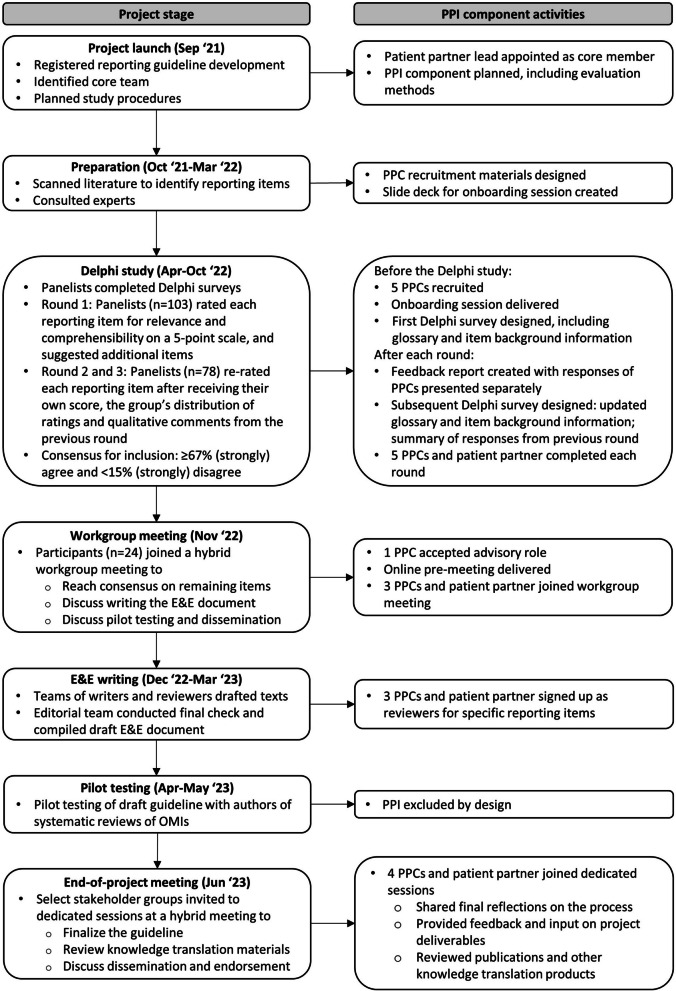
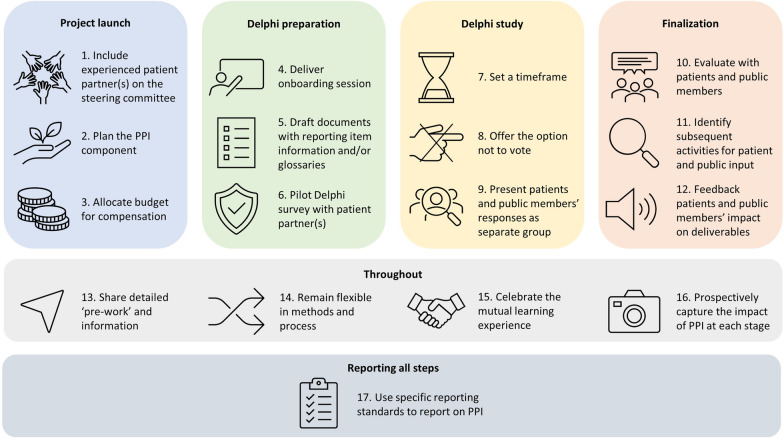
Background: In recent years, projects to develop reporting guidelines have attempted to integrate the perspectives of patients and public members. Best practices for patient and public involvement (PPI) in such projects have not yet been established. We recently developed an extension of PRISMA (Preferred Reporting Items for Systematic Reviews and Meta-Analyses), to be used for systematic reviews of outcome measurement instruments (OMIs): PRISMA-COSMIN (COnsensus-based Standards for the selection of health Measurement INstruments) for OMIs 2024. Patients and public members formed a small but impactful stakeholder group. We critically evaluated the PPI component in this project and developed recommendations for conducting PPI when developing reporting guidelines. Main text: A patient partner was an integral research team member at the project development and grant application stage. Once the project started, five patient and public contributors (PPCs) were recruited to participate in the Delphi study; three PPCs contributed to subsequent steps. We collected quantitative feedback through surveys; qualitative feedback was garnered through a focus group discussion after the Delphi study and through debrief meetings after subsequent project activities. Feedback was thematically combined with reflections from the research team, and was predominantly positive. The following themes emerged: importance of PPI partnership, number of PPCs involved, onboarding, design of Delphi surveys, flexibility in the process, complexity of PPI in methodological research, and power imbalances. Impacts of PPI on the content and presentation of the reporting guideline were evident, and reciprocal learning between PPCs and the research team occurred throughout the project. Lessons learned were translated into 17 recommendations for future projects. Conclusion: Integrating PPI in the development of PRISMA-COSMIN for OMIs 2024 was feasible and considered valuable by PPCs and the research team. Our approach can be applied by others wishing to integrate PPI in developing reporting guidelines.
Overview
The claims and statistics of this paper haven’t been checked yet.
Run the check — free, no account needed. It reads the open-access text and checks the sources it cites.
Integrity signals
Registry
Cites
Statistics
Figures
Verification
Claims the paper makes
The claims and statistics of this paper haven’t been checked yet.
Run the check — free, no account needed. It reads the open-access text and checks the sources it cites.
Claims other papers make about this one
Each is checked against this paper’s own text: does it say what the citing paper says it does?
In the citing paper
“Elsman et al [39] highlighted the importance and feasibility of patient and public involvement during the development of the PRISMA-COSMIN (COnsensus-based Standards for the selection of health Measurement INstruments) for outcome measurement instruments reporting guidelines.”
From Updating the PRISMA reporting guideline for scoping reviews: a scoping review (2026) · cites this paper as [39]
Self-check
Percentages, sums and reported differences re-computed from the paper’s own numbers.
The self-check needs the paper’s full text.
Citations
Cites
COSMIN guideline for systematic reviews of patient-reported outcome measures
Prinsen, C. A. C., Mokkink, L. B., Bouter, L. M., Alonso, J., Patrick, D. L., de Vet, H. C. W., & Terwee, C. B. (2018) · Quality of Life Research · doi:10.1007/s11136-018-1798-3 · Cited by 3,345
Staniszewska, S., Brett, J., Simera, I., Seers, K., Mockford, C., Goodlad, S., Altman, D. G., Moher, D., Barber, R., Denegri, S., et al. (2017) · Research Involvement and Engagement · doi:10.1186/s40900-017-0062-2 · Cited by 1,643
Gates, M., Gates, A., Pieper, D., Fernandes, R. M., Tricco, A. C., Moher, D., Brennan, S. E., Li, T., Pollock, M., Lunny, C., et al. (2022) · BMJ · doi:10.1136/bmj-2022-070849 · Cited by 856
Guidelines for Reporting Outcomes in Trial Reports: The CONSORT-Outcomes 2022 Extension
Butcher, N. J., Monsour, A., Mew, E. J., Chan, A.-W., Moher, D., Mayo-Wilson, E., Terwee, C. B., Chee-A-Tow, A., Baba, A., Gavin, F., et al. (2022) · JAMA · doi:10.1001/jama.2022.21022 · Cited by 719
Self-citation
Research works printed but not linked: 15
- Butcher NJ, Monsour A, Mew EJ, Chan A-W, Moher D, Mayo-Wilson E, et al. Guidelines for reporting outcomes in trial protocols: The SPIRIT-outcomes 2022 extension. JAMA. 2022;328(23):2345–56. · DOI · Paper page
- Schlussel MM, Sharp MK, de Beyer JA, Kirtley S, Logullo P, Dhiman P, et al. Reporting guidelines used varying methodology to develop recommendations. J Clin Epidemiol. 2023;159:246–56. · DOI
- Page MJ, McKenzie JE, Bossuyt PM, Boutron I, Hoffmann TC, Mulrow CD, et al. The PRISMA 2020 statement: an updated guideline for reporting systematic reviews. Int J Surg. 2021;88: 105906. · DOI · Paper page
- Elsman EB, Butcher NJ, Mokkink LB, Terwee CB, Tricco A, Gagnier JJ, et al. Study protocol for developing, piloting and disseminating the PRISMA-COSMIN guideline: a new reporting guideline for systematic reviews of outcome measurement instruments. Syst Rev. 2022;11(1):121. · DOI
- Elsman EB, Mokkink LB, Terwee CB, Beaton D, Gagnier JJ, Tricco AC, et al. Guideline for reporting systematic reviews of outcome measurement instruments (OMIs): PRISMA-COSMIN for OMIs 2024. Accepted for publication. 2024 · DOI · Paper page
- Markham S. A patient’s perspective on mental health and the pandemic. British Medical Journal Publishing Group; 2023. · DOI
- Tariman JD, Berry DL, Halpenny B, Wolpin S, Schepp K. Validation and testing of the acceptability E-scale for web-based patient-reported outcomes in cancer care. Appl Nurs Res. 2011;24(1):53–8. · DOI · Paper page
- Bavelaar L, van Tol LS, Caljouw MA, van der Steen JT. Nederlandse vertaling en eerste stappen in validatie van de PPEET om burger-en patiëntenparticipatie te evalueren. TSG; Tijdschrift voor gezondheiswetenschappen. 2021;99(4):146–53. · DOI
- Abelson J, Li K, Wilson G, Shields K, Schneider C, Boesveld S. Supporting quality public and patient engagement in health system organizations: development and usability testing of the public and patient engagement evaluation tool. Health Expect. 2016;19(4):817–27. · DOI
- Hamilton CB, Hoens AM, McQuitty S, McKinnon AM, English K, Backman CL, et al. Development and pre-testing of the patient engagement in research scale (PEIRS) to assess the quality of engagement from a patient perspective. PLoS ONE. 2018;13(11): e0206588. · DOI
- Wiercioch W, Akl EA, Santesso N, Zhang Y, Morgan RL, Yepes-Nuñez JJ, et al. Assessing the process and outcome of the development of practice guidelines and recommendations: PANELVIEW instrument development. CMAJ. 2020;192(40):E1138–45. · DOI
- Smith M, Potter B, Vanderhout S, Howie A. Patient partnership in a pediatric rare disease research network: mutual learning for meaningful research. In: Reszel J, McCutcheon C, Kothari A, Graham I, editors. How We Work Together: The Integrated Knowledge Translation Research Network Casebook. Ottawa: Integrated Knowledge Translation Research Network; 2022.
- Hajas A, Folkeard P, Ankmnal-Veeranna S, Seelisch A, Curca I, Agrawal S, et al. (Social) distance brings us together: Case report of a virtual rapid protocol development experience. In: McCutcheon C, Reszel J, Kothari A, Graham I, editors., et al., How We Work Together: The Integrated Knowledge Translation Research Network Casebook. Ottawa: Integrated Knowledge Translation Research Network; 2022.
- McCutcheon C, Reszel J, Kothari A, Graham I. How We Work Together: The Integrated Knowledge Translation Research Network Casebook. Ottawa: Integrated Knowledge Translation Research Network; 2022.
- Vollebregt M, Kuiack A, Coughler C, Bardell T, Archibald L. Establishing practice-based research partnerships with educational speech-language pathologists. In: Reszel J, McCutcheon C, Kothari A, Graham I, editors. How We Work Together: The Integrated Knowledge Translation Research Network Casebook. Ottawa: Integrated Knowledge Translation Research Network; 2022.
Cited by
Sorted by citations
Updating the PRISMA reporting guideline for scoping reviews: a scoping review
Tricco, A. C., Robinson, E., Straus, S. E., Colquhoun, H., Godfrey, C. M., Moher, D., Munn, Z., Pollock, D., Logan, S., Elsman, E. B. M., et al. (2026) · Journal of Clinical Epidemiology · doi:10.1016/j.jclinepi.2026.112314 · Cited by 9
Self-citation
Metadata
- Authors
- Elsman, E. B. M., Smith, M., Hofstetter, C., Gavin, F., Jobson, E., Markham, S., Ricketts, J., Baba, A., Butcher, N. J., & Offringa, M.
- Venue
- Research Involvement and Engagement
- Published
- 2024-03-21
- Volume
- 10
- Issue
- 1
- ISSN
- 2056-7529
- PMC
- PMC10956212
- Cited by
- 15
- References
- 4
- Language
- en
- Funders
- Canadian Institutes of Health Research (452145)
About these checks
Registry, retraction, Cites and statistics results are computed, not judged, with one exception: a printed reference that no index lists is read once by a model before it counts as a citation error. Claims are extracted by a model and kept only when their quote appears verbatim in the text; each cited source is then checked, with a model’s help, for whether it says what the claim relies on. Those verdicts can be wrong — read the claim’s quote and the cited source before relying on one.
Statistics and arithmetic are recomputed, not judged.
Confidence bands are shown only for fields calibrated on our annotated test set. None is calibrated yet, so no band is shown.
What counts as a claim ›How we measure confidence ›How we check this ›
Are you an author, or do you see a problem with this page? Request a review
