

The DOI matches its Crossref record; 1 of the 1 references it cites were found in a registry or an index.
Introduction of an undergraduate interprofessional simulation based skills training program in obstetrics and gynaecology in India
Open accessAbstract
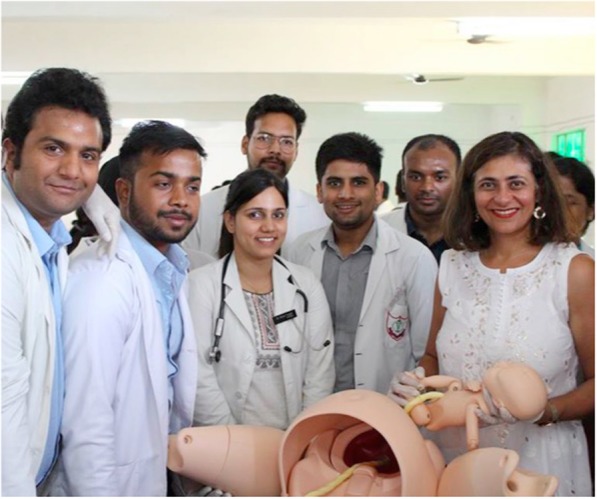
Interprofessional simulation based education (SBE) improves core clinical skills and team training in obstetrics and gynaecology. In this innovative study, the introduction of an undergraduate interprofessional SBE program for teaching obstetrics and gynaecology skills in India was evaluated. The study attempted to evaluate the feasibility and benefit of the interprofessional skills training workshop in obstetrics and gynaecology, which was introduced for medical and midwifery students in a secondary level hospital in India. The program focuses on improving "hands-on" clinical skills and can be explained by the "skills acquisition theory". Using a survey, participants rated relevance, pitch and confidence (on a 5-point Likert scale) and described the contextualisation and teaching of core clinical skills through the workshop using free-text. Descriptive analysis of quantitative Likert scale responses and thematic analysis of the free-text data was conducted and themes identified. Ninety-five medical and midwifery students attended the inaugural workshop, in a low-resource setting. The clinical experience in obstetrics and gynaecology across both groups was minimal, neither were they exposed to any prior SBE. Both health professional groups found the workshop useful, relevant and improved their confidence in performing vaginal examination and births. The key theme, which emerged from qualitative analysis, was "getting hands-on" experience. Other themes included learning by simulation without clinical time constraints, retaining the ability to make mistakes, bridging theory to practice, valuing interprofessional experience and ensuring equal learning opportunities for all participating professional groups. The advantages of interprofessional SBE, for medical and midwifery students, are reproducible in a low-resource setting, and may be be helpful for learning intimate clinical examination, obstetric procedures and team training.
Overview
The claims and statistics of this paper haven’t been checked yet.
Run the check — free, no account needed. It reads the open-access text and checks the sources it cites.
Integrity signals
Registry
Cites
Statistics
Figures
Verification
Claims the paper makes
The claims and statistics of this paper haven’t been checked yet.
Run the check — free, no account needed. It reads the open-access text and checks the sources it cites.
Self-check
Percentages, sums and reported differences re-computed from the paper’s own numbers.
The self-check needs the paper’s full text.
Citations
Cites
Using thematic analysis in psychology
Braun, V., & Clarke, V. (2006) · Qualitative Research in Psychology · doi:10.1191/1478088706qp063oa · Cited by 194,414
Research works printed but not linked: 33
- Kumar A, Gilmour C, Nestel D, Aldridge R, McLelland G, Wallace E. Can we teach core clinical obstetrics and gynaecology skills using low fidelity simulation in an interprofessional setting? Aust N Z J Obstet Gynaecol. 2014;54(6):589–92. · DOI
- Wilson E, Janssens S, Hewett DG, Jolly B, Beckmann M. Simulation training in obstetrics and gynaecology: What's happening on the frontline? Aust N Z J Obstet Gynaecol. 2016;56(5):496–502. · DOI
- Motola I, Devine LA, Chung HS, Sullivan JE, Issenberg SB. Simulation in healthcare education: a best evidence practical guide. AMEE guide no. 82. Med Teach. 2013;35(10):e1511–e30. · DOI
- Hellier SD, Ramponi DR, Wrynn A, Garofalo S. An innovative approach: using simulation to teach primary care gynecologic procedures. Simul Healthc. 2017;12(4):268–73. · DOI
- Nitschmann C, Bartz D, Johnson NR. Gynecologic simulation training increases medical student confidence and interest in Women’s Health. Teach Learn Med. 2014;26(2):160–3. · DOI
- Wei Lin YS. Effectiveness of different numbers of simulation training models on medical students’ cervical examination performance. Int J Obstet Gynaecol. 2017;10:255–60.
- Curl ED, Smith S, Ann Chisholm L, McGee LA, Das K. Effectiveness of integrated simulation and clinical experiences compared to traditional clinical experiences for nursing students. Nurs Educ Perspect. 2016;37(2):72–7.
- van de Ven J, Houterman S, Steinweg RA, Scherpbier AJ, Wijers W, Mol BW, et al. Reducing errors in health care: cost-effectiveness of multidisciplinary team training in obstetric emergencies (TOSTI study); a randomised controlled trial. BMC Pregnancy Childbirth. 2010;10:59. · DOI
- Kumar A, Wallace EM, East C, McClelland G, Hall H, Leech M, et al. Interprofessional simulation-based education for medical and midwifery students: a qualitative study. Clin Simul Nurs. 2017;13(5):217–27. · DOI
- Zhao Z, Niu P, Ji X, Sweet RM. State of simulation in healthcare education: an initial survey in Beijing. JSLS : Journal of the Society of Laparoendoscopic Surgeons. 2017;21(1). · DOI
- Kumar A, Singh T, Bansal U, Singh J, Davie S, Malhotra A. Mobile obstetric and neonatal simulation based skills training in India. Midwifery. 2019;72:14–22. · DOI
- Kumar A, Kent F, Wallace EM, McLelland G, Bentley D, Koutsoukos A, et al. Interprofessional education and practice guide no. 9: sustaining interprofessional simulation using change management principles. J Interprof Care. 2018:1–8. · DOI
- Fitts PMPM. Human performance. Belmont. Calif: Brooks/Cole Pub. Co; 1967.
- Reznick RK, MacRae H. Teaching surgical skills--changes in the wind. N Engl J Med. 2006;355(25):2664–9. · DOI
- Choi W, Dyens O, Chan T, Schijven M, Lajoie S, E Mancini M, et al. Engagement and learning in simulation: recommendations of the Simnovate engaged learning domain Group; 2017. p. S23–32.
- Fenwick T. Sociomateriality in medical practice and learning: attuning to what matters. Med Educ. 2014;48(10):44–52. · DOI
- LaDage LD, Tornello SL, Vallejera JM, Baker EE, Yan Y, Chowdhury A. Variation in behavioral engagement during an active learning activity leads to differential knowledge gains in college students. Adv Physiol Educ. 2018;42(1):99–103. · DOI
- Fenwick T. Re-thinking the “thing”: Sociomaterial approaches to understanding and researching learning in work. J Work Learn. 2010;22(1–2):104–16. · DOI
- Chuderski A. Time pressure prevents relational learning. Learn Individ Differ. 2016;49:361–5. · DOI
- Hall SW. High-fidelity simulation for senior maternity nursing students. Nurs Educ Perspect. 2015;36(2):124–7. · DOI
- Kirkman TR. High fidelity simulation effectiveness in nursing students’ transfer of learning. Int J Nurs Educ Scholarsh. 2013;10. · DOI
- Norman G, Dore K, Grierson L. The minimal relationship between simulation fidelity and transfer of learning. Med Educ. 2012;46(7):636–47. · DOI
- Hanson J. From me to we: transforming values and building professional community through narratives. Nurse Educ Pract. 2013;13(2):142–6. · DOI
- Pecukonis E. Interprofessional education: a theoretical orientation incorporating profession-centrism and social identity theory. J Law Med Ethics : a journal of the American Society of Law, Medicine & Ethics. 2014;42(Suppl 2):60–4. · DOI
- Bhaumik S. Why is India short of nurses and what can we do about it? BMJ. 2013;346:f4024. · DOI
- Timmons S, Evans C, Nair S. The development of the nursing profession in a globalised context: a qualitative case study in Kerala, India. Soc Sci Med (1982). 2016;166:41–8. · DOI
- Tang CJ, Zhou WT, Chan SW, Liaw SY. Interprofessional collaboration between junior doctors and nurses in the general ward setting: a qualitative exploratory study. J Nurs Manag. 2018;26(1):11–8. · DOI
- Quinlivan JA, Thompson CM, Black KI, Kornman LH, McDonald SJ. Medical and midwifery students: how do they view their respective roles on the labour ward? Aust N Z J Obstet Gynaecol. 2002;42(4):401–6. · DOI
- Cullen L, Fraser D, Symonds I. Strategies for interprofessional education: the interprofessional team objective structured clinical examination for midwifery and medical students. Nurse Educ Today. 2003;23(6):427–33. · DOI
- Katrina Anne McKay SN. Bridging the gap between doctors and nurses. J Nurs Educ Pract. 2012;2(4):52–5.
- O’Leary DF. Exploring the importance of team psychological safety in the development of two interprofessional teams. J Interprof Care. 2016;30(1):29–34. · DOI
- O'Keefe M, Henderson A, Chick R. Defining a set of common interprofessional learning competencies for health profession students. Med Teach. 2017;39(5):463–8. · DOI
- INACSL. Standards of best practice: SimulationSM simulation-enhanced Interprofessional education (Sim-IPE). Clin Simul Nurs. 2016;12:S34–S8. · DOI
Metadata
- Authors
- Gorantla, S., Bansal, U., Singh, J. V., Dwivedi, A. D., Malhotra, A., & Kumar, A.
- Affiliations
- Monash University (AU)
- Corresponding author
- Kumar, Arunaz
- Venue
- Advances in Simulation
- Published
- 2019-04-18
- Volume
- 4
- Issue
- 1
- Pages
- 6-6
- ISSN
- 2059-0628 (ISSN-L)
- PMC
- PMC6471777
- OpenAlex
- W2945219451
- Cited by
- 34
- References
- 1
- Citations by year
- 2026: 2 · 2025: 5 · 2024: 3 · 2023: 5 · 2022: 8 · 2021: 7 · 2020: 3 · 2019: 1
- FWCI
- 3.18
- Type
- journal article
- Language
- en
- Open access
- gold
- doi.org
- Licence
- Locations
- Advances in Simulation (publishedVersion, cc-by)
- PubMed Central (publishedVersion, cc-by)
- PubMed (publishedVersion)
- Monash University Research Portal (Monash University) (submittedVersion, cc-by)
- DOAJ (DOAJ: Directory of Open Access Journals) (submittedVersion, cc-by-sa)
- Funders
- Royal Australasian College of Physicians (Eric Burnard)
- Topics
- Social Sciences › Education › Simulation-Based Education in Healthcare
- Health Sciences › Medicine › Surgery › Surgical Simulation and Training
- Health Sciences › Health Professions › General Health Professions › Interprofessional Education and Collaboration
- Keywords
- interprofessional education, simulation-based education, obstetrics and gynecology education, medical students, midwifery students, vaginal examination, resource-limited settings, team training, undergraduate medical education, India
About these checks
Registry, retraction, Cites and statistics results are computed, not judged, with one exception: a printed reference that no index lists is read once by a model before it counts as a citation error. Claims are extracted by a model and kept only when their quote appears verbatim in the text; each cited source is then checked, with a model’s help, for whether it says what the claim relies on. Those verdicts can be wrong — read the claim’s quote and the cited source before relying on one.
Statistics and arithmetic are recomputed, not judged.
Confidence bands are shown only for fields calibrated on our annotated test set. None is calibrated yet, so no band is shown.
What counts as a claim ›How we measure confidence ›How we check this ›
Are you an author, or do you see a problem with this page? Request a review
How to cite
Cite CoChat for the checks on this page, and the paper for its own findings.
- This page
- CoChat. (2026). Citation check: Introduction of an undergraduate interprofessional simulation based skills training program in obstetrics and gynaecology in India. https://app.cochat.ai/papers/10.1186/s41077-019-0096-7
- The paper
- Gorantla, S., Bansal, U., Singh, J. V., Dwivedi, A. D., Malhotra, A., & Kumar, A. (2019). Introduction of an undergraduate interprofessional simulation based skills training program in obstetrics and gynaecology in India. Advances in Simulation. https://doi.org/10.1186/s41077-019-0096-7
