

The DOI matches its Crossref record; 2 of the 2 references it cites were found in a registry or an index.
Ex vivo generation of platelet products from human iPS cells
Abstract
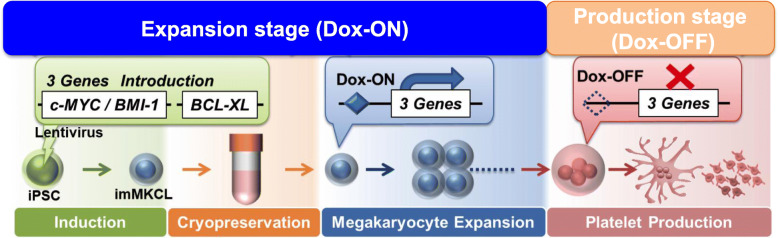
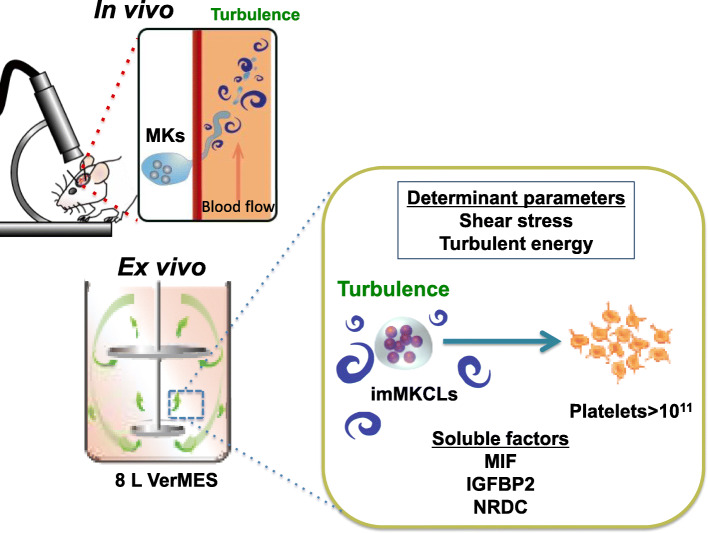
Platelet products are used in treatments for thrombocytopenia caused by hematopoietic diseases, chemotherapy, massive hemorrhages, extracorporeal circulation, and others. Their manufacturing depends on volunteers who donate blood. However, it is becoming increasingly necessary to reinforce this blood donation system with other blood sources due to the increase in demand and shortage of supply accompanying aging societies. In addition, blood-borne infections and alloimmune platelet transfusion refractoriness are not completely resolved. Since human induced pluripotent stem cell (iPSC)-platelet products can be supplied independently from the donor, it is expected to complement current platelet products. One big hurdle with iPSC-based systems is the production of 10 units, which is equivalent to 200 billion platelets. To overcome this issue, we established immortalized megakaryocyte cell lines (imMKCLs) by introducing three transgenes, c-MYC, BMI1, and BCL-XL, sequentially into hematopoietic and megakaryocytic progenitor stage cells derived from iPSCs. The three transgenes are regulated in a Tet-ON manner, enabling the addition and depletion of doxycycline to expand and maturate the imMKCLs, respectively. In addition, we succeeded in discovering drug combinations that enable feeder-free culture conditions in the imMKCL cultivation. Furthermore, we discovered the importance of turbulence in thrombopoiesis through live bone marrow imaging and developed a bioreactor based on the concept of turbulent flow. Eventually, through the identification of two key fluid physic parameters, turbulent energy and shear stress, we succeeded in scaling up the bioreactor to qualitatively and quantitatively achieve clinically applicable levels. Interestingly, three soluble factors released from imMKCLs in the turbulent flow condition, macrophage migration inhibitory factor (MIF), insulin growth factor binding protein 2 (IGFBP2), and nardilysin (NRDC), enhanced platelet production. Based on these developments, we initiated the first-in-human clinical trial of iPSC-derived platelets to a patient with alloimmune platelet transfusion refractoriness (allo-PTR) using an autologous product. In this review, we detail current research in this field and our study about the ex vivo production of iPSC-derived platelets.
Overview
The claims and statistics of this paper haven’t been checked yet.
Run the check — free, no account needed. It reads the open-access text and checks the sources it cites.
Integrity signals
Registry
Cites
Statistics
Figures
Verification
Claims the paper makes
The claims and statistics of this paper haven’t been checked yet.
Run the check — free, no account needed. It reads the open-access text and checks the sources it cites.
Claims other papers make about this one
Each is checked against this paper’s own text: does it say what the citing paper says it does?
In the citing paper
“Lately, a method involving the lentiviral gene transfection of c-MYC has been employed to create immortalized megakaryocyte cell lines, regulated by the TET-on system, using blood cell precursor cells derived from iPSCs (induced pluripotent stem cells). These cells have the capability to produce platelets for use in clinical trials [38].”
From Cell Immortality: In Vitro Effective Techniques to Achieve and Investigate Its Applications and Challenges (2024) · cites this paper as [38]
Self-check
Percentages, sums and reported differences re-computed from the paper’s own numbers.
The self-check needs the paper’s full text.
Citations
Cites
Distinct routes of lineage development reshape the human blood hierarchy across ontogeny
Notta, F., Zandi, S., Takayama, N., Dobson, S., Gan, O. I., Wilson, G., Kaufmann, K. B., McLeod, J., Laurenti, E., Dunant, C. F., et al. (2016) · Science · doi:10.1126/science.aab2116 · Cited by 780
Coppé, J.-P., Patil, C. K., Rodier, F., Sun, Y., Muñoz, D. P., Goldstein, J., Nelson, P. S., Desprez, P.-Y., & Campisi, J. (2008) · PLoS Biology · doi:10.1371/journal.pbio.0060301 · Cited by 302
Research works printed but not linked: 36
- Junt T, Schulze H, Chen Z, Massberg S, Goerge T, Krueger A, et al. Dynamic visualization of thrombopoiesis within bone marrow. Science. 2007;317(5845):1767–70. · DOI
- Kosaki G. Platelet production by megakaryocytes: Protoplatelet theory justifies cytoplasmic fragmentation model. Int J Hematol. 2008;88(3):255–67. · DOI
- Thon JN, Montalvo A, Patel-Hett S, Devine MT, Richardson JL, Ehrlicher A, et al. Cytoskeletal mechanics of proplatelet maturation and platelet release. J Cell Biol. 2010;191(4):861–74. · DOI
- Machlus KR, Italiano JE. The incredible journey: from megakaryocyte development to platelet formation. J Cell Biol. 2013;201(6):785–96. · DOI
- Nishimura S, Nagasaki M, Kunishima S, Sawaguchi A, Sakata A, Sakaguchi H, et al. IL-1α induces thrombopoiesis through megakaryocyte rupture in response to acute platelet needs. J Cell Biol. 2015;209(3):453–66. · DOI
- Lefrançais E, Ortiz-Muñoz G, Caudrillier A, Mallavia B, Liu F, Sayah DM, et al. The lung is a site of platelet biogenesis and a reservoir for haematopoietic progenitors. Nature. 2017;544(7648):105–9. · DOI
- Estcourt LJ, Birchall J, Allard S, Bassey SJ, Hersey P, Kerr JP, et al. Guidelines for the use of platelet transfusions. Br J Haematol. 2017;176(3):365–94. · DOI
- Takahashi K, Tanabe K, Ohnuki M, Narita M, Ichisaka T, Tomoda K, et al. Induction of pluripotent stem cells from adult human fibroblasts by defined factors. Cell. 2007;131(5):861–72. · DOI · Paper page
- Takayama N, Nishikii H, Usui J, Tsukui H, Sawaguchi A, Hiroyama T, et al. Generation of functional platelets from human embryonic stem cells in vitro via ES-sacs, VEGF-promoted structures that concentrate hematopoietic progenitors. Blood. 2008;111(11):5298–306. · DOI
- Takayama N, Nishimura S, Nakamura S, Shimizu T, Ohnishi R, Endo H, et al. Transient activation of c-MYC expression is critical for efficient platelet generation from human induced pluripotent stem cells. J Exp Med. 2010;207(13):2817–30. · DOI
- Feng Q, Shabrani N, Thon JN, Huo H, Thiel A, Machlus KR, et al. Scalable generation of universal platelets from human induced pluripotent stem cells. Stem Cell Rep. 2014;3(5):817–31. · DOI
- Yamamoto R, Morita Y, Ooehara J, Hamanaka S, Onodera M, Rudolph KL, et al. Clonal analysis unveils self-renewing lineage-restricted progenitors generated directly from hematopoietic stem cells. Cell. 2013;154(5):1112–26. · DOI
- Sanjuan-Pla A, Macaulay IC, Jensen CT, Woll PS, Luis TC, Mead A, et al. Platelet-biased stem cells reside at the apex of the haematopoietic stem-cell hierarchy. Nature. 2013;502(7470):232–6. · DOI
- Nakamura S, Takayama N, Hirata S, Seo H, Endo H, Ochi K, et al. Expandable megakaryocyte cell lines enable clinically applicable generation of platelets from human induced pluripotent stem cells. Cell Stem Cell. 2014;14(4):535–48. · DOI
- Thompson A, Zhang Y, Kamen D, Jackson CW, Cardiff RD, Ravid K. Deregulated expression of c-myc in megakaryocytes of transgenic mice increases megakaryopoiesis and decreases polyploidization. J Biol Chem. 1996;271(38):22976–82. · DOI
- Josefsson EC, James C, Henley KJ, Debrincat MA, Rogers KL, Dowling MR, et al. Megakaryocytes possess a functional intrinsic apoptosis pathway that must be restrained to survive and produce platelets. J Exp Med. 2011;208(10):2017–31. · DOI
- Oguro H, Iwama A, Morita Y, Kamijo T, Van Lohuizen M, Nakauchi H. Differential impact of Ink4a and Arf on hematopoietic stem cells and their bone marrow microenvironment in Bmi1-deficient mice. J Exp Med. 2006;203(10):2247–53. · DOI
- Shivdasani RA, Rosenblatt MF, Zucker-Franklin D, Jackson CW, Hunt P, Saris CJM, et al. Transcription factor NF-E2 is required for platelet formation independent of the actions of thrombopoeitin/MGDF in megakaryocyte development. Cell. 1995;81(5):695–704. · DOI
- Shivdasani RA, Fujiwara Y, McDevitt MA, Orkin SH. A lineage-selective knockout establishes the critical role of transcription factor GATA-1 in megakaryocyte growth and platelet development. EMBO J. 1997;16(13):3965–73. · DOI
- Tsang AP, Visvader JE, Turner CA, Fujiwara Y, Yu C, Weiss MJ, et al. FOG, a multitype zinc finger protein, acts as a cofactor for transcription factor GATA-1 in erythroid and megakaryocytic differentiation. Cell. 1997;90(1):109–19. · DOI · Paper page
- Moreau T, Evans AL, Vasquez L, Tijssen MR, Yan Y, Trotter MW, et al. Large-scale production of megakaryocytes from human pluripotent stem cells by chemically defined forward programming. Nat Commun. 2016;7:11208. · DOI
- Ono Y, Wang Y, Suzuki H, Okamoto S, Ikeda Y, Murata M, et al. Induction of functional platelets from mouse and human fibroblasts by p45NF-E2/Maf. Blood. 2012;120(18):3812–21. · DOI
- Pulecio J, Alejo-Valle O, Capellera-Garcia S, Vitaloni M, Rio P, Mejía-Ramírez E, et al. Direct conversion of fibroblasts to megakaryocyte progenitors. Cell Rep. 2016;17(3):671–83. · DOI
- Ito Y, Nakamura S, Sugimoto N, Shigemori T, Kato Y, Ohno M, et al. Turbulence activates platelet biogenesis to enable clinical scale ex vivo production. Cell. 2018;174(3):636–48. · DOI
- Thon JN, Mazutis L, Wu S, Sylman JL, Ehrlicher A, Machlus KR, et al. Platelet bioreactor-on-a-chip. Blood. 2014;124(12):1857–67. · DOI
- Blin A, Le Goff A, Magniez A, Poirault-Chassac S, Teste B, Sicot G, et al. Microfluidic model of the platelet-generating organ: beyond bone marrow biomimetics. Sci Rep. 2016;22(6):21700. · DOI
- Di Buduo CA, Wray LS, Tozzi L, Malara A, Chen Y, Ghezzi CE, et al. Programmable 3D silk bone marrow niche for platelet generation ex vivo and modeling of megakaryopoiesis pathologies. Blood. 2015;125(14):2254–64. · DOI
- Nakagawa Y, Nakamura S, Nakajima M, Endo H, Dohda T, Takayama N, et al. Two differential flows in a bioreactor promoted platelet generation from human pluripotent stem cell-derived megakaryocytes. Exp Hematol. 2013;41(8):742–8. · DOI
- Avanzi MP, Oluwadara OE, Cushing MM, Mitchell ML, Fischer S, Mitchell WB. A novel bioreactor and culture method drives high yields of platelets from stem cells. Transfusion. 2016;56(1):170–8. · DOI
- Watanabe N, Nogawa M, Ishiguro M, Maruyama H, Shiba M, Satake M, et al. Refined methods to evaluate the in vivo hemostatic function and viability of transfused human platelets in rabbit models. Transfusion. 2017;57(8):2035–44. · DOI
- Strüßmann T, Tillmann S, Wirtz T, Bucala R, von Hundelshausen P, Bernhagen J. Platelets are a previously unrecognised source of MIF. Thromb Haemost. 2013;110(5):1004–13.
- Machlus KR, Johnson KE, Kulenthirarajan R, Forward JA, Tippy MD, Soussou TS, et al. CCL5 derived from platelets increases megakaryocyte proplatelet formation. Blood. 2016;127(7):921–6. · DOI
- Tamura S, Suzuki-Lnoue K, Tsukiji N, Shirai T, Sasaki T, Osada M, et al. Podoplanin-positive periarteriolar stromal cells promote megakaryocyte growth and proplatelet formation in mice by CLEC-2. Blood. 2016;127(13):1701–10. · DOI
- Lim CK, Hwang WYK, Aw SE, Sun L. Study of gene expression profile during cord blood-associated megakaryopoiesis. Eur J Haematol. 2008;81(3):196–208. · DOI
- Madoiwa S, Komatsu N, Mimuro J, Asakura S, Matsuda M, Sakata Y. Expression of plasminogen activator inhibitor-1 associated with thrombopoietin-dependent megakaryocytic differentiation. Fibrinolysis Proteolysis. 1998;94(2):475–82.
- Nishi E. Nardilysin. Handb Proteolytic Enzym. 2013;1:1421–6. · DOI
Cited by
Chalak, M., Hesaraki, M., Mirbahari, S. N., Yeganeh, M., Abdi, S., Rajabi, S., & Hemmatzadeh, F. (2024) · Life · doi:10.3390/life14030417 · Cited by 66
Cell Immortalization: In Vivo Molecular Bases and In Vitro Techniques for Obtention
de Bardet, J. C., Cardentey, C. R., González, B. L., Patrone, D., Mulet, I. L., Siniscalco, D., & Robinson-Agramonte, M. D. L. A. (2023) · BioTech · doi:10.3390/biotech12010014 · Cited by 35
Metadata
- Authors
- Nakamura, S., Sugimoto, N., & Eto, K.
- ORCID
- Nakamura, Sou
- Venue
- Inflammation and Regeneration
- Published
- 2020-12
- Volume
- 40
- Issue
- 1
- ISSN
- 1880-8190
- PMC
- PMC7708911
- Cited by
- 16
- References
- 2
- Language
- en
About these checks
Registry, retraction, Cites and statistics results are computed, not judged, with one exception: a printed reference that no index lists is read once by a model before it counts as a citation error. Claims are extracted by a model and kept only when their quote appears verbatim in the text; each cited source is then checked, with a model’s help, for whether it says what the claim relies on. Those verdicts can be wrong — read the claim’s quote and the cited source before relying on one.
Statistics and arithmetic are recomputed, not judged.
Confidence bands are shown only for fields calibrated on our annotated test set. None is calibrated yet, so no band is shown.
What counts as a claim ›How we measure confidence ›How we check this ›
Are you an author, or do you see a problem with this page? Request a review
