

The DOI matches its Crossref record; 70 of the 70 references it cites were found in a registry or an index; 11 of the 73 sources its claims cite were checked for support.
Supporting self-regulated learning through generative AI feedback in online higher education: the importance of student perceptions of the source of feedback
Open accessAbstract
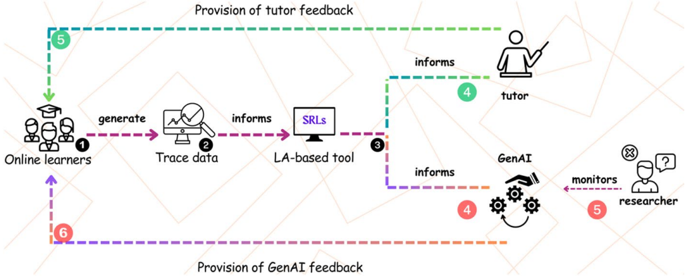
Given the increased autonomy and limited direct instructor presence in online learning settings necessitating advanced self-regulated learning skills (SRLs), many online students face significant learning difficulties, such as low course completion rates. External support, particularly in the form of feedback, is crucial in addressing these difficulties. However, providing timely and personalised feedback at scale remains a key challenge. This study examines the effects of generative artificial intelligence (GenAI) feedback on students' SRLs in an online higher education context. The study compares GenAI feedback, informed by student trace data and learning analytics, with tutor-generated feedback, assessing both student perceptions of feedback and their SRLs development. Employing a mixed-methods research design, we collected survey data, trace-based SRL indicators, and open-ended responses from 46 university students. Quantitative findings revealed that students rated GenAI feedback more positively than tutor-generated feedback, with a statistically significant difference in Genuineness . Moreover, the treatment group showed significant improvement in the Task Strategies dimension of SRLs, suggesting that personalised GenAI feedback may enhance specific regulatory behaviours . Qualitative insights revealed varying student awareness of the feedback source, with some prioritising content over the source of feedback. In contrast, others indicated their attitudes might have differed had they known the provider, highlighting the socio-emotional aspects of feedback adoption and impact. This study concludes that GenAI has the potential to scale SRLs feedback in online learning environments, but the student perceptions of feedback should be carefully managed to observe the expected impact.
Overview
CoChat Summary
TL;DR
In a nine-week online statistics module, 46 students were randomly assigned to receive either GenAI or tutor feedback; GenAI feedback was rated more positively on all perception dimensions, with a significant difference only for Genuineness, and the GenAI group showed significant post-intervention improvement in Task Strategies. Qualitative responses showed varied awareness of the feedback source, with many prioritising content over provider identity.
Key findings
Students rated GenAI feedback higher than tutor feedback on all four perception dimensions under blind conditions, but only Genuineness was statistically significant (GenAI mean 3.40 vs tutor 2.79; p = .036, r = .36); Objectivity was 3.37 vs 3.06 (p = .311), Usefulness 3.24 vs 3.01 (p = .459), and Credibility 3.30 vs 3.06 (p = .542).
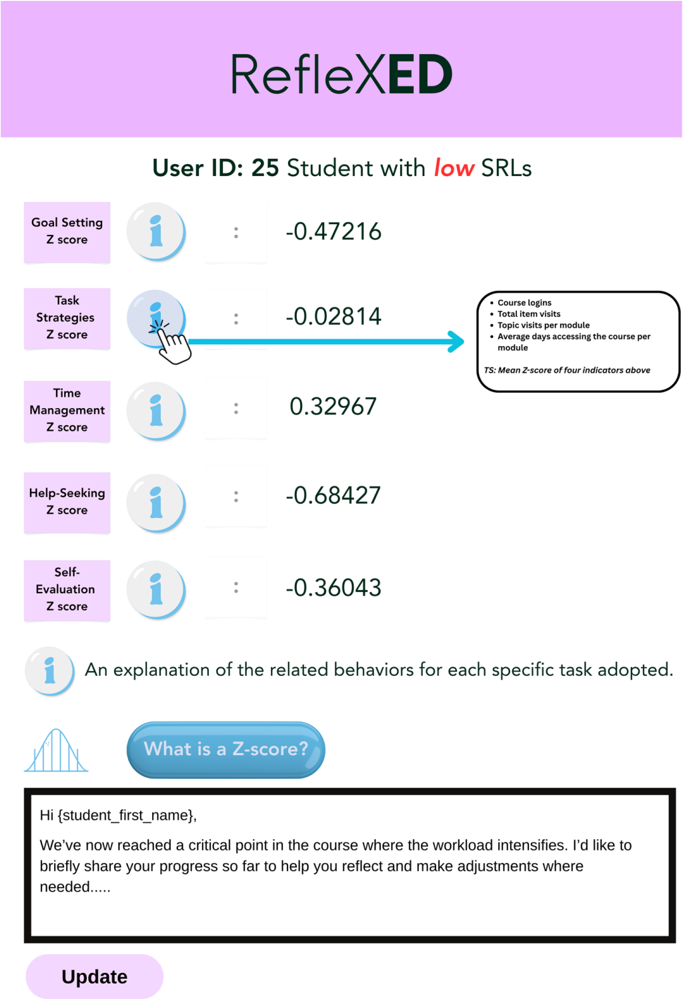
- For SRLs, the GenAI group showed a significant post-intervention improvement in Task Strategies (mean z = 0.27 vs tutor −0.27; p = .044, r = .35); Time Management was marginal (0.28 vs −0.28; p = .057, r = .33), and no significant differences were found for Goal Setting, Help-Seeking, or Self-Evaluation.
- In qualitative responses from 17 treatment-group students, all 5 who were aware of the GenAI source reported no attitude change; among unaware students, 5 said their attitude would not change if they had known, 6 were conditional/unsure, and 1 said it would change if known (Cohen’s κ = .830).
Methods
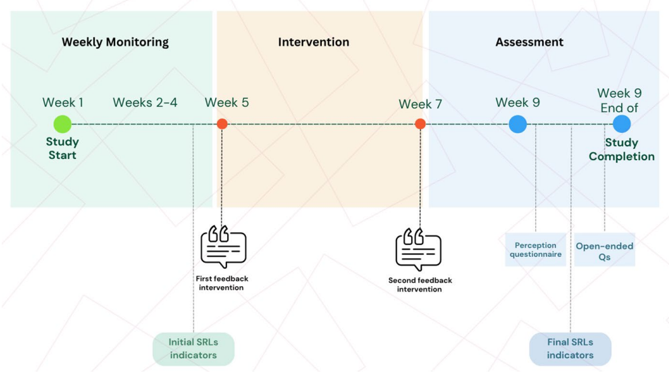
Mixed-methods quasi-experimental study embedded in a nine-week distance-learning Basic Statistics module; 46 higher education students were randomly assigned to GenAI feedback (n = 23) or tutor feedback (n = 23), with students blinded to feedback source during the intervention.
- Data included a post-intervention perception questionnaire adapted from Nazaretsky et al. (41 completed; Cronbach’s α = .923), trace data from approximately 48,000 MOODLE log records mapped to the Ye and Pennisi SRL framework and z-standardised, and open-ended questions administered only to the treatment group (17 completed).
- Analysis used Mann-Whitney U tests with rank-biserial effect sizes for feedback perceptions and pre/post SRL proxies, plus thematic analysis with coding and Cohen’s kappa.
Limitations
Stated by the paper: the small sample (n = 46) from a single online course limits statistical power and generalisability; the study focused on perception and behavioural outcomes rather than broader relational feedback quality; the first author reviewed GenAI feedback before delivery but this workload was not formally measured; and the tutor’s awareness of the GenAI condition may have influenced their feedback drafting.
- Evident in the text: only 41 of 46 participants completed the perception questionnaire and only 17 of 23 treatment-group students completed the open-ended questions, reducing power and representativeness; tutor-generated feedback came from a single course instructor without team-based refinement; and there was no no-feedback control condition, so longitudinal SRL changes cannot be isolated from course exposure or feedback per se.
Model-written summary. Check it against the paper before relying on it.
Integrity signals
Registry
Cites
Statistics
Figures


Verification
Claims the paper makes
11 Valid · 1 Not valid · 33 Not checked · 61 Own results and interpretations
The cited sources support only part of this claim — read each source’s verdict below.
In the paper
“However, providing timely and personalised feedback remains a significant challenge, especially within large and diverse student populations typically found in online learning environments (Julia et al., 2021).”
What the sources say
- Partly supportedcites Julia et al., 2021 sourceExperimental — accuracy not yet measured
Section 3.2.3 says providing formative feedback efficiently to high student numbers in an open online setting can be complex and resource-intensive. Table 3 discusses timely, personalised feedback as a scalable practice. The paper supports the challenge of scale, but the cited passages do not establish that diversity of the student population is a particular reason for it. (LLM, conf=0.84)
plain- Asserted: passes — The authors put it forward as true.
- Checkable: passes — It can be checked against evidence.
- Load-bearing: passes — The paper’s conclusions depend on it.
- Based: passes — The paper gives a reason why it holds.
- Partly supported
The cited sources support only part of this claim — read each source’s verdict below.
In the paper
“The effectiveness of feedback is determined not by the quantity of information provided, but by how targeted, focused, and responsive it is, as emphasised by Black and Wiliam (2009) and Shute (2008).”
What the sources say
- Partly supportedcites Black and Wiliam, 2009 sourceExperimental — accuracy not yet measured
The ‘Categories of feedback’ and ‘Practical guidance?’ sections say effective feedback requires diagnosing a learner’s thinking and choosing an appropriate response, supporting the emphasis on targeted, responsive feedback. The passages do not establish the claim’s contrast with the quantity of information provided. (LLM, conf=0.84)
- Not checked — no full text of the sourcecites Shute, 2008 source
plainstates a cause- Asserted: passes — The authors put it forward as true.
- Checkable: passes — It can be checked against evidence.
- Load-bearing: passes — The paper’s conclusions depend on it.
- Based: passes — The paper gives a reason why it holds.
- Partly supported
The cited sources support only part of this claim — read each source’s verdict below.
In the paper
“Nevertheless, as highlighted in meta-reviews of the field (e.g. Viberg et al., 2020), the provision of timely, personalised feedback to effectively foster SRLs remains limited across many online education environments.”
What the sources say
- Partly supportedcites Viberg et al., 2020 sourceExperimental — accuracy not yet measured
The ‘LA, L2 learning and SRL’ section reports that a review found very limited learning-analytics support for fostering SRL in online settings. The Conclusion calls for real-time, individualised feedback, but the paper does not establish that timely, personalised feedback specifically is limited across many online education environments. It is also a conceptual framework, not itself a meta-review. (LLM, conf=0.85)
plain- Asserted: passes — The authors put it forward as true.
- Checkable: passes — It can be checked against evidence.
- Load-bearing: passes — The paper’s conclusions depend on it.
- Based: passes — The paper gives a reason why it holds.
- Partly supported
The sources with a verdict support this claim; the rest weren’t checked yet, have no full text we could read, or their verdicts aren’t rated yet.
In the paper
“This pattern aligns with findings from studies employing Turing test-like designs, which similarly observed variation in students' ability to identify whether feedback was AI- or tutor-generated (Nazaretsky et al., 2024; Zhang et al., 2025).”
What the sources say
- Not checked — no full text of the sourcecites Nazaretsky et al., 2024 source
- Supportedcites Zhang et al., 2025 source
Section 4.1 reports variation in students’ ability to identify AI-generated and co-produced feedback: some identified neither, some identified one, and some identified both. Section 5.1 describes the study’s Turing test-like comparison of AI-involved feedback with human feedback. The cited paper therefore supports the attributed finding. (LLM, conf=0.92)
plainstates an association- Asserted: passes — The authors put it forward as true.
- Checkable: passes — It can be checked against evidence.
- Load-bearing: unclear — It is unclear whether the paper’s conclusions depend on it.
- Based: passes — The paper gives a reason why it holds.
- Rests on an assumption not shown here.
A result the paper reports from its own data — it cites no other source for it, so there is none to check. The quote shows it is in the paper.
In the paper
“Qualitative insights revealed varying student awareness of the feedback source, with some prioritising content over the source of feedback.”
plain- Asserted: passes — The authors put it forward as true.
- Checkable: passes — It can be checked against evidence.
- Load-bearing: unclear — It is unclear whether the paper’s conclusions depend on it.
- Based: passes — The paper gives a reason why it holds.
42 more claims
Create a free account to see all 106 claims and to verify the 2 references still open.
- Probably not a substantial claim. 43
- It may state two separate claims as one. 30
- The quote only partly states this claim. 2
Self-check
Percentages, sums and reported differences re-computed from the paper’s own numbers.
Each contradiction between two passages listed here was confirmed by an independent check.
Rated minor: it would not touch a result — a value no result rests on, a p-value that stays on the same side of the significance level, or a conflict that is clerical, resolved elsewhere in the paper, or outside its own findings.
In the paper
§ Participants · p. 7
“Participants were randomly assigned to two equal groups: the GenAI feedback group (n = 23) and the tutor feedback group (n = 23).”
§ Open-ended questions · p. 9
“To investigate RQ1 (students' perceptions of feedback) and RQ2 (the impact of feedback on SRLs), a quasi-experimental design was employed.”
Citations
Cites
Hattie, J., & Timperley, H. (2007) · Review of Educational Research · doi:10.3102/003465430298487 · Cited by 12,905
Becoming a Self-Regulated Learner: An Overview
Zimmerman, B. J. (2002) · Theory Into Practice · doi:10.1207/s15430421tip4102_2 · Cited by 10,197 · cited 4×
“…consistently underscored the concept of “ productive failure ” (Kumar et al., 2025; Steinbach et al., 2025), allowing students to identify and correct misleading information, thereby self-regulating and reinforcing their historically intrinsic learning capability (Cukurova, 2025; Zimmerman, 2002).”
InfluentialNicol, D. J., & Macfarlane‐Dick, D. (2006) · Studies in Higher Education · doi:10.1080/03075070600572090 · Cited by 5,846
The Role of Goal Orientation in Self-Regulated Learning
Pintrich, P. R. (2000) · Handbook of Self-Regulation · doi:10.1016/b978-012109890-2/50043-3 · Cited by 5,173 · cited 1×
“Self-regulated learning skills (SRLs) play a critical role in enabling learners to effectively manage their learning processes (Pintrich, 2000; Winne & Hadwin, 1998; Zimmer-man, 2000).”
Shute, V. J. (2008) · Review of Educational Research · doi:10.3102/0034654307313795 · Cited by 4,631 · cited 4×
“The effectiveness of feedback is determined not by the quantity of information provided, but by how targeted, focused, and responsive it is, as emphasised by Black and Wiliam (2009) and Shute (2008).”
InfluentialSelf-Efficacy: An Essential Motive to Learn
Zimmerman, B. J. (2000) · Contemporary Educational Psychology · doi:10.1006/ceps.1999.1016 · Cited by 4,294 · cited 2×
“Self-regulated learning (SRL) refers to the proactive management of cognitive, emotional, and behavioural processes by students in pursuit of their academic objectives (Zimmerman, 2000).”
Zimmerman, B. J. (2008) · American Educational Research Journal · doi:10.3102/0002831207312909 · Cited by 3,735 · cited 1×
“Learning Analytics (LA) has emerged as a promising avenue for addressing these challenges by providing data-driven insights for personalised learning support (Zimmerman, 2008).”
Feedback and Self-Regulated Learning: A Theoretical Synthesis
Butler, D. L., & Winne, P. H. (1995) · Review of Educational Research · doi:10.3102/00346543065003245 · Cited by 3,334 · cited 3×
“While the positive impact of feedback on SRLs is well-documented (Butler & Winne, 1995; Hattie & Timperley, 2007), students in online learning contexts often struggle with engagement and self-regulation due to inadequate or ineffective feed-back (Kizilcec et al., 2017; Viberg et al., 2020).”
Developing the theory of formative assessment
Black, P., & Wiliam, D. (2009) · Educational Assessment, Evaluation and Accountability · doi:10.1007/s11092-008-9068-5 · Cited by 3,301 · cited 1×
“The effectiveness of feedback is determined not by the quantity of information provided, but by how targeted, focused, and responsive it is, as emphasised by Black and Wiliam (2009) and Shute (2008).”
The development of student feedback literacy: Enabling uptake of feedback
Carless, D., & Boud, D. (2018) · Assessment & Evaluation in Higher Education · doi:10.1080/02602938.2018.1463354 · Cited by 2,428 · cited 1×
“…frequently leads learners to perceive feedback as inconsistent, impersonal, or insufficient (Carless et al., 2011; Perera et al., 2008), thereby contributing to widespread dissatisfaction and adversely affecting learning outcomes (Blair et al., 2013; Carless & Boud, 2018; Mulliner & Tucker, 2017).”
Research works printed but not linked: 6
- Ackerman-Barger, K., Valderama-Wallace, C., Latimore, D., & Drake, C. (2016). Stereotype threat susceptibility among minority health professions students. Journal of Best Practices in Health Professions Diversity, 9(2), 1232–1246.
- Arf, C. (1959). Makine düşünebilir mi ve nasıl düşünebilir? [Can a machine think and how can it think?] Atatürk University, Publications on Extending University Studies to the Public: Conference Series, 1 (pp. 91–103).
- Hattie, J. (2003, October). Teachers make a difference: What is the research evidence? Paper presented at the Australian Council for Educational Research (ACER) Annual Conference, Melbourne, Australia. https://research.acer.edu.au/research_conference_2003/4
- Tomczak, M., & Tomczak, E. (2014). The need to report effect size estimates revisited. An overview of some recommended measures of effect size. Trends in Sport Sciences, 1(21), 19–25.
- Viera, A. J., & Garrett, J. M. (2005). Understanding interobserver agreement: The kappa statistic. Family Medicine, 37(5), 360–363.
- Yildirim, A., & Simsek, H. (2013). Sosyal bilimlerde nitel araştırma yöntemleri [Qualitative research methods in the social sciences]. Seçkin Publishing.
Cited by
Modelling Human Generative AI Interaction in Higher Education: Evaluation Among Ghanaian Students
Wahab, A. W., Asabere, T. M., & Chakurah, I. (2026) · Review of Artificial Intelligence in Education · doi:10.37497/rev.artif.intell.educ.v7ii.1381
Yani, S. F., & Kotova, A. (2026) · Digital Learning Social Science and Life-course Studies · doi:10.70211/disolife.v2i1.765
Explainable AI, Academic Confidence, and Decision-Making Quality in Physics Learning
Hidayah, N., & Sodikin, S. (2026) · Digital Learning Social Science and Life-course Studies · doi:10.70211/disolife.v2i1.777 · Cited by 4
“Recent feedback research also shows that students' perceptions of whether feedback is AI-or tutor-generated can influence their evaluations, while GenAI feedback may support selected self-regulated learning processes when embedded in instructional support [27].”
Yu, S., Wang, C., & Zhang, Q. (2026) · Assessment & Evaluation in Higher Education · doi:10.1080/02602938.2026.2726497
Adaptive and Personalized Assessment Pathways Enabled by GenAI
Kayyali, M. (2026) · Advances in computational intelligence and robotics book series · doi:10.4018/979-8-3373-9089-5.ch006
Metadata
- Authors
- Yilmaz, M., Temur, H. B., Emmungil, L., Çelik, E., Gauthier, A., & Cukurova, M.
- Affiliations
- Ostim Technical University (TR)
- Giresun University (TR)
- Atatürk University (TR)
- University College London (GB)
- Corresponding author
- Yilmaz, Mutluhan
- Temur, Hilmi Bahadir
- Emmungil, Levent
- Çelik, Embiya
- Gauthier, Andrea
- Cukurova, Mutlu
- Venue
- International Journal of Educational Technology in Higher Education
- Published
- 2026-04-30
- Volume
- 23
- Issue
- 1
- ISSN
- 2365-9440 (ISSN-L)
- OpenAlex
- W7160061334
- Cited by
- 10
- References
- 58
- Citations by year
- 2026: 10
- FWCI
- 204.89
- Type
- journal article
- Language
- en
- Open access
- diamond
- doi.org
- Licence
- cc-by
- creativecommons.org/licenses/by/4.0 (tdm)
- creativecommons.org/licenses/by/4.0 (vor)
- Locations
- International Journal of Educational Technology in Higher Education (publishedVersion, cc-by)
- DOAJ (DOAJ: Directory of Open Access Journals) (submittedVersion, cc-by-sa)
- Topics
- Social Sciences › Education › Student Assessment and Feedback
- Physical Sciences › Computer Science › Computer Science Applications › Online Learning and Analytics
- Physical Sciences › Computer Science › Artificial Intelligence › Intelligent Tutoring Systems and Adaptive Learning
- Keywords
- student self-regulation, AI-generated feedback, online higher education, student perceptions of feedback, feedback source, personalized feedback, learning analytics, task strategies, course completion
About these checks
Registry, retraction, Cites and statistics results are computed, not judged, with one exception: a printed reference that no index lists is read once by a model before it counts as a citation error. Claims are extracted by a model and kept only when their quote appears verbatim in the text; each cited source is then checked, with a model’s help, for whether it says what the claim relies on. Those verdicts can be wrong — read the claim’s quote and the cited source before relying on one.
The claim verdicts this report counts are experimental: their accuracy is not yet measured.
A language model drew the claims from the paper on 2026-10-10, under version 3 of the claim definition (model deepseek-v4.1-flash, prompt extract-v3).
A second model labelled each claim on 2026-10-10 (model jev-1.13-20260917, definition revision gold-guideline-v0.2).
Cited sources are checked with a language model’s help (gpt-6-sol).
Statistics and arithmetic are recomputed, not judged.
Confidence bands are shown only for fields calibrated on our annotated test set. None is calibrated yet, so no band is shown.
What counts as a claim ›How we measure confidence ›How we check this ›
Are you an author, or do you see a problem with this page? Request a review
How to cite
Cite CoChat for the checks on this page, and the paper for its own findings.
- This page
- CoChat. (2026). Citation check: Supporting self-regulated learning through generative AI feedback in online higher education: the importance of student perceptions of the source of feedback. https://app.cochat.ai/papers/10.1186/s41239-026-00592-y
- The paper
- Yilmaz, M., Temur, H. B., Emmungil, L., Çelik, E., Gauthier, A., & Cukurova, M. (2026). Supporting self-regulated learning through generative AI feedback in online higher education: the importance of student perceptions of the source of feedback. International Journal of Educational Technology in Higher Education. https://doi.org/10.1186/s41239-026-00592-y
Data sources
Bibliographic data: Semantic Scholar, OpenAlex, Crossref.
Contains information from the Semantic Scholar Academic Graph Datasets, made available under the ODC Attribution License (ODC-BY 1.0).
Semantic Scholar’s data is described in: Kinney, R., et al. (2023). The Semantic Scholar Open Data Platform. arXiv:2301.10140.
