

Implementation and fidelity of a participatory learning and action cycle intervention to prevent and control type 2 diabetes in rural Bangladesh
Open accessThe DOI matches its Crossref record; 39 of the 40 references it cites were found in a registry or an index.
Abstract
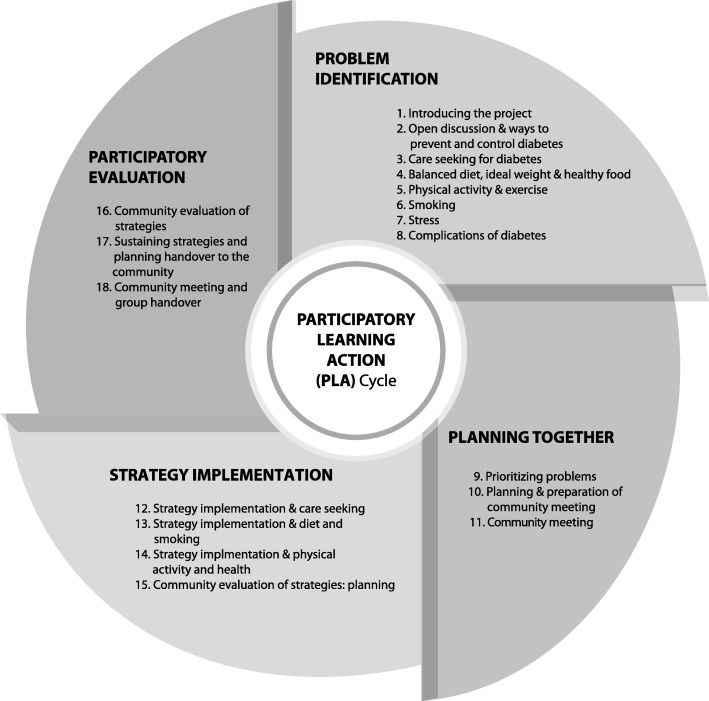
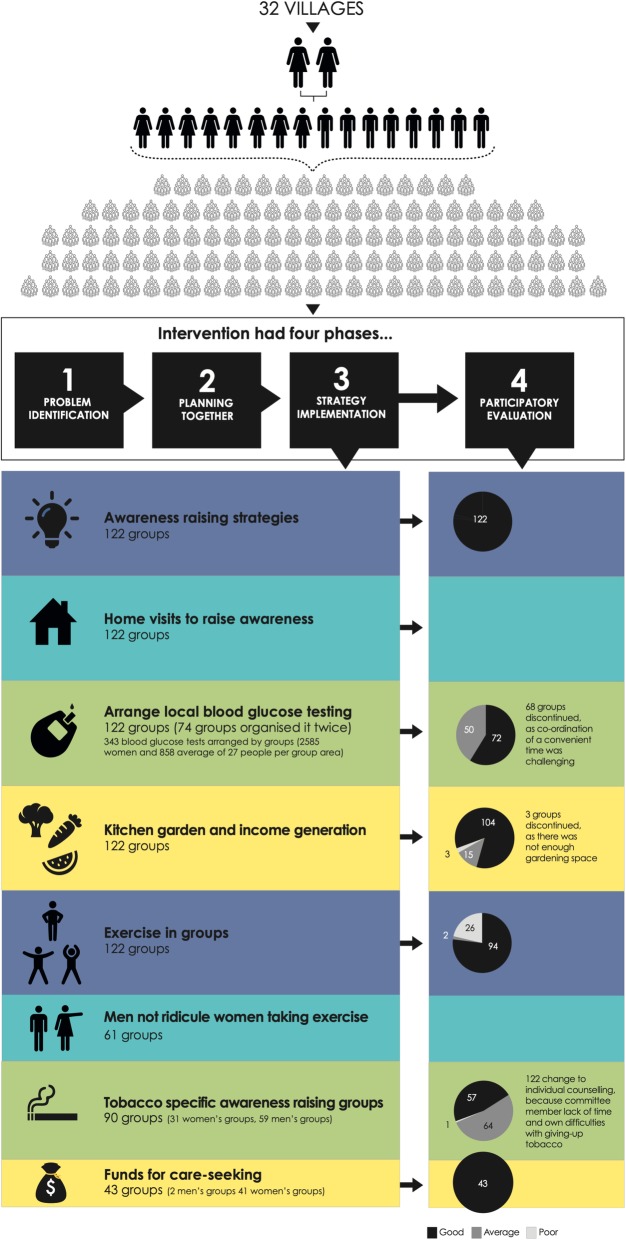
INTRODUCTION: There is an urgent need to address the growing type 2 diabetes disease burden. 20-30% of adults in rural areas of Bangladesh have intermediate hyperglycaemia and about 10% have diabetes. We report on the implementation and fidelity of a Participatory Learning and Action (PLA) intervention, evaluated through a three-arm cluster randomised controlled trial which reduced the incidence of diabetes and intermediate hyperglycaemia in rural Bangladesh. PLA interventions have been effective in addressing population level health problems in low income country contexts, and therefore we sought to use this approach to engage communities to identify and address community barriers to prevention and control of type 2 diabetes. METHODS: We used a mixed methods approach collecting quantitative data through field reports and qualitative data through observations and focus group discussions. Through descriptive analysis, we considered fidelity to the participatory approach and implementation plans. RESULTS: One hundred twenty-two groups per month were convened by 16 facilitators and supervised by two coordinators. Groups worked through a four phase PLA cycle of problem identification, planning together, implementation and evaluation to address the risk factors for diabetes - diet, physical activity, smoking and stress. Groups reported a lack of awareness about diabetes prevention and control, the prohibitive cost of care and healthy eating, and gender barriers to exercise for women. Groups set targets to encourage physical activity, kitchen-gardening, cooking with less oil, and reduced tobacco consumption. Anti-tobacco committees operated in 90 groups. One hundred twenty-two groups arranged blood glucose testing and 74 groups organized testing twice. Forty-one women's groups established funds, and 61 communities committed not to ridicule women exercising. Experienced and committed supervisors enabled fidelity to a participatory methodology. A longer intervention period and capacity building could enable engagement with systems barriers to behaviour change. CONCLUSION: Our complex intervention was implemented as planned and is likely to be valid in similar contexts given the flexibility of the participatory approach to contextually specific barriers to prevention and control of type 2 diabetes. Fidelity to the participatory approach is key to implementing the intervention and effectively addressing type 2 diabetes in a low-income country.
Overview
The claims and statistics of this paper haven’t been checked yet.
Free: it reads the open-access text and checks the first 5 claims that cite a source we can check. Create a free account to check every claim.
Integrity signals
Registry
Cites
Statistics
Figures
Verification
Claims the paper makes
The claims and statistics of this paper haven’t been checked yet.
Free: it reads the open-access text and checks the first 5 claims that cite a source we can check. Create a free account to check every claim.
Claims other papers make about this one
Each is checked against this paper’s own text: does it say what the citing paper says it does?
The source backs part of the claim, not all of it — or backs it for a different population, condition or comparison.
In the citing paper
“In rural Bangladesh, participatory learning and action (PLA) community groups exert prominent sociocultural supportive effects by establishing gender-neutral discussion groups, holding village-wide assemblies, and cooperating with local religious leaders such as imams to embed diabetes lifestyle guidance into daily cultural communication.”
From Implementation and translation of evidence-based dietary strategies for type 2 diabetes in resource-limited settings: a scoping review based on the CFIR framework (2026) · cites this paper as [91]
Experimental — accuracy not yet measuredThe source backs part of the claim, not all of it — or backs it for a different population, condition or comparison.
In the citing paper
“Embedded voluntary and community social enterprise (VCSE) institutions, participatory group learning models, and culture-based peer support constitute core sociocultural enablers that advance diabetic dietary self-management among marginalized ethnic, low-income and rural populations (33, 54, 91).”
From Implementation and translation of evidence-based dietary strategies for type 2 diabetes in resource-limited settings: a scoping review based on the CFIR framework (2026) · cites this paper as [91]
Experimental — accuracy not yet measuredThe source backs part of the claim, not all of it — or backs it for a different population, condition or comparison.
In the citing paper
“Taken together, community participatory mechanisms, ethnicity-specific peer networks, partnerships with religious stakeholders and revitalized indigenous food culture form interrelated sociocultural enablers, which mitigate conflicts over cultural eating norms and consolidate long-term compliance with evidence-based diabetic dietary plans (33, 54, 91).”
From Implementation and translation of evidence-based dietary strategies for type 2 diabetes in resource-limited settings: a scoping review based on the CFIR framework (2026) · cites this paper as [91]
Experimental — accuracy not yet measured
Self-check
Percentages, sums and reported differences re-computed from the paper’s own numbers.
The self-check needs the paper’s full text.
Citations
Cites
Research Design: Qualitative, Quantitative, and Mixed Methods Approaches
Creswell, J. W. (1994) · Cited by 35,508
Research design: qualitative, quantitative, and mixed methods approaches
Caldas, M. P. (2003) · Revista de Administração Contemporânea · doi:10.1590/s1415-65552003000100015 · Cited by 18,745
Process evaluation of complex interventions: Medical Research Council guidance
Moore, G. F., Audrey, S., Barker, M., Bond, L., Bonell, C., Hardeman, W., Moore, L., O'Cathain, A., Tinati, T., Wight, D., et al. (2015) · BMJ · doi:10.1136/bmj.h1258 · Cited by 6,204
Photovoice: Concept, Methodology, and Use for Participatory Needs Assessment
Wang, C., & Burris, M. A. (1997) · Health Education & Behavior · doi:10.1177/109019819702400309 · Cited by 5,551
Ishtiaq, M. (2019) · English Language Teaching · doi:10.5539/elt.v12n5p40 · Cited by 1,732
Complex interventions: how “out of control” can a randomised controlled trial be?
Hawe, P., Shiell, A., & Riley, T. (2004) · BMJ · doi:10.1136/bmj.328.7455.1561 · Cited by 1,244
Stakeholder analysis: a review
Brugha, R. (2000) · Health Policy and Planning · doi:10.1093/heapol/15.3.239 · Cited by 1,030
BANGLADESH DEMOGRAPHIC AND HEALTH SURVEY 2014
Dhaka, B. (2015) · Cited by 896
Prost, A., Colbourn, T., Seward, N., Azad, K., Coomarasamy, A., Copas, A., Houweling, T. A. J., Fottrell, E., Kuddus, A., Lewycka, S., et al. (2013) · The Lancet · doi:10.1016/s0140-6736(13)60685-6 · Cited by 630
Self-citationCampbell, C., & MacPhail, C. (2002) · Social Science & Medicine · doi:10.1016/s0277-9536(01)00289-1 · Cited by 531
Research works printed but not linked: 8
- Cornwall A Body mapping in health RRA/PRA. RRA Notes, IIED London(16) 1992 69 76
- Freire P Pedagogy of the oppressed 1972 London Penguin
- Lunch N Lunch C Insights into participatory video 2006 Oxford InsightShare
- Ministry of Health and Family Welfare Community Based Health Care (CBHC), DGHS 2018
- Rifkin S Pridmore P Partners in Planning 2001 London Macmillan education limited
- WHO Global action plan 2013 2020 2013 Geneva WHO
- WHO Global report on diabetes 2016 Geneva WHO
- WHO Global Health estimates 2016: deaths by cause, age, sex country and by region 2000–2016 2018 Geneva WHO
Cited by
Schleiff, M., Aitken, I. W., Alam, M. A., Damtew, Z. A., & Perry, H. B. (2021) · Health Research Policy and Systems · doi:10.1186/s12961-021-00757-3 · Cited by 197
Liu, F., Guo, Y., Liu, Y., Chen, G., Wang, Y., Xue, X., Liu, S., Huo, W., Mao, Z., Hou, Y., et al. (2019) · Environment International · doi:10.1016/j.envint.2019.105213 · Cited by 75
Seal, A., Mohamed, H. A., Stokes‐Walters, R., Mohamed, S., Abdille, A. M., Yakowenko, E., Omar, M. S., & Jelle, M. (2023) · Vaccine · doi:10.1016/j.vaccine.2023.02.016 · Cited by 44
Morrison, J., Akter, K., Jennings, H. M., Nahar, T., Kuddus, A., Shaha, S. K., Ahmed, N., King, C., Haghparast‐Bidgoli, H., Costello, A. M. D. L., et al. (2019) · BMC Endocrine Disorders · doi:10.1186/s12902-019-0447-3 · Cited by 46
Self-citationvan der Merwe, M., D’Ambruoso, L., Witter, S., Twine, R., Mabetha, D., Hove, J., Byass, P., Tollman, S. M., & Kahn, K. (2021) · Health Research Policy and Systems · doi:10.1186/s12961-021-00716-y · Cited by 30
“Other formative research involving communities in the identification of health behaviours has illustrated that community groups were keen to act but were often unsure about what to do, and recommended capacity-building to enable participants to engage with policy-makers and health workers [56].”
BackgroundKlingberg, S., Motlhatlhedi, M., Mabena, G., Mooki, T., Verdezoto, N. X., Densmore, M., Norris, S. A., & on behalf of the CoMaCH network (2022) · PLOS Global Public Health · doi:10.1371/journal.pgph.0001280 · Cited by 25
“In an effort to address problematic power imbalances and avoid paternalistic health interventions, researchers have drawn on Freire’s philosophy [54, 55], aiming to foster a level of critical consciousness about oppressive social structures as a precondition for successful health interventions [56, 57].”
BackgroundMorrison, J., Jennings, H. M., Akter, K., Kuddus, A., Mannell, J., Nahar, T., Shaha, S. K., Ahmed, N., Haghparast‐Bidgoli, H., Costello, A. M. D. L., et al. (2019) · WHO South-East Asia Journal of Public Health · doi:10.4103/2224-3151.264855 · Cited by 21
Self-citationKlingberg, S., Adhikari, B., Draper, C. E., Bosire, E. N., Nyirenda, D., Tiigah, P., & Mukumbang, F. C. (2024) · BMJ Global Health · doi:10.1136/bmjgh-2023-013712 · Cited by 24
Lazo‐Porras, M., Liu, H., Ouyang, M., Yin, X., Malavera, A., Bressan, T., Guzman‐Vilca, W. C., Pacheco, N. V., Benito, M., Miranda, J. J., et al. (2022) · BMJ Open · doi:10.1136/bmjopen-2021-057597 · Cited by 14
“Some examples of the use of theories and frameworks are Morrison et al 41 who used the MRC framework to describe the implementation and fidelity of a Participatory Learning Action in an RCT in diabetes in Bangladesh; Gyamfi et al 42 who developed their inter-view guide using the CFIR focusing on…”
MethodPires, M., Shaha, S. K., King, C., Morrison, J., Nahar, T., Ahmed, N., Jennings, H. M., Akter, K., Haghparast‐Bidgoli, H., Khan, A., et al. (2022) · Journal of Epidemiology & Community Health · doi:10.1136/jech-2021-217293 · Cited by 17
“23 24 31 Although participation in PLA meetings was higher in the younger age groups of women, the impact of PLA on combined prevalence of T2DM and intermediate hyperglycaemia was observed in all age groups.”
Self-citationFottrell, E. F., King, C., Ahmed, N., Shaha, S. K., Morrison, J., Pires, M., Kuddus, A., Nahar, T., Haghparast‐Bidgoli, H., Khan, A., et al. (2022) · The Lancet Regional Health - Southeast Asia · doi:10.1016/j.lansea.2022.100122 · Cited by 14
Self-citationKing, C., Pires, M., Ahmed, N., Akter, K., Kuddus, A., Copas, A. J., Haghparast‐Bidgoli, H., Morrison, J., Nahar, T., Shaha, S. K., et al. (2021) · Trials · doi:10.1186/s13063-021-05167-y · Cited by 9
Self-citationAkter, K., Kuddus, A., Jeny, T. J., Nahar, T., Shaha, S. K., Ahmed, N., King, C., Pires, M., Haghparast‐Bidgoli, H., Azad, K., et al. (2023) · BMC Public Health · doi:10.1186/s12889-023-15551-9 · Cited by 7
“Communities implemented strategies which addressed barriers to physical activity for women, they sought community-based blood glucose testing through village doctors, and made home visits to promote healthy eating and tobacco reduction [10, 11].”
MethodSelf-citationKing, C., Burgess, R. A., Bakare, A. A., Shittu, F., Salako, J., Bakare, D., Uchendu, O. C., Iuliano, A., Djellouli, N., Isah, A., et al. (2024) · The Lancet Global Health · doi:10.1016/s2214-109x(24)00369-3 · Cited by 5
Self-citationCommunity engagement in population-level research in the context of Covid-19 in rural Bangladesh
Morrison, J., Hossin, R., Kuddus, A., Pires, M., King, C., Ahmed, N., Nahar, T., Shaha, S. K., Azad, K., & Fottrell, E. F. (2023) · Research for All · doi:10.14324/rfa.07.1.17 · Cited by 3
Self-citationFottrell, E. F., Costello, H., Ahmed, N., King, C., Shaha, S. K., Nahar, T., Pires, M., Copas, A. J., Haghparast‐Bidgoli, H., Morrison, J., et al. (2025) · The Lancet Regional Health - Southeast Asia · doi:10.1016/j.lansea.2025.100575 · Cited by 4
Self-citationShao, K., Lei, H., Zhu, J., Chen, X., Sina, Y., & Yao, R. (2026) · Frontiers in Public Health · doi:10.3389/fpubh.2026.1870603
Morrison, J., Pires, M., Ahmed, S. A. U., King, C., Jeny, T. J., Hossin, R., Nahar, T., Ahmed, N., Shaha, S. K., Haghparast‐Bidgoli, H., et al. (2025) · BMJ Open · doi:10.1136/bmjopen-2024-089288 · Cited by 2
Self-citationKhattak, M. I., Rehman, K., Afaq, S., Butt, S. S., Ghutai, G., Hanifi, R., Hofiani, M., Tahir, A., Zafar, R., & Jennings, H. M. (2026) · PLoS ONE · doi:10.1371/journal.pone.0345231
Self-citation
Metadata
- Authors
- Morrison, J., Akter, K., Jennings, H. M., Kuddus, A., Nahar, T., King, C., Shaha, S. K., Ahmed, N., Haghparast-Bidgoli, H., Costello, A., Khan, A. K. A., Azad, K., & Fottrell, E.
- Affiliations
- University College London (GB)
- Karolinska Institutet (SE)
- Corresponding author
- Morrison, Joanna
- ORCID
- Venue
- Global Health Research and Policy
- Publisher
- Elsevier BV
- Published
- 2019-07-05
- Volume
- 4
- Issue
- 1
- Pages
- 19-19
- ISSN
- 2397-0642 (ISSN-L)
- PMC
- PMC6610980
- OpenAlex
- W2955123706
- Cited by
- 19
- References
- 40
- Citations by year
- 2026: 2 · 2025: 2 · 2024: 2 · 2023: 3 · 2022: 4 · 2021: 3 · 2019: 3
- FWCI
- 2.03
- Type
- journal article
- Language
- en
- Open access
- gold
- doi.org
- Licence
- cc-by
- creativecommons.org/licenses/by/4.0/ (tdm)
- creativecommons.org/licenses/by/4.0/ (vor)
- Locations
- Global Health Research and Policy (publishedVersion, cc-by)
- PubMed Central (publishedVersion, cc-by)
- PubMed (publishedVersion)
- White Rose Research Online (University of Leeds, The University of Sheffield, University of York) (acceptedVersion)
- DOAJ (DOAJ: Directory of Open Access Journals) (submittedVersion, cc-by-sa)
- UCL Discovery (University College London) (submittedVersion)
- Greater South Information System
- Funders
- Medical Research Council (MR/M016501/1)
- Topics
- Health Sciences › Medicine › Endocrinology, Diabetes and Metabolism › Diabetes Management and Education
- Health Sciences › Health Professions › General Health Professions › Health Policy Implementation Science
- Health Sciences › Medicine › Public Health, Environmental and Occupational Health › Community Health and Development
- Keywords
- type 2 diabetes prevention, prediabetes, participatory learning and action, intervention fidelity, implementation, community-based intervention, rural Bangladesh, diabetes risk factors, physical activity, tobacco control, blood glucose monitoring, kitchen gardening, complex interventions, low-income countries
About these checks
Registry, retraction, Cites and statistics results are computed, not judged, with one exception: a printed reference that no index lists is read once by a model before it counts as a citation error. Claims are extracted by a model and kept only when their quote appears verbatim in the text; each cited source is then checked, with a model’s help, for whether it says what the claim relies on. Those verdicts can be wrong — read the claim’s quote and the cited source before relying on one.
Statistics and arithmetic are recomputed, not judged.
Confidence bands are shown only for fields calibrated on our annotated test set. None is calibrated yet, so no band is shown.
What counts as a claim ›How we measure confidence ›How we check this ›
Are you an author, or do you see a problem with this page? Request a review
Data sources
Bibliographic data: Semantic Scholar, OpenAlex, Crossref.
Contains information from the Semantic Scholar Academic Graph Datasets, made available under the ODC Attribution License (ODC-BY 1.0).
Semantic Scholar’s data is described in: Kinney, R., et al. (2023). The Semantic Scholar Open Data Platform. arXiv:2301.10140.
