

A narrative review on environmental impacts of cannabis cultivation
Open accessThe DOI matches its Crossref record; 54 of the 55 references it cites were found in a registry or an index.
Abstract
Interest in growing cannabis for medical and recreational purposes is increasing worldwide. This study reviews the environmental impacts of cannabis cultivation. Results show that both indoor and outdoor cannabis growing is water-intensive. The high water demand leads to water pollution and diversion, which could negatively affect the ecosystem. Studies found out that cannabis plants emit a significant amount of biogenic volatile organic compounds, which could cause indoor air quality issues. Indoor cannabis cultivation is energy-consuming, mainly due to heating, ventilation, air conditioning, and lighting. Energy consumption leads to greenhouse gas emissions. Cannabis cultivation could directly contribute to soil erosion. Meanwhile, cannabis plants have the ability to absorb and store heavy metals. It is envisioned that technologies such as precision irrigation could reduce water use, and application of tools such as life cycle analysis would advance understanding of the environmental impacts of cannabis cultivation.
Overview
The claims and statistics of this paper haven’t been checked yet.
Free: it reads the open-access text and checks the first 5 claims that cite a source we can check. Create a free account to check every claim.
Integrity signals
Registry
Cites
Statistics
Figures
Verification
Claims the paper makes
The claims and statistics of this paper haven’t been checked yet.
Free: it reads the open-access text and checks the first 5 claims that cite a source we can check. Create a free account to check every claim.
Claims other papers make about this one
Each is checked against this paper’s own text: does it say what the citing paper says it does?
The source backs part of the claim, not all of it — or backs it for a different population, condition or comparison.
In the citing paper
“During commercial-scale cultivation, large amounts of water and energy are consumed, contributing indirectly to waste through resource depletion and potentially causing ecological harm through land clearance, excessive pesticide use, and fertilizer use”
From Cannabis sativa L. biomass valorization as a strategic bioresource for South Africa’s circular bioeconomy: integrating biorefinery pathways and green extraction (2026) · cites this paper as [47]
Experimental — accuracy not yet measured
Self-check
Percentages, sums and reported differences re-computed from the paper’s own numbers.
The self-check needs the paper’s full text.
Citations
Cites
Transformation of the Nitrogen Cycle: Recent Trends, Questions, and Potential Solutions
Galloway, J. N., Townsend, A. R., Erisman, J. W., Bekunda, M., Cai, Z., Freney, J. R., Martinelli, L. A., Seitzinger, S. P., & Sutton, M. A. (2008) · Science · doi:10.1126/science.1136674 · Cited by 6,995 · cited 1×
“Both soil acidification and water eutrophication risks could significantly increase because of the nitrogen cascade (Galloway et al. 2003; Galloway et al. 2008).”
BackgroundGALLOWAY, J. N., ABER, J. D., ERISMAN, J. W., SEITZINGER, S. P., HOWARTH, R. W., COWLING, E. B., & COSBY, B. J. (2003) · BioScience · doi:10.1641/0006-3568(2003)053[0341:tnc]2.0.co;2 · Cited by 2,973
Known and Unexplored Organic Constituents in the Earth's Atmosphere
Goldstein, A. H., & Galbally, I. E. (2007) · Environmental Science & Technology · doi:10.1021/es072476p · Cited by 1,516 · cited 1×
“Amongst the VOCs, the biogenic volatile organic compounds (BVOCs) (Atkinson and Arey 2003), mainly emitted from vegetation, account for approximately 89% of the total atmospheric VOCs (Goldstein and Galbally 2007).”
BackgroundGas-phase tropospheric chemistry of biogenic volatile organic compounds: a review
Atkinson, R., & Arey, J. (2003) · Atmospheric Environment · doi:10.1016/s1352-2310(03)00391-1 · Cited by 1,385 · cited 3×
“Ambient measurements collected inside growing operations pre-legalization have found concentrations as high as 50–100 ppbv of terpenes including α-pinene, β-pinene, β-myrcene, and d-limonene for fewer than 100 plants in the cannabis cultivation facility (Martyny et al. 2013; Atkinson and Arey 2003; Wang et al. 2019a).”
Background(2003) · Choice Reviews Online · doi:10.5860/choice.40-2804 · Cited by 939
Introduction to Atmospheric Chemistry
Jacob, D. J. (2000) · Princeton University Press eBooks · doi:10.1515/9781400841547 · Cited by 854
Inland Fishes of California: Revised and Expanded
Moyle, P. B. (2002) · University of California Press eBooks · doi:10.1525/9780520926516 · Cited by 849
(2005) · Choice Reviews Online · doi:10.5860/choice.42-4060 · Cited by 372
Environmental damage due to fossil fuels use
Barbir, F., Veziroǧlu, T. N., & Plass, H. J. (1990) · International Journal of Hydrogen Energy · doi:10.1016/0360-3199(90)90005-j · Cited by 315 · cited 1×
“pose effects on (1) humans, (2) animals, (3) farm produce, plants, and forests, (4) aquatic ecosystems, and (5) buildings and structures (Barbir et al. 1990).”
BackgroundLinger, P., Müssig, J., Fischer, H., & Kobert, J. (2002) · Industrial Crops and Products · doi:10.1016/s0926-6690(02)00005-5 · Cited by 290 · cited 1×
“Though limited studies discussed the effectiveness of cannabis for heavy metals removal, many studies have addressed the uptake of heavy metals by industrial hemp (Campbell et al. 2002; Linger et al. 2002).”
Background(2004) · National Academies Press eBooks · doi:10.17226/11011 · Cited by 232
Schlenker, W., Hanemann, W. M., & Fisher, A. C. (2007) · Climatic Change · doi:10.1007/s10584-005-9008-z · Cited by 189 · cited 1×
“Notably, the predicted decrease in water availability downscales in California may adversely affect the value of farmland (Schlenker et al. 2007) and pose a severe challenge to the cannabis industry.”
BackgroundNitrogen supply affects cannabinoid and terpenoid profile in medical cannabis (Cannabis sativa L.)
Saloner, A., & Bernstein, N. (2021) · Industrial Crops and Products · doi:10.1016/j.indcrop.2021.113516 · Cited by 180 · cited 1×
“Recent studies have suggested the considerable demands of nutrition such as nitrogen (Saloner and Bernstein 2020, 2021), phosphorous (Shiponi and Bernstein 2021), and potassium (Saloner et al.”
BackgroundMarine, K. R., & Cech, J. J. (2004) · North American Journal of Fisheries Management · doi:10.1577/m02-142 · Cited by 172 · cited 1×
“As the reduced streamflow has a strong positive correlation with increased water temperature, indirectly resulting in reduced growth rates in salmonids, lowered dissolved oxygen, increased predation risk, and increased susceptibility to disease (Marine and Cech 2004).”
BackgroundThe Volatile Oil Composition of Fresh and Air-Dried Buds of Cannabis sativa
Ross, S. A., & ElSohly, M. A. (1996) · Journal of Natural Products · doi:10.1021/np960004a · Cited by 158 · cited 1×
“1973; Rice and Koziel 2015; Ross and ElSohly 1996).”
BackgroundCannabis contaminants: sources, distribution, human toxicity and pharmacologic effects
Dryburgh, L. M., Bolan, N. S., Grof, C. P. L., Galettis, P., Schneider, J., Lucas, C. J., & Martin, J. H. (2018) · British Journal of Clinical Pharmacology · doi:10.1111/bcp.13695 · Cited by 158
Cocker, D. R., Mader, B. T., Kalberer, M., Flagan, R. C., & Seinfeld, J. H. (2001) · Atmospheric Environment · doi:10.1016/s1352-2310(01)00405-8 · Cited by 156
Gabriel, M. W., Woods, L. W., Poppenga, R. H., Sweitzer, R. A., Thompson, C. M., Matthews, S. M., Higley, J. M., Keller, S. M., Purcell, K. L., Barrett, R. H., et al. (2012) · PLoS ONE · doi:10.1371/journal.pone.0040163 · Cited by 148
WHO Guidelines for Indoor Air Quality: Dampness and Mould
Who Regional Office for Europe (2009) · Cited by 148
The carbon footprint of indoor Cannabis production
Mills, E. (2012) · Energy Policy · doi:10.1016/j.enpol.2012.03.023 · Cited by 123 · cited 8×
“It has been reported that the intensity of the indoor cannabis lamps (25 klux for leaf phase, and 100 klux for flowering (Mills 2012)) approximates that of hospital operating room lamps, which is up to 500 times greater than a standard reading light (Warren 2015).”
BackgroundInfluentialExposure pathways of anticoagulant rodenticides to nontarget wildlife
Elliott, J. E., Hindmarch, S., Albert, C. A., Emery, J., Mineau, P., & Maisonneuve, F. J. (2013) · Environmental Monitoring and Assessment · doi:10.1007/s10661-013-3422-x · Cited by 111 · cited 1×
“Studies show that the second-generation anticoagulant rodenticides (ARs) affect many predators in both rural and urban settings (Gabriel et al. 2013, 2012; Elliott et al. 2014).”
BackgroundBauer, S. D., Olson, J., Cockrill, A., van Hattem, M., Miller, L., Tauzer, M., & Leppig, G. (2015) · PLoS ONE · doi:10.1371/journal.pone.0120016 · Cited by 109 · cited 4×
“In California, irrigated agriculture is regarded as the single largest water consumer, accounting for 70–80% of stored surface water and pumping vast volumes of groundwater (Moyle 2002; Bauer et al. 2015).”
BackgroundInfluentialPimentel, D., & Edwards, C. A. (1982) · BioScience · doi:10.2307/1308603 · Cited by 107
Thompson, C. M., Sweitzer, R. A., Gabriel, M. W., Purcell, K. L., Barrett, R. H., & Poppenga, R. H. (2013) · Conservation Letters · doi:10.1111/conl.12038 · Cited by 97 · cited 11×
“2 Department of Health Sciences Environmental Health and Sustainability Program, Illinois State University, Normal, IL 61790, USA.”
BackgroundInfluentialResponse of Medical Cannabis (Cannabis sativa L.) to Nitrogen Supply Under Long Photoperiod
Saloner, A., & Bernstein, N. (2020) · Frontiers in Plant Science · doi:10.3389/fpls.2020.572293 · Cited by 91 · cited 1×
“Recent studies have suggested the considerable demands of nutrition such as nitrogen (Saloner and Bernstein 2020, 2021), phosphorous (Shiponi and Bernstein 2021), and potassium (Saloner et al.”
BackgroundButsic, V., & Brenner, J. C. (2016) · Environmental Research Letters · doi:10.1088/1748-9326/11/4/044023 · Cited by 87 · cited 3×
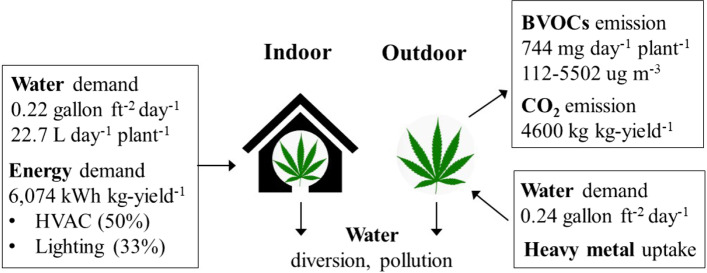
“On average, a cannabis plant is estimated to consume 22.7 l (6 gallons) of water per day during the growing season, which typically ranges from June to October for an approximate total of 150 days (Butsic and Brenner 2016).”
BackgroundInfluentialRice, S., & Koziel, J. A. (2015) · PLoS ONE · doi:10.1371/journal.pone.0144160 · Cited by 85 · cited 1×
“1973; Rice and Koziel 2015; Ross and ElSohly 1996).”
BackgroundHigh Time for Conservation: Adding the Environment to the Debate on Marijuana Liberalization
Carah, J. K., Howard, J. K., Thompson, S., Gianotti, A. G. S., Bauer, S. D., Carlson, S. M., Dralle, D., Gabriel, M. W., Hulette, L. L., Johnson, B. J., et al. (2015) · BioScience · doi:10.1093/biosci/biv083 · Cited by 78
WHO guidelines for indoor air quality: dampness and mold
Hänninen, O. O. (2011) · Fundamentals of mold growth in indoor environments and strategies for healthy living · doi:10.3920/978-90-8686-722-6_10 · Cited by 75
Contaminants of Concern in Cannabis: Microbes, Heavy Metals and Pesticides
McPartland, J. M., & McKernan, K. J. (2017) · Springer eBooks · doi:10.1007/978-3-319-54564-6_22 · Cited by 74 · cited 2×
“Phytoremediation potential Cannabis has gradually garnered attention as a “bioremediation crop” because of its strong ability to absorbing and storing heavy metals (McPartland and McKernan 2017).”
BackgroundPotential Exposures Associated with Indoor Marijuana Growing Operations
Martyny, J. W., Serrano, K. A., Schaeffer, J. W., & Van Dyke, M. V. (2013) · Journal of Occupational and Environmental Hygiene · doi:10.1080/15459624.2013.831986 · Cited by 70 · cited 1×
“Ambient measurements collected inside growing operations pre-legalization have found concentrations as high as 50–100 ppbv of terpenes including α-pinene, β-pinene, β-myrcene, and d-limonene for fewer than 100 plants in the cannabis cultivation facility (Martyny et al. 2013; Atkinson and Arey 2003; Wang et al. 2019a).”
BackgroundThe emergence of cannabis agriculture frontiers as environmental threats
Butsic, V., Carah, J. K., Baumann, M., Stephens, C. W., & Brenner, J. C. (2018) · Environmental Research Letters · doi:10.1088/1748-9326/aaeade · Cited by 70 · cited 1×
“The slope is a useful proxy for erosion potential since soil on steep slopes tends to erosion when cleared or cultivated (Butsic et al. 2018).”
BackgroundHeadspace Volatiles of Marijuana
Hood, L. V. S., DAMES, M. E., & BARRY, G. T. (1973) · Nature · doi:10.1038/242402a0 · Cited by 69
Shiponi, S., & Bernstein, N. (2020) · Industrial Crops and Products · doi:10.1016/j.indcrop.2020.113154 · Cited by 68 · cited 1×
“Recent studies have suggested the considerable demands of nutrition such as nitrogen (Saloner and Bernstein 2020, 2021), phosphorous (Shiponi and Bernstein 2021), and potassium (Saloner et al.”
BackgroundResponse of Medical Cannabis (Cannabis sativa L.) Genotypes to K Supply Under Long Photoperiod
Saloner, A., Sacks, M. M., & Bernstein, N. (2019) · Frontiers in Plant Science · doi:10.3389/fpls.2019.01369 · Cited by 62
Remediation of Benzo[a]pyrene and Chrysene-Contaminated Soil with Industrial Hemp (Cannabis sativa)
Campbell, S., Paquin, D., Awaya, J. D., & Li, Q. X. (2002) · International Journal of Phytoremediation · doi:10.1080/15226510208500080 · Cited by 59 · cited 1×
“Though limited studies discussed the effectiveness of cannabis for heavy metals removal, many studies have addressed the uptake of heavy metals by industrial hemp (Campbell et al. 2002; Linger et al. 2002).”
BackgroundFirst known survey of cannabis production practices in California
Wilson, H., Bodwitch, H., Carah, J. K., Daane, K. M., Getz, C., Grantham, T. E., & Butsic, V. (2019) · California Agriculture · doi:10.3733/ca.2019a0015 · Cited by 59
Irrigation Scheduling for Cotton Cultivation
Hussain, S., Ahmad, A., Wajid, A., Khaliq, T., Hussain, N., Mubeen, M. A., Farid, H. U., Imran, M., Hammad, H. M., Awais, M., et al. (2020) · Springer eBooks · doi:10.1007/978-981-15-1472-2_5 · Cited by 56
Bury, R. B. (2008) · Applied Herpetology · doi:10.1163/157075408783489211 · Cited by 48 · cited 1×
“The headwater stream-dwelling amphibians also exhibit high sensitivity to water temperature changes (Bury 2008).”
BackgroundGianotti, A. G. S., Harrower, J. T., Baird, G., & Sepaniak, S. (2016) · Land Use Policy · doi:10.1016/j.landusepol.2016.11.016 · Cited by 47
The use of pesticides in Belgian illicit indoor cannabis plantations
Cuypers, E., Vanhove, W., Gotink, J., Bonneure, A., Damme, P. V., & Tytgat, J. (2017) · Forensic Science International · doi:10.1016/j.forsciint.2017.05.016 · Cited by 42
Cannabis Contaminants: Regulating Solvents, Microbes, and Metals in Legal Weed
Seltenrich, N. (2019) · Environmental Health Perspectives · doi:10.1289/ehp5785 · Cited by 39 · cited 1×
“Usually, it takes up high levels of heavy metals from the soil or growing medium via its roots and potentially deposits into its flowers (Seltenrich 2019).”
BackgroundCannabis, an emerging agricultural crop, leads to deforestation and fragmentation
Wang, I., Brenner, J. C., & Butsic, V. (2017) · Frontiers in Ecology and the Environment · doi:10.1002/fee.1634 · Cited by 37
Wang, C., Wiedinmyer, C., Ashworth, K., Harley, P. C., Ortega, J., & Vizuete, W. (2018) · Atmospheric Environment · doi:10.1016/j.atmosenv.2018.10.049 · Cited by 34 · cited 1×
“A recent study conducted by Wang et al. was the first attempt at developing an emission inventory for cannabis (Wang et al., 2019a).”
BackgroundBalasubramanian, S., Nelson, A., Koloutsou‐Vakakis, S., Lin, J., Rood, M. J., Myles, L., & Bernacchi, C. J. (2017) · Agricultural and Forest Meteorology · doi:10.1016/j.agrformet.2017.02.006 · Cited by 31
Samburova, V., McDaniel, M. R., Campbell, D., Wolf, M., Stockwell, W. R., & Khlystov, A. Y. (2019) · Journal of the Air & Waste Management Association · doi:10.1080/10962247.2019.1654038 · Cited by 30
Singani, A. A. S., & Ahmadi, P. (2012) · Soil and Sediment Contamination An International Journal · doi:10.1080/15320383.2012.664186 · Cited by 24 · cited 1×
“Singani and Ahmadi reported that Cannabis sativa could absorb lead and cadmium from soils amended with contaminated cow and poultry manures (Singani and Ahmadi 2012).”
BackgroundDillis, C., Grantham, T. E., McIntee, C., McFadin, B., & Grady, K. (2019) · California Agriculture · doi:10.3733/ca.2019a0011 · Cited by 23 · cited 1×
“2%), are the most commonly extracted water source for cannabis cultivation in the North Coast region of California (Dillis et al. 2019).”
BackgroundConsequences of Large-scale Production of Marijuana in Residential Buildings
Johnson, L. I., & Miller, J. D. (2011) · Indoor and Built Environment · doi:10.1177/1420326x11411954 · Cited by 22 · cited 1×
“John and Miller suggested that the houses built after 1980 in Canada are at high risk of moisture-related damage if used as IMGO, and increased moisture levels of the IMGO are associated with elevated mold spore levels (Johnson and Miller 2012).”
BackgroundEnvironmental Risks and Opportunities in Cannabis Cultivation
Alstone, P., & Sanchez, D. L. (2013) · Cited by 20
Potential regional air quality impacts of cannabis cultivation facilities in Denver, Colorado
Wang, C., Wiedinmyer, C., Ashworth, K., Harley, P. C., Ortega, J., Rasool, Q. Z., & Vizuete, W. (2019) · Atmospheric chemistry and physics · doi:10.5194/acp-19-13973-2019 · Cited by 19
Pesticides and Groundwater: A Guide for the Pesticide User
Trautmann, N. M., Porter, K. S., & Wagenet, R. J. (1989) · eCommons (Cornell University) · Cited by 14
Regulating Pot to Save the Polar Bear: Energy and Climate Impacts of the Marijuana Industry
Warren, G. S. (2019) · Columbia Journal of Environmental Law · doi:10.7916/cjel.v40i3.3541 · Cited by 10 · cited 12×
“2 Department of Health Sciences Environmental Health and Sustainability Program, Illinois State University, Normal, IL 61790, USA.”
BackgroundInfluentialSilvey, B. (2019) · ResearchWorks at the University of Washington (University of Washington) · Cited by 1
Research works printed but not linked: 6
- Gabriel MW Wengert GM Higley JM Krogan S Sargent W Clifford DL Silent forests. Rodenticides on illegal marijuana crops harm wildlife Wildl Prof 2013 7 1 46 50
- Intaboot N. The study of water demand to grow rice in Thailand. 6th International Symposium on the Fusion of Science and Technologies. Jeju; 2017.
- Koch TD Chambers C Bucherl S Martyny J Cotner J Thomas S Clandestine indoor marijuana grow operations- recognition, assessment, and remediation 2010 Fairfax American Industrial Hygiene Association
- Rogers D, Aguilar J, Kisekka I, Lamm F. Center povot irrigation system losses and efficiency. Proceedings of the 29th Annual Central Plains Irrigation Conference, Burlington, Colorado. 2017.
- Southwellb J, Wena M, Jobsona B. Spokane Regional Clean Air Agent (SRCAA) Marijuana air emissions sampling testing project. In Inland Northwest Chapter AWMAI, Washington State; 2017.
- Wiedmann T, Minx J. A definition of “carbon footprint.” Ecolog Econ Res Trends. 2008;1:1–11.
Cited by
Pomoni, D. I., Koukou, M. K., Vrachopoulos, M. G., & Vasiliadis, L. (2023) · Energies · doi:10.3390/en16041690 · Cited by 183
Cannabis: a multifaceted plant with endless potentials
Fordjour, E., Manful, C. F., Sey, A. A., Javed, R., Pham, T. H., Thomas, R., & Cheema, M. (2023) · Frontiers in Pharmacology · doi:10.3389/fphar.2023.1200269 · Cited by 129
“Cannabis requires nutrients and water to grow, with varying daily water use depending on location, soil, weather, and growing methods (Carah et al., 2015; Zheng et al., 2021).”
BackgroundLife cycle assessment of mycelium-based composite materials
Volk, R., Schröter, M., Saeidi, N., Steffl, S., Javadian, A., Hebel, D. E., & Schultmann, F. (2024) · Resources Conservation and Recycling · doi:10.1016/j.resconrec.2024.107579 · Cited by 90
“In fact, hemp cultivation requires about 30 % more water than the cultivation of commodity crops like corn, cotton, soybean, wheat or rice (Zheng et al., 2021).”
BackgroundCannabis sativa L.: Crop Management and Abiotic Factors That Affect Phytocannabinoid Production
Trancoso, I., de Souza, G. A. R., dos Santos, P. R., dos Santos, K. D., de Miranda, R. M. D. S. N., da Silva, A. L. P. M., Santos, D. Z., García-Tejero, I. F., & Campostrini, E. (2022) · Agronomy · doi:10.3390/agronomy12071492 · Cited by 83
Massuela, D. C., Münz, S., Hartung, J., Nkebiwe, P. M., & Graeff‐Hönninger, S. (2023) · Frontiers in Plant Science · doi:10.3389/fpls.2023.1233232 · Cited by 27
“, 2021) while negatively affecting the environment through water, air and land pollution due to high water and fertilizer consumption (Pagnani et al., 2018; Zheng et al., 2021).”
Background
Metadata
- Authors
- Zheng, Z., Fiddes, K., & Yang, L.
- Affiliations
- University of Illinois Urbana-Champaign (US)
- Illinois State University (US)
- Corresponding author
- Yang, Liangcheng
- Venue
- Journal of Cannabis Research
- Published
- 2021-08-06
- Volume
- 3
- Issue
- 1
- Pages
- 35-35
- ISSN
- 2522-5782 (ISSN-L)
- PMC
- PMC8349047
- OpenAlex
- W3191909535
- Cited by
- 58
- References
- 55
- Citations by year
- 2026: 12 · 2025: 19 · 2024: 12 · 2023: 11 · 2022: 4
- FWCI
- 0.61
- Type
- journal article
- Language
- en
- Open access
- gold
- doi.org
- Licence
- cc-by
- creativecommons.org/licenses/by/4.0 (tdm)
- creativecommons.org/licenses/by/4.0 (vor)
- Locations
- Journal of Cannabis Research (publishedVersion, cc-by)
- PubMed Central (publishedVersion, cc-by)
- PubMed (publishedVersion)
- Research Explorer (The University of Manchester) (publishedVersion, other-oa)
- ISU Red - Research and eData (Illinois State University) (submittedVersion, cc-by)
- DOAJ (DOAJ: Directory of Open Access Journals) (submittedVersion, cc-by-sa)
- Funders
- Illinois State University
- Topics
- Physical Sciences › Environmental Science › Environmental Engineering › Environmental Impact and Sustainability
- Health Sciences › Medicine › Pharmacology (medical) › Cannabis and Cannabinoid Research
- Physical Sciences › Energy › Renewable Energy, Sustainability and the Environment › Photovoltaic Systems and Sustainability
- Keywords
- cannabis cultivation, environmental impact, water consumption, water pollution, biogenic volatile organic compounds, indoor air quality, energy consumption, greenhouse gas emissions, soil erosion, heavy metal uptake, precision irrigation, life cycle assessment
About these checks
Registry, retraction, Cites and statistics results are computed, not judged, with one exception: a printed reference that no index lists is read once by a model before it counts as a citation error. Claims are extracted by a model and kept only when their quote appears verbatim in the text; each cited source is then checked, with a model’s help, for whether it says what the claim relies on. Those verdicts can be wrong — read the claim’s quote and the cited source before relying on one.
Statistics and arithmetic are recomputed, not judged.
Confidence bands are shown only for fields calibrated on our annotated test set. None is calibrated yet, so no band is shown.
What counts as a claim ›How we measure confidence ›How we check this ›
Are you an author, or do you see a problem with this page? Request a review
Data sources
Bibliographic data: Semantic Scholar, OpenAlex, Crossref.
Contains information from the Semantic Scholar Academic Graph Datasets, made available under the ODC Attribution License (ODC-BY 1.0).
Semantic Scholar’s data is described in: Kinney, R., et al. (2023). The Semantic Scholar Open Data Platform. arXiv:2301.10140.
