

How low can you go? Examining the effects of brief online training and post-training consultation dose on implementation mechanisms and outcomes for measurement-based care
Open accessPublished version of a preprint
The DOI matches its Crossref record; 84 of the 84 references it cites were found in a registry or an index.
Abstract
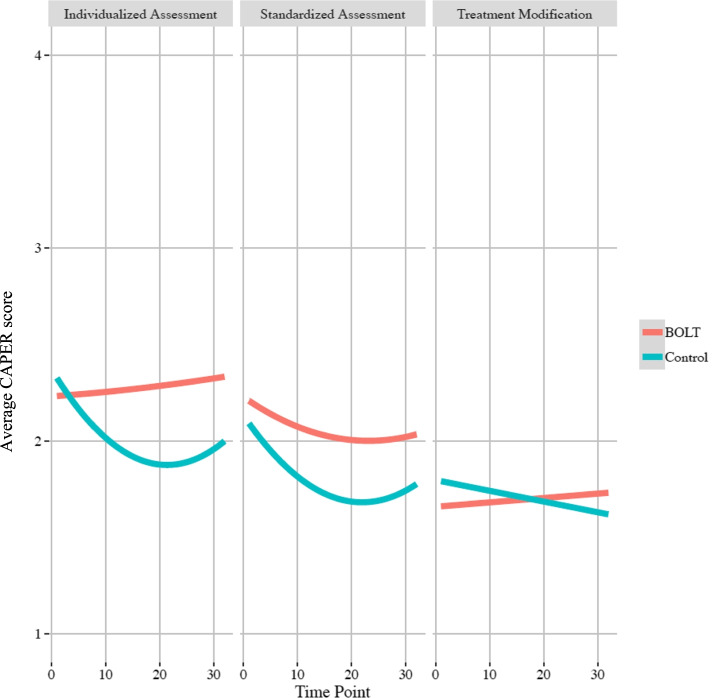
Background: Initial training and ongoing post-training consultation (i.e., ongoing support following training, provided by an expert) are among the most common implementation strategies used to change clinician practice. However, extant research has not experimentally investigated the optimal dosages of consultation necessary to produce desired outcomes. Moreover, the degree to which training and consultation engage theoretical implementation mechanisms—such as provider knowledge, skills, and attitudes—is not well understood. This study examined the effects of a brief online training and varying dosages of post-training consultation (BOLT+PTC) on implementation mechanisms and outcomes for measurement-based care (MBC) practices delivered in the context of education sector mental health services. Methods: A national sample of 75 clinicians who provide mental health interventions to children and adolescents in schools were randomly assigned to BOLT+PTC or control (services as usual). Those in BOLT+PTC were further randomized to 2-, 4-, or 8-week consultation conditions. Self-reported MBC knowledge, skills, attitudes, and use (including standardized assessment, individualized assessment, and assessment-informed treatment modification) were collected for 32 weeks. Multilevel models were used to examine main effects of BOLT+PTC versus control on MBC use at the end of consultation and over time, as well as comparisons among PTC dosage conditions and theorized mechanisms (skills, attitudes, knowledge). Results: There was a significant linear effect of BOLT+PTC over time on standardized assessment use ( b = .02, p < .01), and a significant quadratic effect of BOLT+PTC over time on individualized assessment use ( b = .04, p < .001), but no significant effect on treatment modification. BOLT + any level of PTC resulted in higher MBC knowledge and larger growth in MBC skill over the intervention period as compared to control. PTC dosage levels were inconsistently predictive of outcomes, providing no clear evidence for added benefit of higher PTC dosage. Conclusions: Online training and consultation in MBC had effects on standardized and individualized assessment use among clinicians as compared to services as usual with no consistent benefit detected for increased consultation dosage. Continued research investigating optimal dosages and mechanisms of these established implementation strategies is needed to ensure training and consultation resources are deployed efficiently to impact clinician practices. Trial registration: ClinicalTrials.gov NCT05041517 . Retrospectively registered on 10 September 2021.
Overview
The claims and statistics of this paper haven’t been checked yet.
Free: it reads the open-access text and checks the first 5 claims that cite a source we can check. Create a free account to check every claim.
Integrity signals
Registry
Cites
Statistics
Figures
Verification
Claims the paper makes
The claims and statistics of this paper haven’t been checked yet.
Free: it reads the open-access text and checks the first 5 claims that cite a source we can check. Create a free account to check every claim.
Claims other papers make about this one
Each is checked against this paper’s own text: does it say what the citing paper says it does?
The source backs part of the claim, not all of it — or backs it for a different population, condition or comparison.
In the citing paper
“Current literature also reflects an increasing number of studies testing the effectiveness of implementation strategies and the mechanisms that explain how these strategies may influence implementation outcomes [25–31].”
From Ten years of implementation outcomes research: a scoping review (2023) · cites this paper as [29]
Experimental — accuracy not yet measured
Self-check
Percentages, sums and reported differences re-computed from the paper’s own numbers.
The self-check needs the paper’s full text.
Citations
Cites
Proctor, E., Silmere, H., Raghavan, R., Hovmand, P., Aarons, G., Bunger, A., Griffey, R., & Hensley, M. (2011) · Administration and Policy in Mental Health and Mental Health Services Research · doi:10.1007/s10488-010-0319-7 · Cited by 8,721 · cited 1×
“Current study The current study was designed to better understand the impact of a brief online training (BOLT) and posttraining consultation (PTC) on putative implementation mechanisms as well as MBC penetration, an indicator of the number of service recipients receiving MBC out of the total number possible [66].”
BackgroundPowell, B. J., Waltz, T. J., Chinman, M. J., Damschroder, L. J., Smith, J. L., Matthieu, M. M., Proctor, E. K., & Kirchner, J. E. (2015) · Implementation Science · doi:10.1186/s13012-015-0209-1 · Cited by 4,963 · cited 2×
“Implementation mechanisms: provider knowledge, skill, and attitudes Despite increasingly precise identification of implementation strategies [13], there is little information available about how implementation strategies exert their influence.”
Background(2005) · Cited by 3,748
Implementation strategies: recommendations for specifying and reporting
Proctor, E. K., Powell, B. J., & McMillen, J. C. (2013) · Implementation Science · doi:10.1186/1748-5908-8-139 · Cited by 2,585 · cited 1×
“Ongoing, posttraining consultation refers to practice-specific coaching by one or more experts in the intervention strategy [14].”
BackgroundBeidas, R. S., & Kendall, P. C. (2010) · Clinical Psychology: Science and Practice · doi:10.1111/j.1468-2850.2009.01187.x · Cited by 1,085 · cited 1×
“Initial training generally refers to a combination of didactic content covering intervention materials or protocols and active or experiential learning such as in vivo demonstration or role plays to apply skills and receive feedback [2].”
BackgroundScale up services for mental disorders: a call for action
(2007) · The Lancet · doi:10.1016/s0140-6736(07)61242-2 · Cited by 835
Weisz, J. R. (2012) · Archives of General Psychiatry · doi:10.1001/archgenpsychiatry.2011.147 · Cited by 827
Enhancing the Impact of Implementation Strategies in Healthcare: A Research Agenda
Powell, B. J., Fernandez, M. E., Williams, N. J., Aarons, G. A., Beidas, R. S., Lewis, C. C., McHugh, S. M., & Weiner, B. J. (2019) · Frontiers in Public Health · doi:10.3389/fpubh.2019.00003 · Cited by 775 · cited 1×
“Whether in schools or other healthcare delivery sectors, there is growing recognition that implementation strategy optimization will be greatly facilitated by clear identification and testing of the mechanisms through which implementation outcomes are improved [29, 32, 33].”
BackgroundHandbook of Advanced Multilevel Analysis
(2011) · Routledge eBooks · doi:10.4324/9780203848852 · Cited by 743
Herschell, A. D., Kolko, D. J., Baumann, B. L., & Davis, A. C. (2010) · Clinical Psychology Review · doi:10.1016/j.cpr.2010.02.005 · Cited by 713
Research works printed but not linked: 1
- Lyon A, Liu FF, Coifman JI, Cook H, King K, Ludwig K, et al. Randomized trial to optimize a brief online training and consultation strategy for measurement-based care in school mental health. In: Proceedings of the Fifth Biennial Conference of the Society for Implementation Research Collaboration (SIRC) 2019. BMC Campus, 4 Crinan St, London N1 9XW, England; 2020.
Cited by
Ten years of implementation outcomes research: a scoping review
Proctor, E. K., Bunger, A. C., Lengnick-Hall, R., Gerke, D. R., Martin, J. K., Phillips, R. J., & Swanson, J. C. (2023) · Implementation Science · doi:10.1186/s13012-023-01286-z · Cited by 424
Lyon, A. R., Connors, E. H., Lawson, G. M., Nadeem, E., & Owens, J. S. (2024) · School Mental Health · doi:10.1007/s12310-024-09731-0 · Cited by 60
“…al., 2018; Fabiano et al., 2018; Owens et al., 2020; Reinke et al., 2008; Shernoff et al., 2018; Sutherland et al., 2015) and classroom climate (e.g., Allen et al., 2015; Reinke et al., 2008), as well as to promote school mental health clinician’s use of EBP (Lyon et al., 2022; Meyer et al., 2022).”
Self-citationA Brief Online Implicit Bias Intervention for School Mental Health Clinicians
Liu, F. F., Coifman, J., McRee, E., Stone, J., Law, A., Gaias, L. M., Reyes, R., Lai, C. K., Blair, I. V., Yu, C.-L., et al. (2022) · International Journal of Environmental Research and Public Health · doi:10.3390/ijerph19020679 · Cited by 29
Self-citationSichel, C. E., & Connors, E. H. (2022) · Implementation Science Communications · doi:10.1186/s43058-022-00356-5 · Cited by 18
Self-citationLewis, C. C., Boyd, M. R., Marti, C. N., & ALBRIGHT, K. J. (2022) · Implementation Science · doi:10.1186/s13012-022-01244-1 · Cited by 15
“Consultation has been shown to be a promising strategy for supporting clinician skill acquisition and implementation of new practices [45].”
BackgroundJensen‐Doss, A., Casline, E. P., Woodard, G. S., Phillips, D. A., Lane, E., Palafu, T., Waye, C., Ramirez, V., Cheron, D. M., & Okamura, K. H. (2024) · Administration and Policy in Mental Health and Mental Health Services Research · doi:10.1007/s10488-024-01354-6 · Cited by 13
“…other studies indicating that even when implementation strategies effectively increase MBC use, routine use remains low overall (Lewis et al., 2022; Lyon et al., 2022), and that the use of MBC data to guide treatment is consistently less frequent than other MBC practices (Casline et al., 2022;…”
Triplett, N. S., Mbwayo, A., Kiche, S. W., Liu, L., Silva, J., AlRasheed, R., Johnson, C. M., Amanya, C., Munson, S. A., Weiner, B. J., et al. (2023) · Cambridge Prisms Global Mental Health · doi:10.1017/gmh.2023.23 · Cited by 12
“Increasingly, implementation researchers are trying to understand how little support or intervention can be provided to achieve desired impacts (Glasgow et al., 2014; Lyon et al., 2022).”
BackgroundSelf-citationImplementation Science to Advance Health Equity in Stroke Rehabilitation
Juckett, L., Owolabi, M. O., Gustavson, A. M., & Ifejika, N. L. (2024) · Journal of the American Heart Association · doi:10.1161/jaha.123.031311 · Cited by 12
“…that is augmented with consultation activities have been effective for improving provider skill, knowledge, and use of evidence-based practices, 20 indicating that providers may benefit from education-based interventions, such as those that draw awareness to implicit biases, followed by…”
BackgroundPartnering with Schools to Adapt a Team Science Intervention: Processes and Challenges
Kuriyan, A. B., Albright, J., Rushworth, S., Duresso, B., Testa, S. M., Eiraldi, R. B., Marshaleck, E. W., & Wolk, C. B. (2024) · School Mental Health · doi:10.1007/s12310-024-09665-7 · Cited by 9
“This is in line with other research that shows that consultation after training enhances implementation outcomes (Lyon et al., 2022).”
ResultWoodard, G. S., Casline, E. P., Ehrenreich, J. T., Ginsburg, G. S., & Jensen‐Doss, A. (2023) · Administration and Policy in Mental Health and Mental Health Services Research · doi:10.1007/s10488-023-01321-7 · Cited by 9
“When MBC consultation is offered, it has been found to increase use of standardized and individualized assessments (Lyon et al., 2022) and rates of clinicians delivering MBC feedback to clients (Lyon et al., 2019a, 2019b).”
InfluentialLocke, J. J., Corbin, C. M., Goosey, R., Collins, V. K., Ehrhart, M. G., Hatch, K., Espeland, C., & Lyon, A. R. (2025) · Implementation Research and Practice · doi:10.1177/26334895241312405 · Cited by 8
Self-citationThe Use of Feedback in Mental Health Services: Expanding Horizons on Reach and Implementation
Connors, E. H., Janse, P. D., de Jong, K., & Bickman, L. (2024) · Administration and Policy in Mental Health and Mental Health Services Research · doi:10.1007/s10488-024-01426-7 · Cited by 8
“This is consistent with other research investigating the value, dosage and content of post-training consulta-tion to promote clinician use of feedback (Lyon et al., 2022; Marriott et al., 2023).”
Self-citationJensen‐Doss, A., Woodard, G. S., Patel, Z. S., Ehrenreich, J. T., Rosenfield, D., & Ginsburg, G. S. (2023) · Journal of Clinical Child & Adolescent Psychology · doi:10.1080/15374416.2023.2272958 · Cited by 7
“…literature suggests that intensive training is likely needed to support clinician behavior change (Herschell et al., 2010), there is a critical need for research to identify “how low we can go” (Lyon et al., 2022) to balance training needs with the realities of clinical practice setting demands.”
BackgroundStrategies for implementing the interRAI home care frailty scale with home-delivered meal clients
Juckett, L., Oliver, H. V., Hariharan, G., Bunck, L. E., & Devier, A. (2023) · Frontiers in Public Health · doi:10.3389/fpubh.2023.1022735 · Cited by 5
“The combination of training and followup consultations has been previously found effective for supporting the uptake of evidence-based interventions and assessments (53, 54), particularly in the community setting.”
BackgroundSocial work, mental health and substance use: a scoping review
Benson, C., Cameron, J. J., & Allan, J. (2023) · Advances in Dual Diagnosis · doi:10.1108/add-12-2022-0031 · Cited by 4
Johnston, T., Beaumont-Boileau, R., Acker, J. J., & Batt, A. M. (2023) · Paramedicine · doi:10.1177/27536386231174097 · Cited by 3
“In addition, posttraining support provided by experts is required to maintain clinical knowledge and skills over time.(40) As BCEHS considers a wider rollout of PCP-administered ketamine, they can integrate study findings with evidence informed behavioural techniques to support paramedic capability aspects of the prac…”
BackgroundCasline, E. P., Woodard, G. S., Lane, E., Pollowitz, S., Douglas, S. R., Ehrenreich, J. T., Ginsburg, G. S., & Jensen‐Doss, A. (2024) · Administration and Policy in Mental Health and Mental Health Services Research · doi:10.1007/s10488-024-01417-8 · Cited by 3
“…for mental health intervention, and efforts to improve training models have identified that ongoing clinical consultation is necessary to help facilitate the adoption and sustainment of implementation in community settings (Frank et al., 2020; Lyon et al., 2022; Valenstein-Mah et al., 2020).”
InfluentialJuckett, L., Wengerd, L. R., Banhos, M., & Darragh, A. R. (2022) · Neurorehabilitation and neural repair · doi:10.1177/15459683221138747 · Cited by 2
Haug, I. M., Neumer, S., Handegård, B. H., Lisøy, C., Rasmussen, L. P., Bania, E. V., Adolfsen, F., & Patras, J. (2024) · Administration and Policy in Mental Health and Mental Health Services Research · doi:10.1007/s10488-024-01389-9 · Cited by 2
“While facilitating implementation of ROM might lead to more use, research also indicates limited benefits of adding consultation beyond a certain amount (Lyon et al., 2022; Wray et al., 2023).”
Connors, E. H., Selino, S., Almirall, D., Fusco, N., & Tebes, J. K. (2025) · Implementation Research and Practice · doi:10.1177/26334895251363416 · Cited by 2
“…caseload-wide implementation was not a stated expectation or goal in the pilot, clinicians self-reported using measures with an average of up to 32% of their caseload (see Table 2), which is similar to rates reported in a national sample of 75 school mental health clinicians (Lyon et al., 2022).”
Self-citationTugendrajch, S. K., Comly, R., Rushworth, S., Eiraldi, R. B., Wolk, C. B., & Creed, T. A. (2025) · Evidence-Based Practice in Child and Adolescent Mental Health · doi:10.1080/23794925.2025.2485085 · Cited by 1
Howard, M. L., Hand, B. N., Wengerd, L. R., & Juckett, L. (2025) · OTJR Occupational Therapy Journal of Research · doi:10.1177/15394492251370667 · Cited by 1
Juckett, L., Bernard, K. P., & Thomas, K. S. (2023) · Trials · doi:10.1186/s13063-023-07757-4 · Cited by 1
“Consistent with prior literature, this finding provides further empirical support for the benefits of technical assistance when staff are introduced to new practices or procedures, particularly when assistance is complemented by tailored training or education [48–50].”
ResultIsabirye, A. K., Moloi, K., & Mkhabela, Z. (2024) · JISR management and social sciences & economics · doi:10.31384/jisrmsse/2024.22.1.1
Juckett, L., Bernard, K. P., & Thomas, K. S. (2023) · Figshare · doi:10.6084/m9.figshare.24585921
Juckett, L., Bernard, K. P., & Thomas, K. S. (2024) · Figshare · doi:10.6084/m9.figshare.24586138
Additional file 1 of Ten years of implementation outcomes research: a scoping review
Proctor, E. K., Bunger, A. C., Lengnick‐Hall, R., Gerke, D. R., Martin, J. K., Phillips, R. J., & Swanson, J. C. (2024) · Figshare · doi:10.6084/m9.figshare.26606383
Connors, E. H., Ouellette, R. R., Selino, S., & Tebes, J. A. (2025) · School Mental Health · doi:10.1007/s12310-025-09809-3
“…strategy called Feedback and Outcomes for Clinically Useful Student Services (FOCUSS), which was developed using a modified Delphi method with a national sample of 52 school mental health clinicians, supervisors and researchers (Connors, Lyon et al., 2022 (Connors, Selino et al., 2025).”
Self-citationGatto, A. J., Ko, H., O’Brien, V. C., Mcnamara, R. S., Jones, S. B., Sharp, H. D., Phenes, A. R., Cooper, L. D., & Kablinger, A. S. (2026) · Implementation Research and Practice · doi:10.1177/26334895261456673
“Previous research has found signi fi cant results for the use of online training and posttraining con-sultation in MBC, though the authors suggest further research on optimal consultation dosages (Lyon et al., 2022).”
Metadata
- Authors
- Lyon, A. R., Liu, F. F., Connors, E. H., King, K. M., Coifman, J. I., Cook, H., McRee, E., Ludwig, K., Law, A., Dorsey, S., & McCauley, E.
- Affiliations
- University of Washington (US)
- Yale University (US)
- Corresponding author
- Lyon, Aaron R.
- ORCID
- Venue
- Implementation Science Communications
- Published
- 2022-07-22
- Volume
- 3
- Issue
- 1
- Pages
- 79-79
- ISSN
- 2662-2211 (ISSN-L)
- PMC
- PMC9306246
- OpenAlex
- W4286697645
- Semantic Scholar
- b5483d6f608c6e174ad42611208f1b36c35a4737
- Cited by
- 28
- References
- 84
- Citations by year
- 2026: 1 · 2025: 4 · 2024: 10 · 2023: 9 · 2022: 4
- FWCI
- 7.75
- Type
- journal article
- Language
- en
- Open access
- gold
- doi.org
- Licence
- cc-by
- creativecommons.org/licenses/by/4.0 (tdm)
- creativecommons.org/licenses/by/4.0 (vor)
- Locations
- Implementation Science Communications (publishedVersion, cc-by)
- Research Square (acceptedVersion, cc-by)
- PubMed Central (publishedVersion, cc-by)
- PubMed (publishedVersion)
- DOAJ (DOAJ: Directory of Open Access Journals) (submittedVersion, cc-by-sa)
- Funders
- National Institute of Mental Health (R34MH109605, K08MH116119, P50MH115837)
- Topics
- Health Sciences › Health Professions › General Health Professions › Health Policy Implementation Science
- Social Sciences › Psychology › Clinical Psychology › Psychotherapy Techniques and Applications
- Social Sciences › Education › Innovations in Medical Education
- Keywords
- measurement-based care, online training, implementation strategies, implementation mechanisms, standardized assessment, individualized assessment, treatment modification, school-based mental health services, child and adolescent mental health, clinician knowledge and skills
About these checks
Registry, retraction, Cites and statistics results are computed, not judged, with one exception: a printed reference that no index lists is read once by a model before it counts as a citation error. Claims are extracted by a model and kept only when their quote appears verbatim in the text; each cited source is then checked, with a model’s help, for whether it says what the claim relies on. Those verdicts can be wrong — read the claim’s quote and the cited source before relying on one.
Statistics and arithmetic are recomputed, not judged.
Confidence bands are shown only for fields calibrated on our annotated test set. None is calibrated yet, so no band is shown.
What counts as a claim ›How we measure confidence ›How we check this ›
Are you an author, or do you see a problem with this page? Request a review
Data sources
Bibliographic data: Semantic Scholar, OpenAlex, Crossref.
Contains information from the Semantic Scholar Academic Graph Datasets, made available under the ODC Attribution License (ODC-BY 1.0).
Semantic Scholar’s data is described in: Kinney, R., et al. (2023). The Semantic Scholar Open Data Platform. arXiv:2301.10140.
