

Readiness as a precursor of early implementation outcomes: an exploratory study in specialty clinics
Open accessThe DOI matches its Crossref record; 24 of the 25 references it cites were found in a registry or an index.
Abstract
Background: Readiness has been identified as an essential precursor of successful implementation. However, evidence supporting its value is sparse. Empirical studies exploring the relationship between the application of readiness interventions, readiness levels, and implementation outcomes are lacking. The purpose of this study was twofold: (1) to evaluate the effectiveness of a readiness intervention (based on increases in readiness levels, changes in early implementation outcomes (i.e., acceptability, appropriateness, feasibility, and intent to adopt), and qualitative insights into the types of perceived outcomes) and (2) to assess the role of readiness as a predictor of these early implementation outcomes. Methods: Seven healthcare specialty clinics engaged in a structured process to assess and build readiness for implementing a comprehensive medication management (CMM) service over a 10-month period. A mixed methods approach, which included surveys with healthcare stakeholders at each clinic ( N = 27) and interviews with the lead pharmacists ( N = 7), was used to evaluate the effectiveness of the readiness intervention (aim 1). Survey data were also used to conduct multiple regression models to assess the role of readiness as a predictor of early acceptability, appropriateness, feasibility, and intent to adopt CMM (aim 2). Results: Significantly higher readiness levels, as well as higher scores on acceptability, appropriateness, feasibility, and intent to adopt, were reported as a result of engaging in the readiness intervention. However, upon closer examination, the direction of this association seemed to be dependent on the type of clinic. Qualitative data on the types of perceived outcomes resulting from engaging in the readiness intervention provided further insights into the potential reasons for these findings. Furthermore, post-readiness levels predicted between 44 and 68% of the variance in the early implementation outcomes. When accounting for clinic membership, readiness remained critical for service acceptability, feasibility, and intent to adopt but not for appropriateness. Conclusion: These findings provide insights into the relationship between use of a readiness intervention, readiness levels, and early implementation outcomes. Engaging healthcare settings in a readiness intervention was beneficial in ways more complex than a simple positive linear relationship, highlighting the opportunity to broaden its purpose and expand definitions of readiness success. In addition, the importance of readiness levels in predicting early implementation outcomes, while critical, also seems to be highly dependent on context, particularly for appropriateness (fit).
Overview
The claims and statistics of this paper haven’t been checked yet.
Free: it reads the open-access text and checks the first 5 claims that cite a source we can check. Create a free account to check every claim.
Integrity signals
Registry
Cites
Statistics
Figures
Verification
Claims the paper makes
The claims and statistics of this paper haven’t been checked yet.
Free: it reads the open-access text and checks the first 5 claims that cite a source we can check. Create a free account to check every claim.
Claims other papers make about this one
Each is checked against this paper’s own text: does it say what the citing paper says it does?
The cited source says what the claim attributes to it.
In the citing paper
“The context for implementation, often varying by setting, has been shown to affect certain implementation outcomes [43].”
From Ten years of implementation outcomes research: a scoping review (2023) · cites this paper as [43]
Self-check
Percentages, sums and reported differences re-computed from the paper’s own numbers.
The self-check needs the paper’s full text.
Citations
Cites
Three Approaches to Qualitative Content Analysis
Hsieh, H.-F., & Shannon, S. E. (2005) · Qualitative Health Research · doi:10.1177/1049732305276687 · Cited by 44,601 · cited 1×
“Interview transcript data were examined using directive content analysis [29].”
MethodDamschroder, L. J., Aron, D. C., Keith, R. E., Kirsh, S. R., Alexander, J. A., & Lowery, J. C. (2009) · Implementation Science · doi:10.1186/1748-5908-4-50 · Cited by 14,496
Proctor, E., Silmere, H., Raghavan, R., Hovmand, P., Aarons, G., Bunger, A., Griffey, R., & Hensley, M. (2011) · Administration and Policy in Mental Health and Mental Health Services Research · doi:10.1007/s10488-010-0319-7 · Cited by 8,721 · cited 2×
“Although the concept of fit has been identified as critical to implementation success [19, 30], few implementation frameworks make a conceptual distinction between fit and readiness [31].”
BackgroundDiffusion of Innovations in Service Organizations: Systematic Review and Recommendations
GREENHALGH, T., ROBERT, G., MACFARLANE, F., BATE, P., & KYRIAKIDOU, O. (2004) · The Milbank Quarterly · doi:10.1111/j.0887-378x.2004.00325.x · Cited by 7,448
(2009) · The SAGE Glossary of the Social and Behavioral Sciences · doi:10.4135/9781412972024.n747 · Cited by 2,442
A theory of organizational readiness for change
Weiner, B. J. (2009) · Implementation Science · doi:10.1186/1748-5908-4-67 · Cited by 2,268
Wandersman, A., Duffy, J., Flaspohler, P., Noonan, R., Lubell, K., Stillman, L., Blachman, M., Dunville, R., & Saul, J. (2008) · American Journal of Community Psychology · doi:10.1007/s10464-008-9174-z · Cited by 1,339 · cited 4×
“It has been widely used in a number of fields, including public health, community, education, and healthcare, and is described elsewhere [25].”
BackgroundMethodInfluentialMixed method designs in implementation research
Palinkas, L. A., Aarons, G. A., Horwitz, S., Chamberlain, P., Hurlburt, M., & Landsverk, J. (2011) · Administration and Policy in Mental Health and Mental Health Services Research · doi:10.1007/s10488-010-0314-z · Cited by 1,187 · cited 1×
“, for answering different aspects of the same overall question), with the qualitative dataset embedded into the quantitative study [26].”
MethodOrganizational readiness for implementing change: a psychometric assessment of a new measure
Shea, C. M., Jacobs, S. R., Esserman, D. A., Bruce, K., & Weiner, B. J. (2014) · Implementation Science · doi:10.1186/1748-5908-9-7 · Cited by 856 · cited 4×
“Items from the previously validated ORIC were tailored to assess individual (rather than organizational) ability and motivation to implement CMM (i.e., “I” instead of “people who work here,” “CMM” instead of “this change”).”
BackgroundInfluentialWeiner, B. J., Amick, H., & Lee, S.-Y. D. (2008) · Medical Care Research and Review · doi:10.1177/1077558708317802 · Cited by 786
A PRACTICAL IMPLEMENTATION SCIENCE HEURISTIC FOR ORGANIZATIONAL READINESS: R = MC2
Scaccia, J. P., Cook, B. S., Lamont, A., Wandersman, A., Castellow, J., Katz, J., & Beidas, R. S. (2015) · Journal of Community Psychology · doi:10.1002/jcop.21698 · Cited by 375 · cited 5×
“The need for evidence to support the theoretical linkages between readiness and implementation outcomes has repeatedly been emphasized by several groups of researchers [6, 12, 14].”
BackgroundInfluentialLeeman, J., Calancie, L., Hartman, M. A., Escoffery, C. T., Herrmann, A. K., Tague, L. E., Moore, A. A., Wilson, K. M., Schreiner, M., & Samuel-Hodge, C. (2015) · Implementation Science · doi:10.1186/s13012-015-0272-7 · Cited by 217 · cited 1×
“, capacity-building strategies) and their influence on implementation success, rather than evaluate a comprehensive readiness intervention [10, 11].”
BackgroundHolt, D. T., & Vardaman, J. M. (2013) · Journal of Change Management · doi:10.1080/14697017.2013.768426 · Cited by 204
Drzensky, F., Egold, N. W., & van Dick, R. (2012) · Journal of Change Management · doi:10.1080/14697017.2011.652377 · Cited by 163
Fishman, J., Lushin, V., & Mandell, D. S. (2020) · Implementation Science Communications · doi:10.1186/s43058-020-00050-4 · Cited by 134
Flaspohler, P. D., Meehan, C., Maras, M. A., & Keller, K. E. (2012) · American Journal of Community Psychology · doi:10.1007/s10464-012-9520-z · Cited by 120
Thomas, E. V., Wells, R., Baumann, S. D., Graybill, E. C., Roach, A. T., Truscott, S. D., Crenshaw, M., & Crimmins, D. (2018) · Maternal and Child Health Journal · doi:10.1007/s10995-018-2615-x · Cited by 88
Building Schools’ Readiness to Implement a Comprehensive Approach to School Safety
Kingston, B. E., Mattson, S. A., Dymnicki, A. B., Spier, E., Fitzgerald, M. M., Shipman, K., Goodrum, S., Woodward, W., Witt, J., Hemphill, S. A., et al. (2018) · Clinical Child and Family Psychology Review · doi:10.1007/s10567-018-0264-7 · Cited by 72 · cited 1×
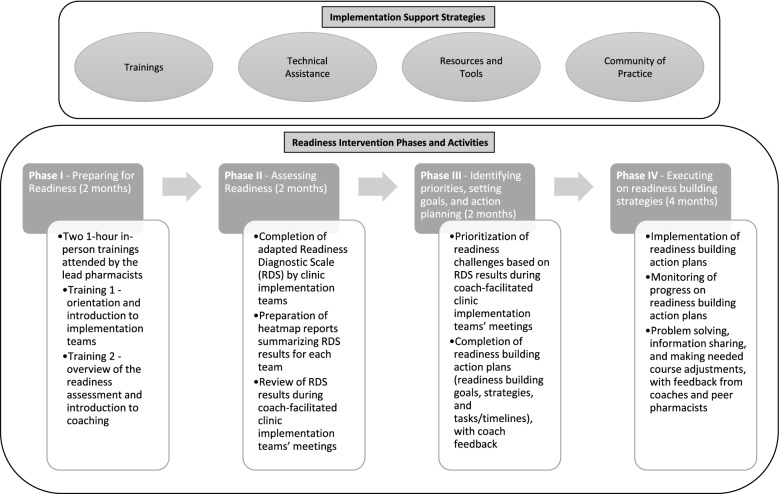
“In phase II, assessing readiness, lead pharmacists and members of their implementation team completed an adapted version of the Readiness Diagnostic Scale (RDS) individually [13, 14].”
MethodMoullin, J. C., Ehrhart, M. G., & Aarons, G. A. (2018) · Implementation Science · doi:10.1186/s13012-018-0782-1 · Cited by 52
Community coalition readiness for implementing something new: Using a Delphi methodology
Domlyn, A. M., & Wandersman, A. (2019) · Journal of Community Psychology · doi:10.1002/jcop.22161 · Cited by 47 · cited 3×
“In phase II, assessing readiness, lead pharmacists and members of their implementation team completed an adapted version of the Readiness Diagnostic Scale (RDS) individually [13, 14].”
BackgroundMethodReady, set, go!: exploring use of a readiness process to implement pharmacy services
Livet, M., Yannayon, M., Richard, C., Sorge, L. A., & Scanlon, P. (2020) · Implementation Science Communications · doi:10.1186/s43058-020-00036-2 · Cited by 31
Self-citationWandersman, A. H., Duffy, J. L., Flaspohler, P. D., Noonan, R. K., Lubell, K. M., Stillman, L., Blachman, M., Dunville, R. L., & Saul, J. R. (2007) · PsycEXTRA Dataset · doi:10.1037/e628612012-125 · Cited by 29
Livet, M., Blanchard, C., Richard, C., Sheppard, K. W., Yannayon, M., Sorensen, T. D., & McClurg, M. R. (2021) · Research in Social and Administrative Pharmacy · doi:10.1016/j.sapharm.2021.01.001 · Cited by 27 · cited 4×
“Implementing Change (ORIC) [18] to assess readiness levels, and the Implementation Outcomes Questionnaire (IOQ) [28] measures to assess acceptability, appropriateness, feasibility, and intent to adopt.”
BackgroundSelf-citationLivet, M., Yannayon, M., Sheppard, K. W., Kocher, K., Upright, J. J., & McMillen, J. S. (2017) · Administration and Policy in Mental Health and Mental Health Services Research · doi:10.1007/s10488-017-0829-7 · Cited by 21 · cited 1×
“, capacity-building strategies) and their influence on implementation success, rather than evaluate a comprehensive readiness intervention [10, 11].”
BackgroundSelf-citation
Research works printed but not linked: 6
- Hall GE Hord SM Aguilera R Zepeda O von Frank V Implementation: learning builds the bridge between research and practice Learn Profession 2011 32 52
- Dwayne SD Organizational readiness for stage-based dynamics of innovation implementation. Research on Social Work Practice Sage Publications Sage CA 2009 19 541 551
- Rafferty AE Jimmieson NL Armenakis AA Change readiness: a multilevel review J Manage 2013 39 110 135
- Kotter JP Leading change 1996 Boston Harvard Business School Press
- Blanchard C Steinbacher D Ward C Sorensen TD Roth MCM Establishing a common language for comprehensive medication management: applying implementation science to the patient care process 2016 Hollywood Podium Presentation at ACCP
- CMM in Primary Care Research Team The patient care process for delivering comprehensive medication management (CMM). 2018
Cited by
Ten years of implementation outcomes research: a scoping review
Proctor, E. K., Bunger, A. C., Lengnick-Hall, R., Gerke, D. R., Martin, J. K., Phillips, R. J., & Swanson, J. C. (2023) · Implementation Science · doi:10.1186/s13012-023-01286-z · Cited by 424
Alley, Z. M., Chapman, J. E., Schaper, H., & Saldana, L. (2023) · Implementation Science · doi:10.1186/s13012-023-01285-0 · Cited by 86
Fehlberg, Z., Stark, Z., Klaic, M., & Best, S. (2024) · Implementation Science Communications · doi:10.1186/s43058-024-00675-9 · Cited by 22
“Readiness includes concepts of willingness and ability [43] which conceptually involves aspects of acceptability and feasibility that were fore fronted in our findings.”
Institutional readiness for the implementation of micro-credentials in higher education
Varadarajan, S., Koh, J. H. L., & Daniel, B. K. (2025) · Distance Education · doi:10.1080/01587919.2024.2442017 · Cited by 18
“Furthermore, high levels of readiness align change outcomes more closely with the academic community ’ s expectations, leading to improved satisfaction post-implementation (Livet et al., 2022; Wraikat et al., 2017).”
Assessing the readiness of pre-service mathematics teachers to learn Euclidean geometry
Akosah, E. F., Boateng, F. O., Arhin, J., & Obeng, B. A. (2024) · International Journal of Didactical Studies · doi:10.33902/ijods.202424863 · Cited by 9
Metadata
- Authors
- Livet, M., Blanchard, C., & Richard, C.
- Affiliations
- University of North Carolina at Chapel Hill (US)
- Corresponding author
- Livet, Melanie
- Venue
- Implementation Science Communications
- Published
- 2022-09-03
- Volume
- 3
- Issue
- 1
- Pages
- 94-94
- ISSN
- 2662-2211 (ISSN-L)
- PMC
- PMC9441080
- OpenAlex
- W4294495285
- Semantic Scholar
- e94b06f0c166b1da3e71ff057d6fe98fe156901d
- Cited by
- 41
- References
- 25
- Citations by year
- 2026: 15 · 2025: 11 · 2024: 9 · 2023: 6
- FWCI
- 7.46
- Type
- journal article
- Language
- en
- Open access
- gold
- doi.org
- Licence
- cc-by
- creativecommons.org/licenses/by/4.0 (tdm)
- creativecommons.org/licenses/by/4.0 (vor)
- Locations
- Implementation Science Communications (publishedVersion, cc-by)
- PubMed Central (publishedVersion, cc-by)
- PubMed (publishedVersion)
- DOAJ (DOAJ: Directory of Open Access Journals) (submittedVersion, cc-by-sa)
- Funders
- Robert Wood Johnson Foundation
- Eshelman Institute for Innovation, University of North Carolina at Chapel Hill
- Topics
- Health Sciences › Health Professions › General Health Professions › Health Policy Implementation Science
- Health Sciences › Health Professions › General Health Professions › Health Sciences Research and Education
- Health Sciences › Medicine › Public Health, Environmental and Occupational Health › Healthcare Quality and Management
- Keywords
- implementation readiness, comprehensive medication management, specialist clinics, acceptability, appropriateness, feasibility, readiness levels, pharmacist-led services, implementation context
About these checks
Registry, retraction, Cites and statistics results are computed, not judged, with one exception: a printed reference that no index lists is read once by a model before it counts as a citation error. Claims are extracted by a model and kept only when their quote appears verbatim in the text; each cited source is then checked, with a model’s help, for whether it says what the claim relies on. Those verdicts can be wrong — read the claim’s quote and the cited source before relying on one.
Statistics and arithmetic are recomputed, not judged.
Confidence bands are shown only for fields calibrated on our annotated test set. None is calibrated yet, so no band is shown.
What counts as a claim ›How we measure confidence ›How we check this ›
Are you an author, or do you see a problem with this page? Request a review
Data sources
Bibliographic data: Semantic Scholar, OpenAlex, Crossref.
Contains information from the Semantic Scholar Academic Graph Datasets, made available under the ODC Attribution License (ODC-BY 1.0).
Semantic Scholar’s data is described in: Kinney, R., et al. (2023). The Semantic Scholar Open Data Platform. arXiv:2301.10140.
