

Co-creating systems change for mental health: a theory of change approach from the MeHPriC initiative in Lagos, Nigeria
Open accessThe DOI matches its Crossref record; 43 of the 43 references it cites were found in a registry or an index; 16 of the 28 sources its claims cite were checked for support.
Abstract
Participatory theory-of-change development and evaluation for a mental-health integration initiative in Lagos.
Overview
CoChat Summary
## TL;DR
This paper reports how the MeHPriC initiative in Lagos, Nigeria co-created a participatory Theory of Change (ToC) to guide mental health integration into primary health care, and then used it to monitor implementation from 2014–2017. The approach was associated with training 320 PHC workers, 69.1% practice adoption, 79.6% fidelity, a 58.7% increase in mental health consultations, and a 60.3% clinical recovery rate for depression.
## Key findings
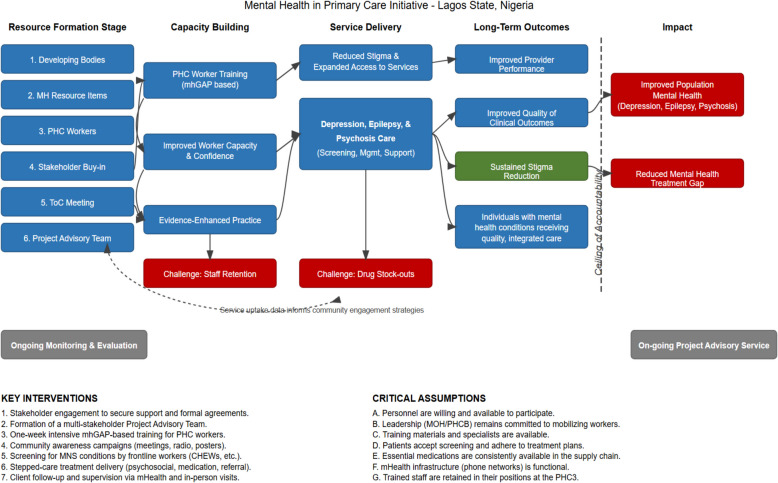
- The participatory process produced a co-owned ToC map spanning community, facility, administrative, and state levels, with 4 causal pathways and a “ceiling of accountability” for outcomes beyond the project’s direct control.
- Implementation outcomes reported included training 320 PHC workers, with 87% achieving competency benchmarks; 1,890 clients screened; 15% diagnosed with depression; 78.1% treatment adherence; 69.1% practice adoption; and 79.6% fidelity to mhGAP protocols.
- Clinical and service outcomes included a 60.3% clinical recovery rate for depression and a 58.7% increase in mental health consultations recorded in the HMIS.
- Community stigma did not disappear: post-intervention, 20% of community members still endorsed discriminatory attitudes, and 62.4% of rural PHCs still experienced medication stock-outs.
## Methods
- Participatory action research design, guided by CFIR and reported using COREQ, to co-create and refine a Theory of Change over 18 months (2013–2014).
- Stakeholder engagement included 3 structured workshops, 36 stakeholder-specific consultations, 4 technical working groups, and over 150 participants from government, facilities, and communities; supplementary data included surveys of 265 PHC workers, 40 facility-level ORCA assessments, and a community KAP survey of 1,200 people.
- Mixed-methods evaluation (2014–2017) used framework analysis for qualitative data, descriptive and inferential statistics for quantitative data, and sequential explanatory integration to validate ToC assumptions and interpret implementation outcomes.
## Limitations
- The paper states that its single-state design may limit generalizability to other Nigerian states or LMIC contexts with different governance structures and health system capacities.
- The paper states that service users and caregivers were insufficiently included in the initial framework design workshops; their voices were more visible in post-implementation interviews than in early ToC development.
- The paper states that it did not include a formal cost-effectiveness analysis.
- Evident from the text: several outcome claims are reported without full statistical detail in the main narrative, and some supporting analyses are deferred to supplementary tables.
Model-written summary. Check it against the paper before relying on it.
Integrity signals
Registry
Cites
Statistics
Figures
Verification
Claims the paper makes
13 Valid · 4 Not valid · 9 Not checked · 83 Own results and interpretations
Every source the paper cites for this claim was checked and supports it.
In the paper
“Theory of Change (ToC) has emerged as a key planning and evaluation tool suited to these demands.”
§ Co-creating systems change for mental health: a theory of change approach from the MeHPriC initiative in Lagos, Nigeria > Background
What the sources say
- Supportedcites [17] De Silva MJ, Breuer E, Lee L, Asher L, Chowdhary N, Lund C, et al. Theory of change: a theory-driven approach to enhance the Medical Research Council’s framework for complex interventions. Trials. 2014;15:1–3. 24996765 PMC4227087 source
The Background describes ToC as increasingly used to design and evaluate programs, while the Results explains its use in both developing and evaluating complex interventions. The Background also says its flexible causal pathways and feedback loops reflect how complex interventions achieve impact. (LLM, conf=0.92)
plain- Asserted: passes — The authors put it forward as true.
- Checkable: passes — It can be checked against evidence.
- Load-bearing: passes — The paper’s conclusions depend on it.
- Based: passes — The paper gives a reason why it holds.
- Supported
Every source the paper cites for this claim was checked and supports it.
In the paper
“However, integrating mental health into PHC is a complex systems intervention involving multiple stakeholders and dynamic implementation contexts.”
§ Co-creating systems change for mental health: a theory of change approach from the MeHPriC initiative in Lagos, Nigeria > Background
What the sources say
- Supportedcites [16] Wakida EK, Talib ZM, Akena D, Okello ES, Kinengyere A, Mindra A, et al. Barriers and facilitators to the integration of mental health services into primary health care: a systematic review. Syst Rev. 2018;7:1–3. 30486900 PMC6264616 source
The Introduction (Rationale; page unavailable) describes integration as requiring coordinated changes in staffing, funding, medicines, training, and specialist support. The Methods identify recipients, providers, other stakeholders, and health-system and social constraints; the Conclusions call for identifying context-specific barriers. Together, these support the sentence as a broad paraphrase, though the paper does not use the phrase “complex systems intervention.” (LLM, conf=0.85)
plain- Asserted: passes — The authors put it forward as true.
- Checkable: passes — It can be checked against evidence.
- Load-bearing: passes — The paper’s conclusions depend on it.
- Based: passes — The paper gives a reason why it holds.
- Supported
The cited sources support only part of this claim — read each source’s verdict below.
In the paper
“This participatory process appears to have been crucial for building the shared ownership and the political will necessary to overcome implementation barriers, a finding consistent with literature emphasizing the importance of co-creation in settings where top-down approaches often fail [17].”
§ Co-creating systems change for mental health: a theory of change approach from the MeHPriC initiative in Lagos, Nigeria > Discussion > Methodological contributions and ToC process innovations
What the sources say
- Partly supportedcites [17] De Silva MJ, Breuer E, Lee L, Asher L, Chowdhary N, Lund C, et al. Theory of change: a theory-driven approach to enhance the Medical Research Council’s framework for complex interventions. Trials. 2014;15:1–3. 24996765 PMC4227087 sourceExperimental — accuracy not yet measured
The Discussion (page not provided) says participatory Theory of Change workshops helped stakeholders identify politically unacceptable plans and agree on alternatives to implementation barriers. It does not establish that the process built shared ownership or political will; the RISE case study’s Challenges section says stakeholders did not achieve true ownership of the resulting map. (LLM, conf=0.85)
hedgedstates a possible cause- Asserted: passes — The authors put it forward as true.
- Checkable: passes — It can be checked against evidence.
- Load-bearing: passes — The paper’s conclusions depend on it.
- Based: passes — The paper gives a reason why it holds.
- Partly supported
Every source the paper cites for this claim was checked and supports it.
In the paper
“Our study affirms the utility of the CFIR [25] in structuring a participatory ToC process.”
§ Co-creating systems change for mental health: a theory of change approach from the MeHPriC initiative in Lagos, Nigeria > Discussion > Implementation science insights and evidence integration
What the sources say
- Supportedcites [25] Damschroder LJ, Aron DC, Keith RE, Kirsh SR, Alexander JA, Lowery JC. Fostering implementation of health services research findings into practice: a consolidated framework for advancing implementation science. Implement Sci. 2009;4:1–5. 19664226 PMC2736161 source
The citation identifies the CFIR, while the statement that it structured a participatory ToC process describes the citing authors’ own study. The cited paper’s Conclusion describes the CFIR as a pragmatic structure for identifying influences on implementation and organizing findings; the Discussion says it can guide formative evaluations. (LLM, conf=0.92)
plainstates a cause- Asserted: passes — The authors put it forward as true.
- Checkable: passes — It can be checked against evidence.
- Load-bearing: passes — The paper’s conclusions depend on it.
- Based: passes — The paper gives a reason why it holds.
- Supported
The cited sources support only part of this claim — read each source’s verdict below.
In the paper
“This variation suggests that while mhGAP training is effective, local contextual factors heavily influence its translation into practice, supporting recent evidence that core intervention components may be universal, but implementation strategies must be highly tailored [36].”
§ Co-creating systems change for mental health: a theory of change approach from the MeHPriC initiative in Lagos, Nigeria > Discussion > Implementation science insights and evidence integration
What the sources say
- Partly supportedcites [36] Davies T, Lund C. Integrating mental health care into primary care systems in low-and middle-income countries: lessons from PRIME and AFFIRM. Glob Ment Health. 2017;4:e7. PMC5454718 28596908 sourceExperimental — accuracy not yet measured
The PRIME section describes site-specific mental health care plans based on mhGAP, and the ‘Engage actively and collaboratively with local stakeholders’ section says implementation planning must account for local context. The paper does not report variation in provider adoption or establish that mhGAP training is effective; its Conclusion says impact results were not yet available. It also does not make the specific claim that core intervention components are universal. (LLM, conf=0.84)
hedgedstates a cause- Asserted: passes — The authors put it forward as true.
- Checkable: passes — It can be checked against evidence.
- Load-bearing: passes — The paper’s conclusions depend on it.
- Based: passes — The paper gives a reason why it holds.
- Partly supported
56 more claims · 1 with their cited sources checked
Create a free account to see all 109 claims and every source verdict.
- It may state two separate claims as one. 24
- Probably not a substantial claim. 28
Citations
Cites
The PHQ-9: Validity of a brief depression severity measure
Kroenke, K., Spitzer, R. L., & Williams, J. B. W. (2001) · Journal of General Internal Medicine · doi:10.1046/j.1525-1497.2001.016009606.x · Cited by 44,910
Tong, A., Sainsbury, P., & Craig, J. (2007) · International Journal for Quality in Health Care · doi:10.1093/intqhc/mzm042 · Cited by 42,509
Damschroder, L. J., Aron, D. C., Keith, R. E., Kirsh, S. R., Alexander, J. A., & Lowery, J. C. (2009) · Implementation Science · doi:10.1186/1748-5908-4-50 · Cited by 14,496 · cited 2×
“CFIR [25] was used to systematically identify and categorize the multilevel determinants of implementation success across its five domains, ensuring a comprehensive assessment of contextual factors.”
Gale, N. K., Heath, G., Cameron, E., Rashid, S., & Redwood, S. (2013) · BMC Medical Research Methodology · doi:10.1186/1471-2288-13-117 · Cited by 10,865 · cited 1×
“We employed framework analysis [27] for our qualitative data.”
Using Mixed-Methods Sequential Explanatory Design: From Theory to Practice
Ivankova, N. V., Creswell, J. W., & Stick, S. L. (2006) · Field Methods · doi:10.1177/1525822x05282260 · Cited by 3,167 · cited 1×
“We used a sequential explanatory design [28] to integrate our data streams.”
Baum, F., MacDougall, C., & Smith, D. (2006) · Journal of Epidemiology and Community Health · doi:10.1136/jech.2004.028662 · Cited by 2,420
The dynamic sustainability framework: addressing the paradox of sustainment amid ongoing change
Chambers, D. A., Glasgow, R. E., & Stange, K. C. (2013) · Implementation Science · doi:10.1186/1748-5908-8-117 · Cited by 1,724 · cited 1×
“This iterative approach aligns with calls for implementation strategies that can respond to the emergent and often unpredictable nature of systems change [32].”
An Attribution Model of Public Discrimination Towards Persons with Mental Illness
Corrigan, P., Markowitz, F. E., Watson, A., Rowan, D., & Kubiak, M. A. (2003) · Journal of Health and Social Behavior · doi:10.2307/1519806 · Cited by 1,407 · cited 1×
“Stigma measurement Community stigma was operationalized using a 12-item scale adapted from Corrigan et al.’s Attribution Questionnaire [29], measuring social distance preferences and discriminatory beliefs about mental illness.”
De Silva, M. J., Breuer, E., Lee, L., Asher, L., Chowdhary, N., Lund, C., & Patel, V. (2014) · Trials · doi:10.1186/1745-6215-15-267 · Cited by 738
Adewuya, A. O., Ola, B. A., & Afolabi, O. O. (2006) · Journal of Affective Disorders · doi:10.1016/j.jad.2006.05.021 · Cited by 474 · cited 1×
“Primary assessment utilized clinician-rated improvement based on structured clinical interviews at 3, 6, and 12-month intervals, supplemented by the Patient Health Question-naire-9 (PHQ-9) [30, 31] where feasible.”
Self-citationUsing theory of change to design and evaluate public health interventions: a systematic review
Breuer, E., Lee, L., De Silva, M., & Lund, C. (2015) · Implementation Science · doi:10.1186/s13012-016-0422-6 · Cited by 425 · cited 2×
“The workshop adapted global ToC methodologies [17, 18] to the Nigerian context, informed by frameworks from programmes like PRIME [19].”
Means, A. R., Kemp, C. G., Gwayi-Chore, M.-C., Gimbel, S., Soi, C., Sherr, K., Wagenaar, B. H., Wasserheit, J. N., & Weiner, B. J. (2020) · Implementation Science · doi:10.1186/s13012-020-0977-0 · Cited by 418
Strengthening mental health systems in low-and middle-income countries: the Emerald programme
Semrau, M., Evans-Lacko, S., Alem, A., Ayuso-Mateos, J. L., Chisholm, D., Gureje, O., Hanlon, C., Jordans, M., Kigozi, F., Lempp, H., et al. (2015) · BMC Medicine · doi:10.1186/s12916-015-0309-4 · Cited by 288 · cited 2×
“…including PRIME (Programme for Improving Mental Health Care) [19], which developed district-level mental health care plans across five LMICs, and EMERALD (Emerging Mental Health Systems in LMICs) [20], which strengthened health system responses through implementation research in six LMICs.”
(2025) · doi:10.1186/s12888-025-06932-y · Cited by 227 · cited 1×
“Low-and middle-income countries (LMICs) bear a disproportionate share of this burden due to severe resource limitations [1, 2].”
Wakida, E. K., Talib, Z. M., Akena, D., Okello, E. S., Kinengyere, A., Mindra, A., & Obua, C. (2018) · Systematic Reviews · doi:10.1186/s13643-018-0882-7 · Cited by 219 · cited 2×
“While our adaptive response of partnering with private pharmacies provided temporary solutions, recent evidence [40] identified medication supply chains as a persistent barrier to sustainable mental health integration across LMICs, suggesting that long-term sustainability requires comprehensive…”
Keynejad, R., Spagnolo, J., & Thornicroft, G. (2021) · Evidence Based Mental Health · doi:10.1136/ebmental-2021-300254 · Cited by 219 · cited 1×
“Robust evidence confirms that integrating mental health services into primary care can improve clinical outcomes and has demonstrated favourable cost-effectiveness [13].”
Gureje, O., Abdulmalik, J., Kola, L., Musa, E., Yasamy, M. T., & Adebayo, K. (2015) · BMC Health Services Research · doi:10.1186/s12913-015-0911-3 · Cited by 188 · cited 2×
“This reinforces their central role in the future of integrated mental health care delivery in Nigeria and elsewhere [14].”
Association of Urbanicity With Psychosis in Low- and Middle-Income Countries
DeVylder, J. E., Kelleher, I., Lalane, M., Oh, H., Link, B. G., & Koyanagi, A. (2018) · JAMA Psychiatry · doi:10.1001/jamapsychiatry.2018.0577 · Cited by 171 · cited 1×
“These findings are consistent with a large body of literature documenting the urban–rural health divide in LMICs [43, 44].”
Breuer, E., De Silva, M. J., Shidaye, R., Petersen, I., Nakku, J., Jordans, M. J. D., Fekadu, A., & Lund, C. (2016) · British Journal of Psychiatry · doi:10.1192/bjp.bp.114.153841 · Cited by 111 · cited 4×
“…this approach has been documented in major global mental health research programmes, including PRIME (Programme for Improving Mental Health Care) [19], which developed district-level mental health care plans across five LMICs, and EMERALD (Emerging Mental Health Systems in LMICs) [20], which…”
InfluentialMental health in Nigeria: A Neglected issue in Public Health
Wada, Y. H., Rajwani, L., Anyam, E., Karikari, E., Njikizana, M., Srour, L., & Khalid, G. M. (2021) · Public Health in Practice · doi:10.1016/j.puhip.2021.100166 · Cited by 99
Medicines and vaccines supply chains challenges in Nigeria: a scoping review
Olutuase, V. O., Iwu-Jaja, C. J., Akuoko, C. P., Adewuyi, E. O., & Khanal, V. (2022) · BMC Public Health · doi:10.1186/s12889-021-12361-9 · Cited by 99 · cited 1×
“The chronic stock-outs of psychotropic medications in rural facilities (affecting 62.4% of PHCs) remain a major sustainability challenge, reflecting systemic failures common across sub-Saharan Africa [42].”
InfluentialMental health challenges in Nigeria: Bridging the gap between demand and resources
Precious, F. K., Igwe, S. C., Toluwalogo, N.-O., Udokang, E. I., Ogaya, J. B., & Lucero‐Prisno, D. E. (2024) · Cambridge Prisms Global Mental Health · doi:10.1017/gmh.2024.19 · Cited by 98
Atewologun, F., Adigun, O. A., Okesanya, O. J., Hassan, H. K., Olabode, O. N., Micheal, A. S., Ahmed, M. M., Ukoaka, B. M., Idris, N. B., Oso, T. A., et al. (2025) · Discover Mental Health · doi:10.1007/s44192-025-00177-7 · Cited by 89 · cited 1×
“This crisis is particularly acute in sub-Saharan Africa, where under-resourced health systems, a severe shortage of a specialist workforce, and pervasive stigma combine to create formidable barriers to care [5–7].”
Isaacs, A. N., & Mitchell, E. (2024) · International Journal of Mental Health Systems · doi:10.1186/s13033-024-00625-x · Cited by 88 · cited 1×
“Recent Australian reviews of integrated mental health care emphasize co-located mental health clinicians working with primary care teams [41].”
Mental health system governance in Nigeria: challenges, opportunities and strategies for improvement
Abdulmalik, J. O., Kola, L., & Gureje, O. (2016) · Cambridge Prisms Global Mental Health · doi:10.1017/gmh.2016.2 · Cited by 78 · cited 1×
“The nation’s mental health system is critically undermined by a shortage of specialists, with fewer than 300 psychiatrists servicing over 200 million people, inadequate financing, poor integration of services at the primary care level, and deep-rooted societal stigma [10].”
Davies, T., & Lund, C. (2017) · Global Mental Health · doi:10.1017/gmh.2017.3 · Cited by 71 · cited 2×
“While PRIME and AFFIRM programs used ToC frameworks [36], neither described the explicit monitoring of assumptions that we implemented.”
Abayneh, S., Lempp, H., Alem, A., Kohrt, B. A., Fekadu, A., & Hanlon, C. (2020) · International Journal of Mental Health Systems · doi:10.1186/s13033-020-00383-6 · Cited by 67 · cited 1×
“Recent work from Ethiopia specifically developing a ToC for service user and caregiver involvement in mental health system strengthening [38] highlights the importance of embedding service user perspectives from the outset of ToC development, rather than as an afterthought in evaluation phases.”
Hailemariam, M., Fekadu, A., Medhin, G., Prince, M., & Hanlon, C. (2019) · International Journal of Mental Health Systems · doi:10.1186/s13033-019-0332-5 · Cited by 44 · cited 1×
“[35].”
Adewuya, A. O., Ola, B. A., Coker, O., Atilola, O., Fasawe, A., & Ajomale, T. (2019) · General Hospital Psychiatry · doi:10.1016/j.genhosppsych.2019.07.012 · Cited by 38 · cited 3×
“Initial training and supervision led to marked improvements in provider knowledge, attitudes, and practice adoption, with a pilot study demonstrating a 60.3% clinical recovery rate from depression in stepped-care versus 18.2% in usual care [21, 22].”
InfluentialSelf-citationMutiso, V., Pike, K. M., Musyimi, C. W., Gitonga, I., Tele, A., Rebello, T. J., Thornicroft, G., & Ndetei, D. M. (2019) · General Hospital Psychiatry · doi:10.1016/j.genhosppsych.2019.04.005 · Cited by 38
Kelly, G., Wang, S., Lucas, G. I., Fraenkel, L., & Gross, C. P. (2017) · Progress in community health partnerships · doi:10.1353/cpr.2017.0029 · Cited by 32 · cited 1×
“This reflects broader challenges in LMIC mental health research related to stigma and logistical barriers to patient participation, but it represents a critical gap that future ToC processes must address through dedicated service user advisory groups from the outset [45].”
Mental health services in low-income and middle-income countries
Jacob, K. S. (2017) · The Lancet Psychiatry · doi:10.1016/s2215-0366(16)30423-0 · Cited by 29 · cited 1×
“In low-and middle-income countries (LMICs), more than 75% of individuals affected do not receive formal treatment, with this gap exceeding 90% in certain resource-limited regions [2, 4].”
Shortage of psychiatrists: A barrier to effective mental health-care delivery in Nigeria
Okechukwu, C. E. (2020) · International Journal of Noncommunicable Diseases · doi:10.4103/jncd.jncd_1_20 · Cited by 26
Amu, H., Dzenu, M. W., Baku, S. T., Naboare, D., Charles-Unadike, V. O., Boateng, L. A., Tarkang, E. E., & Baiden, F. (2023) · Preventive Medicine Research & Reviews · doi:10.4103/pmrr.pmrr_57_23 · Cited by 22 · cited 1×
“This crisis is particularly acute in sub-Saharan Africa, where under-resourced health systems, a severe shortage of a specialist workforce, and pervasive stigma combine to create formidable barriers to care [5–7].”
Epidemiology and risk factors of mental disorders
Kumar, P. M., Kumar, V., Meenakshi, S., Bahekar, T. N., Narapaka, P. K., Dhingra, S., & Murti, K. (2024) · Elsevier eBooks · doi:10.1016/b978-0-323-95735-9.00003-6 · Cited by 21
Bitta, M. A., Kariuki, S. M., Omar, A., Nasoro, L., Njeri, M., Kiambu, C., Ongeri, L., & Newton, C. R. J. C. (2020) · Cambridge Prisms Global Mental Health · doi:10.1017/gmh.2020.6 · Cited by 20
Adewuya, A. O., Adewumi, T., Momodu, O., Olibamoyo, O., Adesoji, O., Adegbokun, A., Adeyemo, S., Manuwa, O., & Adegbaju, D. (2019) · Psychological Medicine · doi:10.1017/s0033291718002970 · Cited by 18 · cited 1×
“However, implementation challenges persisted, including medication supply gaps in 62.4% of rural PHCs, continued community stigma affecting 20% of respondents post-training, and fragmented referral pathways with completion rates below 40% [23].”
InfluentialSelf-citationAdewuya, A. O., Adewumi, T., Ola, B., Abosede, O., Oyeneyin, A., Fasawe, A., & Idris, O. (2017) · General Hospital Psychiatry · doi:10.1016/j.genhosppsych.2017.04.002 · Cited by 17
Self-citationKemp, C. G., Mntambo, N., Bachmann, M., Bhana, A., Rao, D., Grant, M., Hughes, J. P., Simoni, J. M., Weiner, B. J., Gigaba, S. G., et al. (2020) · Global Mental Health · doi:10.1017/gmh.2020.11 · Cited by 12 · cited 1×
“%) compares favourably with experiences from similar programs: higher than reported in some PRIME sites in South Africa (23–50% adoption depending on sites) [34] but lower than Ethiopia (81.7”
InfluentialAe-Ngibise, K. A., Sakyi, L., Adwan-Kamara, L., Cooper, T. D., Weobong, B., & Lund, C. (2024) · Community Mental Health Journal · doi:10.1007/s10597-024-01357-5 · Cited by 11
(2008) · PubMed · Cited by 3
Rural-urban appraisal of the prevalence and factors of depression status in South Africa
Onuh, J. C., Mbah, P. O., Ajaero, C. K., Orjiakor, C. T., Igboeli, E. E., & Ayogu, C. K. (2021) · Journal of Affective Disorders Reports · doi:10.1016/j.jadr.2021.100082
Research works printed but not linked: 2
- World Health Organization, 2016. mhGAP intervention guide for mental, neurological and substance use disorders in non-specialized health settings: mental health Gap Action Programme (mhGAP). In mhGAP intervention guide for mental, neurological and substance use disorders in non-specialized health settings: mental health Gap Action Programme (mhGAP). https://www.who.int/publications/i/item/9789241549790 27786430
- Wakida EK, Talib ZM, Akena D, Okello ES, Kinengyere A, Mindra A, et al. Barriers and facilitators to the integration of mental health services into primary health care: a systematic review. Syst Rev. 2018;7(1):211. 30486900 PMC6264616 · DOI · Paper page
Cited by
Adewuya, A. O., Abímbọ́lá, Ṣ., Ola, B., Abdulmalik, J. O., & Oladipo, O. E. (2026) · Journal of Health Services Research & Policy · doi:10.1177/13558196261490908
Self-citation
Metadata
- Authors
- Adewuya, A. O., Ola, B. A., Coker, O., Oladipo, O. E., Olibamoyo, O., & Atilola, O.
- Affiliations
- Lagos State University (NG)
- Corresponding author
- Adewuya, Abiodun Olugbenga
- ORCID
- Venue
- Implementation Science Communications
- Published
- 2025-11-04
- Volume
- 6
- Issue
- 1
- Pages
- 114-114
- ISSN
- 2662-2211 (ISSN-L)
- PMC
- PMC12584243
- OpenAlex
- W4415848898
- Cited by
- 1
- References
- 38
- Citations by year
- 2026: 1
- FWCI
- 1.26
- Type
- journal article
- Language
- en
- Open access
- gold
- doi.org
- Licence
- cc-by
- creativecommons.org/licenses/by/4.0 (tdm)
- creativecommons.org/licenses/by/4.0 (vor)
- Locations
- Implementation Science Communications (publishedVersion, cc-by)
- Europe PMC (PubMed Central) (publishedVersion, cc-by)
- PubMed (publishedVersion)
- DOAJ (DOAJ: Directory of Open Access Journals) (submittedVersion, cc-by-sa)
- Funders
- Grand Challenges Canada (GMH 0084-04)
- Topics
- Health Sciences › Health Professions › General Health Professions › Health Policy Implementation Science
- Health Sciences › Medicine › Psychiatry and Mental health › Mental Health Treatment and Access
- Social Sciences › Psychology › Clinical Psychology › Psychiatric care and mental health services
- Keywords
- theory of change, task sharing, Mental Health Gap Action Programme, depression, psychosis, epilepsy, mental health stigma, implementation barriers and facilitators, Consolidated Framework for Implementation Research, stakeholder co-creation, health system governance, supervision models, religious leaders, Lagos
About these checks
Registry, retraction, Cites and statistics results are computed, not judged, with one exception: a printed reference that no index lists is read once by a model before it counts as a citation error. Claims are extracted by a model and kept only when their quote appears verbatim in the text; each cited source is then checked, with a model’s help, for whether it says what the claim relies on. Those verdicts can be wrong — read the claim’s quote and the cited source before relying on one.
The claim verdicts this report counts are experimental: their accuracy is not yet measured.
A language model drew the claims from the paper on 2026-10-06, under version 3 of the claim definition (model deepseek-v4.1-flash, prompt extract-v3).
A second model labelled each claim on 2026-10-06 (model jev-1.13-20260917, definition revision gold-guideline-v0.2).
Cited sources are checked with a language model’s help (gpt-6-sol).
Statistics and arithmetic are recomputed, not judged.
Confidence bands are shown only for fields calibrated on our annotated test set. None is calibrated yet, so no band is shown.
What counts as a claim ›How we measure confidence ›How we check this ›
Are you an author, or do you see a problem with this page? Request a review
Data sources
Bibliographic data: Semantic Scholar, OpenAlex, Crossref.
Contains information from the Semantic Scholar Academic Graph Datasets, made available under the ODC Attribution License (ODC-BY 1.0).
Semantic Scholar’s data is described in: Kinney, R., et al. (2023). The Semantic Scholar Open Data Platform. arXiv:2301.10140.
