

The DOI matches its Crossref record; 16 of the 17 references it cites were found in a registry or an index.
Opportunistic Breast Cancer Education and Screening in Rural Honduras
Open accessAbstract
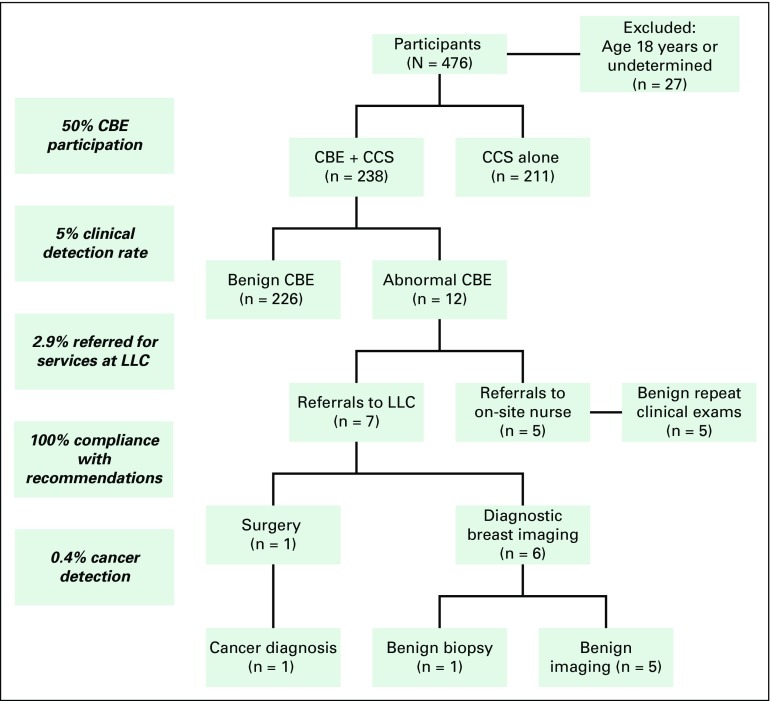
Purpose: In Honduras, the breast cancer burden is high, and access to women’s health services is low. This project tested the connection of community-based breast cancer detection with clinical diagnosis and treatment in a tightly linked and quickly facilitated format. Methods: The Norris Cotton Cancer Center at Dartmouth College partnered with the Honduran cancer hospital La Liga Contra el Cancer to expand a cervical cancer screening program, which included self-breast exam (SBE) education and clinical breast exams (CBEs), to assess patient attitudes about and uptake of breast cancer education and screening services. The cervical cancer screening event was held in Honduras in 2013; 476 women from 31 villages attended. Results: Half of the women attending elected to receive a CBE; most had concerns about lactation. Clinicians referred 12 women with abnormal CBEs to La Liga Contra el Cancer for additional evaluation at no cost. All referred patients were compliant with the recommendation and received follow-up care. One abnormal follow-up mammogram/ultrasound result was negative on biopsy. One woman with an aggressive phyllodes tumor had a mastectomy within 60 days. Multimodal education about breast cancer screening maximized delivery of women’s health services in a low-tech rural setting. Conclusion: The addition of opportunistic breast cancer education and screening to a cervical cancer screening event resulted in high uptake of services at low additional cost to program sponsors. Such novel strategies to maximize delivery of women’s health services in low-resource settings, where there is no access to mammography, may result in earlier detection of breast cancer. Close follow-up of positive results with referral to appropriate treatment is essential.
Overview
The claims and statistics of this paper haven’t been checked yet.
Run the check — free, no account needed. It reads the open-access text and checks the sources it cites.
Integrity signals
Registry
Cites
Statistics
Figures
Verification
Claims the paper makes
The claims and statistics of this paper haven’t been checked yet.
Run the check — free, no account needed. It reads the open-access text and checks the sources it cites.
Claims other papers make about this one
Each is checked against this paper’s own text: does it say what the citing paper says it does?
The check wasn’t confident either way, so it gives no verdict — never disputed.
In the citing paper
“There are 305,229 women older than age 50 years who live in this region.8”
From Model for Early Detection of Breast Cancer in Low-Resource Areas: The Experience in Peru (2018) · cites this paper as [8]
Experimental — accuracy not yet measured
Self-check
Percentages, sums and reported differences re-computed from the paper’s own numbers.
The self-check needs the paper’s full text.
Citations
Cites
Effect of Three Decades of Screening Mammography on Breast-Cancer Incidence
Bleyer, A., & Welch, H. G. (2012) · New England Journal of Medicine · doi:10.1056/nejmoa1206809 · Cited by 1,410
Randomized Trial of Breast Self-Examination in Shanghai: Final Results
Thomas, D. B., Gao, D. L., Ray, R. M., Wang, W., Allison, C. J., Chen, F. L., Porter, P. L., Hu, Y. W., Zhao, G., Pan, L., et al. (2002) · JNCI Journal of the National Cancer Institute · doi:10.1093/jnci/94.19.1445 · Cited by 714
Guideline implementation for breast healthcare in low-income and middle-income countries
Anderson, B. O., Yip, C. H., Smith, R. A., Shyyan, R., Sener, S. F., Eniu, A. E., Carlson, R. W., Azavedo, E., & Harford, J. B. (2008) · Cancer · doi:10.1002/cncr.23844 · Cited by 534
Planning cancer control in Latin America and the Caribbean
Goss, P. E., Lee, B. L., Badovinac-Črnjević, T., Strasser‐Weippl, K., Chávarri-Guerra, Y., Louis, J. S., Villarreal-Garza, C. M., Unger‐Saldaña, K., Ferreyra, M., Debiasi, M., et al. (2013) · The Lancet Oncology · doi:10.1016/s1470-2045(13)70048-2 · Cited by 526
Warner, E. (2011) · New England Journal of Medicine · doi:10.1056/nejmcp1101540 · Cited by 515
Urban poverty and health in developing countries: Household and neighborhood Effects
Montgomery, M. R., & Hewett, P. (2005) · Demography · doi:10.1353/dem.2005.0020 · Cited by 282
Breast Cancer in Developing Countries: Opportunities for Improved Survival
Shulman, L. N., Willett, W. C., Sievers, A., & Knaul, F. M. (2010) · Journal of Oncology · doi:10.1155/2010/595167 · Cited by 255
Effect of Three Decades of Screening Mammography on Breast-Cancer Incidence
Bleyer, A., & Welch, H. G. (2013) · Obstetrical & Gynecological Survey · doi:10.1097/ogx.0b013e3182978e4a · Cited by 248
Progress and remaining challenges for cancer control in Latin America and the Caribbean
Strasser‐Weippl, K., Chávarri-Guerra, Y., Villarreal-Garza, C. M., Bychkovsky, B., Debiasi, M., Liedke, P. E. R., Soto‐Pérez‐de‐Celis, E., Dizon, D. S., Cazap, E. L., Lopes, G. D. L., Jr., et al. (2015) · The Lancet Oncology · doi:10.1016/s1470-2045(15)00218-1 · Cited by 186
Breast cancer incidence in South Africa.
Vorobiof, D., Sitas, F., & Vorobiof, G. (2001) · PubMed · Cited by 152
Leung, J., McKenzie, S. J., Martin, J. H., & McLaughlin, D. (2014) · Rural and Remote Health · doi:10.22605/rrh2730 · Cited by 99
Семиглазов, В. В., Моисеенко, В., Manikhas, A., Анатольевна, П. С., Kharikova, R. S., Rt, P., Ns, M., Orlov, A. A., Бараш, Н. Ю., Ivanova, O. A., et al. (1999) · PubMed · Cited by 63
Perkins, R. B., Langrish, S. M., Stern, L. J., & Simon, C. J. (2007) · Revista Panamericana de Salud Pública · doi:10.1590/s1020-49892007000800005 · Cited by 42
Pilot Implementation of Breast Cancer Early Detection Programs in Colombia
Murillo, R., az, S. D. I., nchez, O. S. A., Perry, F., eros, M. P. N., Poveda, C., Salguero, É., & Osorio, D. (2008) · Breast Care · doi:10.1159/000114446 · Cited by 25
Michell, M. (2001) · International Journal of Clinical Practice · doi:10.1111/j.1742-1241.2001.tb11117.x · Cited by 14
Jamison, D. T. T., Jg, B., Ar, M., Alleyne, G. A. O., Claeson, M., Db, E., Jha, P., Mills, A. L., & Musgrove, P. (2006) · Cited by 6
Research works printed but not linked: 3
- Vorobiof DA, 2001, J Clin Oncol, 19, 125S
- Semiglazov VF, 1999, Vopr Onkol, 45, 265
- Leung J, 2014, Rural Remote Health, 14, 2730
Cited by
Naz, M. S. G., Simbar, M., Fakari, F. R., & Ghasemi, V. (2018) · PubMed Central · doi:10.22034/apjcp.2018.19.8.2031 · Cited by 75
Model for Early Detection of Breast Cancer in Low-Resource Areas: The Experience in Peru
Bain, C., Constant, T. H., Contreras, I., Vega, A. M. B., Jeronimo, J., & Tsu, V. (2018) · Journal of Global Oncology · doi:10.1200/jgo.17.00006 · Cited by 17
Forty-Five Years of Research and Progress in Breast Cancer: Progress for Some, Disparities for Most
Hoxha, I. S., Islami, D. A., Uwizeye, G., Forbes, V., & Chamberlin, M. D. (2022) · JCO Global Oncology · doi:10.1200/go.21.00424 · Cited by 16
Self-citationPilot Educational Intervention and Feasibility Assessment of Breast Ultrasound in Rural South Africa
Dickerson, L. K., Rositch, A. F., Lucas, S. M., & Harvey, S. C. (2017) · Journal of Global Oncology · doi:10.1200/jgo.2016.008086 · Cited by 15
Feasibility of Brigade-Style, Multiphasic Cancer Screening in Rural Honduras
Lyons, K. D., Kennedy, L. S., LaRochelle, E. P. M., Tsongalis, G. J., Reyes, H. S., Zuniga-Moya, J. C., Chamberlin, M. D., BRUCE, M. L., & Bejarno, S. (2020) · JCO Global Oncology · doi:10.1200/jgo.19.00396 · Cited by 6
Self-citation
Metadata
- Authors
- Kennedy, L. S., Bejarano, S. A., Onega, T. L., Stenquist, D. S., & Chamberlin, M. D.
- Affiliations
- Dartmouth College (US)
- Corresponding author
- Chamberlin, Mary D.
- Venue
- Journal of Global Oncology
- Published
- 2016-08
- Volume
- 2
- Issue
- 4
- Pages
- 174-180
- ISSN
- 2378-9506 (ISSN-L)
- PMC
- PMC5497619
- OpenAlex
- W2341060139
- Cited by
- 12
- References
- 17
- Citations by year
- 2026: 1 · 2024: 1 · 2022: 2 · 2021: 2 · 2020: 1 · 2019: 1 · 2018: 2 · 2017: 2
- FWCI
- 1.65
- Type
- journal article
- Language
- en
- Open access
- gold
- doi.org
- Licence
- cc-by
- Locations
- Journal of Global Oncology (publishedVersion, cc-by)
- Europe PMC (PubMed Central) (publishedVersion, cc-by-nc-nd)
- PubMed Central (publishedVersion, cc-by-nc-nd)
- PubMed (publishedVersion)
- Funders
- Dartmouth College
- Norris Cotton Cancer Center
- Audrey and Theodor Geisel School of Medicine at Dartmouth
- Topics
- Health Sciences › Medicine › Public Health, Environmental and Occupational Health › Women's cancer prevention and management
- Health Sciences › Medicine › Oncology › Global Cancer Incidence and Screening
- Health Sciences › Medicine › Pathology and Forensic Medicine › Breast Lesions and Carcinomas
- Keywords
- breast cancer screening, rural Honduras, cervical cancer screening, breast self-examination, clinical breast examination, breast cancer education, resource-limited settings, phyllodes tumor, mammography, ultrasound
About these checks
Registry, retraction, Cites and statistics results are computed, not judged, with one exception: a printed reference that no index lists is read once by a model before it counts as a citation error. Claims are extracted by a model and kept only when their quote appears verbatim in the text; each cited source is then checked, with a model’s help, for whether it says what the claim relies on. Those verdicts can be wrong — read the claim’s quote and the cited source before relying on one.
Statistics and arithmetic are recomputed, not judged.
Confidence bands are shown only for fields calibrated on our annotated test set. None is calibrated yet, so no band is shown.
What counts as a claim ›How we measure confidence ›How we check this ›
Are you an author, or do you see a problem with this page? Request a review
