

European Society of Endocrinology and Endocrine Society Joint Clinical Guideline: Diagnosis and Therapy of Glucocorticoid-induced Adrenal Insufficiency
Open accessThe DOI matches its Crossref record; 135 of the 149 references it cites were found in a registry or an index; 96 of the 172 sources its claims cite were checked for support.
Abstract
Glucocorticoids are widely prescribed as anti-inflammatory and immunosuppressive agents. This results in at least 1% of the population using chronic glucocorticoid therapy, being at risk for glucocorticoid-induced adrenal insufficiency. This risk is dependent on the dose, duration and potency of the glucocorticoid, route of administration, and individual susceptibility. Once glucocorticoid-induced adrenal insufficiency develops or is suspected, it necessitates careful education and management of affected patients. Tapering glucocorticoids can be challenging when symptoms of glucocorticoid withdrawal develop, which overlap with those of adrenal insufficiency. In general, tapering of glucocorticoids can be more rapidly within a supraphysiological range, followed by a slower taper when on physiological glucocorticoid dosing. The degree and persistence of HPA axis suppression after cessation of glucocorticoid therapy are dependent on overall exposure and recovery of adrenal function varies greatly amongst individuals. This first European Society of Endocrinology/Endocrine Society joint clinical practice guideline provides guidance on this clinically relevant condition to aid clinicians involved in the care of patients on chronic glucocorticoid therapy.
Overview
CoChat Summary
## TL;DR
This joint ESE/Endocrine Society guideline provides practical recommendations for evaluating, tapering, and treating adults at risk of glucocorticoid-induced adrenal insufficiency. It emphasizes that biochemical HPA-axis suppression is common, but clinically meaningful adrenal crisis is much rarer, so tapering and testing should be individualized.
## Key findings
- Chronic glucocorticoid use is common: the paper states at least 1% of the population uses chronic glucocorticoid therapy and is therefore at risk for glucocorticoid-induced adrenal insufficiency.
- In a meta-analysis, pooled biochemical adrenal insufficiency rates varied by route: 4.2% for nasal use, 48.7% for oral use, and 52.2% for intra-articular administration; in asthma, risk ranged from 1.4% after <28 days to 27.4% after >1 year, and from 2.4% at low dose to 21.5% at high dose.
- For recovery of HPA axis function, pooled studies showed adrenal insufficiency decreased from 38.7% to 14.9% after 4 weeks in one group (141 patients) and from 56.4% to 25.3% after 6 months in another (174 patients). Across individual studies, recovery was reported in 58.8% (median 16 months), 60.6% (median 24 months), and 10% after 3 months.
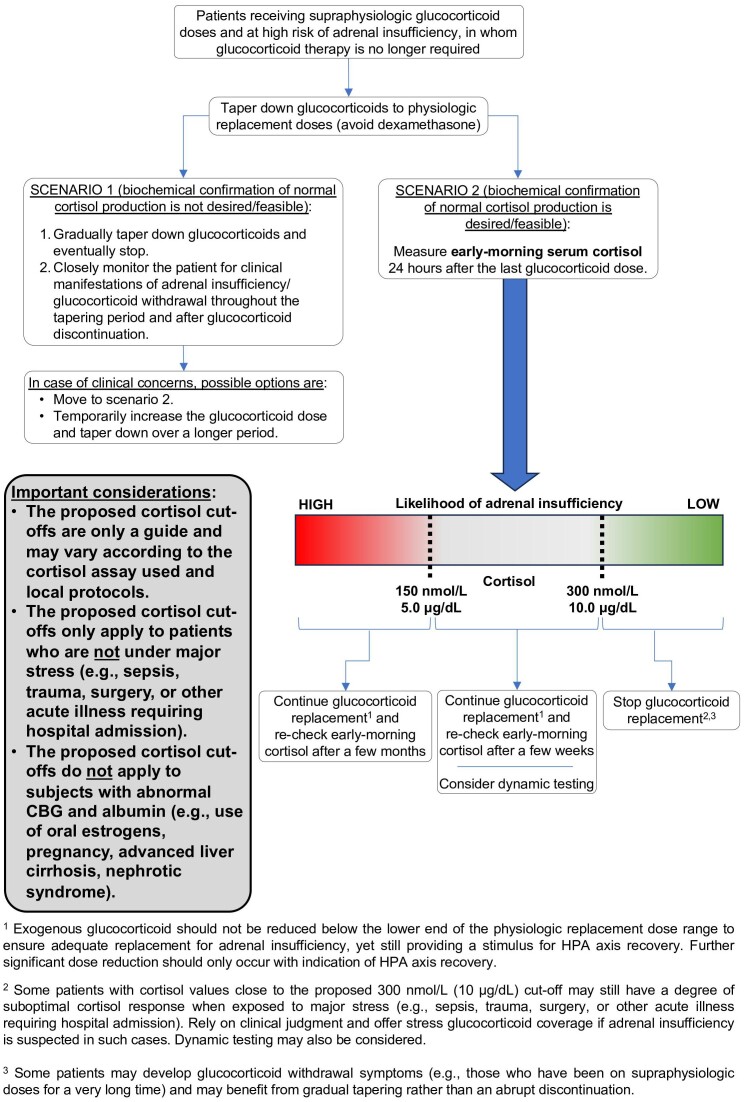
- For morning cortisol as a test of recovery, the guideline reports examples where >300 nmol/L (10 μg/dL) suggests HPA recovery, while <150 nmol/L (5 μg/dL) suggests persistent insufficiency; in included studies, values such as ≥336 nmol/L and >327 nmol/L had very high specificity/sensitivity for ruling in or out adrenal insufficiency.
## Methods
- Joint clinical guideline developed by the European Society of Endocrinology and Endocrine Society using GRADE; recommendations were based on systematic literature searches plus expert panel consensus.
- Literature searches were conducted in PubMed, MEDLINE, Embase, Web of Science, and Cochrane Library in January–March 2023; only adult studies and studies with ≥10 patients were eligible.
- The evidence base included 3 studies for HPA-axis recovery, 5 studies for tapering strategy, and 3 studies for morning cortisol vs 250 μg ACTH (1-24)-test diagnostic accuracy.
## Limitations
- The paper explicitly states that the evidence behind most recommendations is low or very low.
- It also states that many findings are based on biochemical adrenal insufficiency, while the clinical relevance was often not established and outcomes such as adrenal crisis were not linked to test results.
- Evident from the text: the included studies were small, heterogeneous, and often lacked head-to-head comparisons of tapering or diagnostic strategies, limiting firm conclusions.
Model-written summary. Check it against the paper before relying on it.
Integrity signals
Registry
Cites
Statistics
Figures
Verification
Claims the paper makes
66 Valid · 13 Not valid · 36 Not checked · 66 Own results and interpretations
At least one cited source doesn’t support this claim or points to a different paper, and none confirmed it — see the verdicts below.
In the paper
“A baseline serum cortisol < 152 nmol/L (< 5.5 μg/dL) confirmed glucocorticoid-induced adrenal insufficiency with a specificity of 97% and a positive predictive value of 95%.”
§ European Society of Endocrinology and Endocrine Society Joint Clinical Guideline: Diagnosis and Therapy of Glucocorticoid-induced Adrenal Insufficiency > Summary and Interpretation of Evidence From the Systematic Reviews > Clinical Question III: What Is the Diagnostic Accuracy of a Morning Cortisol Value vs 250 μg ACTH (1-24)-test in Diagnosing Glucocorticoid-induced Adrenal Insufficiency?
What the sources say
- Disputedcites [55] Debono M, Elder CJ, Lewis J, et al Home waking salivary cortisone to screen for adrenal insufficiency. NEJM Evid. 2023; 2(2): EVIDoa2200182. 38320034 sourceExperimental — accuracy not yet measured
The Secondary Measures section reports that baseline serum cortisol <152 nmol/L confirmed adrenal insufficiency, but gives a specificity of 95% and a positive predictive value of 91%, not 97% and 95%. Those latter figures belong to the waking salivary cortisone cutoff in the Waking Saliva Cortisone section. The Patients section says 67% were screened for glucocorticoid-induced adrenal insufficiency; it does not report these performance figures for that subgroup separately. (LLM, conf=0.90)
Checked by a reasoning model — may be wrong.
plainstates an association- Asserted: passes — The authors put it forward as true.
- Checkable: passes — It can be checked against evidence.
- Load-bearing: passes — The paper’s conclusions depend on it.
- Based: passes — The paper gives a reason why it holds.
- Disputed
At least one cited source doesn’t support this claim or points to a different paper, and none confirmed it — see the verdicts below.
In the paper
“In contrast, intermediate- or short-acting glucocorticoids—which have both a shorter biological half-life and lower glucocorticoid potency—are more likely to allow HPA recovery, provided that they are not administered at nighttime, when they can more pronouncedly inhibit ACTH production and the early-morning rise of endogenous cortisol (19, 79).”
§ European Society of Endocrinology and Endocrine Society Joint Clinical Guideline: Diagnosis and Therapy of Glucocorticoid-induced Adrenal Insufficiency > Recommendations > Rationale
What the sources say
- Not checked — no full text of the sourcecites [19] Meikle AW, Tyler FH. Potency and duration of action of glucocorticoids. Effects of hydrocortisone, prednisone and dexamethasone on human pituitary-adrenal function. Am J Med. 1977; 63(2): 200‐ 207. 888843 source
- Disputedcites [79] Arshad MF, Elder C, Newell-Price J, Ross R, Debono M. A retrospective study on weaning glucocorticoids and recovery of the hypothalamic-pituitary-adrenal axis. J Clin Endocrinol Metab. Published online January 31, 2024. doi: 10.1210/clinem/dgae059 PMC11479689 38298131 sourceExperimental — accuracy not yet measured
The Discussion (page not available) reports that converting patients from longer-acting prednisolone to shorter-acting hydrocortisone did not improve HPA-axis recovery; the study’s conclusion likewise finds no apparent advantage to conversion. The paper describes faster recovery with hydrocortisone as a supposition, not a finding, and does not establish the claim’s nighttime-administration condition. (LLM, conf=0.88)
Checked by a reasoning model — may be wrong.
hedgedstates a possible cause- Asserted: passes — The authors put it forward as true.
- Checkable: passes — It can be checked against evidence.
- Load-bearing: passes — The paper’s conclusions depend on it.
- Based: passes — The paper gives a reason why it holds.
Every source the paper cites for this claim was checked and supports it.
In the paper
“Whilst only 13 subjects had their cause of death recorded as adrenal insufficiency, the relationship with glucocorticoid cessation raises the suspicion of possible undiagnosed adrenal crises (29).”
§ European Society of Endocrinology and Endocrine Society Joint Clinical Guideline: Diagnosis and Therapy of Glucocorticoid-induced Adrenal Insufficiency > Epidemiology of Glucocorticoid-induced Adrenal Insufficiency and Associated Morbidity and Mortality
What the sources say
- Supportedcites [29] Mebrahtu TF, Morgan AW, Keeley A, Baxter PD, Stewart PM, Pujades-Rodriguez M. Dose dependency of iatrogenic glucocorticoid excess and adrenal insufficiency and mortality: a cohort study in England. J Clin Endocrinol Metab. 2019; 104(9): 3757‐ 3767. 31009052 PMC6656418 source
The Results (Mortality; page unavailable) report that only 13 patients had adrenal insufficiency recorded as their cause of death. The Discussion (page unavailable) reports increased mortality soon after oral glucocorticoid cessation and says this is consistent with undiagnosed adrenal crises leading to deaths. (LLM, conf=0.94)
hedgedstates an associationn = 13- Asserted: passes — The authors put it forward as true.
- Checkable: passes — It can be checked against evidence.
- Load-bearing: passes — The paper’s conclusions depend on it.
- Based: passes — The paper gives a reason why it holds.
- Supported
Every source the paper cites for this claim was checked and supports it.
In the paper
“Estimates from these studies have to be interpreted cautiously because of potential underlying confounding factors such as underlying disease and disease severity (30).”
§ European Society of Endocrinology and Endocrine Society Joint Clinical Guideline: Diagnosis and Therapy of Glucocorticoid-induced Adrenal Insufficiency > Epidemiology of Glucocorticoid-induced Adrenal Insufficiency and Associated Morbidity and Mortality
What the sources say
- Supportedcites [30] Movahedi M, Costello R, Lunt M, Pye SR, Sergeant JC, Dixon WG. Oral glucocorticoid therapy and all-cause and cause-specific mortality in patients with rheumatoid arthritis: a retrospective cohort study. Eur J Epidemiol. 2016; 31(10): 1045‐ 1055. 27256352 PMC5065607 source
The Discussion says that bias and confounding make the causal relationship between glucocorticoid use and mortality difficult to establish. It specifically identifies residual confounding by rheumatoid arthritis disease severity, supporting caution when interpreting dose–mortality estimates. (LLM, conf=0.92)
plain- Asserted: passes — The authors put it forward as true.
- Checkable: passes — It can be checked against evidence.
- Load-bearing: unclear — It is unclear whether the paper’s conclusions depend on it.
- Based: passes — The paper gives a reason why it holds.
- Supported
The cited sources support only part of this claim — read each source’s verdict below.
In the paper
“In primary and secondary adrenal insufficiency, peak cortisol levels < 500 nmol/L (< 18.1 μg/dL), depending on assay, are indicative of adrenal insufficiency (38, 39).”
§ European Society of Endocrinology and Endocrine Society Joint Clinical Guideline: Diagnosis and Therapy of Glucocorticoid-induced Adrenal Insufficiency > Results of the Systematic Reviews > Clinical Questions, Eligibility Criteria, and Definition of Endpoints
What the sources say
- Partly supportedcites [38] Bornstein SR, Allolio B, Arlt W, et al Diagnosis and treatment of primary adrenal insufficiency: an Endocrine Society clinical practice guideline. J Clin Endocrinol Metab. 2016; 101(2): 364‐ 389. 26760044 PMC4880116 sourceExperimental — accuracy not yet measured
Section 2.1 states that peak cortisol below 500 nmol/L (18 μg/dL), depending on assay, after corticotropin stimulation indicates adrenal insufficiency. But the guideline addresses primary adrenal insufficiency and its diagnosis section says the test is a diagnostic gold standard for primary, “but not secondary,” adrenal insufficiency. This source therefore does not establish the claimed application to secondary adrenal insufficiency. (LLM, conf=0.88)
- Partly supportedcites [39] Fleseriu M, Hashim IA, Karavitaki N, et al Hormonal replacement in hypopituitarism in adults: an Endocrine Society clinical practice guideline. J Clin Endocrinol Metab. 2016; 101(11): 3888‐ 3921. 27736313 sourceExperimental — accuracy not yet measured
The Central Adrenal Insufficiency section says that peak cortisol below 500 nmol/L (18.1 μg/dL) after corticotropin stimulation indicates adrenal insufficiency, and Table 3 notes that cutoffs depend on the assay. The guideline addresses central (including secondary) adrenal insufficiency here; it refers readers to a separate guideline for primary adrenal insufficiency, so this source does not establish the claim for both types. (LLM, conf=0.88)
plainstates an association- Asserted: passes — The authors put it forward as true.
- Checkable: passes — It can be checked against evidence.
- Load-bearing: passes — The paper’s conclusions depend on it.
- Based: passes — The paper gives a reason why it holds.
- Partly supported
99 more claims · 38 with their cited sources checked
Create a free account to see all 181 claims and to verify the 1 reference still open.
- Probably not a substantial claim. 32
- It may state two separate claims as one. 54
- The quote only partly states this claim. 1
Claims other papers make about this one
Each is checked against this paper’s own text: does it say what the citing paper says it does?
The source backs part of the claim, not all of it — or backs it for a different population, condition or comparison.
In the citing paper
“Adrenal insufficiency and glucocorticoid withdrawal syndrome share similar clinical features and require investigations to differentiate in clinical practice (141).”
From Measuring cortisol in Cushing syndrome: diagnosis, monitoring, and cortisol circadian rhythm improvement. (2026) · cites this paper as [141]
Experimental — accuracy not yet measured
Citations
Cites
Bornstein, S. R., Allolio, B., Arlt, W., Barthel, A., Don-Wauchope, A., Hammer, G. D., Husebye, E. S., Merke, D. P., Murad, M. H., Stratakis, C. A., et al. (2016) · The Journal of Clinical Endocrinology & Metabolism · doi:10.1210/jc.2015-1710 · Cited by 1,769
Self-citationAndrews, J. C., Schünemann, H. J., Oxman, A. D., Pottie, K., Meerpohl, J. J., Coello, P. A., Rind, D., Montori, V. M., Brito, J. P., Norris, S., et al. (2013) · Journal of Clinical Epidemiology · doi:10.1016/j.jclinepi.2013.02.003 · Cited by 1,315
Hormonal Replacement in Hypopituitarism in Adults: An Endocrine Society Clinical Practice Guideline
Fleseriu, M., Hashim, I. A., Karavitaki, N., Melmed, S., Murad, M. H., Salvatori, R., & Samuels, M. H. (2016) · The Journal of Clinical Endocrinology & Metabolism · doi:10.1210/jc.2016-2118 · Cited by 945
Self-citationPharmacokinetics and pharmacodynamics of systemically administered glucocorticoids.
Czock, D., Keller, F., Rasche, F. M., & H??ussler, U. (2005) · Clinical Pharmacokinetics · doi:10.2165/00003088-200544010-00003 · Cited by 886
Waljee, A. K., Rogers, M. A. M., Lin, P., Singal, A. G., Stein, J. D., Marks, R. M., Ayanian, J. Z., & Nallamothu, B. K. (2017) · BMJ · doi:10.1136/bmj.j1415 · Cited by 830
Bledsoe, R. K., Montana, V. G., Stanley, T. B., Delves, C. J., Apolito, C. J., McKee, D. D., Consler, T. G., Parks, D. J., Stewart, E. L., Willson, T. M., et al. (2002) · Cell · doi:10.1016/s0092-8674(02)00817-6 · Cited by 818
Measurements of Serum Free Cortisol in Critically Ill Patients
Hamrahian, A. H., Oseni, T. S., & Arafah, B. M. (2004) · New England Journal of Medicine · doi:10.1056/nejmoa020266 · Cited by 726
Charmandari, E., Nicolaides, N. C., & Chrousos, G. P. (2014) · The Lancet · doi:10.1016/s0140-6736(13)61684-0 · Cited by 644
Use of oral corticosteroids in the United Kingdom
van Staa, T. P. (2000) · QJM · doi:10.1093/qjmed/93.2.105 · Cited by 529
Bollerslev, J., Rejnmark, L., Marcocci, C., Shoback, D. M., Sitges-Serra, A., van Biesen, W., & Dekkers, O. M. (2015) · European Journal of Endocrinology · doi:10.1530/eje-15-0628 · Cited by 462
Self-citation
Research works printed but not linked: 1
- Nicolaides NC, Pavlaki AN, Maria Alexandra MA, Chrousos GP. Glucocorticoid therapy and adrenal suppression. In: Feingold KR, Anawalt B, Blackman MR, et al, eds. Endotext. MDText.com, Inc; 2000:4-5.
Cited by
An Update on Advances in Hypopituitarism: Etiology, Diagnosis, and Current Management
Iglesias, P. (2024) · Journal of Clinical Medicine · doi:10.3390/jcm13206161 · Cited by 44
“…can suppress the function of several hypothalamic–pituitary axes, resulting in a decrease in the production of pituitary hormones such as ACTH, TSH, and Gn, which may become clinically evident during steroid treatment (CeH and/or CeHg) or after withdrawal (secondary adrenal insufficiency) [93].”
BackgroundJackson, D. J., Lugogo, N. L., Gurnell, M., Heaney, L. G., Korn, S., Brusselle, G., Chanez, P., del Olmo, R., Llanos, J., Keeling, N., et al. (2025) · The Lancet Respiratory Medicine · doi:10.1016/s2213-2600(25)00359-5 · Cited by 30
Wells, A. U., Lower, E. E., Baughman, R. P., Culver, D. A., Judson, M. A., Bonham, C. A., Gerke, A. K., Grutters, J. C., Knoet, C., Martone, F., et al. (2025) · The Lancet Respiratory Medicine · doi:10.1016/s2213-2600(25)00338-8 · Cited by 33
Long COVID and pituitary dysfunctions: a bidirectional relationship?
di Filippo, L., Franzese, V., Santoro, S., Doga, M., & Giustina, A. (2024) · Pituitary · doi:10.1007/s11102-024-01442-8 · Cited by 22
Kulkarni, A. V., Kumar, K., Giri, S., Arab, J. P., Venishetty, S., Premkumar, M., Kadnur, H. B., Sharma, M., Alla, M., Iyengar, S., et al. (2025) · The American Journal of Gastroenterology · doi:10.14309/ajg.0000000000003416 · Cited by 18
Nowak, E., Zhang, Q., Zhang, S., Yao, Z., Ye, H., Machado, M. C., Moises, C., Tóth, M., Stark, J., Yuen, K. C. J., et al. (2025) · The Lancet Diabetes & Endocrinology · doi:10.1016/s2213-8587(25)00249-9 · Cited by 18
Self-citationChanges in Adrenal Function and Insufficiency Symptoms After Cessation of Prednisolone
Hansen, S. B., Dreyer, A. F., Jørgensen, N. T., Al-Jorani, H., Bislev, L. S., Boesen, V. B., Borresen, S. W., Christensen, L. L., Glintborg, D., Hauge, E., et al. (2025) · JAMA Network Open · doi:10.1001/jamanetworkopen.2025.1029 · Cited by 14
Carosi, G., Cremaschi, A., Giavoli, C., Ferrante, E., & Mantovani, G. (2024) · Pituitary · doi:10.1007/s11102-024-01463-3 · Cited by 9
Glucocorticoid in systemic lupus erythematosus: the art beyond science
Mok, T. C., & Mok, C. C. (2025) · Expert Review of Clinical Immunology · doi:10.1080/1744666x.2025.2494654 · Cited by 8
“The routine use of dynamic tests to assess for adrenal insufficiency before GC withdrawal in all patients is not recommended by updated guidelines [53,54], although this approach may help reduce the emergence of withdrawal symptoms that mimic SLE flares.”
Samson, S. L., Donegan, D. M., Geer, E. B., Gordon, M. B., Hamidi, O., Huang, W., Ioachimescu, A. G., Silverstein, J. M., Spencer-Segal, J. L., Tritos, N. A., et al. (2025) · Journal of the Endocrine Society · doi:10.1210/jendso/bvaf103 · Cited by 9
Self-citationHamidi, O., Salama, B., Wang, T. S., Findling, J. W., Zhang, C. D., Carroll, T. B., Dream, S. Y., Sada, A., Balderrama-Brondani, V., Dogra, P., et al. (2025) · The Journal of Clinical Endocrinology & Metabolism · doi:10.1210/clinem/dgaf515 · Cited by 12
Self-citationImpact of Surreptitious Glucocorticoids in Over-the-Counter Arthritis Supplements
Wei, K. S., Torre, M. O. D. L., Flores, A., Chiu, C. E., Hurtado, C., & Angell, T. E. (2024) · Journal of the Endocrine Society · doi:10.1210/jendso/bvae227 · Cited by 7
Bancos, I., Kim, H., Cheng, H. K.-H., Rodríguez-Lee, M., Coope, H., Cicero, S., Goldsmith, H., Lin, V. H., & Jeha, G. S. (2025) · Expert Review of Endocrinology & Metabolism · doi:10.1080/17446651.2025.2450423 · Cited by 9
Self-citationShesternya, P. A., Игоревна, З. А., Антипова, О. В., Arbuzova, I., Bannikova, I. G., Владимировна, Б. Л., Bogdanova, E. A., Bykova, S. A., Алексеевна, В. Е., Vinogradova, I. B., et al. (2025) · Modern Rheumatology Journal · doi:10.14412/1996-7012-2025-2-39-49 · Cited by 5
Endocrinology and the Lung: Exploring the Bidirectional Axis and Future Directions
Iglesias, P. (2025) · Journal of Clinical Medicine · doi:10.3390/jcm14196985 · Cited by 10
“Iatrogenic adrenal suppression manifests with fatigue, hypotension and adrenal crisis; it is recommended to monitor basal cortisol in chronic treatments and to use the minimum effective dose [153,154].”
Practical guidance for stopping glucocorticoids
Khalili, F., & Burt, M. G. (2025) · Australian Prescriber · doi:10.18773/austprescr.2025.037 · Cited by 5
Angelousi, A. G., Asimakopoulou, S., Bourgioti, C. I., Anastasopoulou, A. N., Kazanas, S., Diamantopoulos, P. T., Karabela, A., Tasouli, E., Moulopoulos, L. A., Ziogas, D. C., et al. (2025) · Journal of Neuroendocrinology · doi:10.1111/jne.70116 · Cited by 4
“32,33 Central hypothyroidism was defined as low fT4 with low or inappropriately normal TSH. Similarly, central hypogonadotropic hypogonadism was defined by low estradiol or testosterone with low or inappropriately normal FSH/LH.”
Clinical features, investigation, and management of Addison's disease
Dong, J., Hahner, S., Bancos, I., & Tomlinson, J. (2026) · The Lancet Diabetes & Endocrinology · doi:10.1016/s2213-8587(25)00393-6 · Cited by 5
Self-citationFousekis, F. S., Lamprou, A., Saridi, M. I., Mastorogianni, I. N., Mpakogiannis, K. C., Lianos, G. D., & Katsanos, K. H. (2026) · Metabolites · doi:10.3390/metabo16030181 · Cited by 9
Ornetti, P., Bouillet, B., & Denimal, D. (2025) · RMD Open · doi:10.1136/rmdopen-2024-005251 · Cited by 4
Eng, P. C., Ramadoss, V., Tan, L. Y. L., Ong, L. Z., Deepak, D. S., & Khoo, C. M. (2024) · Endocrine Practice · doi:10.1016/j.eprac.2024.10.006 · Cited by 5
Gut Microbiota in IBD: The Beneficial and Adverse Effects of Diet and Medication
Juhl, A. E., Westfall, M., Jensen, B. H., & Mirsepasi‐Lauridsen, H. C. (2025) · Nutrients · doi:10.3390/nu18010009 · Cited by 7
“…by corticosteroid therapy are described in Table 2 and include metabolic and endocrine [113], musculoskeletal [114], immunosuppression and risk of infections [115], neuropsychiatric [116], gastrointestinal disorders [117], dermatologic disorders [118], and adrenal disorders [119] side effects.”
Tsiakas, S., Angelousi, A. G., Benetou, V., Orfanos, P., Xagas, E., Boletis, J., & Marinaki, S. (2024) · Journal of Clinical Medicine · doi:10.3390/jcm13226712 · Cited by 5
“Baseline morning cortisol levels can be used as a first-line screening tool to predict AI in patients on a physiological daily dose equivalent, aiming to discontinue glucocorticoid therapy, according to the recent European Society of Endocrinology and Endocrine Society Joint Clinical Guideline [15].”
InfluentialExpert consensus on oral corticosteroid use and tapering in severe asthma management
Kim, J., Kang, N., Kang, S., Sim, D. W., Park, S., Park, J., Lee, H. J., Jin, H. J., Song, W., Kim, S. R., et al. (2025) · Allergy Asthma & Respiratory Disease · doi:10.4168/aard.2025.13.1.12 · Cited by 3
Hamidi, O., St-Jean, M., Lacroix, A., & Bancos, I. (2026) · The Journal of Clinical Endocrinology & Metabolism · doi:10.1210/clinem/dgag095 · Cited by 5
Self-citationComparison of bone mineral density and influencing factors in iatrogenic and idiopathic POI
Wang, Z., Ruan, X., Jiang, L., Zhang, M., Yu, Y., Liu, A., Li, J., Gu, M., Li, Y., Cheng, J., et al. (2025) · Climacteric · doi:10.1080/13697137.2025.2524170 · Cited by 2
“…in DHEAS may be because most iatrogenic POI patients in this study had hematologic diseases and long-term glucocorticoid use following hematopoietic stem cell transplantation, which suppresses the hypothalamic–pituitary–adrenal axis [29], leading to adrenal insufficiency and reduced DHEAS levels.”
Adrenal function, morbidity and mortality in patients with COVID-19
Rozenfeld, K., Shemesh, E., Izkhakov, E., Moshiashvili, M., Feigin, E., Goldiner, I., Katz, B., Tordjman, K. M., Shefer, G., & Greenman, Y. (2025) · Endocrine · doi:10.1007/s12020-025-04401-w · Cited by 2
Brussino, L., Camiciottoli, G., Stassaldi, A., Bagnasco, D., Barbaglia, S., Bilò, M. B., Caruso, C., Cipriani, F., Cutrera, R., Nicolosi, G., et al. (2025) · Frontiers in Allergy · doi:10.3389/falgy.2025.1638304 · Cited by 2
The role and risks of systemic corticosteroids in atopic dermatitis: an expert consensus
Burshtein, J. G., Bunick, C. G., Vleugels, R. A., Armstrong, A. W., Golant, A., Schlesinger, T. E., Strober, B. E., Song, E. J., Gold, L. S., Shah, M. M., et al. (2026) · Archives of Dermatological Research · doi:10.1007/s00403-025-04502-6 · Cited by 2
Interstitial lung abnormalities: to treat or not to treat? The hamlet dilemma
Zanini, U., Franco, G., Pirotta, C., Passeri, E., Mazzotta, S. M., Ferrara, G., Mura, M., Faverio, P., & Luppi, F. (2026) · Frontiers in Medicine · doi:10.3389/fmed.2026.1762243 · Cited by 2
“Corticosteroids, even at low doses and with long-term use, are associated with hyper-glycemia, hypertension, bone fragility, and neuropsychiatric effects, with a particularly high risk of serious complications in frail or comorbid patients (93).”
Shesternya, P. A., Aitova, E. M., Алексеев, Е. С., Bannikova, I. G., Bogdanova, E. A., Gordeeva, D. S., Dolishnaya, E. O., Doroshevskaya, A. Y., Ershova, O. B., Zlobin, M. V., et al. (2026) · Modern Rheumatology Journal · doi:10.14412/1996-7012-2026-1-44-53 · Cited by 2
Lochmüller, H., Gonorazky, H., Nigro, E., et al. (2026) · Journal of Neurology · doi:10.1007/s00415-026-13711-6 · Cited by 2
“This necessitates the administration of stress doses of CS such as hydrocortisone (HC) as per clinical guidelines [7, 8].”
Murphy, C., Nasomyont, N., Tian, C., Ryan, T. D., Villa, C., Reebals, L., Zygmunt, A., & Rutter, M. M. (2026) · Neuromuscular Disorders · doi:10.1016/j.nmd.2026.106411 · Cited by 2
Lun, A. I., de Barros, B., & Walker, S. L. (2026) · PLoS neglected tropical diseases · doi:10.1371/journal.pntd.0014152 · Cited by 6
“GICS is characterised by corticosteroid-induced lipodystrophy, weight gain and acneiform eruption [36,37].”
Hansen, B. B., Rubin, K. H., Nielsen, C. V., Nielsen, M. F., Hermann, A. P., & Abrahamsen, B. (2024) · The Journal of Clinical Endocrinology & Metabolism · doi:10.1210/clinem/dgae832 · Cited by 1
Pasaribu, M. Y. D. B., & Novida, H. (2025) · IDCases · doi:10.1016/j.idcr.2025.e02319 · Cited by 1
Insuficiencia adrenal inducida por glucocorticoides: tratamiento y seguimiento clínico
Maurell, E. R. (2025) · Revista Médica Clínica Las Condes · doi:10.1016/j.rmclc.2025.08.008 · Cited by 1
Saiegh, L., Dakwar, B., Jovanovic, K., Rosenblat, I., Mahamed, M., & Sheikh‐Ahmad, M. (2025) · Frontiers in Endocrinology · doi:10.3389/fendo.2025.1655146 · Cited by 2
Management of Chronic Hyponatremia in the Outpatient Setting
Savelberg, A. B. M. C., Hoorn, E. J., & Refardt, J. C. (2025) · American Journal of Kidney Diseases · doi:10.1053/j.ajkd.2025.06.024 · Cited by 1
Pellegrini, B., Cantaluppi, V., Aimaretti, G., et al. (2025) · Journal of Endocrinological Investigation · doi:10.1007/s40618-025-02741-y · Cited by 1
“…or glucocorticoid doses, many centers do not prescribe preventive treatment This highlights the need for increased awareness and sensitivity to adrenal insufficiency risks, especially given the recent 2024 guidelines from endocrine societies on gluco - corticoid-induced adrenal insufficiency [ 62].”
Sbrocchi, A. M., Kinnett, K., Lautatzis, M.-E., McMillan, H. J., Selby, K., Veerapandiyan, A., Weber, D. R., Apkon, S. D., Bharucha-Goebel, D. X., Bharill, S., et al. (2025) · Journal of the Endocrine Society · doi:10.1210/jendso/bvaf181 · Cited by 2
Okutan, S., Borresen, S. W., Hilsted, L. M., Feldt‐Rasmussen, U., & Klose, M. (2025) · Pituitary · doi:10.1007/s11102-025-01608-y · Cited by 1
Controlling cortisol excess and comorbidities in Cushing’s syndrome with osilodrostat
Fleseriu, M., Newell-Price, J. D. C., Gadelha, M. R., & Biller, B. M. K. (2025) · Pituitary · doi:10.1007/s11102-025-01605-1 · Cited by 2
“Treatment of confirmed AI includes replacement or stress-dose glucocorticoids and fluid repletion, according to treatment guidelines [ 24 , 25].”
Autoimmune Diseases and Incident Spontaneous Subarachnoid Hemorrhage
Zhang, H., Janszky, I., Arkema, E. V., Wang, H., Möller, J., Liang, Y., Mo, X., & László, K. D. (2026) · Neurology · doi:10.1212/wnl.0000000000214679 · Cited by 1
Steroid-induced adrenal insufficiency in children with nephrotic syndrome: a systematic review
Vardaki, K., Maniadaki, I., Galanakis, E., & Bitsori, M. (2026) · Pediatric Nephrology · doi:10.1007/s00467-026-07154-4 · Cited by 1
Tanaka, Y. (2026) · Expert Opinion on Biological Therapy · doi:10.1080/14712598.2026.2634052 · Cited by 3
Incidence and hospital outcomes of acute adrenal crisis in a Swiss-wide cohort study
Gafner, S., Leitner, K., Schüetz, P., Müeller, B., Laager, R., Struja, T., & Kutz, A. (2026) · European Journal of Endocrinology · doi:10.1093/ejendo/lvag056 · Cited by 1
Survey of Adrenal Insufficiency Management for Duchenne muscular dystrophy in Italy
Tornese, G., Wong, S. C., Sbrocchi, A. M., Angelis, F. D., Zito, I., Weber, D. R., & Aversa, T. (2026) · Endocrine · doi:10.1007/s12020-026-04596-6 · Cited by 1
Withdrawal effects following treatment discontinuation: A blind spot in evidence-based medicine
Mathioudakis, A. G. (2026) · Med · doi:10.1016/j.medj.2026.101181 · Cited by 2
Rivière, É., Nunes, M. L., & Haissaguerre, M. (2024) · La Revue de Médecine Interne · doi:10.1016/j.revmed.2024.10.001 · Cited by 1
Treatment-related adrenal insufficiency in patients with autoimmune blistering diseases
Yoong, C., Tang-Lin, L., Yew, J., et al. (2024) · JAAD International · doi:10.1016/j.jdin.2024.11.001 · Cited by 1
Unintentional dexamethasone and steroid abuse among Yemeni patients: a case series
Al-Sharafi, B. A. (2025) · Journal of Clinical and Translational Endocrinology Case Reports · doi:10.1016/j.jecr.2025.100198 · Cited by 1
Luo, N., Shen, Y., Su, L., & Hao, P. (2025) · Journal of Dermatological Treatment · doi:10.1080/09546634.2025.2545297 · Cited by 1
“…therapy for asthma, hematologic/oncologic diseases, or rheumatic immune disorders), as well as surgical procedures or organ transplantation (3). exogenous glucocorticoids (including both topical and systemic administration) entering the circulation can inhibit the synthesis and secretion…”
Cognitive Assessment in Adults With Adrenal Cortisol Insufficiency: Challenges and Opportunities
Ben-Shlomo, A., Koh, M., Kremen, S. A., & Wertheimer, J. C. (2025) · Endocrine Reviews · doi:10.1210/endrev/bnaf029 · Cited by 4
de Sandes‐Freitas, T. V., de Araújo, F. B., Domingues-da-Silva, R. D. O., Sales, M. L. D. M. B. O., & Esmeraldo, R. D. M. (2025) · Brazilian Journal of Nephrology · doi:10.1590/2175-8239-jbn-2025-0062en · Cited by 1
CAI Score for the Diagnosis of Central Adrenal Insufficiency
Almalki, M., Saygılı, E. S., Aboalsamh, N., Alghassab, A. S., Alshammari, Y., Alali, F., Alghufaili, S., Alshehri, H., Alshahrani, A. S., & Elhassan, Y. (2025) · Journal of the Endocrine Society · doi:10.1210/jendso/bvaf167
Management of Thyroiditis in the Context of Covid-19: Cause-Effect and Beyond
Gherlan, G. S., Gheorghiu, M. L., Constantin, C., Enyedi, M., Baloseanu, N., Tanasie, D. I., & Gherlan, I. (2023) · Acta Endocrinologica (Bucharest) · doi:10.4183/aeb.2023.471 · Cited by 1
Hypothalamic–pituitary–adrenal suppression
Kelsall, A., & Newell-Price, J. D. C. (2024) · Elsevier eBooks · doi:10.1016/b978-0-443-13825-6.00139-4
Pseudo-endocrine Disorders: Recognition, Management, and Action
McDermott, M. T. (2024) · Journal of the Endocrine Society · doi:10.1210/jendso/bvae226
Denimal, D. (2025) · Annales Pharmaceutiques Françaises · doi:10.1016/j.pharma.2025.01.014
Response to letter to the editor “Hypopituitarism and COVID-19, what else?”
Carosi, G., Mantovani, G., di Filippo, L., et al. (2025) · Pituitary · doi:10.1007/s11102-025-01499-z
Management of Cushing’s disease in the initial phase~From detection to surgery~
Fukuoka, H. (2025) · Endocrine Journal · doi:10.1507/endocrj.ej24-0309
Principles of corticosteroid use in acute oncology nursing
Taylor, A. (2025) · Cancer Nursing Practice · doi:10.7748/cnp.2025.e1887
Suspected Adrenocortical Deficiency
Vaidya, A. (2025) · Springer eBooks · doi:10.1007/978-3-031-86099-7_17
Self-citationIshola, A. F., Rao, A., Desai, D., & Sellmeyer, D. E. (2025) · Annals of Internal Medicine Clinical Cases · doi:10.7326/aimcc.2024.1123
Thyreotoxische Krise und Myxödem-Koma
Auer, M. K., & Pappa, E. (2025) · DMW - Deutsche Medizinische Wochenschrift · doi:10.1055/a-2318-7637
Cutaneous Limited Langerhans Cell Histiocytosis Complicated by Late-onset Panhypopituitarism
Ahmed, N., Davidge-Pitts, C. J., Johnson, E. F., Young, J., & Go, R. S. (2025) · JCEM Case Reports · doi:10.1210/jcemcr/luaf138
“Initial assessment for AI involves morning cortisol and ACTH testing with subsequent delayed (after 6 weeks to allow adrenal atro - phy) Synacthen testing in equivocal cases [4, 10].”
Glukokortikoidanwendung und Diabetes mellitus – Pathogenese, Diagnostik und Therapie
Tschaidse, L., Auer, M. K., & Reisch, N. (2025) · Diabetologie und Stoffwechsel · doi:10.1055/a-2029-6126
“Dosen, welche die oben vermerkten Werte überschreiten, werden als supraphysiologische Glukokortikoid-Dosen bezeichnet – im Gegensatz zu physiologischen Substitutions-dosen – und sind typischerweise mit einem erhöhten Risiko für Glukokortikoid-assoziierte Nebenwirkungen ver-bunden [6].”
de Sandes‐Freitas, T. V., de Araújo, F. B., Domingues-da-Silva, R. D. O., Sales, M. L. D. M. B. O., & Esmeraldo, R. D. M. (2025) · Brazilian Journal of Nephrology · doi:10.1590/2175-8239-jbn-2025-0062pt
“O uso prolongado de esteroides está associado a maior ocorrência de hipertensão, dislipidemia, diabetes, osteoporose, fraturas, ganho excessivo de peso, além de maior risco de infecções e eventos cardiovasculares 2,3 .”
Adrenal insufficiency after megestrol acetate for fertility-sparing treatment of endometrial cancer
Clarfield, L., Diamond, L., Kim, S. R., et al. (2025) · Gynecologic Oncology Reports · doi:10.1016/j.gore.2025.101961
Adrenal Insufficiency in ASEAN: Barriers and Variations in Diagnosis and ManagementPreprint
Ramadoss, V., Cheong, L., Tan, L. K., Lazarus, K., Limumpornpetch, P., Puar, T. H. K., & Eng, P. C. (2025) · Research Square · doi:10.21203/rs.3.rs-7575544/v1
Endokrinologische Notfälle: Nebennierenrindeninsuffizienz und Cushing-Syndrom
Tizek, L., Roser, P., & Issleib, M. (2025) · Notarzt · doi:10.1055/a-2359-9383
Diagnostic performance of morning serum cortisol for glucocorticoid weaning in children and adults
Arshad, M. F., Ahmed, A., Beddows, S., Marsh, I., Mullamitha, A., Newell-Price, J. D. C., Ross, R. J. M., Elder, C. J., & Debono, M. (2025) · European Journal of Endocrinology · doi:10.1093/ejendo/lvaf215
Reversible Central Adrenal Insufficiency Without Identifiable Cause: A Diagnostic Challenge
Masri, R., Farhat, R., Jida, H., & Kdouh, G. (2025) · Cureus · doi:10.7759/cureus.97505
“This distinction is particularly significant because transient forms of CAI can mimic permanent adrenal failure, leading to unnecessary long-term glucocorticoid therapy if not accurately identified [3,9].”
An Unexpected Cause of Hypotension
Heath, J. R., Chang, A., & Finkbeiner, M. (2025) · JAMA Internal Medicine · doi:10.1001/jamainternmed.2025.6324
Myrou, A. D. (2025) · Cureus · doi:10.7759/cureus.99304 · Cited by 1
“Long-term exposure additionally suppresses the HPA axis, blunts inflammatory responses, and predisposes patients to infection and metabolic deterioration [5-7].”
Emergency Nursing Review Questions: January 2026
Marett, B. E., & Vega, L. E. C. (2026) · Journal of Emergency Nursing · doi:10.1016/j.jen.2025.08.011
Bowley, J., Shallish, S., Smyth, N., Lax, S. J., & Pearce, F. (2026) · European Journal of Internal Medicine · doi:10.1016/j.ejim.2026.106707
Acute Diverticulitis in Immunosuppressed Patients
McDonald, C., & Ng, Z. Q. (2026) · Diseases of the Colon & Rectum · doi:10.1097/dcr.0000000000004143
Zhou, B., Jiao, W., Li, Y., Hou, Y., Zhu, F., & Yang, X. Y. (2026) · Pediatric Health Medicine and Therapeutics · doi:10.2147/phmt.s549393
“21,22 Vitamin K not only enhances coagulation factor synthesis but may also modulate immune cell function.”
Medical clearance considerations for medically complex adult patients
Sandhu, S., Newsome, L. T., & Shazib, M. A. (2026) · The Journal of the American Dental Association · doi:10.1016/j.adaj.2025.11.017 · Cited by 1
Nebenwirkungsmanagement unter Checkpointinhibitoren
Herda, L., & Hiemer, S. (2026) · Im Focus Onkologie · doi:10.1007/s15015-025-4491-8
“Die Mortalität kardialer irAE liegt bei bis zu 50 % [14, 16, 17, 18, 19].”
Endocrine late-effects in survivors of childhood and adolescence cancer: clinical management
Biasin, E., Felicetti, F. C., Cattoni, A., Aloj, G., Giorgiani, G., Gorio, C., Haupt, R., Mastronuzzi, A., Muraca, M., Pillon, M., et al. (2026) · Journal of Endocrinological Investigation · doi:10.1007/s40618-026-02824-4 · Cited by 2
“From a practical perspective, patients at risk of developing iatrogenic PAI should undergo a periodical screening for baseline 8:00 am cortisol and ACTH levels [107].”
Systemic Corticosteroid Exposure in Patients with Atopic Dermatitis: A US Population-Based Study
Bunick, C. G., Vleugels, R. A., Lebwohl, M. G., Armstrong, A., Grada, A. A., Yue, E. X., Saranadasa, M., Wegrzyn, L. R., & D’Andrea, E. (2026) · Dermatology and Therapy · doi:10.1007/s13555-026-01667-4
Watson, S. C., Garg, P. M., & Constantacos, C. (2026) · Journal of Perinatology · doi:10.1038/s41372-026-02592-2 · Cited by 1
Cortisol ‘spikes’ are normal, so when is cortisol a real problem?
McCormack, A. I. (2026) · The Conversation · doi:10.64628/aa.wenptekuf
Richter, S., & Carol, S. B. (2026) · Research Square · doi:10.21203/rs.3.rs-8935281/v1
Richter, S., & Carol, S. B. (2026) · Research Square · doi:10.21203/rs.3.rs-8935281/v2
Weismann, D. (2026) · Medizinische Klinik - Intensivmedizin und Notfallmedizin · doi:10.1007/s00063-026-01422-9
Adrenal Insufficiency in Adults
Abraham, S. B. (2026) · Endocrinology and Metabolism Clinics of North America · doi:10.1016/j.ecl.2025.12.001
Shrestha, E., Albert, S. G., Ghimire, A., Canales, S. P., Iqbal, I., & Akande, R. O. (2026) · AACE Endocrinology and Diabetes · doi:10.1016/j.aed.2026.03.001
Richter, S., & Carol, S. B. (2026) · Research Square · doi:10.21203/rs.3.rs-8935281/v3
Tratamiento del síndrome de espasmos epilépticos infantiles
Abath, C. B., Rosso, K., Ferretto, M. A. P., Sison, J., Marti, C., Donatelli, S., & Harini, C. (2026) · Revista Médica Clínica Las Condes · doi:10.1016/j.rmclc.2026.02.008
Bedeutung der Glukokortikoide bei der Therapie entzündlich-rheumatischer Erkrankungen
Villiger, P. (2026) · Rheuma Plus / Schweiz · doi:10.1007/s44332-026-00113-z
“Neben diesen sehr pragmatischen Äusserungen gibt es eine kürzlich aktualisierte Referenz der Europäischen Fachgesellschaften für Endokrinologie zu Diagnose und Therapie der GC-induzierten NNR-Insuffizienz [11].”
Sanchis-Pascual, D., Gómez, R. C., Morillas-Amat, P., Domínguez, S. R., Polo, J. C., Lara-Gálvez, D., Cano-Jiménez, L., Nohales, J. D., & Merino-Torres, J. F. (2026) · Endocrinología Diabetes y Nutrición · doi:10.1016/j.endinu.2026.501798
Agrawal, N., Shah, S. N., Kushnir, S., Shochat, T., Rudman, Y., Fleseriu, M., & Akirov, A. (2026) · Pituitary · doi:10.1007/s11102-026-01665-x
Iglesias, P. (2026) · Expert Review of Cardiovascular Therapy · doi:10.1080/14779072.2026.2649164 · Cited by 1
“…in women, very low prolactin levels ( 3 ng/mL) have been independently associated with an increased long-term risk of incident myocardial infarction and type 2 diabetes [128], whereas in men low prolactin is consistently associated with diabetes but not with major CV events or mortality [131,132].”
Co‐Creating an Adrenal Insufficiency Patient Toolkit Using Human‐Centered Design
Sinclair, A., Budiyanto, I., Ghosh, M., Mereu, L., Lam, A. P., Opgenorth, A., Campbell-Scherer, D., & Yeung, R. O. (2026) · International Journal of Endocrinology · doi:10.1155/ije/8410431
Kinetics of cortisol and cortisone binding to corticosteroid binding globulin and albumin in vivoPreprint
Authement, A. K., Nath, A., Rubinow, K. B., Amory, J. K., & Isoherranen, N. (2026) · bioRxiv (Cold Spring Harbor Laboratory) · doi:10.64898/2026.04.14.718600
Turska, E., Lewandowski, K. C., Symonowicz, I., Kobus, M., Horzelski, W., Kubiatowski, T., Marchewka, J., & Kalinka, E. (2026) · Frontiers in Endocrinology · doi:10.3389/fendo.2026.1810229
Metadata
- Authors
- Beuschlein, F., Else, T., Bancos, I., Hahner, S., Hamidi, O., van Hulsteijn, L., Husebye, E. S., Karavitaki, N., Prete, A., Vaidya, A., Yedinak, C., & Dekkers, O. M.
- Affiliations
- University of Zurich (CH)
- University of Michigan (US)
- Mayo Clinic (US)
- University of Würzburg (DE)
- The University of Texas Southwestern Medical Center (US)
- Leiden University Medical Center (NL)
- Haukeland University Hospital (NO)
- University Hospitals Birmingham NHS Foundation Trust (GB)
- Brigham and Women's Hospital (US)
- Oregon Health & Science University (US)
- Aarhus University (DK)
- Corresponding author
- Beuschlein, Felix
- ORCID
- Venue
- The Journal of Clinical Endocrinology & Metabolism
- Publisher
- The Endocrine Society
- Published
- 2024-05-10
- Volume
- 109
- Issue
- 7
- Pages
- 1657-1683
- ISSN
- 0021-972X (ISSN-L)
- 1945-7197
- PMC
- PMC11180513
- OpenAlex
- W4396810892
- Cited by
- 172
- References
- 149
- Citations by year
- 2026: 103 · 2025: 55 · 2024: 13
- FWCI
- 47.27
- Type
- journal article
- Language
- en
- Open access
- hybrid
- doi.org
- Licence
- Locations
- The Journal of Clinical Endocrinology & Metabolism (publishedVersion, cc-by-nc)
- PubMed Central (publishedVersion, cc-by-nc)
- PubMed (publishedVersion)
- University of Birmingham Research Portal (University of Birmingham) (publishedVersion, cc-by-nc)
- Zurich Open Repository and Archive (University of Zurich) (acceptedVersion, cc-by-nc-nd)
- Leiden Repository (Leiden University) (submittedVersion, cc-by-nc)
- Zurich Open Repository and Archive (University of Zurich) (submittedVersion, cc-by-nc)
- Zurich Open Repository and Archive (University of Zurich)
- Funders
- European Society of Endocrinology
- Topics
- Health Sciences › Medicine › Endocrinology, Diabetes and Metabolism › Adrenal Hormones and Disorders
- Life Sciences › Neuroscience › Behavioral Neuroscience › Stress Responses and Cortisol
- Health Sciences › Medicine › Endocrinology, Diabetes and Metabolism › Pituitary Gland Disorders and Treatments
- Keywords
- glucocorticoid-induced adrenal insufficiency, chronic glucocorticoid therapy, glucocorticoid tapering, glucocorticoid withdrawal, HPA axis suppression, adrenal function recovery, diagnosis, treatment, individual susceptibility
- MeSH terms
- Adrenal Insufficiency, Endocrinology, Europe, Glucocorticoids, Humans, Societies, Medical
About these checks
Registry, retraction, Cites and statistics results are computed, not judged, with one exception: a printed reference that no index lists is read once by a model before it counts as a citation error. Claims are extracted by a model and kept only when their quote appears verbatim in the text; each cited source is then checked, with a model’s help, for whether it says what the claim relies on. Those verdicts can be wrong — read the claim’s quote and the cited source before relying on one.
The claim verdicts this report counts are experimental: their accuracy is not yet measured.
A language model drew the claims from the paper on 2026-10-07, under version 3 of the claim definition (model deepseek-v4.1-flash, prompt extract-v3).
A second model labelled each claim on 2026-10-07 (model jev-1.13-20260917, definition revision gold-guideline-v0.2).
Cited sources are checked with a language model’s help (gpt-6-sol).
Statistics and arithmetic are recomputed, not judged.
Confidence bands are shown only for fields calibrated on our annotated test set. None is calibrated yet, so no band is shown.
What counts as a claim ›How we measure confidence ›How we check this ›
Are you an author, or do you see a problem with this page? Request a review
Data sources
Bibliographic data: Semantic Scholar, OpenAlex, Crossref.
Contains information from the Semantic Scholar Academic Graph Datasets, made available under the ODC Attribution License (ODC-BY 1.0).
Semantic Scholar’s data is described in: Kinney, R., et al. (2023). The Semantic Scholar Open Data Platform. arXiv:2301.10140.
