

The DOI matches its Crossref record; the references it cites are not checked yet.
Rare ABCA7 variants in 2 German families with Alzheimer disease
Open accessAbstract
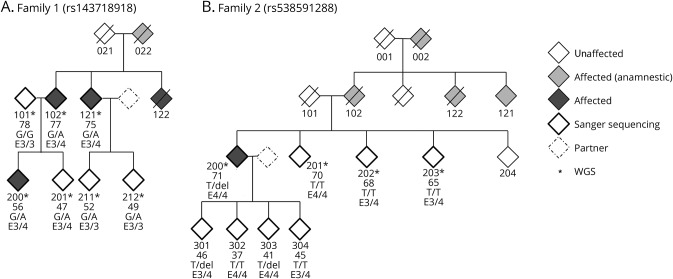
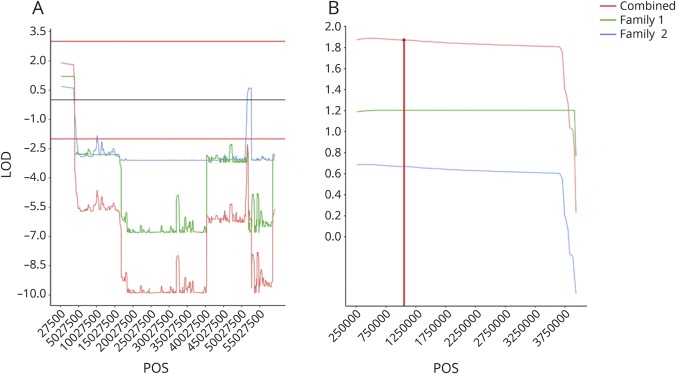
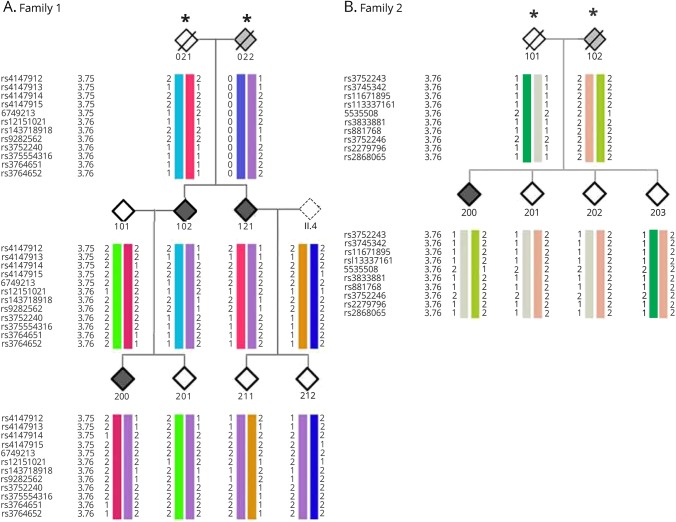
Objective The aim of this study was to identify variants associated with familial late-onset Alzheimer disease (AD) using whole-genome sequencing. Methods Several families with an autosomal dominant inheritance pattern of AD were analyzed by whole-genome sequencing. Variants were prioritized for rare, likely pathogenic variants in genes already known to be associated with AD and confirmed by Sanger sequencing using standard protocols. Results We identified 2 rare ABCA7 variants (rs143718918 and rs538591288) with varying penetrance in 2 independent German AD families, respectively. The single nucleotide variant (SNV) rs143718918 causes a missense mutation, and the deletion rs538591288 causes a frameshift mutation of ABCA7. Both variants have previously been reported in larger cohorts but with incomplete segregation information. ABCA7 is one of more than 20 AD risk loci that have so far been identified by genome-wide association studies, and both common and rare variants of ABCA7 have previously been described in different populations with higher frequencies in AD cases than in controls and varying penetrance. Furthermore, ABCA7 is known to be involved in several AD-relevant pathways. Conclusions We conclude that both SNVs might contribute to the development of AD in the examined family members. Together with previous findings, our data confirm ABCA7 as one of the most relevant AD risk genes.
Overview
The claims and statistics of this paper haven’t been checked yet.
Run the check — free, no account needed. It reads the open-access text and checks the sources it cites.
Integrity signals
Registry
Cites
Statistics
Figures
Verification
Claims the paper makes
The claims and statistics of this paper haven’t been checked yet.
Run the check — free, no account needed. It reads the open-access text and checks the sources it cites.
Claims other papers make about this one
Each is checked against this paper’s own text: does it say what the citing paper says it does?
In the citing paper
“we also identified ten genes located in our genome-wide loci as having rare deleterious coding, splicing or LOF burden associations with LOAD (false discovery rate (FDR) P < 0.01), including previously implicated rare-variant signals in ABCA7, TREM2, and SORL1 (refs. 14,49–55), and additional associations with TREML4 in the TREM2 locus, TAP2 and PSMB8 in the HLA-DRB1 locus, PIP in the EPHA1 locus,”
From Genetic meta-analysis of diagnosed Alzheimer’s disease identifies new risk loci and implicates Aβ, tau, immunity and lipid processing (2019) · cites this paper as [54]
Self-check
Percentages, sums and reported differences re-computed from the paper’s own numbers.
The self-check needs the paper’s full text.
Citations
The citation lists haven’t been fetched yet
References 33 · Cited by 18
Metadata
- Authors
- May, P., Pichler, S., Hartl, D., Bobbili, D. R., Mayhaus, M., Spaniol, C., Kurz, A., Balling, R., Schneider, J. G., & Riemenschneider, M.
- Affiliations
- University of Luxembourg (LU)
- From the Luxembourg Centre for Systems Biomedicine (LCSB) (P.M., D.R.B., R.B., J.G.S.), University of Luxembourg, Esch-sur-Alzette; Department of Psychiatry and Psychotherapy (S.P., D.H., M.M., C.S., M.R.), Saarland University Hospital, Saarland University, Homburg; and Department of Psychiatry and Psychotherapy (A.K.), Klinikum Rechts der Isar, TU-Muenchen, Munich, Germany.
- Corresponding author
- Pichler, Sabrina
- Venue
- Neurology Genetics
- Published
- 2018-04
- Volume
- 4
- Issue
- 2
- Pages
- e224-e224
- ISSN
- 2376-7839 (ISSN-L)
- PMC
- PMC5863691
- OpenAlex
- W2790576634
- Cited by
- 18
- References
- 33
- Citations by year
- 2026: 2 · 2025: 2 · 2024: 3 · 2023: 1 · 2022: 2 · 2021: 2 · 2020: 2 · 2019: 3 · 2018: 1
- FWCI
- 1.38
- Type
- journal article
- Language
- en
- Open access
- gold
- doi.org
- Licence
- cc-by-nc-nd
- Locations
- Neurology Genetics (publishedVersion, cc-by-nc-nd)
- PubMed Central (publishedVersion, cc-by-nc-nd)
- PubMed (publishedVersion)
- Open Repository and Bibliography (University of Luxembourg) (submittedVersion, cc-by-nc-sa)
- Funders
- Bundesministerium für Bildung und Forschung
- Fonds De La Recherche Scientifique - FNRS
- Universität des Saarlandes
- Novo Nordisk Fonden
- Topics
- Life Sciences › Neuroscience › Cellular and Molecular Neuroscience › Alzheimer's disease research and treatments
- Health Sciences › Medicine › Psychiatry and Mental health › Dementia and Cognitive Impairment Research
- Life Sciences › Biochemistry, Genetics and Molecular Biology › Genetics › Genetic Associations and Epidemiology
- Keywords
- ABCA7, Alzheimer's disease, late-onset Alzheimer's disease, familial Alzheimer's disease, rare variants, autosomal dominant inheritance, missense mutations, frameshift deletion, genetic susceptibility loci, penetrance, German families
About these checks
Registry, retraction, Cites and statistics results are computed, not judged, with one exception: a printed reference that no index lists is read once by a model before it counts as a citation error. Claims are extracted by a model and kept only when their quote appears verbatim in the text; each cited source is then checked, with a model’s help, for whether it says what the claim relies on. Those verdicts can be wrong — read the claim’s quote and the cited source before relying on one.
Statistics and arithmetic are recomputed, not judged.
Confidence bands are shown only for fields calibrated on our annotated test set. None is calibrated yet, so no band is shown.
What counts as a claim ›How we measure confidence ›How we check this ›
Are you an author, or do you see a problem with this page? Request a review
How to cite
Cite CoChat for the checks on this page, and the paper for its own findings.
- This page
- CoChat. (2026). Citation check: Rare ABCA7 variants in 2 German families with Alzheimer disease. https://app.cochat.ai/papers/10.1212/nxg.0000000000000224
- The paper
- May, P., Pichler, S., Hartl, D., Bobbili, D. R., Mayhaus, M., Spaniol, C., Kurz, A., Balling, R., Schneider, J. G., & Riemenschneider, M. (2018). Rare ABCA7 variants in 2 German families with Alzheimer disease. Neurology Genetics. https://doi.org/10.1212/nxg.0000000000000224
