

The DOI matches its Crossref record; the references it cites are not checked yet.
Prognostic importance of apathy in syndromes associated with frontotemporal lobar degeneration
Open accessAbstract
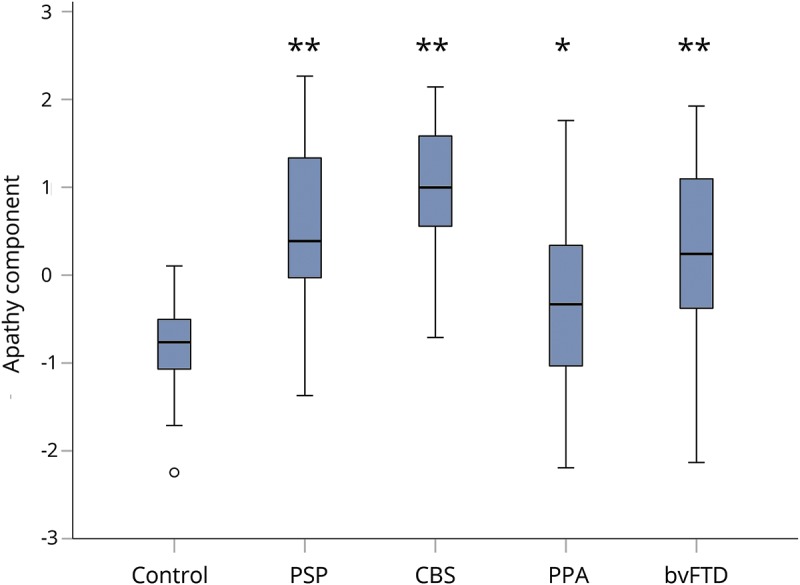
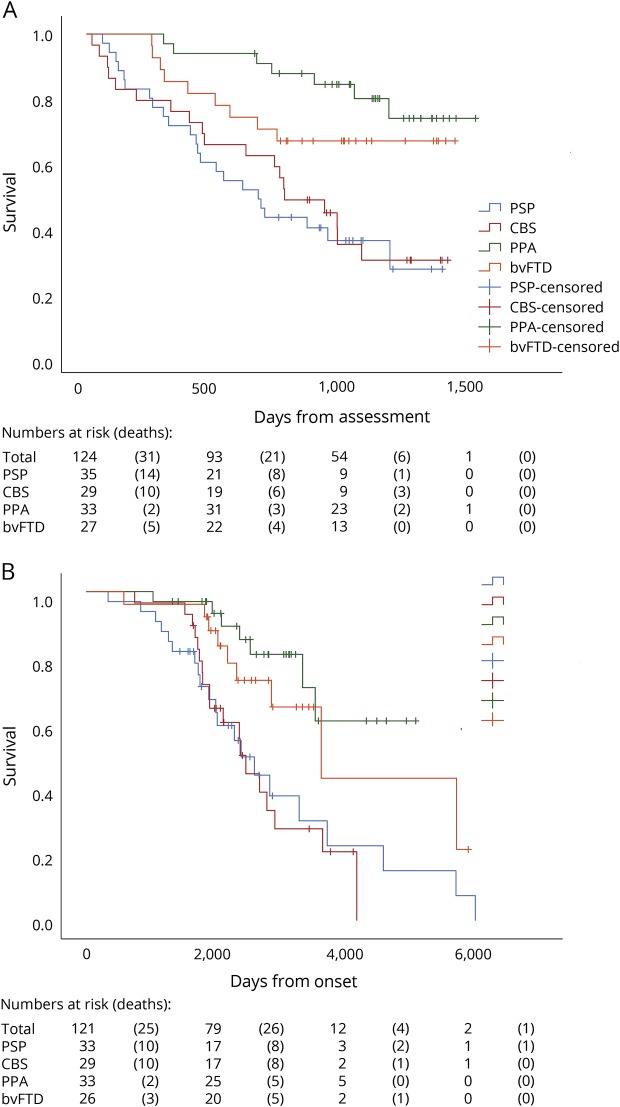
OBJECTIVE: To determine the influence of apathy, impulsivity, and behavioral change on survival in patients with frontotemporal dementia, progressive supranuclear palsy, and corticobasal syndrome. METHODS: We assessed 124 patients from the epidemiologic PiPPIN (Pick's Disease and Progressive Supranuclear Palsy, Prevalence and Incidence) study. Patients underwent detailed baseline cognitive and behavioral assessment focusing on apathy, impulsivity, and behavioral change. Logistic regression identified predictors of death within 2.5 years from assessment, including age, sex, diagnosis, cognition, and 8 neurobehavioral profiles derived from a principal component analysis of neuropsychological and behavioral measures. RESULTS: = 0.004, Exp(B) = 2.912, confidence interval = >1 [1.396-6.075]) and was elevated in all patient groups. This profile represented apathy, weighted strongly to carer reports from the Apathy Evaluation Scale, Neuropsychiatric Inventory, and Cambridge Behavioral Inventory. Age at assessment, sex, and global cognitive impairment were not significant predictors. Differences in mortality risk across diagnostic groups were accounted for by their neuropsychiatric and behavioral features. CONCLUSIONS: The relationship between apathy and survival highlights the need to develop more effective and targeted measurement tools to improve its recognition and facilitate treatment. The prognostic importance of apathy suggests that neurobehavioral features might be useful to predict survival and stratify patients for interventional trials. Effective symptomatic interventions targeting the neurobiology of apathy might ultimately also improve prognosis.
Overview
The claims and statistics of this paper haven’t been checked yet.
Run the check — free, no account needed. It reads the open-access text and checks the sources it cites.
Integrity signals
Registry
Cites
Statistics
Figures
Verification
Claims the paper makes
The claims and statistics of this paper haven’t been checked yet.
Run the check — free, no account needed. It reads the open-access text and checks the sources it cites.
Claims other papers make about this one
Each is checked against this paper’s own text: does it say what the citing paper says it does?
In the citing paper
“Literature demonstrated declines of MMSE, FAB and ACE-R total scores in bvFTD (Mioshi and Hodges, 2009; Devenney et al., 2015; Schubert et al., 2016; Reus et al., 2018), but a principal component analysis of these measures (reflecting global cognitive status) showed no association with mortality (Lansdall et al., 2019).”
From The pursuit for markers of disease progression in behavioral variant frontotemporal dementia: a scoping review to optimize outcome measures for clinical trials (2024) · cites this paper as Lansdall et al., 2019
In the citing paper
“In addition, increased apathy predicted mortality, as stated in a principal component analysis using the Apathy Evaluation Scale (AES), NPI and CBI sub scores (Lansdall et al., 2019).”
From The pursuit for markers of disease progression in behavioral variant frontotemporal dementia: a scoping review to optimize outcome measures for clinical trials (2024) · cites this paper as Lansdall et al., 2019
Self-check
Percentages, sums and reported differences re-computed from the paper’s own numbers.
The self-check needs the paper’s full text.
Citations
The citation lists haven’t been fetched yet
References 40 · Cited by 66
Metadata
- Authors
- Lansdall, C. J., Coyle-Gilchrist, I. T. S., Vázquez Rodríguez, P., Wilcox, A., Wehmann, E., Robbins, T. W., & Rowe, J. B.
- Affiliations
- Universität Hamburg (DE)
- From the Departments of Clinical Neurosciences (C.J.L., I.T.S.C.-G., P.V.R., A.W., E.W., J.B.R.) and Psychology (T.W.R.), and Behavioral and Clinical Neuroscience Institute (T.W.R., J.B.R.), University of Cambridge, UK; University Medical Centre Hamburg-Eppendorf (E.W.), University of Hamburg, Germany; and MRC Cognition and Brain Sciences Unit (J.B.R.), Cambridge, UK.
- Corresponding author
- Lansdall, Claire J.
- Venue
- Neurology
- Published
- 2019-04-02
- Volume
- 92
- Issue
- 14
- Pages
- e1547-e1557
- ISSN
- 0028-3878 (ISSN-L)
- 1526-632X
- PMC
- PMC6448451
- OpenAlex
- W2912821744
- Cited by
- 66
- References
- 40
- Citations by year
- 2026: 3 · 2025: 15 · 2024: 5 · 2023: 12 · 2022: 9 · 2021: 12 · 2020: 6 · 2019: 4
- FWCI
- 6.17
- Type
- journal article
- Language
- en
- Open access
- hybrid
- doi.org
- Licence
- cc-by
- Locations
- Neurology (publishedVersion, cc-by)
- PubMed Central (publishedVersion, cc-by)
- PubMed (publishedVersion)
- UEA Digital Repository (University of East Anglia) (submittedVersion)
- Apollo (University of Cambridge) (submittedVersion)
- Apollo
- Funders
- James S. McDonnell Foundation (220020289)
- Wellcome Trust (103838/Z/14/Z, 103838)
- PSP Association
- National Institute for Health and Care Research
- Cambridge University Hospitals (146281)
- Evelyn Trust (46722)
- Medical Research Council (MR/M024873/1, MR/M009041/1)
- Topics
- Health Sciences › Medicine › Psychiatry and Mental health › Dementia and Cognitive Impairment Research
- Health Sciences › Medicine › Clinical Neurology › Parkinson's Disease Mechanisms and Treatments
- Health Sciences › Medicine › Clinical Neurology › Amyotrophic Lateral Sclerosis Research
- Keywords
- apathy, frontotemporal lobar degeneration, frontotemporal dementia, progressive supranuclear palsy, corticobasal syndrome, Pick's disease, impulsivity, behavior change, survival, mortality prediction, prognostic factors, neuropsychiatric symptoms, neurobehavioral profile
- MeSH terms
- Aged, Aged, 80 and over, Female, Humans, Impulsive Behavior, Male, Middle Aged, Prognosis, Supranuclear Palsy, Progressive, Survival Rate, Logistic Models, Principal Component Analysis, Frontotemporal Lobar Degeneration, Frontotemporal Dementia, Apathy
About these checks
Registry, retraction, Cites and statistics results are computed, not judged, with one exception: a printed reference that no index lists is read once by a model before it counts as a citation error. Claims are extracted by a model and kept only when their quote appears verbatim in the text; each cited source is then checked, with a model’s help, for whether it says what the claim relies on. Those verdicts can be wrong — read the claim’s quote and the cited source before relying on one.
Statistics and arithmetic are recomputed, not judged.
Confidence bands are shown only for fields calibrated on our annotated test set. None is calibrated yet, so no band is shown.
What counts as a claim ›How we measure confidence ›How we check this ›
Are you an author, or do you see a problem with this page? Request a review
How to cite
Cite CoChat for the checks on this page, and the paper for its own findings.
- This page
- CoChat. (2026). Citation check: Prognostic importance of apathy in syndromes associated with frontotemporal lobar degeneration. https://app.cochat.ai/papers/10.1212/wnl.0000000000007249
- The paper
- Lansdall, C. J., Coyle-Gilchrist, I. T. S., Vázquez Rodríguez, P., Wilcox, A., Wehmann, E., Robbins, T. W., & Rowe, J. B. (2019). Prognostic importance of apathy in syndromes associated with frontotemporal lobar degeneration. Neurology. https://doi.org/10.1212/wnl.0000000000007249
