

The DOI matches its Crossref record; 7 of the 7 references it cites were found in a registry or an index.
Association Between Dietary Habits in Midlife With Dementia Incidence Over a 20-Year Period
Open accessAbstract
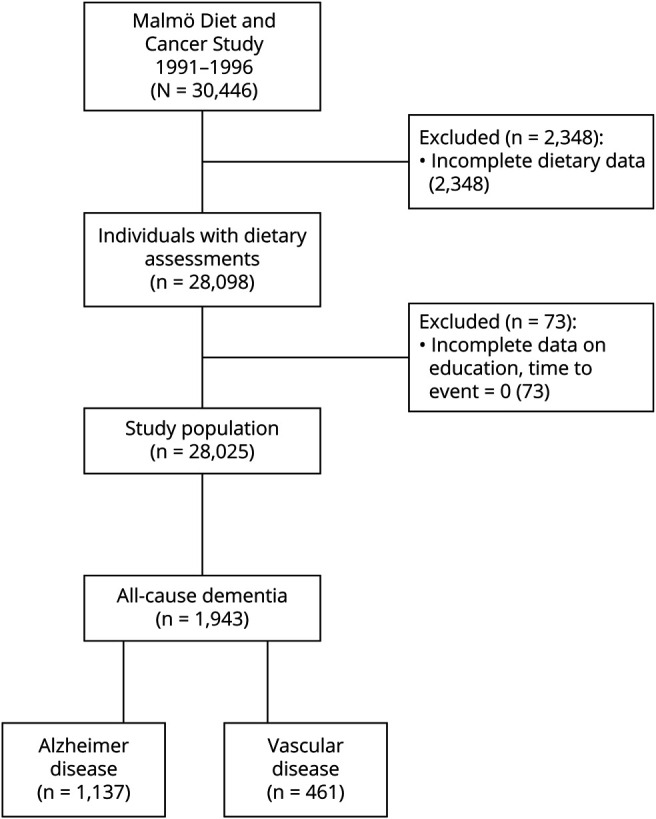
BACKGROUND AND OBJECTIVES: Dementia cases are expected to triple during the next 30 years, highlighting the importance of finding modifiable risk factors for dementia. The aim of this study was to investigate whether adherence to conventional dietary recommendations or to a modified Mediterranean diet are associated with a subsequent lower risk of developing all-cause dementia, Alzheimer disease (AD), vascular dementia (VaD), or with future accumulation of AD-related β-amyloid (Aβ) pathology. METHODS: Baseline examination in the prospective Swedish population-based Malmö Diet and Cancer Study took place in 1991-1996 with a follow-up for incident dementia until 2014. Nondemented individuals born 1923-1950 and living in Malmö were invited to participate. Thirty thousand four hundred forty-six were recruited (41% of all eligible). Twenty-eight thousand twenty-five had dietary data and were included in this study. Dietary habits were assessed with a 7-day food diary, detailed food frequency questionnaire, and 1-hour interview. Main outcomes were incident all-cause dementia, AD, or VaD determined by memory clinic physicians. Secondary outcome was Aβ-accumulation measured using CSF Aβ42 (n = 738). Cox proportional hazard models were used to examine associations between diet and risk of developing dementia (adjusted for demographics, comorbidities, smoking, physical activity, and alcohol). RESULTS: Sixty-one percent were women, and the mean (SD) age was 58.1 (7.6) years. One thousand nine hundred forty-three (6.9%) were diagnosed with dementia (median follow-up, 19.8 years). Individuals adhering to conventional dietary recommendations did not have lower risk of developing all-cause dementia (hazard ratio [HR] comparing worst with best adherence, 0.93, 95% CI 0.81-1.08), AD (HR 1.03, 0.85-1.23), or VaD (HR 0.93, 0.69-1.26). Neither did adherence to the modified Mediterranean diet lower the risk of developing all-cause dementia (HR 0.93 0.75-1.15), AD (HR 0.90, 0.68-1.19), or VaD (HR 1.00, 0.65-1.55). The results were similar when excluding participants developing dementia within 5 years or those with diabetes. No significant associations were found between diet and abnormal Aβ accumulation, conventional recommendations (OR 1.28, 0.74-2.24) or modified Mediterranean diet (OR 0.85, 0.39-1.84). DISCUSSION: In this 20-year follow-up study, neither adherence to conventional dietary recommendations nor to modified Mediterranean diet were significantly associated with subsequent reduced risk for developing all-cause dementia, AD dementia, VaD, or AD pathology.
Overview
The claims and statistics of this paper haven’t been checked yet.
Run the check — free, no account needed. It reads the open-access text and checks the sources it cites.
Integrity signals
Registry
Cites
Statistics
Figures
Verification
Claims the paper makes
The claims and statistics of this paper haven’t been checked yet.
Run the check — free, no account needed. It reads the open-access text and checks the sources it cites.
Claims other papers make about this one
Each is checked against this paper’s own text: does it say what the citing paper says it does?
The cited source says what the claim attributes to it.
In the citing paper
“Since these reviews, a Swedish prospective cohort of 28,025 people in midlife (mean age at first assessment 58 years, median follow-up 19.8 years) reported neither adherence to dietary recommendations nor to the modified Mediterranean diet lowered the risk of dementia, AD or VD or AD pathology. (326)”
From Dementia prevention, intervention, and care: 2024 report of the Lancet standing Commission (2024) · cites this paper as [326]
The cited source says what the claim attributes to it.
In the citing paper
“These results remained the same when those who developed dementia in the five years after baseline were excluded.”
From Dementia prevention, intervention, and care: 2024 report of the Lancet standing Commission (2024) · cites this paper as [326]
Self-check
Percentages, sums and reported differences re-computed from the paper’s own numbers.
The self-check needs the paper’s full text.
Citations
Cites
1 retracted
Dementia prevention, intervention, and care: 2020 report of the Lancet Commission
Livingston, G., Huntley, J., Sommerlad, A., Ames, D., Ballard, C., Banerjee, S., Brayne, C., Burns, A., Cohen-Mansfield, J., Cooper, C., et al. (2020) · The Lancet · doi:10.1016/s0140-6736(20)30367-6 · Cited by 10,430 · cited 3×
“In addition to a large burden for patients and relatives, there is a tremendous burden for the health care system, with a global cost of US$1 trillion annually.(2) As acknowledged by the 2020 report of the Lancet Commission on Dementia prevention, intervention, and care, modifiable risk factors account for 40% of worl…”
BackgroundMethodInfluentialRetractedBiomarkers for neurodegenerative diseases
Hansson, O. (2021) · Nature Medicine · doi:10.1038/s41591-021-01382-x · Cited by 1,159
Self-citationMartínez-González, M. A., García-Arellano, A., Toledo, E., Salas-Salvadó, J., Buil-Cosiales, P., Corella, D., Covas, M. I., Schröder, H., Arós, F., Gómez-Gracia, E., et al. (2012) · PLoS ONE · doi:10.1371/journal.pone.0043134 · Cited by 1,150
Palmqvist, S., Zetterberg, H., Blennow, K., Vestberg, S., Andreasson, U., Brooks, D. J., Owenius, R., Hägerström, D., Wollmer, P., Minthon, L., et al. (2014) · JAMA Neurology · doi:10.1001/jamaneurol.2014.1358 · Cited by 368
Self-citationJanelidze, S., Pannee, J., Mikulskis, A., Chiao, P., Zetterberg, H., Blennow, K., & Hansson, O. (2017) · JAMA Neurology · doi:10.1001/jamaneurol.2017.2814 · Cited by 147
Association of midlife diet with subsequent risk for dementia
Akbaraly, T. N., Singh-Manoux, A., Dugravot, A., Brunner, E. J., Kivimäki, M., & Sabia, S. (2019) · JAMA · doi:10.1001/jama.2019.1432 · Cited by 121
Unbiased estimates of cerebrospinal fluid β-amyloid 1–42 cutoffs in a large memory clinic population
Bertens, D., Tijms, B. M., Scheltens, P., Teunissen, C. E., & Visser, P. J. (2017) · Alzheimer's Research & Therapy · doi:10.1186/s13195-016-0233-7 · Cited by 91
Research works printed but not linked: 27
- 10.3945/an.116.012138 · DOI · Paper page
- 10.3109/00207454.2016.1155572 · DOI
- 10.3233/JAD-130830 · DOI
- 10.1097/00008469-200112000-00003 · DOI
- 10.1093/ije/26.suppl_1.S161 · DOI
- 10.1186/1475-2891-1-3 · DOI
- Elmståhl S Riboli E Lindgärde F Gullberg B Saracci R. The Malmö food Study: the relative validity of a modified diet history method and an extensive food frequency questionnaire for measuring food intake. Eur J Clin Nutr. 1996 Mar;50(3):143-51.
- United States Department of Agriculture and the Department of Health and Human Services. Dietary Guidelines for Americans, 2020-2025. 9th ed; updated 2020. Accessed September 16, 2021. pcrm.org/good-nutrition/nutrition-programs-policies/2020-2025-dietary-guidelines.
- Public Health England. Government Dietary Recommendations. 2016. Accessed September 16, 2021. assets.publishing.service.gov.uk/government/uploads/system/uploads/attachment_data/file/618167/government_dietary_recommendations.pdf.
- 10.1017/S1368980010003848 · DOI
- 10.1016/j.numecd.2005.08.006 · DOI
- 10.1016/j.jalz.2011.03.008 · DOI · Paper page
- 10.18637/jss.v032.i06 · DOI
- 10.1001/jamaneurol.2014.2031 · DOI · Paper page
- 10.1001/jamaneurol.2019.1632 · DOI · Paper page
- 10.1161/CIRCULATIONAHA.115.017719 · DOI · Paper page
- 10.3390/ijms20112842 · DOI
- World Health Organization. Global Status Report on Noncommunicable Diseases 2014. World Health Organization; 2014.
- 10.1001/jamanetworkopen.2019.16641 · DOI
- 10.1016/j.jalz.2018.12.011 · DOI
- 10.1016/j.amepre.2013.08.015 · DOI
- 10.1093/aje/kwx293 · DOI
- 10.3945/ajcn.117.162263 · DOI
- 10.1016/j.jagp.2016.05.007 · DOI
- 10.1001/archneurol.2011.125 · DOI
- 10.1016/j.neurobiolaging.2018.12.008 · DOI
- 10.1212/WNL.0000000000007243 · DOI
Cited by
Sorted by citations
Dementia prevention, intervention, and care: 2024 report of the Lancet standing Commission
Livingston, G., Huntley, J., Liu, K. Y., Costafreda, S. G., Selbæk, G., Alladi, S., Ames, D., Banerjee, S., Burns, A., Brayne, C., et al. (2024) · The Lancet · doi:10.1016/s0140-6736(24)01296-0 · Cited by 3,860
Yang, J., Zhi, W., & Wang, L. (2024) · Molecules · doi:10.3390/molecules29122812 · Cited by 63
Metadata
- Authors
- Glans, I., Sonestedt, E., Nägga, K., Gustavsson, A.-M., González-Padilla, E., Borne, Y., Stomrud, E., Melander, O., Nilsson, P. M., Palmqvist, S., & Hansson, O.
- Affiliations
- Linköping University (SE)
- From the Clinical Memory Research Unit (I.G., K.N., A.-M.G., Erik Stomrud, S.P., O.H.), Department of Clinical Sciences Malmö, Lund University, Sweden; Memory Clinic (I.G., A.-M.G., Erik Stomrud, S.P., O.H.), Skåne University Hospital, Malmö, Sweden; Department of Clinical Sciences in Malmö(Emily Sonestedt, E.G.-P., Y.B.), Nutritional Epidemiology, Lund University, Skåne University Hospital, Malmö, Sweden; Department of Acute Internal Medicine and Geriatrics (K.N.), Linköping University, Sweden; and...
- Corresponding author
- Glans, Isabelle
- ORCID
- Venue
- Neurology
- Published
- 2023-01-03
- Volume
- 100
- Issue
- 1
- Pages
- e28-e37
- ISSN
- 0028-3878 (ISSN-L)
- 1526-632X
- PMC
- PMC9827131
- OpenAlex
- W4304809056
- Cited by
- 40
- References
- 7
- Citations by year
- 2026: 6 · 2025: 7 · 2024: 12 · 2023: 14
- FWCI
- 5.54
- Type
- journal article
- Language
- en
- Update notices
- correction (2023-02-07)
- Open access
- hybrid
- doi.org
- Licence
- cc-by
- Locations
- Neurology (publishedVersion, cc-by)
- PubMed Central (publishedVersion, cc-by)
- PubMed (publishedVersion)
- DiVA (Linkoping University) (submittedVersion, other-oa)
- Lund University Publications (Lund University) (submittedVersion)
- Funders
- Eli Lilly and Company
- Pfizer
- Biogen
- Australian Government
- Lunds Universitet
- Eisai
- Karolinska Institutet
- Knut och Alice Wallenbergs Stiftelse
- Vetenskapsrådet
- Konung Gustaf V:s och Drottning Victorias Frimurarestiftelse
- Skånes universitetssjukhus
- Marcus och Amalia Wallenbergs minnesfond
- Genentech
- Parkinsonfonden
- Avid Radiopharmaceuticals
- Topics
- Health Sciences › Medicine › Psychiatry and Mental health › Dementia and Cognitive Impairment Research
- Health Sciences › Medicine › Public Health, Environmental and Occupational Health › Nutritional Studies and Diet
- Life Sciences › Neuroscience › Cellular and Molecular Neuroscience › Alzheimer's disease research and treatments
- Keywords
- dietary habits, dementia incidence, Alzheimer's disease, vascular dementia, Mediterranean diet, amyloid-beta deposition, midlife, modifiable risk factors, Malmö Diet and Cancer Study, all-cause dementia, food frequency questionnaire, dementia prevention
- MeSH terms
- Alzheimer Disease, Feeding Behavior, Female, Follow-Up Studies, Humans, Male, Middle Aged, Prospective Studies, Risk Factors, Dementia, Vascular, Incidence, Diet, Mediterranean
About these checks
Registry, retraction, Cites and statistics results are computed, not judged, with one exception: a printed reference that no index lists is read once by a model before it counts as a citation error. Claims are extracted by a model and kept only when their quote appears verbatim in the text; each cited source is then checked, with a model’s help, for whether it says what the claim relies on. Those verdicts can be wrong — read the claim’s quote and the cited source before relying on one.
Statistics and arithmetic are recomputed, not judged.
Confidence bands are shown only for fields calibrated on our annotated test set. None is calibrated yet, so no band is shown.
What counts as a claim ›How we measure confidence ›How we check this ›
Are you an author, or do you see a problem with this page? Request a review
