

“My Surgical Success”: Feasibility and Impact of a Single-Session Digital Behavioral Pain Medicine Intervention on Pain Intensity, Pain Catastrophizing, and Time to Opioid Cessation After Orthopedic Trauma Surgery—A Randomized Trial
Open accessThe DOI matches its Crossref record; 38 of the 38 references it cites were found in a registry or an index.
Abstract
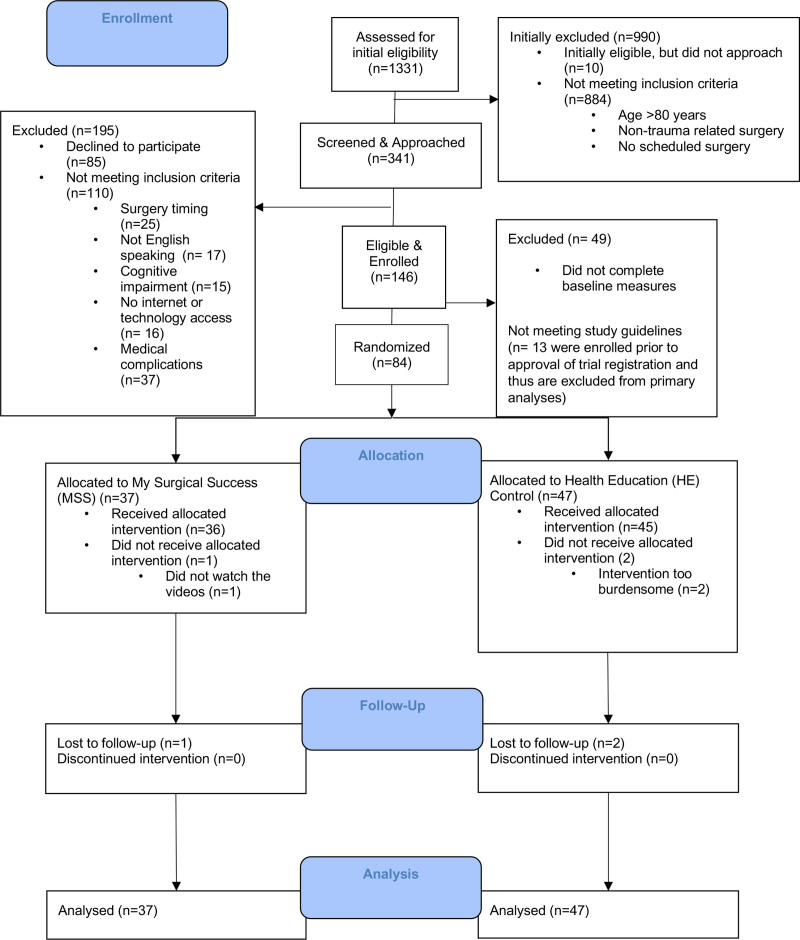
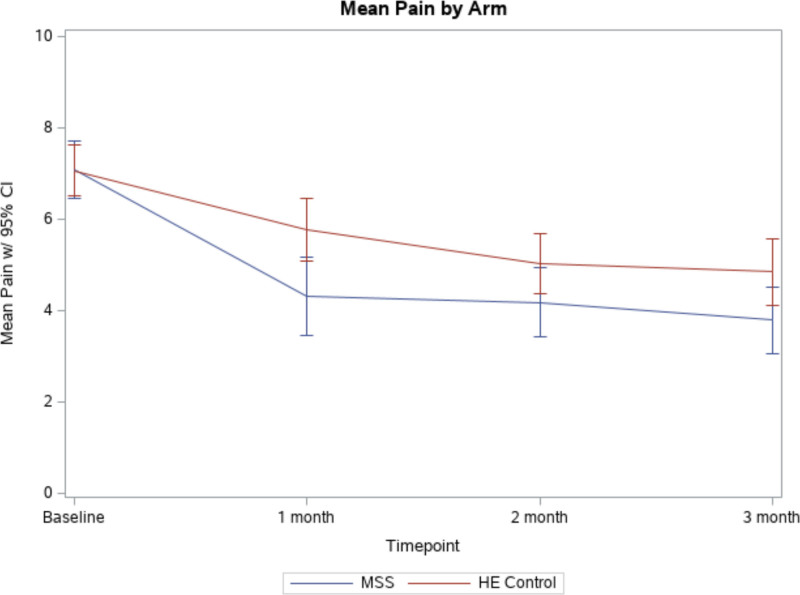
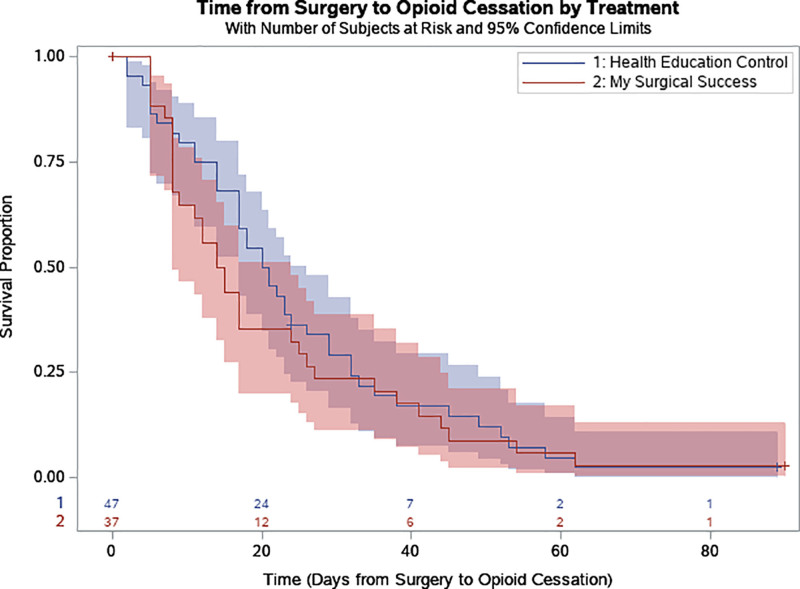
BACKGROUND: Behavioral pain treatments may improve postsurgical analgesia and recovery; however, effective and scalable options are not widely available. This study tested a digital perioperative behavioral medicine intervention in orthopedic trauma surgery patients for feasibility and efficacy for reducing pain intensity, pain catastrophizing, and opioid cessation up to 3 months after surgery. METHODS: A randomized controlled clinical trial was conducted at an orthopedic trauma surgery unit at a major academic hospital to compare a digital behavioral pain management intervention (“My Surgical Success” [MSS]) to a digital general health education (HE) intervention (HE; no pain management skills). The enrolled sample included 133 patients; 84 patients were randomized (MSS, n = 37; HE, n = 47) and completed study procedures. Most patients received their assigned intervention within 3 days of surgery (85%). The sample was predominantly male (61.5%), White (61.9%), and partnered (65.5%), with at least a bachelor’s degree (69.0%). Outcomes were collected at 1–3 months after intervention through self-report e-surveys and electronic medical record review; an intention-to-treat analytic framework was applied. Feasibility was dually determined by the proportion of patients engaging in their assigned treatment and an application of an 80% threshold for patient-reported acceptability. We hypothesized that MSS would result in greater reductions in pain intensity and pain catastrophizing after surgery and earlier opioid cessation compared to the digital HE control group. RESULTS: The engagement rate with assigned interventions was 63% and exceeded commonly reported rates for fully automated Internet-based e-health interventions. Feasibility was demonstrated for the MSS engagers, with >80% reporting treatment acceptability. Overall, both groups improved in the postsurgical months across all study variables. A significant interaction effect was found for treatment group over time on pain intensity, such that the MSS group evidenced greater absolute reductions in pain intensity after surgery and up to 3 months later (treatment × time fixed effects; F [215] = 5.23; P = .024). No statistically significant between-group differences were observed for time to opioid cessation or for reductions in pain catastrophizing ( F [215] = 0.20; P = .653), although the study sample notably had subclinical baseline pain catastrophizing scores (M = 14.10; 95% confidence interval, 11.70–16.49). CONCLUSIONS: Study findings revealed that a fully automated behavioral pain management skills intervention (MSS) may be useful for motivated orthopedic trauma surgery patients and reduce postsurgical pain up to 3 months. MSS was not associated with reduced time to opioid cessation compared to the HE control intervention.
Overview
The claims and statistics of this paper haven’t been checked yet.
Free: it reads the open-access text and checks the first 5 claims that cite a source we can check. Create a free account to check every claim.
Integrity signals
Registry
Cites
Statistics
Figures
Verification
Claims the paper makes
The claims and statistics of this paper haven’t been checked yet.
Free: it reads the open-access text and checks the first 5 claims that cite a source we can check. Create a free account to check every claim.
Claims other papers make about this one
Each is checked against this paper’s own text: does it say what the citing paper says it does?
The cited source says what the claim attributes to it.
In the citing paper
“In terms of postoperative pain, an SSI helped to decrease adult pain intensity following orthopedic trauma surgery. 45”
From Virtual psychoeducation for improvement of pain catastrophizing in pediatric presurgical patients and caregivers: a proof-of-concept study (2023) · cites this paper as [45]
The cited source says what the claim attributes to it.
In the citing paper
“Relative to the adult literature, 45,66,70 there is much less pediatric research on psychological interventions during the perioperative period, 46”
From Virtual psychoeducation for improvement of pain catastrophizing in pediatric presurgical patients and caregivers: a proof-of-concept study (2023) · cites this paper as [45]
Self-check
Percentages, sums and reported differences re-computed from the paper’s own numbers.
The self-check needs the paper’s full text.
Citations
Cites
Harris, P. A., Taylor, R., Thielke, R., Payne, J., Gonzalez, N., & Conde, J. G. (2009) · Journal of Biomedical Informatics · doi:10.1016/j.jbi.2008.08.010 · Cited by 51,384
The Pain Catastrophizing Scale: Development and validation.
Sullivan, M. J. L., Bishop, S. R., & Pivik, J. (1995) · Psychological Assessment · doi:10.1037//1040-3590.7.4.524 · Cited by 8,227
Farrar, J. T., Young, J. P., LaMoreaux, L., Werth, J. L., & Poole, M. R. (2001) · Pain · doi:10.1016/s0304-3959(01)00349-9 · Cited by 5,808
Power and sample size calculations
Dupont, W. D., & Plummer, W. D. (1990) · Controlled Clinical Trials · doi:10.1016/0197-2456(90)90005-m · Cited by 2,092
Salaffi, F., Stancati, A., Silvestri, C. A., Ciapetti, A., & Grassi, W. (2004) · European Journal of Pain · doi:10.1016/j.ejpain.2003.09.004 · Cited by 1,724
Acute Pain after Thoracic Surgery Predicts Long-Term Post-Thoracotomy Pain
Katz, J., Jackson, M., Kavanagh, B. P., & Sandler, A. N. (1996) · The Clinical Journal of Pain · doi:10.1097/00002508-199603000-00009 · Cited by 915 · cited 1×
“Exclusion criteria were: (1) inability to complete study procedures (eg, cognitive ability, mental status, or medical status) or lack of access to Internet and phone that would prevent participation in study procedures, (2) long-term opioid use (>3 months) before surgery, (3) known pregnancy, (4) ongoing legal action…”
BackgroundPain Catastrophizing and Kinesiophobia: Predictors of Chronic Low Back Pain
Picavet, H. S. J. (2002) · American Journal of Epidemiology · doi:10.1093/aje/kwf136 · Cited by 744
Eccleston, C., Blyth, F. M., Dear, B. F., Fisher, E. A., Keefe, F. J., Lynch, M. E., Palermo, T. M., Reid, M. C., & Williams, A. C. D. C. (2020) · Pain · doi:10.1097/j.pain.0000000000001885 · Cited by 480
Clinically significant changes in pain along the visual analog scale
Bird, S. B., & Dickson, E. W. (2001) · Annals of Emergency Medicine · doi:10.1067/mem.2001.118012 · Cited by 368
Lai, J.-S., Cella, D., Choi, S., Junghaenel, D. U., Christodoulou, C., Gershon, R., & Stone, A. (2011) · Archives of Physical Medicine and Rehabilitation · doi:10.1016/j.apmr.2010.08.033 · Cited by 362
Preamputation Pain and Acute Pain Predict Chronic Pain After Lower Extremity Amputation
Hanley, M. A., Jensen, M. P., Smith, D. G., Ehde, D. M., Edwards, W. T., & Robinson, L. R. (2007) · The Journal of Pain · doi:10.1016/j.jpain.2006.06.004 · Cited by 234
Spiegel, B., Fuller, G., Lopez, M., Dupuy, T., Noah, B., Howard, A., Albert, M., Tashjian, V., Lam, R., Ahn, J., et al. (2019) · PLOS ONE · doi:10.1371/journal.pone.0219115 · Cited by 233
Kovacs, F. M., Abraira, V., Royuela, A., Corcoll, J., Alegre, L., Cano, A., Muriel, A., Zamora, J., Gil del Real, M. T., Gestoso, M., et al. (2007) · Spine · doi:10.1097/brs.0b013e31815b75ae · Cited by 211
Hauser-Ulrich, S., Künzli, H., Meier-Peterhans, D., & Kowatsch, T. (2020) · JMIR mHealth and uHealth · doi:10.2196/15806 · Cited by 210
Hah, J., Mackey, S. C., Schmidt, P., McCue, R., Humphreys, K., Trafton, J., Efron, B., Clay, D., Sharifzadeh, Y., Ruchelli, G., et al. (2018) · JAMA Surgery · doi:10.1001/jamasurg.2017.4915 · Cited by 203
Darnall, B. D., Roy, A., Chen, A. L., Ziadni, M. S., Keane, R. T., You, D. S., Slater, K., Poupore-King, H., Mackey, I., Kao, M.-C., et al. (2021) · JAMA Network Open · doi:10.1001/jamanetworkopen.2021.13401 · Cited by 191
Self-citationPatient and Procedural Determinants of Postoperative Pain Trajectories
Vasilopoulos, T., Wardhan, R., Rashidi, P., Fillingim, R. B., Wallace, M. R., Crispen, P. L., Parvataneni, H. K., Prieto, H. A., Machuca, T., Hughes, S. J., et al. (2021) · Anesthesiology · doi:10.1097/aln.0000000000003681 · Cited by 173
George, S. Z., Wittmer, V. T., Fillingim, R. B., & Robinson, M. E. (2007) · Journal of Pain · doi:10.1016/j.jpain.2006.05.009 · Cited by 149
Farrar, J. T., Dworkin, R. H., & Max, M. B. (2006) · Journal of Pain and Symptom Management · doi:10.1016/j.jpainsymman.2005.08.018 · Cited by 147
Darnall, B., Sturgeon, J., Kao, M.-C., Hah, J., & Mackey, S. (2014) · Journal of Pain Research · doi:10.2147/jpr.s62329 · Cited by 140
Self-citationGeraghty, A. W. A., Torres, L. D., Leykin, Y., Perez-Stable, E. J., & Munoz, R. F. (2013) · Health Promotion International · doi:10.1093/heapro/das029 · Cited by 139
Pain assessment using the NIH Toolbox
Cook, K. F., Dunn, W., Griffith, J. W., Morrison, M. T., Tanquary, J., Sabata, D., Victorson, D., Carey, L. M., MacDermid, J. C., Dudgeon, B. J., et al. (2013) · Neurology · doi:10.1212/wnl.0b013e3182872e80 · Cited by 137
Hah, J. M., Cramer, E. M., Hilmoe, H. E., Schmidt, P., McCue, R., Trafton, J. A., Clay, D., Sharifzadeh, Y., Ruchelli, G., Goodman, S. B., et al. (2019) · JAMA Network Open · doi:10.1001/jamanetworkopen.2019.0168 · Cited by 121 · cited 3×
“Second, results may not generalize to: (1) populations with greater baseline pain-related distress, (2) different surgical types or populations, or (3) lower socioeconomic populations.”
BackgroundResultSzeverenyi, C., Kekecs, Z., Johnson, A., Elkins, G., Csernatony, Z., & Varga, K. (2018) · The Journal of Pain · doi:10.1016/j.jpain.2018.05.006 · Cited by 87 · cited 1×
“Exclusion criteria were: (1) inability to complete study procedures (eg, cognitive ability, mental status, or medical status) or lack of access to Internet and phone that would prevent participation in study procedures, (2) long-term opioid use (>3 months) before surgery, (3) known pregnancy, (4) ongoing legal action…”
BackgroundRamachandruni, S., Fillingim, R. B., McGorray, S. P., Schmalfuss, C. M., Cooper, G. R., Schofield, R. S., & Sheps, D. S. (2006) · Journal of the American College of Cardiology · doi:10.1016/j.jacc.2005.10.051 · Cited by 85
Darnall, B. D., Ziadni, M. S., Krishnamurthy, P., Flood, P., Heathcote, L. C., Mackey, I. G., Taub, C. J., & Wheeler, A. (2019) · Pain Medicine · doi:10.1093/pm/pnz094 · Cited by 83
Self-citationJarman, M. P., Weaver, M. J., Haider, A. H., Salim, A., & Harris, M. B. (2020) · Journal of Surgical Research · doi:10.1016/j.jss.2019.12.023 · Cited by 73 · cited 3×
“Second, results may not generalize to: (1) populations with greater baseline pain-related distress, (2) different surgical types or populations, or (3) lower socioeconomic populations.”
BackgroundResultExploratory and confirmatory factor analysis of the PROMIS pain quality item bank
Revicki, D. A., Cook, K. F., Amtmann, D., Harnam, N., Chen, W.-H., & Keefe, F. J. (2014) · Quality of Life Research · doi:10.1007/s11136-013-0467-9 · Cited by 62
Roh, Y. H., Lee, B. K., Noh, J. H., Oh, J. H., Gong, H. S., & Baek, G. H. (2014) · The Journal of Hand Surgery · doi:10.1016/j.jhsa.2014.08.007 · Cited by 62
Veal, F. C., Bereznicki, L. R. E., Thompson, A. J., Peterson, G. M., & Orlikowski, C. (2015) · Medicine · doi:10.1097/md.0000000000001498 · Cited by 59 · cited 2×
“Exclusion criteria were: (1) inability to complete study procedures (eg, cognitive ability, mental status, or medical status) or lack of access to Internet and phone that would prevent participation in study procedures, (2) long-term opioid use (>3 months) before surgery, (3) known pregnancy, (4) ongoing legal action…”
BackgroundZiadni, M. S., Gonzalez-Castro, L., Anderson, S., Krishnamurthy, P., & Darnall, B. D. (2021) · Journal of Medical Internet Research · doi:10.2196/29672 · Cited by 59
Self-citationPsychological interventions for acute pain after open heart surgery
Ziehm, S., Rosendahl, J., Barth, J., Strauss, B. M., Mehnert, A., & Koranyi, S. (2017) · Cochrane Database of Systematic Reviews · doi:10.1002/14651858.cd009984.pub3 · Cited by 56
Singh, J. A., Lemay, C. A., Nobel, L., Yang, W., Weissman, N., Saag, K. G., Allison, J. J., & Franklin, P. D. (2019) · JAMA Network Open · doi:10.1001/jamanetworkopen.2019.15105 · Cited by 54
Tong, F., Dannaway, J., Enke, O., & Eslick, G. (2020) · ANZ Journal of Surgery · doi:10.1111/ans.15332 · Cited by 47
Preamputation pain and acute pain predict chronic pain after lower extremity amputation
Hanley, M. A., Jensen, M. P., Smith, D. G., Ehde, D. M., Edwards, W., & Robinson, L. R. (2007) · Acute Pain · doi:10.1016/j.acpain.2007.04.038 · Cited by 41 · cited 1×
“Exclusion criteria were: (1) inability to complete study procedures (eg, cognitive ability, mental status, or medical status) or lack of access to Internet and phone that would prevent participation in study procedures, (2) long-term opioid use (>3 months) before surgery, (3) known pregnancy, (4) ongoing legal action…”
BackgroundPain Duration and Resolution following Surgery: An Inception Cohort Study
Carroll, I. R., Hah, J. M., Barelka, P. L., Wang, C. K. M., Wang, B. M., Gillespie, M., McCue, R., Younger, J., Trafton, J. A., Humphreys, K. N., et al. (2015) · Pain Medicine · doi:10.1111/pme.12842 · Cited by 31
Noori, A., Sprague, S., Bzovsky, S., Schemitsch, E. H., Poolman, R. W., Frihagen, F., Axelrod, D. E., Heels‐Ansdell, D., Bhandari, M., Busse, J. W., et al. (2020) · Journal of Orthopaedic Trauma · doi:10.1097/bot.0000000000001929 · Cited by 18
Acute Pain Predictors of Remote Postoperative Pain Resolution After Hand Surgery
Hah, J. M., Nwaneshiudu, C. A., Cramer, E. M., Carroll, I. R., & Curtin, C. M. (2021) · Pain and Therapy · doi:10.1007/s40122-021-00263-y · Cited by 18
Cited by
Darnall, B. D., Edwards, K. A., Courtney, R. E., Ziadni, M. S., Simons, L. E., & Harrison, L. E. (2023) · Frontiers in Pain Research · doi:10.3389/fpain.2023.1223172 · Cited by 22
Self-citationCheng, L., Gong, R., Zhang, J., Sunzi, K., Xu, N., & Shi, Q. (2023) · Cancer Medicine · doi:10.1002/cam4.6616 · Cited by 22
Darnall, B. D., Abshire, L., Courtney, R. E., & Davin, S. A. (2025) · Regional Anesthesia & Pain Medicine · doi:10.1136/rapm-2024-105601 · Cited by 17
“We highlight the two studies that used autonomous digital interventions 23 24 and the potential of these approaches to improve patient access to skills-based perioperative pain management.”
InfluentialSelf-citationZiadni, M. S., Sturgeon, J. A., & Lumley, M. A. (2022) · Frontiers in Pain Research · doi:10.3389/fpain.2022.1028561 · Cited by 14
Self-citationCan perioperative psychological interventions reduce chronic pain after surgery?
Peters, M. L. (2023) · British Journal of Hospital Medicine · doi:10.12968/hmed.2022.0400 · Cited by 9
Metadata
- Authors
- Ziadni, M. S., You, D. S., Keane, R., Salazar, B., Jaros, S., Ram, J., Roy, A., Tanner, N., Salmasi, V., Gardner, M., & Darnall, B. D.
- Affiliations
- Stanford Medicine (US)
- Department of Orthopaedic Surgery, Orthopaedic Trauma Service
- Department of Epidemiology, Stanford University School of Medicine, Palo Alto, California.
- Corresponding author
- Ziadni, Maisa S.
- You, Dokyoung S.
- Keane, Ryan
- Ram, Jesmin
- Roy, Anuradha
- Salmasi, Vafi
- Darnall, Beth D.
- ORCID
- Venue
- Anesthesia & Analgesia
- Published
- 2022-07-05
- Volume
- 135
- Issue
- 2
- Pages
- 394-405
- ISSN
- 0003-2999 (ISSN-L)
- PMC
- PMC9259046
- OpenAlex
- W4282832937
- Cited by
- 28
- References
- 38
- Citations by year
- 2026: 9 · 2025: 7 · 2024: 6 · 2023: 5 · 2022: 1
- FWCI
- 4.54
- Type
- journal article
- Language
- en
- Open access
- hybrid
- doi.org
- Licence
- Locations
- Anesthesia & Analgesia (publishedVersion, cc-by-nc-nd)
- PubMed Central (publishedVersion, cc-by-nc-nd)
- PubMed (publishedVersion)
- Funders
- National Heart, Lung, and Blood Institute (T32HL151323)
- National Institute on Drug Abuse (K23DA048972, K23DA047473, K24DA053564)
- Topics
- Health Sciences › Medicine › Anesthesiology and Pain Medicine › Anesthesia and Pain Management
- Health Sciences › Medicine › Pediatrics, Perinatology and Child Health › Pediatric Pain Management Techniques
- Health Sciences › Medicine › Anesthesiology and Pain Medicine › Pain Management and Opioid Use
- Keywords
- digital interventions, orthopedic trauma surgery, postoperative pain, pain intensity, pain catastrophizing, opioid cessation, opioid use reduction, e-health, patient engagement, treatment acceptability, perioperative care, feasibility
- MeSH terms
- Analgesics, Analgesics, Opioid, Feasibility Studies, Female, Humans, Male, Pain Measurement, Postoperative Pain, Pain, Postoperative, Catastrophization
About these checks
Registry, retraction, Cites and statistics results are computed, not judged, with one exception: a printed reference that no index lists is read once by a model before it counts as a citation error. Claims are extracted by a model and kept only when their quote appears verbatim in the text; each cited source is then checked, with a model’s help, for whether it says what the claim relies on. Those verdicts can be wrong — read the claim’s quote and the cited source before relying on one.
Statistics and arithmetic are recomputed, not judged.
Confidence bands are shown only for fields calibrated on our annotated test set. None is calibrated yet, so no band is shown.
What counts as a claim ›How we measure confidence ›How we check this ›
Are you an author, or do you see a problem with this page? Request a review
Data sources
Bibliographic data: Semantic Scholar, OpenAlex, Crossref.
Contains information from the Semantic Scholar Academic Graph Datasets, made available under the ODC Attribution License (ODC-BY 1.0).
Semantic Scholar’s data is described in: Kinney, R., et al. (2023). The Semantic Scholar Open Data Platform. arXiv:2301.10140.
