

Asymptotic analysis for personalized Web search
Open accessThe DOI matches its Crossref record; 51 of the 51 references it cites were found in a registry or an index; 3 of the 18 sources its claims cite were checked for support.
Abstract
PageRank with personalization is used in Web search as an importance measure for Web documents. The goal of this paper is to characterize the tail behavior of the PageRank distribution in the Web and other complex networks characterized by power laws. To this end, we model the PageRank as a solution of a stochastic equation where the R i s are distributed as R . This equation is inspired by the original definition of the PageRank. In particular, N models the number of incoming links to a page, and B stays for the user preference. Assuming that N or B are heavy tailed, we employ the theory of regular variation to obtain the asymptotic behavior of R under quite general assumptions on the involved random variables. Our theoretical predictions show good agreement with experimental data.
Overview
CoChat Summary
## TL;DR
This paper models personalized PageRank as the solution to a stochastic fixed-point equation and derives its tail asymptotics under heavy-tailed in-degree and/or teleportation distributions. The main conclusion is that the PageRank tail is governed by the heaviest tail among the in-degree and teleportation, while out-degree has only a negligible effect.
## Key findings
- The paper proves that the stochastic equation for PageRank has a unique nontrivial solution with mean 1.
- Theorem 4.1 shows that the tail behavior of PageRank is determined by the heavier-tailed of the in-degree \(N\) and teleportation \(B\):
- if \(P(B>x)=o(P(N>x))\), then PageRank follows the in-degree tail;
- if \(P(N>x)=o(P(B>x))\), then PageRank follows the teleportation tail;
- if \(P(B>x)\sim C_{BN}P(N>x)\), then both contribute.
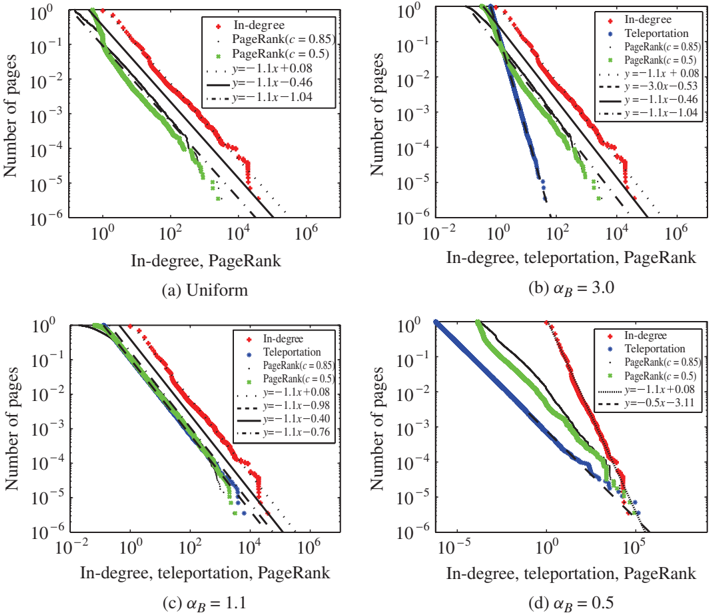
- In the numerical example on the Stanford data set, the authors use \(w=281{,}903\) pages and \(2{,}312{,}497\) links, with in-degree exponent \(\alpha_N=1.1\), and test teleportation exponents \(\alpha_B=0.5, 1.1, 3.0\).
- For the Stanford sample, they report predicted PageRank log-log lines such as \(y=-1.1x-0.46\) for \(c=0.85\) and \(y=-1.1x-1.04\) for \(c=0.5\), and state that these match the experimental PageRank slopes well.
## Methods
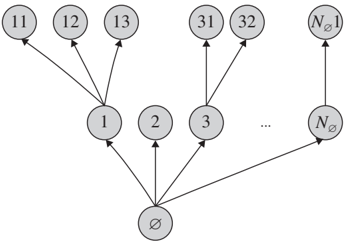
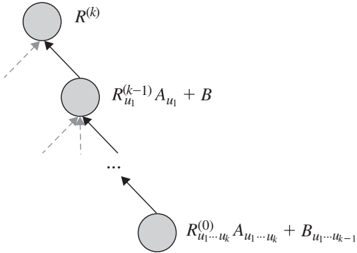
- The paper models personalized PageRank as a distributional fixed-point equation of the form \(R \overset{d}{=} \sum_{i=1}^N A_i R_i + B\), with \(N\) for in-degree and \(B\) for user preference/teleportation; it also analyzes the PageRank iteration via a Galton–Watson tree representation.
- Tail asymptotics are derived using regular variation, Laplace–Stieltjes transform analysis, and a Tauberian theorem; the authors also analyze finite iterations and then pass to the limit.
- Numerical experiments use the Stanford Web data set (\(281{,}903\) pages, \(2{,}312{,}497\) links) and matrix power iteration to compute personalized PageRank under different teleportation power laws.
## Limitations
- The paper states that the assumption of a branching structure for the Web “is probably not justified.”
- The authors note that the model/data differences depend on many factors, “in particular, on the choice of data set,” and that this affects the fit.
- Evident from the text: several derivations require strong assumptions such as heavy-tailed regular variation, moment conditions, and noninteger \(\alpha=\min(\alpha_N,\alpha_B)>1\) in the Laplace-transform analysis.
Model-written summary. Check it against the paper before relying on it.
Integrity signals
Registry
Cites
Statistics
Figures
Verification
Claims the paper makes
2 Valid · 2 Not valid · 9 Not checked · 48 Own results and interpretations
The cited sources that could be checked couldn’t confirm or dispute this claim.
In the paper
“Moreover, since the corresponding moments of X and N always exist together [26], we use only moments of X”
What the sources say
- Could not verifycites [26] [26] Litvak, N., Scheinhardt, W. R. W. and Volkovich, Y. (2007). In-degree and PageRank: why do they follow similar power laws? Internet Math. 4, 175-198. - sourceExperimental — accuracy not yet measured
Our full-text copy of Avrachenkov, Litvak & Pham (2007) concerns the PageRank mass of the bow-tie components (IN+SCC, Pure OUT, ESCC) as a function of the damping factor c, via singular perturbation theory (Sections 3-5, pp. 3-10; Appendix A.1-A.2, pp. 12-14). No passage discusses moments of random variables X or N, or the joint existence of their moments; searches for 'moments exist', 'moment of in-degree distribution E[X]', and 'random variables X and N' returned only the component-mass and perturbation-lemma passages. The closest the paper comes is a remark (Section 4, p. 5) that 'the PageRank of pages in IN+SCC with many incoming links will increase as c increases from zero', which says nothing about moment existence. The copy is not truncated, so the claim simply is not in this paper. (LLM, conf=0.70)
plainstates an association- Asserted: passes — The authors put it forward as true.
- Checkable: passes — It can be checked against evidence.
- Load-bearing: passes — The paper’s conclusions depend on it.
- Based: passes — The paper gives a reason why it holds.
- Could not verify
Every source the paper cites for this claim was checked and supports it.
In the paper
“Note that the constant in (5.1) is the same as the predicted constant from [37], where we assumed that the out-degree is random and the teleportation is uniform.”
What the sources say
- Supportedcites [37] [37] Volkovich, Y., Litvak, N. and Donato, D. (2007). Determining factors behind the PageRank log-log plot. In Algorithms and Models for the Web-Graph (Lecture Notes Comput. Sci. 4863 ), Springer, Berlin, pp. 108-123. - source
Section 5 (Analytical Results) of Volkovich, Litvak & Donato (2007) states the predicted constant explicitly: C = lim k→∞ C_k = c^α(1−p0)^α / (d^α(1−c^α b)), with b = Σ p_j j^{α−1} depending on the out-degree distribution, and Section 6 uses it to predict the log-log intercepts (e.g. log10(C) giving y = −1.17x−1.73 etc.). The two qualifiers the citing sentence attributes are also in our copy: Section 3.2 says they make 'a step further allowing for random out-degrees', modelling D as i.i.d. random variables with arbitrary distribution, and Section 7 (Discussion) lists the simplifying assumptions as 'independence of certain parameters and uniform teleportation'. Whether the citing paper's own (5.1) matches that constant is the citing authors' computation, not attributed content; the identification of [37] as the source of the predicted constant under random out-degree and uniform teleportation is supported. (LLM, conf=0.90)
plain- Asserted: passes — The authors put it forward as true.
- Checkable: passes — It can be checked against evidence.
- Load-bearing: unclear — It is unclear whether the paper’s conclusions depend on it.
- Based: passes — The paper gives a reason why it holds.
- Supported
The cited sources support only part of this claim — read each source’s verdict below.
In the paper
“Note that the asymptotic equivalence P (R > x) ∼ C ′ N P (N > x) as x → ∞ holds if we assume that the values of the PageRank R can be approximated by cN E ( 1 /D) , as proposed in [14].”
What the sources say
- Partly supportedcites [14] [14] Fortunato, S., Boguñá, M., Flammini, A. and Menczer, F. (2006). Approximating PageRank from indegree. In Algorithms and Models for the Web-Graph (Lecture Notes Comput. Sci. 4936 ), Springer, Berlin, pp. 59-71. - sourceExperimental — accuracy not yet measured
Our copy of Jessen et al. (2006) is a pure survey on regular variation: Section 4.1 (One-dimensional results) states the generic tail equivalence P(X1X2 > x) ~ E(X2^alpha) P(X1 > x) (eq. 4.3, Breiman's lemma) and Lemma 4.1(4) for products, and Section 2 gives the scaling relation P(|X| > x t)/P(|X| > x) -> t^-alpha (eq. 2.2) — the abstract machinery behind a constant-times-N tail equivalence of the form claimed. However, no passage in our copy mentions PageRank, the number of nodes N, in-degree D, or the approximation R ~ cN E(1/D) that the citing sentence credits to this source (searched: 'PageRank', 'web graph', 'in-degree', 'number of pages'); that proposal, and hence the conditional trigger of the equivalence, is not in it. So only the general regular-variation form is supported, not the PageRank instantiation attributed here. (LLM, conf=0.65)
plainstates an association- Asserted: passes — The authors put it forward as true.
- Checkable: passes — It can be checked against evidence.
- Load-bearing: unclear — It is unclear whether the paper’s conclusions depend on it.
- Based: passes — The paper gives a reason why it holds.
- Rests on an assumption not shown here.
- Partly supported
A result the paper states — it cites no source for it, so there is none to check. The quote shows it is in the paper.
In the paper
“Lemma 4.1. If ξ n < ∞ and βm < ∞ for some integers m,n ≥ 1 , and E (X j B k + 1 -j ) < ∞ for all 0 < j < k + 1 , where k = min (m, n) , then ρk < ∞ .”
plainstates a cause- Asserted: passes — The authors put it forward as true.
- Checkable: passes — It can be checked against evidence.
- Load-bearing: passes — The paper’s conclusions depend on it.
- Based: passes — The paper gives a reason why it holds.
- Rests on 4 assumptions not shown here.
A result the paper states — it cites no source for it, so there is none to check. The quote shows it is in the paper.
In the paper
“Theorem 3.2. (i) If P (B > x) = o( P (N > x)) and P (R ( 0 ) > x) = o( P (N > x)) , then, for all k ≥ 1 ,”
plainstates a cause- Asserted: passes — The authors put it forward as true.
- Checkable: passes — It can be checked against evidence.
- Load-bearing: passes — The paper’s conclusions depend on it.
- Based: passes — The paper gives a reason why it holds.
25 more claims
Create a free account to see all 61 claims and to verify the 7 references still open.
- Probably not a substantial claim. 17
- It may state two separate claims as one. 14
- The quote only partly states this claim. 1
Citations
Cites
Emergence of Scaling in Random Networks
Barabási, A.-L., & Albert, R. (1999) · Science · doi:10.1126/science.286.5439.509 · Cited by 36,135
The anatomy of a large-scale hypertextual Web search engine
Brin, S., & Page, L. (1998) · Computer Networks and ISDN Systems · doi:10.1016/s0169-7552(98)00110-x · Cited by 16,004 · cited 1×
“In the end of 90 ′ s Brin and Page with PageRank [23] and Kleinberg with HITS [16] proposed to use hyperlink analysis for measuring importance of pages in Web search.”
Method(1999) · Cited by 12,854
Authoritative sources in a hyperlinked environment
Kleinberg, J. M. (1999) · Journal of the ACM · doi:10.1145/324133.324140 · Cited by 8,959
Broder, A., Kumar, R., Maghoul, F., Raghavan, P., Rajagopalan, S., Stata, R., Tomkins, A., & Wiener, J. (2000) · Computer Networks · doi:10.1016/s1389-1286(00)00083-9 · Cited by 2,810 · cited 1×
“1 for the in-degree and PageRank, and α ≈ 2 for the out-degree [9], [32], [38].”
BackgroundA Language Modeling Approach to Information Retrieval
Ponte, J. M., & Croft, W. B. (2017) · ACM SIGIR Forum · doi:10.1145/3130348.3130368 · Cited by 2,503
A language modeling approach to information retrieval
Ponte, J. M., & Croft, W. B. (1998) · Proceedings of the 21st annual international ACM SIGIR conference on Research and development in information retrieval · doi:10.1145/290941.291008 · Cited by 1,821
Authoritative sources in a hyperlinked environment
Kleinberg, J. M. (1998) · Symposium on Discrete Algorithms · doi:10.5555/314613.315045 · Cited by 1,814
Haveliwala, T. H. (2002) · Proceedings of the 11th international conference on World Wide Web · doi:10.1145/511446.511513 · Cited by 1,567
Google's PageRank and Beyond: The Science of Search Engine Rankings
Langville, A. N., & Meyer, C. D. (2006) · Cited by 1,204
Research works printed but not linked: 3
- [21] Kamvar, S. D., Haveliwala, T. H., Manning, C. D. and Golub, G. H. (2003). Exploiting the block structure of the Web for computing. Tech. Rep., Stanford University. -
- [6] Bingham, N. H., Goldie, C. M. and Teugels, J. L. (1989). Regular Variation . Cambridge University Press. -
- 10.1017/s0001867800008090 · doi:10.1017/s0001867800008090
Cited by
Information ranking and power laws on trees
Jelenković, P. R., & Olvera‐Cravioto, M. (2010) · Advances in Applied Probability · doi:10.1239/aap/1293113151 · Cited by 59
Implicit Renewal Theory and Power Tails on Trees
Jelenković, P. R., & Olvera‐Cravioto, M. (2012) · Advances in Applied Probability · doi:10.1239/aap/1339878723 · Cited by 44
“Google’s PageRank algorithm [19], [27], in this section we apply the implicit renewal theory for trees developed in the previous section to the linear recursion”
MethodLocal weak convergence for PageRank
Garavaglia, A., van der Hofstad, R., & Litvak, N. (2020) · The Annals of Applied Probability · doi:10.1214/19-aap1494 · Cited by 62
“The literature [20, 43, 45, 52] usually studies the following graph-normalized equation: where (A i ) i ∈[ n ] and (B i ) i ∈[ n ] are values assigned to the vertices in the graph.”
BackgroundSelf-citationImplicit renewal theorem for trees with general weights
Jelenković, P. R., & Olvera‐Cravioto, M. (2012) · Stochastic Processes and their Applications · doi:10.1016/j.spa.2012.05.004 · Cited by 37
Asymptotics for Weighted Random Sums
Olvera‐Cravioto, M. (2012) · Advances in Applied Probability · doi:10.1239/aap/1354716592 · Cited by 39
“weights {Ci} independent of N , was introduced in [20], and has been studied in detail in [13].”
BackgroundFixed points of inhomogeneous smoothing transforms
Alsmeyer, G., & Meiners, M. (2011) · The Journal of Difference Equations and Applications · doi:10.1080/10236198.2011.589514 · Cited by 26
“Jelenković [13] and Volkovich [20] studied (1) under more restrictive assumptions on the sequence ðC; T1; T2; . . . Þ, whereas [12] deals with (1) in essentially the same generality as here.”
BackgroundMethodInfluentialPageRank in Scale-Free Random Graphs
Chen, N., Litvak, N., & Olvera‐Cravioto, M. (2014) · Lecture notes in computer science · doi:10.1007/978-3-319-13123-8_10 · Cited by 32
“[14, 19, 18] suggested an analytical explanation for the power law behavior of PageRank by comparing it to the endogenous solution of a stochastic fixed point equation (SFPE).”
BackgroundSelf-citationDistribution of centrality measures on undirected random networks via the cavity method
Bartolucci, S., Caccioli, F., Caravelli, F., & Vivo, P. (2024) · Proceedings of the National Academy of Sciences of the United States of America · doi:10.1073/pnas.2403682121 · Cited by 16
PageRank on inhomogeneous random digraphs
Lee, J., & Olvera‐Cravioto, M. (2019) · Stochastic Processes and their Applications · doi:10.1016/j.spa.2019.07.002 · Cited by 30
“Its typical behavior on scale-free directed complex networks has also been an important research topic, since abundant empirical evidence suggests that the distribution of the ranks produced by PageRank follows a power-law distribution with the same tail index as the in-degree distribution [28, 2, 23, 34, 35, 20].”
BackgroundResultJelenković, P. R., & Olvera‐Cravioto, M. (2014) · Stochastic Processes and their Applications · doi:10.1016/j.spa.2014.09.004 · Cited by 17
“Quicksort [10]; the analysis of the PageRank algorithm [20, 13]; and kinetic gas theory [8].”
MethodAsymptotics for randomly weighted and stopped dependent sums
Yang, Y., Leipus, R., & Šiaulys, J. (2015) · Stochastics · doi:10.1080/17442508.2015.1052812 · Cited by 17
Linear stochastic equations in the critical case
Buraczewski, D., & Kolesko, K. (2013) · The Journal of Difference Equations and Applications · doi:10.1080/10236198.2013.822494 · Cited by 17
“This equation has gained importance in the last few years since it turns out to be closely related to important objects in computer science: the Quicksort algorithm [27,29] (and other divide and conquer algorithms), the Pagerank algorithm [22,23,31] (being in the heart of the Google engine) and in stochastic geometry…”
MethodFixed points of multivariate smoothing transforms with scalar weightsPreprint
Iksanov, A., & Meiners, M. (2014) · arXiv (Cornell University) · doi:10.48550/arxiv.1402.4147 · Cited by 12
“1) in various applications such as interacting particle systems [26], branching random walks [15, 18], analysis of algorithms [45, 49, 52], and kinetic gas theory [13], there is a large body of papers dealing with it in different settings.”
BackgroundPrecise tail asymptotics of fixed points of the smoothing transform with general weights
Buraczewski, D., Damek, E., & Zienkiewicz, J. (2015) · Bernoulli · doi:10.3150/13-bej576 · Cited by 14
“It appears for example, in the stochastic analysis of the Pagerank algorithm (which is the heart of the Google engine) [13, 14, 18] as well as in the analysis of a large class of divide and conquer algorithms including the Quicksort algorithm [16, 17].”
MethodMean Field Analysis of Personalized PageRank with Implications for Local Graph Clustering
Avrachenkov, K. E., Kadavankandy, A., & Litvak, N. (2018) · Journal of Statistical Physics · doi:10.1007/s10955-018-2099-5 · Cited by 13
Self-citationTail behavior of solutions of linear recursions on trees
Olvera‐Cravioto, M. (2012) · Stochastic Processes and their Applications · doi:10.1016/j.spa.2012.01.003 · Cited by 11
PageRank asymptotics on directed preferential attachment networks
Banerjee, S., & Olvera‐Cravioto, M. (2022) · The Annals of Applied Probability · doi:10.1214/21-aap1757 · Cited by 22
“…in many real-world networks, has been proven to be true for directed random graphs that are generated via either a directed configuration model [15, 36] or an inhomogeneous random digraph [32, 36], and is based on the asymptotic analysis of the local weak limit of the underlying graphs [42, 29, 35].”
BackgroundInformation ranking and power laws on trees
Jelenković, P. R., & Olvera‐Cravioto, M. (2010) · Advances in Applied Probability · doi:10.1017/s0001867800004523 · Cited by 53
Maxima and sums of non-stationary random length sequences
Markovich, N. M., & Rodionov, I. V. (2020) · Extremes · doi:10.1007/s10687-020-00372-5 · Cited by 15
PageRank’s behavior under degree correlations
Olvera‐Cravioto, M. (2021) · The Annals of Applied Probability · doi:10.1214/20-aap1623 · Cited by 22
“The aim of this work, as well as of much of the earlier work on the distribution of the ranks produced by PageRank [15, 29, 32, 33, 42, 43], is to provide some mathematical interpretation to what PageRank is actually ranking highly, and how this is related to the underlying graph where it is being…”
BackgroundMethodInfluentialNonparametric Analysis of Extremes on Web Graphs: PageRank Versus Max-Linear Model
Markovich, N. M., Рыжов, М. С., & Krieger, U. R. (2017) · Communications in computer and information science · doi:10.1007/978-3-319-66836-9_2 · Cited by 12
PageRank in Undirected Random Graphs
Avrachenkov, K. E., Kadavankandy, A., Prokhorenkova, L. O., & Raigorodskii, A. M. (2015) · Lecture notes in computer science · doi:10.1007/978-3-319-26784-5_12 · Cited by 21
“According to several studies [18,20,29,36], PageRank and in-degree are strongly correlated in directed networks such as the Web graph.”
BackgroundAsmussen, S., & Foss, S. (2018) · Advances in Applied Probability · doi:10.1017/apr.2018.69 · Cited by 10
“Part (ii) generalizes and unifies results of [20] and [27] in several ways.”
BackgroundResultInfluentialOn some tractable growth-collapse processes with renewal collapse epochs
Boxma, O., Kella, O., & Perry, D. (2011) · Journal of Applied Probability · doi:10.1239/jap/1318940467 · Cited by 10
Implicit Renewal Theory and Power Tails on Trees
Jelenković, P. R., & Olvera‐Cravioto, M. (2012) · Advances in Applied Probability · doi:10.1017/s0001867800005711 · Cited by 10
Efficient Simulation for Branching Linear RecursionsPreprint
Chen, N., & Olvera‐Cravioto, M. (2015) · arXiv (Cornell University) · doi:10.48550/arxiv.1503.09150 · Cited by 10
“…recent analysis of information ranking algorithms on complex graphs (e.g., Google’s PageRank) [14, 7, 3] motivate the analysis of the stochastic fixed-point equation where ( Q, N, C 1 , C 2 , . . . ) is a real-valued random vector with N ∈ N , and { R i } i ∈ N is a sequence of i.i.d. copies of R…”
BackgroundYang, Y., Zhang, T., & Yuen, K. C. (2017) · Journal of Computational and Applied Mathematics · doi:10.1016/j.cam.2017.02.004 · Cited by 9
Rankings in directed configuration models with heavy tailed in-degrees
Cai, X. S., Caputo, P., Perarnau, G., & Quattropani, M. (2023) · The Annals of Applied Probability · doi:10.1214/23-aap1955 · Cited by 14
“A series of papers [38, 50, 51] proposed an idealized stochastic model proving that the power-law distributions of the in-degree and of the PageRank score of a uniformly random vertex I only differ by a multiplicative factor.”
BackgroundRanking algorithms on directed configuration networksPreprint
Chen, N., Litvak, N., & Olvera‐Cravioto, M. (2014) · arXiv (Cornell University) · doi:10.48550/arxiv.1409.7443 · Cited by 13
“The tail behavior of R is the main focus of the work in [40, 22, 24, 23, 30].”
BackgroundMethodInfluentialSelf-citationEfficient simulation for branching linear recursions
Chen, N., & Olvera‐Cravioto, M. (2015) · Winter Simulation Conference · doi:10.1109/wsc.2015.7408378 · Cited by 7
“…recent analysis of information ranking algorithms on complex graphs (e.g., Google’s PageRank) [14, 7, 3] motivate the analysis of the stochastic fixed-point equation where ( Q, N, C 1 , C 2 , . . . ) is a real-valued random vector with N ∈ N , and { R i } i ∈ N is a sequence of i.i.d. copies of R…”
BackgroundExtreme Value Statistics for Evolving Random Networks
Markovich, N. M., & Vaičiulis, M. (2023) · Mathematics · doi:10.3390/math11092171 · Cited by 12
Characterization of Tail Dependence for In-Degree and PageRank
Litvak, N., Scheinhardt, W., Volkovich, Y., & Zwart, B. (2009) · Lecture notes in computer science · doi:10.1007/978-3-540-95995-3_8 · Cited by 6
Self-citationImplicit Renewal Theorem for Trees with General WeightsPreprint
Jelenković, P. R., & Olvera‐Cravioto, M. (2010) · arXiv (Cornell University) · doi:10.48550/arxiv.1012.2165 · Cited by 6
PageRank's behavior under degree-degree correlationsPreprint
Olvera‐Cravioto, M. (2019) · arXiv (Cornell University) · doi:10.48550/arxiv.1909.09744 · Cited by 6
“This fact was first proved for trees in [42, 28], then for graphs generated via the directed configuration model (DCM) in [15], and more recently, for graphs generated via the inhomogeneous random digraph model (IRD) in [31].”
BackgroundInfluentialRegular variation of fixed points of the smoothing transform
Liang, X., & Liu, Q. (2019) · Stochastic Processes and their Applications · doi:10.1016/j.spa.2019.11.011 · Cited by 5
Coupling on weighted branching trees
Chen, N., & Olvera‐Cravioto, M. (2016) · Advances in Applied Probability · doi:10.1017/apr.2016.12 · Cited by 6
“Although convergence to the (unique) endogenous solution to (1) for nonnegative weights has been previously studied in the context of the analysis of divideand-conquer algorithms using the Wasserstein distance of order 2 (see [19], [21], and [22]), recent applications to the analysis of information ranking algorithms…”
MethodA Structural Result for Personalized PageRank and its Algorithmic Consequences
Vial, D., & Subramanian, V. (2019) · ACM SIGMETRICS International Conference on Measurement and Modeling of Computer Systems (SIGMETRICS) · doi:10.1145/3309697.3331481 · Cited by 4
On preemptive-repeat LIFO queues
Asmussen, S., & Glynn, P. W. (2017) · Queueing Systems · doi:10.1007/s11134-017-9532-3 · Cited by 7
“1) in its general form as a recursion leads to branching tree considerations similar, for example to those studied, in [28].”
BackgroundStochastic analysis of web page ranking
Volkovich, Y. (2009) · doi:10.3990/1.9789036528238 · Cited by 5
“First and foremost, I would like to thank Nelly Litvak who not only is a great advisor but also a great friend.”
BackgroundMethodInfluentialSelf-citationStochastic recursions on directed random graphs
Fraiman, N., Lin, T.-C., & Olvera‐Cravioto, M. (2022) · Stochastic Processes and their Applications · doi:10.1016/j.spa.2022.10.007 · Cited by 12
“Its convergence on random graphs to the special endogenous solution of a smoothing transform has been established in [17, 47, 51], and this characterization has been used to prove the so-called “power-law hypothesis” in [59, 41, 50, 35].”
MethodExtremal properties of evolving networks: local dependence and heavy tails
Markovich, N. M. (2023) · Annals of Operations Research · doi:10.1007/s10479-023-05175-y · Cited by 7
“To obtain regularly varying PRs, one can consider nodes with PRs in (7) as roots of classical branching trees whose leafs have PRs equal to 1 as in Chen et al. (2014a,b), Volkovich and Litvak (2010).”
InfluentialConvergence of the population dynamics algorithm in the Wasserstein metric
Olvera‐Cravioto, M. (2019) · Electronic Journal of Probability · doi:10.1214/19-ejp315 · Cited by 4
“For the PageRank algorithm studied in [34, 21, 10] we have {Ci}1≤i≤N i.”
MethodStatistical Clustering of a Random Network by Extremal Properties
Markovich, N. M., Рыжов, М. С., & Krieger, U. R. (2018) · Lecture notes in computer science · doi:10.1007/978-3-319-99447-5_7 · Cited by 4
Ranking Algorithms on Directed Configuration Networks
Chen, N. (2015) · University of Twente Research Information · doi:10.7916/d8j38rx8 · Cited by 5
“The tail behavior of R is the main focus of the work in [40, 22, 24, 23, 30].”
BackgroundMethodInfluentialRandomly Stopped Sums, Minima and Maxima for Heavy-Tailed and Light-Tailed Distributions
Leipus, R., Šiaulys, J., Даниленко, С. В., et al. (2024) · Axioms · doi:10.3390/axioms13060355 · Cited by 3
Tail Index Estimation of PageRanks in Evolving Random Graphs
Markovich, N. M., Рыжов, М. С., & Vaičiulis, M. (2022) · Mathematics · doi:10.3390/math10163026 · Cited by 3
Analysis of Clusters in Network Graphs for Personalized Web Search
Markovich, N. M. (2017) · IFAC-PapersOnLine · doi:10.1016/j.ifacol.2017.08.442 · Cited by 3
Extremes of Sums and Maxima with Application to Random NetworksPreprint
Markovich, N. M. (2021) · arXiv (Cornell University) · doi:10.48550/arxiv.2110.04120 · Cited by 3
Extremes Control of Complex Systems With Applications to Social Networks
Markovich, N. M. (2015) · IFAC-PapersOnLine · doi:10.1016/j.ifacol.2015.06.264 · Cited by 2
A Class of Semiparametric Tail Index Estimators and Its Applications
Vaičiulis, M., & Markovich, N. M. (2019) · Automation and Remote Control · doi:10.1134/s0005117919100035 · Cited by 2
Power Laws on Weighted Branching Trees
Jelenković, P. R., & Olvera‐Cravioto, M. (2013) · Springer proceedings in mathematics & statistics · doi:10.1007/978-3-642-38806-4_8 · Cited by 2
“4 in [47] (for (Q,N) independent of {Ci}, {Ci} iid, E[Q] < 1 and E[C] = (1−E[Q])/E[N]).”
BackgroundMethodResultInfluentialA Structural Result for Personalized PageRank and its Algorithmic Consequences
Vial, D., & Subramanian, V. (2019) · Proceedings of the ACM on Measurement and Analysis of Computing Systems · doi:10.1145/3341617.3326140 · Cited by 4
“On the other hand, [21] was preceded by [20], where the power law hypothesis was established for global PageRank; further back, the hypothesis was studied under more restrictive assumptions in [38, 48, 49].”
BackgroundExtremes in Random Graphs Models of Complex NetworksPreprint
Markovich, N. M. (2017) · arXiv (Cornell University) · doi:10.48550/arxiv.1704.01302 · Cited by 2
“The assumptions of both Theorem 4 and the statements in [5] and [14] do not reflect properly the complicated dependence between node ranks due to the entanglement of links in a real network.”
BackgroundCoupling on weighted branching treesPreprint
Chen, N., & Olvera‐Cravioto, M. (2014) · arXiv (Cornell University) · doi:10.48550/arxiv.1410.1050 · Cited by 2
“Although convergence to the (unique) endogenous solution to (1) for nonnegative weights has been previously studied in the context of the analysis of divideand-conquer algorithms using the Wasserstein distance of order 2 (see [19], [21], and [22]), recent applications to the analysis of information ranking algorithms…”
MethodRegularity of a randomly stopped sum determines regularity of the stopping moment
Šiaulys, J., Elijio, A., Leipus, R., et al. (2025) · Lithuanian Mathematical Journal · doi:10.1007/s10986-025-09685-z · Cited by 1
Statistical Analysis of the End-to-End Delay of Packet Transfers in a Peer-to-Peer Network
Markovich, N. M., & Krieger, U. R. (2020) · Lecture notes in computer science · doi:10.1007/978-3-030-66471-8_22 · Cited by 1
Extremal independence in discrete random systems
Isaev, M., Rodionov, I. V., Zhang, R.-R., et al. (2024) · Annales de l Institut Henri Poincaré Probabilités et Statistiques · doi:10.1214/23-aihp1402 · Cited by 1
“Similar lack of mathematically rigorous justification occurs in several papers on ranking web pages [27, 46].”
Linear stochastic equations in the critical casePreprint
Buraczewski, D., & Kolesko, K. (2012) · arXiv (Cornell University) · doi:10.48550/arxiv.1210.7732
“This equation has gained importance in the last few years since it turns out to be closely related to important objects in computer science: the Quicksort algorithm [27,29] (and other divide and conquer algorithms), the Pagerank algorithm [22,23,31] (being in the heart of the Google engine) and in stochastic geometry…”
MethodMaximums on TreesPreprint
Jelenković, P. R., & Olvera‐Cravioto, M. (2014) · arXiv (Cornell University)
Tail behavior of solutions of linear recursions on treesPreprint
Olvera‐Cravioto, M. (2011) · arXiv (Cornell University) · doi:10.48550/arxiv.1108.3809
Random Graph Node Classification by Extremal Index of PageRank
Markovich, N. M., & Рыжов, М. С. (2019) · Communications in computer and information science · doi:10.1007/978-3-030-36625-4_34
Estimation of the Tail Index of PageRanks in Random Graphs
Markovich, N. M., & Рыжов, М. С. (2022) · Lecture notes in computer science · doi:10.1007/978-3-031-23207-7_7
Tail asymptotics and precise large deviations for some Poisson cluster processes
Baeriswyl, F., Chavez‐Demoulin, V., & Wintenberger, O. (2024) · Advances in Applied Probability · doi:10.1017/apr.2024.32 · Cited by 1
“In the Google PageRank literature, one should also mention [58] for similar results.”
BackgroundResultMarkovich, N. M., & Рыжов, М. С. (2025) · Lecture notes in computer science · doi:10.1007/978-3-031-80853-1_20
Weighted maxima and sums of non-stationary random-length sequences in heavy-tailed models
Markovich, N. M. (2025) · Journal of Applied Probability · doi:10.1017/jpr.2024.118
Metadata
- Authors
- Volkovich, Y., & Litvak, N.
- Affiliations
- University of Twente (NL)
- Corresponding author
- Volkovich, Yana
- Litvak, Nelly
- Venue
- Advances in Applied Probability
- Publisher
- Cambridge University Press (CUP)
- Published
- 2010-06
- Volume
- 42
- Issue
- 2
- Pages
- 577-604
- ISSN
- 0001-8678 (ISSN-L)
- 1475-6064
- OpenAlex
- W2109819452
- Semantic Scholar
- 32ae967679ec6b37c7ba896b7882c14b5573f140
- Cited by
- 69
- References
- 46
- Citations by year
- 2026: 1 · 2025: 3 · 2024: 4 · 2023: 3 · 2022: 5 · 2021: 2 · 2020: 3 · 2019: 8 · 2018: 3 · 2017: 5 · 2016: 2 · 2015: 7 · 2014: 5 · 2013: 2 · 2012: 7
- FWCI
- 14.35
- Type
- journal article
- Language
- en
- Open access
- bronze
- doi.org
- Locations
- Advances in Applied Probability (publishedVersion)
- University of Twente Research Information (publishedVersion)
- Project Euclid (Cornell University) (submittedVersion)
- University of Twente Research Information (submittedVersion, other-oa)
- University of Twente Research Information (submittedVersion)
- Funders
- Nederlandse Organisatie voor Wetenschappelijk Onderzoek
- Topics
- Physical Sciences › Computer Science › Information Systems › Information Retrieval and Search Behavior
- Physical Sciences › Physics and Astronomy › Statistical and Nonlinear Physics › Complex Network Analysis Techniques
- Social Sciences › Decision Sciences › Management Science and Operations Research › Probability and Risk Models
- Keywords
- personalized PageRank, web search, heavy-tailed distributions, power-law networks, regular variation, stochastic equations, user preferences, complex networks
About these checks
Registry, retraction, Cites and statistics results are computed, not judged, with one exception: a printed reference that no index lists is read once by a model before it counts as a citation error. Claims are extracted by a model and kept only when their quote appears verbatim in the text; each cited source is then checked, with a model’s help, for whether it says what the claim relies on. Those verdicts can be wrong — read the claim’s quote and the cited source before relying on one.
The claim verdicts this report counts are experimental: their accuracy is not yet measured.
A language model drew the claims from the paper on 2026-10-10, under version 3 of the claim definition (model deepseek-v4.1-flash, prompt extract-v3).
A second model labelled each claim on 2026-10-10 (model jev-1.13-20260917, definition revision gold-guideline-v0.2).
Cited sources are checked with a language model’s help (qwen3.8-omni-flash).
Statistics and arithmetic are recomputed, not judged.
Confidence bands are shown only for fields calibrated on our annotated test set. None is calibrated yet, so no band is shown.
What counts as a claim ›How we measure confidence ›How we check this ›
Are you an author, or do you see a problem with this page? Request a review
Data sources
Bibliographic data: Semantic Scholar, OpenAlex, Crossref.
Contains information from the Semantic Scholar Academic Graph Datasets, made available under the ODC Attribution License (ODC-BY 1.0).
Semantic Scholar’s data is described in: Kinney, R., et al. (2023). The Semantic Scholar Open Data Platform. arXiv:2301.10140.
