

The DOI matches its Crossref record; 1 of the 1 references it cites were found in a registry or an index.
A high-lipid diet leads to greater pathology and lower tolerance during infection
Open accessPublished version of a preprint
Abstract
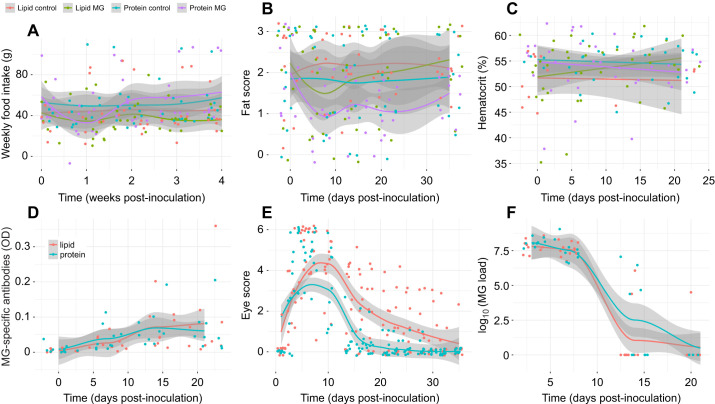
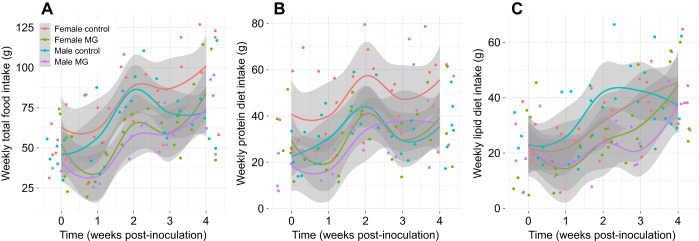
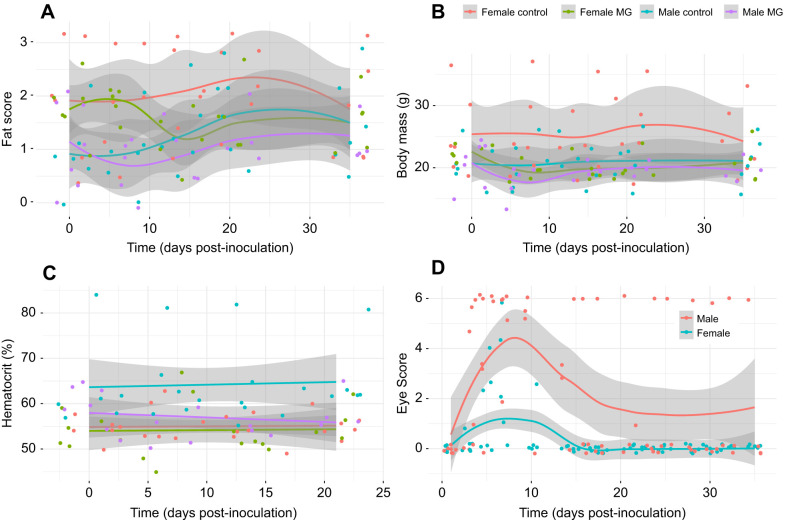
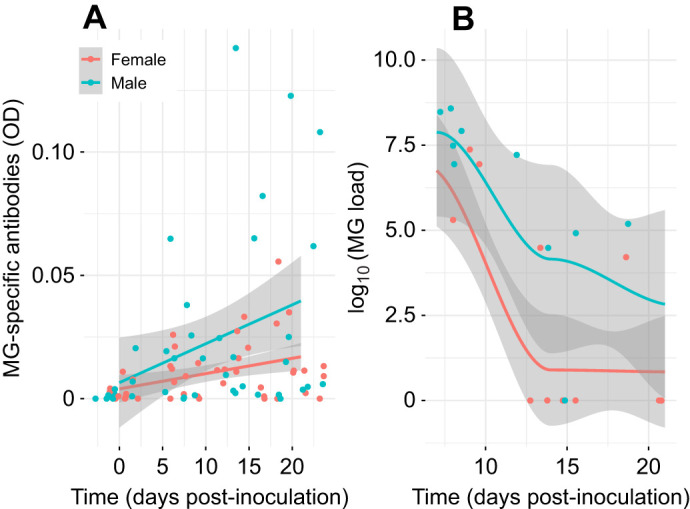
Altered food landscapes contribute importantly to wildlife disease dynamics and may play a critical role in host heterogeneity in disease outcomes through changes in host diet composition. We explored the effects of dietary macronutrient composition on disease pathology and feeding behavior of canaries (Serinus canaria domestica) infected with Mycoplasma gallisepticum (MG). In the first experiment, we provided canaries with isocaloric diets composed of identical ingredients that varied in macronutrient content (high protein or high lipid) then MG- or sham-inoculated birds. In the second experiment, we offered both diets to canaries before and after MG or sham inoculation. In experiment one, high-protein diet birds consumed more food than high-lipid diet birds and experienced a more pronounced decrease in food intake after infection. High-protein diet birds were more tolerant to MG infection, exhibiting reduced pathology when compared with high-lipid diet birds, despite the two treatments having similar levels of MG-specific antibodies and MG loads. When birds had access to both diets, they consumed more of the high-protein diet and experienced pathology for less time than lipid- or protein-restricted birds. These results highlight that macronutrient makeup of the diet can shape vertebrate host tolerance and pathology, which has direct implications for host–pathogen transmission dynamics.
Overview
The claims and statistics of this paper haven’t been checked yet.
Run the check — free, no account needed. It reads the open-access text and checks the sources it cites.
Integrity signals
Registry
Cites
Statistics
Figures
Verification
Claims the paper makes
The claims and statistics of this paper haven’t been checked yet.
Run the check — free, no account needed. It reads the open-access text and checks the sources it cites.
Self-check
Percentages, sums and reported differences re-computed from the paper’s own numbers.
The self-check needs the paper’s full text.
Citations
Cites
Iron in infection and immunity
Cassat, J. E., & Skaar, E. P. (2013) · Cell Host & Microbe · doi:10.1016/j.chom.2013.04.010 · Cited by 1,214
Research works printed but not linked: 60
- Adamo, 2006, Comparative psychoneuroimmunology: evidence from the insects, Behav. Cognit. Neurosci. Rev., 5, 128, 10.1177/1534582306289580 · DOI
- Adamo, 2008, Competition between immune function and lipid transport for the protein apolipophorin III leads to stress-induced immunosuppression in crickets, J. Exp. Biol., 211, 531, 10.1242/jeb.013136 · DOI
- Adelman, 2009, Vertebrate sickness behaviors: adaptive and integrated neuroendocrine immune responses, Integr. Comp. Biol., 49, 202, 10.1093/icb/icp028 · DOI
- Adelman, 2013, Deposition of pathogenic Mycoplasma gallisepticum onto bird feeders: host pathology is more important than temperature-driven increases in food intake, Biol. Lett., 9, 20130594, 10.1098/rsbl.2013.0594 · DOI
- Amar, 2007, Diet-induced obesity in mice causes changes in immune responses and bone loss manifested by bacterial challenge, Proc. Natl. Acad. Sci. USA, 104, 20466, 10.1073/pnas.0710335105 · DOI
- Barlein, 1990, Nutrition and food selection in migratory birds, 1998, 10.1007/978-3-642-74542-3_14 · DOI
- Becker, 2018, Anthropogenic resource subsidies and host-parasite dynamics in wildlife, Philos. Trans. R. Soc. B, 373, 20170086, 10.1098/rstb.2017.0086 · DOI
- Behm, 2000, The role of eosinophils in parasitic helminth infections: insights from genetically modified mice, Parasitol. Today., 16, 202, 10.1016/S0169-4758(99)01620-8 · DOI
- Bellrose, 1994, Ecology and Management of the Wood Duck
- Bouwman, 2010, Sickness behavior acting as an evolutionary trap? Male house finches preferentially feed near diseased conspecifics, Biol. Lett., 6, 462, 10.1098/rsbl.2010.0020 · DOI
- Coogan, 2018, Multidimensional nutritional ecology and urban birds, Ecosphere, 9, e02177, 10.1002/ecs2.2177 · DOI
- Cornet, 2014, Impact of host nutritional status on infection dynamics and parasite virulence in a bird malaria system, J. Anim. Ecol., 83, 256, 10.1111/1365-2656.12113 · DOI
- Cotter, 2011, Macronutrient balance mediates trade-offs between immune function and life history traits, Funct. Ecol., 25, 186, 10.1111/j.1365-2435.2010.01766.x · DOI
- Cressler, 2014, Disentangling the interaction among host resources, the immune system and pathogens, Ecol. Lett., 17, 284, 10.1111/ele.12229 · DOI
- Cunningham-Rundles, 2005, Mechanisms of nutrient modulation of the immune response, J. Allergy Clin. Immunol., 115, 1119, 10.1016/j.jaci.2005.04.036 · DOI
- Dhondt, 2007, Experimental evidence for transmission of Mycoplasma gallisepticum in house finches by fomites, Avian Pathol., 36, 205, 10.1080/03079450701286277 · DOI
- Dhondt, 2008, Comparative infectiousness of three passerine bird species after experimental inoculation with Mycoplasma gallisepticum, Avian Pathol., 37, 635, 10.1080/03079450802499100 · DOI
- Dinarello, 1997, Role of pro-and anti-inflammatory cytokines during inflammation: experimental and clinical findings, J. Biol. Regul. Homeostat. Agents, 11, 91
- Friedman, 1995, Effect of dietary fatty acids on antibody production and fatty acid composition of lymphoid organs in broiler chicks, Poult. Sci., 74, 1463, 10.3382/ps.0741463 · DOI
- Gomes, 2023, High-fat diet increases mortality and intensifies immunometabolic changes in septic mice, J. Nutr. Biochem., 116, 109315, 10.1016/j.jnutbio.2023.109315 · DOI
- Graham, 2005, Evolutionary causes and consequences of immunopathology, Annu. Rev. Ecol. Evol. Systemat., 36, 373, 10.1146/annurev.ecolsys.36.102003.152622 · DOI
- Grieger, 1978, Fever and survival: the role of serum iron, J. Physiol., 279, 187, 10.1113/jphysiol.1978.sp012339 · DOI
- Grodio, 2008, Detection and quantification of Mycoplasma gallisepticum genome load in conjunctival samples of experimentally infected house finches (Carpodacus mexicanus) using real-time polymerase chain reaction, Avian Pathol., 37, 385, 10.1080/03079450802216629 · DOI
- Hall, 2019, Modeling the effects of resource-driven immune defense on parasite transmission in heterogenoeous host populations, Integr. Comp. Biol., 59, 1253, 10.1093/icb/icz074 · DOI
- Hall, 2009, Resource ecology of virulence in a planktonic host-parasite system: an explanation using dynamic energy budgets, Am. Nat., 174, 149, 10.1086/600086 · DOI
- Hawley, 2011, Experimental infection of domestic canaries (Serinus canaria domestica) with Mycoplasma gallisepticum: a new model system for a wildlife disease, Avian Pathol., 40, 321, 10.1080/03079457.2011.571660 · DOI
- Hite, 2018, Resource-driven changes to host population stability alter the evolution of virulence and transmission, Philos. Trans. R. Soc. B, 373, 20170087, 10.1098/rstb.2017.0087 · DOI
- Hosseini, 2017, Does the impact of biodiversity differ between emerging and endemic pathogens? The need to separate the concepts of hazard and risk, Philos. Trans. R. Soc. B, 372, 20160129, 10.1098/rstb.2016.0129 · DOI
- Huffman, 1989, Observations on the illness and consumption of a possibly medicinal plant Vernonia amygdalina (del.), by a wild chimpanzee in the Mahale Mountains National Park, Tanzania, Primates, 30, 51, 10.1007/BF02381210 · DOI
- Hutchings, 2003, Can animals use foraging behaviour to combat parasites?, Proc. Nutr. Soc., 62, 361, 10.1079/PNS2003243 · DOI
- Jahanian, 2009, Immunological responses as affected by dietary protein and arginine concentrations in starting broiler chicks, Poult. Sci., 88, 1818, 10.3382/ps.2008-00386 · DOI
- Klasing, 1998, Comparative Avian Nutrition, 10.1079/9780851992198.0000 · DOI
- Klasing, 2007, Nutrition and the immune system, Brit. Poult. Sci., 48, 525, 10.1080/00071660701671336 · DOI
- Kluger, 1979, Fever and reduced iron: their interaction as a host defense response to bacterial infection, Science, 203, 374, 10.1126/science.760197 · DOI
- Koch, 2018, No evidence that carotenoid pigments boost either immune or antioxidant defenses in a songbird, Nat. Commun., 9, 491, 10.1038/s41467-018-02974-x · DOI · Paper page
- Kurihara, 1997, Defects in macrophage recruitment and host defense in mice lacking the CCR2 chemokine receptor, J. Exp. Med., 186, 1757, 10.1084/jem.186.10.1757 · DOI
- LeBien, 2008, B Lymphocytes: how they develop and function, Blood, 112, 1570, 10.1182/blood-2008-02-078071 · DOI
- Lee, 2008, Dietary protein–quality influences melanization and immune function in an insect, Funct. Ecol., 22, 1052, 10.1111/j.1365-2435.2008.01459.x · DOI
- Lin, 2020, Role of protein glycosylation in host-pathogen interaction, Cells, 9, 1022, 10.3390/cells9041022 · DOI
- Long, 2011, Consequences of immunopathology for pathogen virulence evolution and public health: malaria as a case study, Evol. Apps., 4, 278, 10.1111/j.1752-4571.2010.00178.x · DOI
- Love, 2021, Perception of infection: disease-related social cues influence immunity in songbirds, Biol. Lett., 17, 20210125, 10.1098/rsbl.2021.0125 · DOI
- Love, 2023, Simulated infection alters the behavior of pair bonded songbirds and their healthy neighbors, Behav. Ecol., 34, 251, 10.1093/beheco/arac120 · DOI
- Love, 2024, Effect of dietary macronutrients and immune challenge on gut microbiota, physiology and feeding behaviour in zebra finches, Mol. Ecol., 33, e17428, 10.1111/mec.17428 · DOI
- Macpherson, 2001, IgA responses in the intestinal mucosa against pathogenic and non-pathogenic microorganisms, Microbes Infect., 3, 1021, 10.1016/S1286-4579(01)01460-5 · DOI
- Murray, 1979, Anorexia of infection as a mechanism of host defense, Am. J. Clin. Nutr., 32, 593, 10.1093/ajcn/32.3.593 · DOI
- Murray, 2016, Wildlife health and supplemental feeding: a review and management recommendations, Biological Cons., 204, 163, 10.1016/j.biocon.2016.10.034 · DOI
- Napier, 2019, Western diet regulates immune status and the response to LPS-driven sepsis independent of diet-associated microbiome, Proc. Natl. Acad. Sci. USA, 116, 3688, 10.1073/pnas.1814273116 · DOI
- Newton, 1967, The adaptive radiation and feeding ecology of some British Finches, Ibis, 109, 1, 10.1111/j.1474-919X.1967.tb00005.x · DOI
- Nwaogu, 2020, A fruit diet rather than invertebrate diet maintains a robust innate immunity in an omnivorous tropical songbird, J. Anim. Ecol., 89, 867, 10.1111/1365-2656.13152 · DOI
- Peng, 2007, Amino acids and immune function, Brit. J. Nutr., 98, 237, 10.1017/S000711450769936X · DOI
- Pfenning-Butterworth, 2023, Natural variation in host feeding behaviors impacts host disease and pathogen transmission potential, Ecol. Evol., 13, e9865, 10.1002/ece3.9865 · DOI
- Pirola, 2017, Role of pro-and anti-inflammatory phenomena in the physiopathology of type 2 diabetes and obesity, World J. Biol. Chem., 8, 120, 10.4331/wjbc.v8.i2.120 · DOI
- Plowright, 2011, Urban habituation, ecological connectivity and epidemic dampening: the emergence of Hendra virus from flying foxes (Pteropus spp.), Proc. R. Soc. B., 278, 3703, 10.1098/rspb.2011.0522 · DOI
- Povey, 2009, Can the protein costs of bacterial resistance be offset by altered feeding behaviour?, J Anim. Ecol., 78, 437, 10.1111/j.1365-2656.2008.01499.x · DOI
- Povey, 2013, Dynamics of macronutrient self-medication and illness-induced anorexia in virally infected insects, J. Anim. Ecol., 83, 245, 10.1111/1365-2656.12127 · DOI
- Sauer, 2024, Male pathology regardless of behaviour drives transmission in an avian host–pathogen system, J. Anim. Ecol., 93, 36, 10.1111/1365-2656.14026 · DOI
- Sieksmeyer, 2022, Eating in a losing cause: limited benefit of modified macronutrient consumption following infection in the oriental cockroach Blatta orientalis, BMC Ecol. Evol., 22, 67, 10.1186/s12862-022-02007-8 · DOI
- Sorci, 2009, Inflammation and oxidative stress in vertebrate host-parasite systems, Philos. Trans. R. Soc. B, 364, 71, 10.1098/rstb.2008.0151 · DOI
- Tschirren, 2007, Host condition and host immunity affect parasite fitness in a bird-ectoparasite system, Funct. Ecol., 21, 372, 10.1111/j.1365-2435.2007.01235.x · DOI
- Unckless, 2015, The complex contributions of genetics and nutrition to immunity in Drosophila melanogaster, PLoS Genet., 11, e1005030, 10.1371/journal.pgen.1005030 · DOI
Metadata
- Authors
- Perrine, W. G., Sauer, E. L., Love, A. C., Morris, A., Novotny, J., & DuRant, S. E.
- Affiliations
- University of Arkansas at Fayetteville (US)
- University of Arkansas 1 Department of Biological Sciences , , Fayetteville, AR 72701 ,
- Corresponding author
- DuRant, Sarah E.
- Venue
- Journal of Experimental Biology
- Publisher
- The Company of Biologists
- Published
- 2025-03-01
- Volume
- 228
- Issue
- 5
- ISSN
- 0022-0949 (ISSN-L)
- 1477-9145
- PMC
- PMC11925396
- OpenAlex
- W4407039604
- Cited by
- 6
- References
- 1
- Citations by year
- 2026: 2 · 2025: 4
- FWCI
- 3.29
- Type
- journal article
- Language
- en
- Open access
- hybrid
- doi.org
- Licence
- Locations
- Journal of Experimental Biology (publishedVersion, cc-by)
- bioRxiv (Cold Spring Harbor Laboratory) (acceptedVersion)
- PubMed Central (publishedVersion, cc-by)
- PubMed (publishedVersion)
- Journal of the Arkansas Academy of Science (submittedVersion, cc-by)
- Funders
- National Science Foundation (1941861)
- Arkansas Biosciences Institute
- University of Arkansas
- Topics
- Life Sciences › Immunology and Microbiology › Microbiology › Microbial infections and disease research
- Life Sciences › Immunology and Microbiology › Parasitology › Bird parasitology and diseases
- Life Sciences › Agricultural and Biological Sciences › Ecology, Evolution, Behavior and Systematics › Animal Behavior and Reproduction
- Keywords
- Mycoplasma gallisepticum, canaries, high-fat diet, macronutrient composition, host tolerance, disease pathology, feeding behavior, dietary intake, wildlife disease, diet and immunity
- MeSH terms
- Animals, Animal Feed, Bird Diseases, Canaries, Diet, Dietary Fats, Feeding Behavior, Female, Male, Mycoplasma Infections, Mycoplasma gallisepticum, Diet, High-Fat
About these checks
Registry, retraction, Cites and statistics results are computed, not judged, with one exception: a printed reference that no index lists is read once by a model before it counts as a citation error. Claims are extracted by a model and kept only when their quote appears verbatim in the text; each cited source is then checked, with a model’s help, for whether it says what the claim relies on. Those verdicts can be wrong — read the claim’s quote and the cited source before relying on one.
Statistics and arithmetic are recomputed, not judged.
Confidence bands are shown only for fields calibrated on our annotated test set. None is calibrated yet, so no band is shown.
What counts as a claim ›How we measure confidence ›How we check this ›
Are you an author, or do you see a problem with this page? Request a review
How to cite
Cite CoChat for the checks on this page, and the paper for its own findings.
- This page
- CoChat. (2026). Citation check: A high-lipid diet leads to greater pathology and lower tolerance during infection. https://app.cochat.ai/papers/10.1242/jeb.249541
- The paper
- Perrine, W. G., Sauer, E. L., Love, A. C., Morris, A., Novotny, J., & DuRant, S. E. (2025). A high-lipid diet leads to greater pathology and lower tolerance during infection. Journal of Experimental Biology. https://doi.org/10.1242/jeb.249541
