

The DOI matches its Crossref record; 2 of the 2 references it cites were found in a registry or an index.
Outdoor Air Pollution, Preterm Birth, and Low Birth Weight: Analysis of the World Health Organization Global Survey on Maternal and Perinatal Health
Abstract
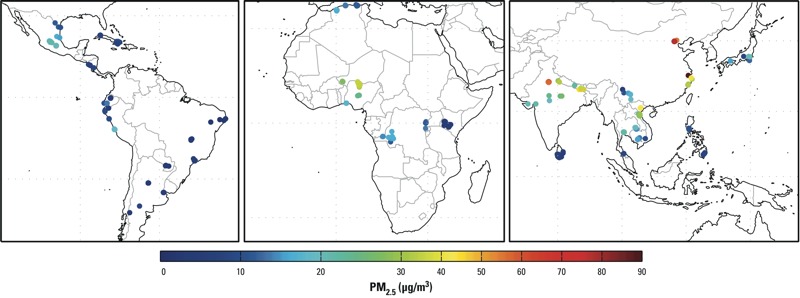
Background: Inhaling fine particles (particulate matter with diameter ≤ 2.5 μm; PM2.5) can induce oxidative stress and inflammation, and may contribute to onset of preterm labor and other adverse perinatal outcomes. Objectives: We examined whether outdoor PM2.5 was associated with adverse birth outcomes among 22 countries in the World Health Organization Global Survey on Maternal and Perinatal Health from 2004 through 2008. Methods: Long-term average (2001–2006) estimates of outdoor PM2.5 were assigned to 50-km–radius circular buffers around each health clinic where births occurred. We used generalized estimating equations to determine associations between clinic-level PM2.5 levels and preterm birth and low birth weight at the individual level, adjusting for seasonality and potential confounders at individual, clinic, and country levels. Country-specific associations were also investigated. Results: Across all countries, adjusting for seasonality, PM2.5 was not associated with preterm birth, but was associated with low birth weight [odds ratio (OR) = 1.22; 95% CI: 1.07, 1.39 for fourth quartile of PM2.5 (> 20.2 μg/m3) compared with the first quartile (< 6.3 μg/m3)]. In China, the country with the largest PM2.5 range, preterm birth and low birth weight both were associated with the highest quartile of PM2.5 only, which suggests a possible threshold effect (OR = 2.54; CI: 1.42, 4.55 and OR = 1.99; CI: 1.06, 3.72 for preterm birth and low birth weight, respectively, for PM2.5 ≥ 36.5 μg/m3 compared with PM2.5 < 12.5 μg/m3). Conclusions: Outdoor PM2.5 concentrations were associated with low birth weight but not preterm birth. In rapidly developing countries, such as China, the highest levels of air pollution may be of concern for both outcomes. Citation: Fleischer NL, Merialdi M, van Donkelaar A, Vadillo-Ortega F, Martin RV, Betran AP, Souza JP, O´Neill MS. 2014. Outdoor air pollution, preterm birth, and low birth weight: analysis of the World Health Organization Global Survey on Maternal and Perinatal Health. Environ Health Perspect 122:425–430; http://dx.doi.org/10.1289/ehp.1306837
Overview
The claims and statistics of this paper haven’t been checked yet.
Run the check — free, no account needed. It reads the open-access text and checks the sources it cites.
Integrity signals
Registry
Cites
Statistics
Figures
Verification
Claims the paper makes
The claims and statistics of this paper haven’t been checked yet.
Run the check — free, no account needed. It reads the open-access text and checks the sources it cites.
Claims other papers make about this one
Each is checked against this paper’s own text: does it say what the citing paper says it does?
In the citing paper
“exposure to fine particulate matter during gestation increases the risk of low birth weight in the child [164]”
From Particle toxicology and health - where are we? (2019) · cites this paper as [164]
Self-check
Percentages, sums and reported differences re-computed from the paper’s own numbers.
The self-check needs the paper’s full text.
Citations
Cites
Long-term exposure to air pollution and incidence of cardiovascular events in women
Miller, K. A., Siscovick, D. S., Sheppard, L., Shepherd, K., Sullivan, J. H., Anderson, G. L., & Kaufman, J. D. (2007) · New England Journal of Medicine · doi:10.1056/nejmoa054409 · Cited by 1,854
Ambient Air Pollution and Preterm Birth: A Time-series Analysis
Darrow, L. A., Klein, M., Flanders, W. D., Waller, L. A., Correa, A., Marcus, M., Mulholland, J. A., Russell, A. G., & Tolbert, P. E. (2009) · Epidemiology · doi:10.1097/ede.0b013e3181a7128f · Cited by 155
Research works printed but not linked: 45
- Bell, 2007, Ambient air pollution and low birth weight in Connecticut and Massachusetts., Environ Health Perspect, 115, 1118, 10.1289/ehp.9759 · DOI
- Brauer, 2008, A cohort study of traffic-related air pollution impacts on birth outcomes., Environ Health Perspect, 116, 680, 10.1289/ehp.10952 · DOI
- Brunekreef, 2002, Air pollution and health., Lancet, 360, 1233, 10.1016/S0140-6736(02)11274-8 · DOI
- Casanueva, 2005, Vitamin C supplementation to prevent premature rupture of the chorioamniotic membranes: a randomized trial., Am J Clin Nutr, 81, 859, 10.1093/ajcn/81.4.859 · DOI
- Chang, 2012, Time-to-event analysis of fine particle air pollution and preterm birth: results from North Carolina, 2001–2005., Am J Epidemiol, 175, 91, 10.1093/aje/kwr403 · DOI
- Cohen, 2005, The global burden of disease due to outdoor air pollution., J Toxicol Env Heal A, 68, 1301, 10.1080/15287390590936166 · DOI
- Dadvand, 2013, Maternal exposure to particulate air pollution and term birth weight: a multi-country evaluation of effect and heterogeneity., Environ Health Perspect, 121, 367, 10.1289/ehp.1205575 · DOI
- Diner, 1998, Multi-angle imaging spectroradiometer (MISR)–instrument description and experiment overview., Trans Geosci Remote Sensing, 36, 1072, 10.1109/36.700992 · DOI
- Gehring, 2011, Traffic-related air pollution, preterm birth and term birth weight in the Piama birth cohort study., Environ Res, 111, 125, 10.1016/j.envres.2010.10.004 · DOI
- Glinianaia, 2004, Particulate air pollution and fetal health: a systematic review of the epidemiologic evidence., Epidemiology, 15, 36, 10.1097/01.ede.0000101023.41844.ac · DOI
- Gouveia, 2004, Association between ambient air pollution and birth weight in São Paulo, Brazil., J Epidemiol Community Health, 58, 11, 10.1136/jech.58.1.11 · DOI
- Huynh, 2006, Relationships between air pollution and preterm birth in California., Paediatr Perinat Epidemiol, 20, 454, 10.1111/j.1365-3016.2006.00759.x · DOI
- Jiang, 2007, A time series analysis of outdoor air pollution and preterm birth in Shanghai, China., Biomed Environ Sci, 20, 426
- Junger, 2007, Air pollution and low birth weight in the city of Rio de Janeiro, Brazil, 2002, Cad Saude Publica, 23, S588, 10.1590/S0102-311X2007001600019 · DOI
- Kampa, 2008, Human health effects of air pollution., Environ Pollut, 151, 362, 10.1016/j.envpol.2007.06.012 · DOI · Paper page
- Kloog, 2012, Using new satellite based exposure methods to study the association between pregnancy PM2.5 exposure, premature birth and birth weight in Massachusetts., Environ Health, 11, 40, 10.1186/1476-069X-11-40 · DOI
- Kramer, 2003, The epidemiology of adverse pregnancy outcomes: an overview., J Nutr, 133, 1592S, 10.1093/jn/133.5.1592S · DOI
- Lacasana, 2005, Exposure to ambient air pollution and prenatal and early childhood health effects., Eur J Epidemiol, 20, 183, 10.1007/s10654-004-3005-9 · DOI
- Lee, 2012, Comparison of geostatistical interpolation and remote sensing techniques for estimating long-term exposure to ambient PM2.5 concentrations across the continental United States., Environ Health Perspect, 120, 1727, 10.1289/ehp.1205006 · DOI
- Levy, 2007, Second-generation operational algorithm: retrieval of aerosol properties over land from inversion of moderate resolution imaging spectroradiometer spectral reflectance., J Geophys Res-Atmos, 112, 16, 10.1029/2006JD007811 · DOI
- Liang, 1986, Longitudinal data-analysis using generalized linear-models., Biometrika, 73, 13, 10.1093/biomet/73.1.13 · DOI · Paper page
- Longo, 2013, Short-term and long-term sequelae in intrauterine growth retardation (IUGR)., J Matern Fetal Neonatal Med, 26, 222, 10.3109/14767058.2012.715006 · DOI
- Maisonet, 2004, A review of the literature on the effects of ambient air pollution on fetal growth., Environ Res, 95, 106, 10.1016/j.envres.2004.01.001 · DOI
- Morello-Frosch, 2010, Ambient air pollution exposure and full-term birth weight in California., Environ Health, 9, 44, 10.1186/1476-069X-9-44 · DOI
- O’Neill, 2008, Environmental equity in air quality management: local and international implications for human health and climate change., J Toxicol Environ Health A, 71, 570, 10.1080/15287390801997625 · DOI
- Park, 2006, Hfe genotype, particulate air pollution, and heart rate variability: a gene-environment interaction., Circulation, 114, 2798, 10.1161/CIRCULATIONAHA.106.643197 · DOI
- Parker, 2005, Air pollution and birth weight among term infants in California., Pediatrics, 115, 121, 10.1542/peds.2004-0889 · DOI
- Ritz, 2008, Ambient air pollution and adverse birth outcomes: methodologic issues in an emerging field., Basic Clin Pharmacol Toxicol, 102, 182, 10.1111/j.1742-7843.2007.00161.x · DOI
- Ritz, 2007, Ambient air pollution and preterm birth in the environment and pregnancy outcomes study at the University of California, Los Angeles., Am J Epidemiol, 166, 1045, 10.1093/aje/kwm181 · DOI
- Rogers, 2011, Maternal inflammation, growth retardation, and preterm birth: insights into adult cardiovascular disease., Life Sci, 89, 417, 10.1016/j.lfs.2011.07.017 · DOI
- Rossner, 2011, Genetic, biochemical, and environmental factors associated with pregnancy outcomes in newborns from the Czech Republic., Environ Health Perspect, 119, 265, 10.1289/ehp.1002470 · DOI
- Rudra, 2011, Ambient carbon monoxide and fine particulate matter in relation to preeclampsia and preterm delivery in western Washington State., Environ Health Perspect, 119, 886, 10.1289/ehp.1002947 · DOI
- Sarnat, 2005, Ambient gas concentrations and personal particulate matter exposures–implications for studying the health effects of particles., Epidemiology, 16, 385, 10.1097/01.ede.0000155505.04775.33 · DOI
- Seo, 2007, Environmental health surveillance of low birth weight in Seoul using air monitoring and birth data, J Prev Med Public Health, 40, 363, 10.3961/jpmph.2007.40.5.363 · DOI
- Seo, 2010, Population-attributable risk of low birthweight related to PM10 pollution in seven Korean cities., Paediatr Perinat Epidemiol, 24, 140, 10.1111/j.1365-3016.2009.01085.x · DOI
- Shah, 2008, Methodological considerations in implementing the WHO Global Survey for Monitoring Maternal and Perinatal Health., Bull World Health Organ, 86, 126, 10.2471/BLT.06.039842 · DOI
- Slama, 2008, Meeting report: Atmospheric pollution and human reproduction. Report of the Munich international workshop., Environ Health Perspect, 116, 791, 10.1289/ehp.11074 · DOI
- Šrám, 2005, Ambient air pollution and pregnancy outcomes: a review of the literature., Environ Health Perspect, 113, 375, 10.1289/ehp.6362 · DOI
- Suh, 2009, Different effects of PM10 exposure on preterm birth by gestational period estimated from time-dependent survival analyses., Int Arch Occup Environ Health, 82, 613, 10.1007/s00420-008-0380-7 · DOI
- van Donkelaar, 2010, Global estimates of exposure to fine particulate matter concentrations from satellite based aerosol optical depth., Environ Health Perspect, 118, 847, 10.1289/ehp.0901623 · DOI
- Wilhelm, 2012, Traffic-related air toxics and term low birth weight in Los Angeles County, California., Environ Health Perspect, 120, 132, 10.1289/ehp.1103408 · DOI
- Woodruff, 2009, Methodological issues in studies of air pollution and reproductive health., Environ Res, 109, 311, 10.1016/j.envres.2008.12.012 · DOI
- Wu, 2009, Association between local traffic-generated air pollution and preeclampsia and preterm delivery in the South Coast Air Basin of California., Environ Health Perspect, 117, 1773, 10.1289/ehp.0800334 · DOI
- Wu, 2011, Comparing exposure assessment methods for traffic-related air pollution in an adverse pregnancy outcome study., Environ Res, 111, 685, 10.1016/j.envres.2011.03.008 · DOI
- Zhao, 2011, Effects of air pollution on neonatal prematurity in Guangzhou of China: a time-series study., Environ Health, 10, 2, 10.1186/1476-069X-10-2 · DOI
Cited by
Sorted by citations
Sun, X., Luo, X., Zhao, C., Zhang, B., Tao, J., Yang, Z., Ma, W., & Liu, T. (2016) · Environmental Pollution · doi:10.1016/j.envpol.2015.12.022 · Cited by 233
Particle toxicology and health - where are we?
Riediker, M., Zink, D., Kreyling, W., Oberdörster, G., Elder, A., Graham, U., Lynch, I., Duschl, A., Ichihara, G., Ichihara, S., et al. (2019) · Particle and Fibre Toxicology · doi:10.1186/s12989-019-0302-8 · Cited by 237
Rich, D. Q., Liu, K., Zhang, J., Thurston, S. W., Stevens, T. P., Pan, Y., Kane, C., Weinberger, B., Ohman-Strickland, P., Woodruff, T. J., et al. (2015) · Environmental Health Perspectives · doi:10.1289/ehp.1408795 · Cited by 174
Liu, W., Huang, C., Hu, Y., Fu, Q., Zou, Z., Sun, C., Shen, L., Wang, X., Cai, J., Pan, J., et al. (2016) · Environment International · doi:10.1016/j.envint.2016.04.019 · Cited by 92
Metadata
- Authors
- Fleischer, N. L., Merialdi, M., van Donkelaar, A., Vadillo-Ortega, F., Martin, R. V., Betran, A. P., Souza, J. P., & O´Neill, M. S.
- Venue
- Environmental Health Perspectives
- Publisher
- American Chemical Society (ACS)
- Published
- 2014-02-07
- Volume
- 122
- Issue
- 4
- Pages
- 425-430
- ISSN
- 0091-6765
- 1552-9924
- PMC
- PMC3984219
- Cited by
- 270
- References
- 2
- Language
- en
About these checks
Registry, retraction, Cites and statistics results are computed, not judged, with one exception: a printed reference that no index lists is read once by a model before it counts as a citation error. Claims are extracted by a model and kept only when their quote appears verbatim in the text; each cited source is then checked, with a model’s help, for whether it says what the claim relies on. Those verdicts can be wrong — read the claim’s quote and the cited source before relying on one.
Statistics and arithmetic are recomputed, not judged.
Confidence bands are shown only for fields calibrated on our annotated test set. None is calibrated yet, so no band is shown.
What counts as a claim ›How we measure confidence ›How we check this ›
Are you an author, or do you see a problem with this page? Request a review
