

Models for quantifying human thermoregulatory responses
Open accessThe DOI matches its Crossref record; 73 of the 73 references it cites were found in a registry or an index; none of the 53 sources its claims cite is checked for support yet.
Abstract
This review examines the evolution of thermal models applicable to water immersion and outlines the fundamental principles of accessible human thermoregulation and physiological models. It identifies available source code and proposes future development steps to enhance model generalizability. These models are crucial for translating biophysical and physiological data into practical applications, extrapolating quantitative relationships to novel conditions, and identifying knowledge gaps to guide future research and model refinement.
Overview
CoChat Summary
TL;DR
This review summarizes mathematical models of human thermoregulation, grouping them into empirical, node, multi-segmental, and finite element/3D categories and tracing their development for heat, cold, and immersion applications. It concludes that while many validated models exist, no single model is fully adequate for predicting core temperature, extremity temperatures/function, and metabolic limits in diving and cold-water swimming.
Key findings
- Models fall into four structural categories: empirical, node (single or multiple layers), multi-segmental, and finite element/3D; design approaches are empirical, rational, or hybrid. Segmental biophysical models such as the five-six cylinder model underpin CoWEDA and PSDA; multi-node engineering models include Montgomery, Yermakova, and Wissler; simplified empirical/mechanistic models underpin HSDA and SCENARIO.
- Required inputs span four categories plus time: human (e.g., body mass, body surface area, initial core/skin temperature), activity (metabolic rate, external work), environment (air/water temperature, relative humidity, wind, etc.), and clothing (insulation, thermal/evaporative resistance, wind/wet effects). Example: resting metabolic rate can be estimated as BSA × 58.2 W/m²; for 1.8 m² this is ~105 W, and a normal initial core temperature of ~37.0 °C can be assumed if unknown.
- Chronology: Wissler’s 1960s model divided the body into 15 geometric regions; Montgomery’s NASA model included WETMAN and SIZE; Tikuisis developed the three-cylinder cold thermoregulatory model (3-CTM); Werner and Webb developed the six-cylinder model (“Thermosim”); Xu and Werner divided segments into core, muscle, fat, and skin layers; PSDA and CoWEDA are based on the 6-CTM; Fiala models focus on comfort; JOS-3 increased complexity to 83 nodes; Kingma’s ThermoSEM derives from Fiala principles.
- The review concludes that immersion cold modeling has been driven almost exclusively by military needs, and there is no predictive model fully adequate for core temperature, extremity temperatures and function, and metabolic limits (mental and physical endurance limits) for diving and cold water swimming. More data may help empirically based models revalidate fundamental relationships and identify overlooked quantitative rules.
Methods
- A literature review was conducted by a subject matter expert to evaluate human thermoregulatory models that included published, reproducible or functional code, or functioning versions obtained for the work; search sources included Google Scholar, PubMed, Defense Technical Information Center, and other internal records.
- Model selection required published analyses related to prediction of core body temperature (Tc) or thermal health risks at a minimum; ideally models included additional physiological predictions (e.g., skin temperature, muscle temperature, cardiac output, shivering, sweating). An additional consideration was clear applicability to militarily relevant working conditions (e.g., extreme hot, cold, immersion, high intensity).
- The review describes the mathematical basis of models, necessary inputs and computational management, provides a chronology of biophysical model development, and concludes with a brief discussion of the current state of commonly used models and applications. No quantitative meta-analysis is described.
Limitations
- Paper-stated: no predictive model is fully adequate for core temperature, extremity temperatures and function, and metabolic limits for diving and cold water swimming; few models have versatility to describe dynamic activities or complex transitions without a subject matter expert; models have become complex and difficult for non-modeling experts; less detailed inputs likely yield less accurate outputs.
- Evident from the text: this is a narrative review by a single subject matter expert, without a systematic search protocol, independent screening, risk-of-bias assessment, or quantitative synthesis; model selection and conclusions may reflect expert judgment.
- Evident from the text: many supporting tables and equations are referenced but not fully reproduced in the provided text, limiting independent verification of specific model equations and the chronological table.
Model-written summary. Check it against the paper before relying on it.
Integrity signals
Registry
Cites
Statistics
Figures
Verification
Claims the paper makes
0 Valid · 7 Not valid · 21 Not checked · 23 Own results and interpretations
In the paper
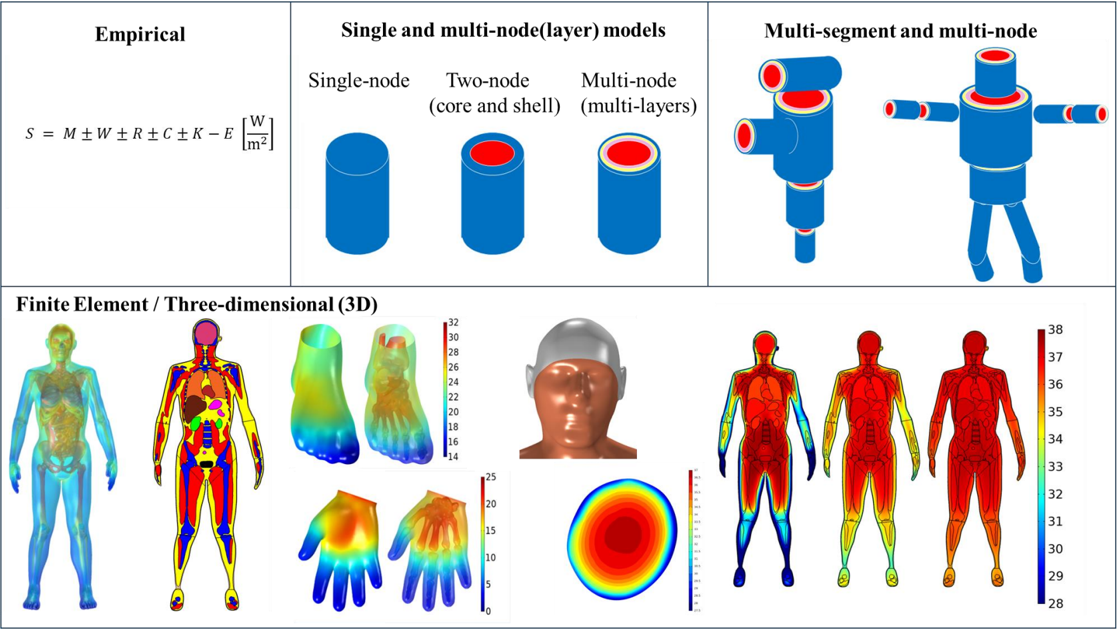
“The majority of models reviewed fall into four broad categories: 1) empirical (i.e., non-dimensional, mathematical or statistical models), 2) node models (single or multiple layers), 3) multi-segmental, and 4) finite element or three-dimensional (3D) models (1)(2)(3)(4).”
- Also stated in: § What is required for a comprehensive model of human thermoregulation? · plain
“The major models reviewed fall into four broad structural categories.We see these as 1) empirical (i.e., non-dimensional, mathematical or statistical models), 2) node models (single or multiple layers), 3) multisegmental, and 4) finite element or threedimensional (3D) models (Figure 1 shown above).”
§ MODELS FOR QUANTIFYING HUMAN THERMOREGULATORY RESPONSES > BACKGROUND -SUMMARY
What the sources say
- Not matchedcites (1)(2)(3)(4)
This doesn’t read as a citation we can look up.
plain- Asserted: passes — The authors put it forward as true.
- Checkable: passes — It can be checked against evidence.
- Load-bearing: unclear — It is unclear whether the paper’s conclusions depend on it.
- Based: passes — The paper gives a reason why it holds.
- Also stated in: § What is required for a comprehensive model of human thermoregulation? · plain
A result the paper states — it cites no source for it, so there is none to check. The quote shows it is in the paper.
In the paper
“Inputs related to clothing typically required biophysical properties to describe heat transfer (dry or evaporative) through them and into the environment or as an interpretation of how much heat is retained within them (e.g., insulation).”
§ MODELS FOR QUANTIFYING HUMAN THERMOREGULATORY RESPONSES > 4. Clothing:
plain- Asserted: passes — The authors put it forward as true.
- Checkable: passes — It can be checked against evidence.
- Load-bearing: unclear — It is unclear whether the paper’s conclusions depend on it.
- Based: passes — The paper gives a reason why it holds.
In the paper
“The Montgomery model was used to predict core temperature of divers in a range of water temperatures, protective clothing, duration of dives, and with different breathing gas mixtures (17).”
§ MODELS FOR QUANTIFYING HUMAN THERMOREGULATORY RESPONSES > DISCUSSION
What the sources say
- Not matchedcites [17]
The reference list we hold has no entry [17].
plain- Asserted: passes — The authors put it forward as true.
- Checkable: passes — It can be checked against evidence.
- Load-bearing: unclear — It is unclear whether the paper’s conclusions depend on it.
- Based: passes — The paper gives a reason why it holds.
- Not matched
None of the sources cited for this claim could be matched to a paper, so there is nothing to check it against.
In the paper
“Simplified modeling approaches based on empirically predictive methods such as Givoni and Goldman (24)(25)(26)(27) or from mechanistic methods (e.g., Kraning and Gonzalez (28)(29)(30)(31)) used to predict responses to metabolic heat production, clothing, and environment have formed the basis for widely used heat stress models (e.g., the Heat Strain Decision Aid (HSDA) (32)(33)(34)(35)(36)(37)(38),”
§ MODELS FOR QUANTIFYING HUMAN THERMOREGULATORY RESPONSES > BACKGROUND -SUMMARY
What the sources say
- Not matchedcites (24)(25)(26)(27)
This doesn’t read as a citation we can look up.
- Not matchedcites (28)(29)(30)(31)
This doesn’t read as a citation we can look up.
- Not matchedcites (32)(33)(34)(35)(36)(37)(38)
This doesn’t read as a citation we can look up.
plainstates a cause- Asserted: passes — The authors put it forward as true.
- Checkable: passes — It can be checked against evidence.
- Load-bearing: unclear — It is unclear whether the paper’s conclusions depend on it.
- Based: passes — The paper gives a reason why it holds.
- Not matched
None of the sources cited for this claim could be matched to a paper, so there is nothing to check it against.
In the paper
“This has been further enhanced to develop the Cold Weather Ensemble Decision Aid (CoWEDA) application for prediction of clothing, activity, and ambient cold conditions to predict core temperature (hypothermia risk) and peripheral (hand and feet) temperatures and freezing cold injury risk (14,15,173).”
§ MODELS FOR QUANTIFYING HUMAN THERMOREGULATORY RESPONSES > DISCUSSION
What the sources say
- Not matchedcites [14]
The reference list we hold has no entry [14].
- Not matchedcites [15]
The reference list we hold has no entry [15].
- Not matchedcites [173]
The reference list we hold has no entry [173].
plainstates a cause- Asserted: passes — The authors put it forward as true.
- Checkable: passes — It can be checked against evidence.
- Load-bearing: unclear — It is unclear whether the paper’s conclusions depend on it.
- Based: passes — The paper gives a reason why it holds.
- Not matched
6 more claims
Create a free account to see all 51 claims and every source verdict.
- Probably not a substantial claim. 32
- It may state two separate claims as one. 13
Citations
Cites
Part of this paper’s reference list could not be split into single entries.
Analysis of Tissue and Arterial Blood Temperatures in the Resting Human Forearm
Pennes, H. H. (1948) · Journal of Applied Physiology · doi:10.1152/jappl.1948.1.2.93 · Cited by 4,646
Simplified calculation of body surface area
(1987) · New England Journal of Medicine · doi:10.1056/nejm198710223171717 · Cited by 3,238
Haycock, G. B., Schwartz, G. J., & Wisotsky, D. H. (1978) · The Journal of Pediatrics · doi:10.1016/s0022-3476(78)80601-5 · Cited by 1,675
Skin blood flow in adult human thermoregulation: How it works, when it does not, and why
Charkoudian, N. (2003) · Mayo Clinic Proceedings · doi:10.4065/78.5.603 · Cited by 1,041
Temperature regulation in man ? A theoretical study
Stolwijk, J. A. J., & Hardy, J. D. (1966) · Pfl�gers Archiv f�r die Gesamte Physiologie des Menschen und der Tiere · doi:10.1007/bf00412787 · Cited by 503
A mathematical model of physiological temperature regulation in man
Stolwijk, J. A. J. (1971) · NASA Technical Reports Server (NASA) · Cited by 418
The blood flow in skin and muscle of the human forearm
Cooper, K. E., Edholm, O. G., & Mottram, R. F. (1955) · The Journal of Physiology · doi:10.1113/jphysiol.1955.sp005304 · Cited by 298
Predicting rectal temperature response to work, environment, and clothing.
Givoni, B., & Goldman, R. F. (1972) · Journal of Applied Physiology · doi:10.1152/jappl.1972.32.6.812 · Cited by 269
Predicting metabolic energy cost
Givoni, B., & Goldman, R. F. (1971) · Journal of Applied Physiology · doi:10.1152/jappl.1971.30.3.429 · Cited by 269
A Mathematical Model of the Human Temperature Regulatory System - Transient Cold Exposure Response
Gordon, R. G., Roemer, R. B., & Horvath, S. M. (1976) · IEEE Transactions on Biomedical Engineering · doi:10.1109/tbme.1976.324601 · Cited by 245
Research works printed but not linked: 4
- Xu X, Werner J. A dynamic model of the human/clothing/environment-system. Applied Human Science. 1997;16(2):61-75.
- Waldock K, Lee B, Powell S, Wardle S, Looney D, Greeves J, et al. Field validation surface area: a height-weight formula validated in infants, children, and adults. Journal of Pediatrics. 1978;93(1):62-6.
- Meeh K. Oberflächenmessungen des menschlichen Körpers. Zeitschrift fur Biologie. 1879;15:425-85.
- Schlich E, Schumm M, Schlich M. 3D- Body-Scan als anthropometrisches Verfahren zur Bestimmung der spezifischen Körperoberfläche. Ernährungs Umschau. 2010;57(4):178-83.
Cited by
Modeling physiological and thermoregulatory responses during an Olympic triathlon
Yermakova, I. I., Potter, A. W., Chapman, C. L., & Friedl, K. E. (2025) · Journal of Thermal Biology · doi:10.1016/j.jtherbio.2025.104203 · Cited by 4
Self-citation
Metadata
- Authors
- Potter, A., & Friedl, K.
- Affiliations
- U.S. Army Research Institute of Environmental Medicine (US)
- Corresponding author
- Potter, Adam
- ORCID
- Potter, Adam
- Venue
- Journal of Sport and Human Performance
- Publisher
- Human Performance Consortium
- Published
- 2025-05-30
- Volume
- 13
- Issue
- 1
- Pages
- 40-63
- ISSN
- 2326-6333 (ISSN-L)
- OpenAlex
- W7167826191
- Semantic Scholar
- 57b96fa8d104b3d3b3260611e84f1ee626e29b9f
- Cited by
- 1
- References
- 73
- Citations by year
- 2025: 1
- FWCI
- 0.42
- Type
- journal article
- Language
- en
- Open access
- diamond
- doi.org
- Licence
- Locations
- Journal of Sport and Human Performance (publishedVersion, cc-by-nc)
- Funders
- U.S. Army Research Institute of Environmental Medicine
- Topics
- Health Sciences › Medicine › Physiology (medical) › Thermoregulation and physiological responses
- Health Sciences › Medicine › Physiology (medical) › Cardiovascular and exercise physiology
- Physical Sciences › Engineering › Building and Construction › Building Energy and Comfort Optimization
- Keywords
- human thermoregulation, thermal modeling, water immersion, physiological modeling, model generalization, heat loss, model source code, model refinement
About these checks
Registry, retraction, Cites and statistics results are computed, not judged, with one exception: a printed reference that no index lists is read once by a model before it counts as a citation error. Claims are extracted by a model and kept only when their quote appears verbatim in the text; each cited source is then checked, with a model’s help, for whether it says what the claim relies on. Those verdicts can be wrong — read the claim’s quote and the cited source before relying on one.
A language model drew the claims from the paper on 2026-11-23, under version 3 of the claim definition (model deepseek-v4.1-flash, prompt extract-v3).
A second model labelled each claim on 2026-11-23 (model jev-1.13-20260917, definition revision gold-guideline-v0.2).
Statistics and arithmetic are recomputed, not judged.
Confidence bands are shown only for fields calibrated on our annotated test set. None is calibrated yet, so no band is shown.
What counts as a claim ›How we measure confidence ›How we check this ›
Are you an author, or do you see a problem with this page? Request a review
How to cite
Cite CoChat for the checks on this page, and the paper for its own findings.
- This page
- CoChat. (2026). Citation check: Models for quantifying human thermoregulatory responses. https://app.cochat.ai/papers/10.12922/jshp.v13i1.190
- The paper
- Potter, A., & Friedl, K. (2025). Models for quantifying human thermoregulatory responses. Journal of Sport and Human Performance. https://doi.org/10.12922/jshp.v13i1.190
Data sources
Bibliographic data: Semantic Scholar, OpenAlex, Crossref.
Contains information from the Semantic Scholar Academic Graph Datasets, made available under the ODC Attribution License (ODC-BY 1.0).
Semantic Scholar’s data is described in: Kinney, R., et al. (2023). The Semantic Scholar Open Data Platform. arXiv:2301.10140.
