

Students’ Understanding on Newton’s Third Law in Identifying the Reaction Force in Gravity Interactions
Open accessThe DOI matches its Crossref record; 30 of the 30 references it cites were found in a registry or an index; none of the 16 sources its claims cite is checked for support yet.
Abstract
Background: In the past three decades, previous researches showed that students had various misconceptions of Newton’s Third Law. The present study focused on students’ difficulties in identifying the third-law force pair in gravity interaction situations. Materials and methods:An instrument involving contexts with gravity and non-gravity associated interactions was designed and conducted among students in junior secondary school, senior high school and university. Results: The finding revealed that students in all grades did statistically worse in gravity interaction contexts and had general difficulties in distinguishing interaction forces and balanced forces. However, students improved their reasoning on third-law force pair with the increase of grade level irrespective of contexts. Special difficulties for junior secondary school students in understanding gravity interaction were also addressed. Conclusions: It is important to emphasize that the educational contexts of gravity interactions should be paid more attention to.
Overview
CoChat Summary
TL;DR
This study designed an 8-item multiple-choice instrument to examine how Chinese students at three grade levels identify Newton’s third-law force pairs in gravity versus non-gravity interactions. Students performed significantly worse in gravity-associated contexts and commonly confused balanced forces with third-law force pairs, though performance improved with grade level.
Key findings
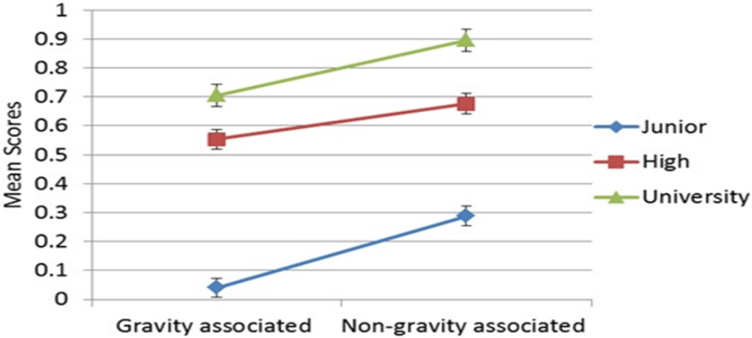
- Across all participants, performance was lower in gravity-associated contexts (M=0.41, SD=0.29) than in non-gravity-associated contexts (M=0.60, SD=0.25), with a significant main effect of context, F(1, 214)=41.36, p<0.001.
- Grade level mattered: ANOVA showed a significant grade effect, F(2, 214)=174.56, p<0.001; university students outperformed senior high school students (p=0.001), and both groups outperformed junior secondary students (p<0.001). In gravity contexts, junior students scored M=0.04, senior students M=0.55, and university students M=0.71; in non-gravity contexts, the means were M=0.29, M=0.68, and M=0.90, respectively.
- A common incorrect reasoning pattern was confusing balanced forces with third-law force pairs. For example, in the book-on-table context, 74%, 44%, and 31% of junior, senior high, and university students, respectively, selected a balanced force as the reaction force of the gravitational force (Table 4).
- Junior secondary students showed specific difficulties: some treated an “object” rather than a “force” as the reaction force (e.g., 10% chose “the ceiling” for the ceiling-lamp context; 7.5% chose “the book” for the book-table context), and some focused only on direction while disregarding magnitude (e.g., in the box-on-slope context, 23% chose the normal force and 43% chose the frictional force as the reaction force).
Methods
- The instrument contained 8 multiple-choice questions: 5 gravity-associated interaction contexts and 3 non-gravity-associated contexts. Contexts included a raindrop falling, a table with a book, a ceiling lamp on a string, a box on a slope, floating wood pressed by hand, car collisions, magnetic attraction, and a person rowing a boat.
- Participants were 217 students from Guangzhou, China: 80 grade 8 junior secondary students, 73 grade 10 senior high school students, and 64 first-year university students, all from medium-level institutions.
- Analysis used a 3×2 (grade level × context) measures ANOVA on mean scores, followed by separate one-way ANOVAs and independent-groups t-tests to compare contexts within grade levels, with effect sizes reported.
Limitations
- The paper does not state explicit limitations.
- Evident from the text: the design is cross-sectional across grade levels, so the claim that students “improved” with grade level reflects between-group differences rather than longitudinal individual change.
- Evident from the text: the sample is limited to three medium-level institutions in Guangzhou, China, and the instrument uses only 8 multiple-choice items, which may limit generalizability and depth of reasoning captured.
Model-written summary. Check it against the paper before relying on it.
Integrity signals
Registry
Cites
Statistics
Figures
Verification
Claims the paper makes
0 Valid · 2 Not valid · 11 Not checked · 65 Own results and interpretations
A result the paper reports from its own data — it cites no other source for it, so there is none to check. The quote shows it is in the paper.
In the paper
“Analysis of Poc Hoc Multiple comparisons indicated that there were significant differences between the junior level and both the other two groups (p<0.001).”
§ Students' Understanding on Newton's Third Law in Identifying the Reaction Force in Gravity Interactions > FINDINGS AND DISCUSSIONS Students' performances in identifying the reaction force in both gravity and non-gravity associated interactions
plainstates an association- Asserted: passes — The authors put it forward as true.
- Checkable: passes — It can be checked against evidence.
- Load-bearing: passes — The paper’s conclusions depend on it.
- Based: passes — The paper gives a reason why it holds.
- Rests on an assumption not shown here.
A result the paper reports from its own data — it cites no other source for it, so there is none to check. The quote shows it is in the paper.
In the paper
“The finding revealed that students in all grades did statistically worse in gravity interaction contexts and had general difficulties in distinguishing interaction forces and balanced forces.”
- Also stated in: § FINDINGS AND DISCUSSIONS Students' performances in identifying the reaction force in both gravity and non-gravity associated interactions · plain
“students outperformed in the non-gravity associated contexts (M=0.60,SD=0.25) than in the gravity associated contexts (M=0.41,SD=0.29).”
- Also stated in: § FINDINGS AND DISCUSSIONS Students' performances in identifying the reaction force in both gravity and non-gravity associated interactions · hedged
“the result suggested a main effect for context, F (1, 214) =41.36, p<0.001”
§ Students' Understanding on Newton's Third Law in Identifying the Reaction Force in Gravity Interactions > Abstract
plain- Asserted: passes — The authors put it forward as true.
- Checkable: passes — It can be checked against evidence.
- Load-bearing: passes — The paper’s conclusions depend on it.
- Based: passes — The paper gives a reason why it holds.
- Rests on an assumption not shown here.
- Also stated in: § FINDINGS AND DISCUSSIONS Students' performances in identifying the reaction force in both gravity and non-gravity associated interactions · plain
A result the paper reports from its own data — it cites no other source for it, so there is none to check. The quote shows it is in the paper.
In the paper
“However, students improved their reasoning on third-law force pair with the increase of grade level irrespective of contexts.”
- Also stated in: § FINDINGS AND DISCUSSIONS Students' performances in identifying the reaction force in both gravity and non-gravity associated interactions · hedged
“the analyses proved an effect for grade level, F(2, 214)=174.56,p<0.001, indicating significant differences among three group levels.”
§ Students' Understanding on Newton's Third Law in Identifying the Reaction Force in Gravity Interactions > Abstract
plainstates an association- Asserted: passes — The authors put it forward as true.
- Checkable: passes — It can be checked against evidence.
- Load-bearing: passes — The paper’s conclusions depend on it.
- Based: passes — The paper gives a reason why it holds.
- Rests on an assumption not shown here.
- Also stated in: § FINDINGS AND DISCUSSIONS Students' performances in identifying the reaction force in both gravity and non-gravity associated interactions · hedged
A result the paper reports from its own data — it cites no other source for it, so there is none to check. The quote shows it is in the paper.
In the paper
“At junior secondary school level, the difference of students' mean scores between gravity associated contexts and non-gravity associated contexts was significant, t(151.5)=5.14, p<0.001,ES=1.04”
§ Students' Understanding on Newton's Third Law in Identifying the Reaction Force in Gravity Interactions > 595
plain- Asserted: passes — The authors put it forward as true.
- Checkable: passes — It can be checked against evidence.
- Load-bearing: passes — The paper’s conclusions depend on it.
- Based: passes — The paper gives a reason why it holds.
A result the paper reports from its own data — it cites no other source for it, so there is none to check. The quote shows it is in the paper.
In the paper
“Similarly, analysis of ANVOAs for non-gravity associated contexts indicated a significant difference for grade level, F(2, 214)=90.50,p<0.001.”
§ Students' Understanding on Newton's Third Law in Identifying the Reaction Force in Gravity Interactions > FINDINGS AND DISCUSSIONS Students' performances in identifying the reaction force in both gravity and non-gravity associated interactions
hedgedstates an association- Asserted: passes — The authors put it forward as true.
- Checkable: passes — It can be checked against evidence.
- Load-bearing: unclear — It is unclear whether the paper’s conclusions depend on it.
- Based: passes — The paper gives a reason why it holds.
- Rests on an assumption not shown here.
49 more claims
Create a free account to see all 78 claims and to verify the 15 references still open.
- It may state two separate claims as one. 19
- Probably not a substantial claim. 11
Statistics that don’t add up
Each reported p-value recomputed from its test statistic and degrees of freedom, each partial η² from its F, and each ratio, mean difference or B printed with a p checked against its own confidence interval.
Rated minor: it would not touch a result — a value no result rests on, a p-value that stays on the same side of the significance level, or a conflict that is clerical, resolved elsewhere in the paper, or outside its own findings.
In the paper
“F(1, 433)=1.65,p=0.19”
§ Students' Understanding on Newton's Third Law in Identifying the Reaction Force in Gravity Interactions > FINDINGS AND DISCUSSIONS Students' performances in identifying the reaction force in both gravity and non-gravity associated interactions
Reported p = .19 · recomputed p = .200
Statistics recomputed
Every reported test result, recomputed from its test statistic and degrees of freedom. A result shows as not adding up only once an independent check has confirmed it.
- Doesn’t add upF(1, 433) = 1.65reported p = .19 · recomputed p = .200
“F(1, 433)=1.65,p = .19”
- ConsistentF(1, 214) = 41.36reported p < .001 · recomputed p < .001
“F (1, 214) =41.36, p < .001”
- ConsistentF(2, 214) = 174.56reported p < .001 · recomputed p < .001
“F(2, 214)=174.56,p < .001”
- ConsistentF(2, 214) = 86.35reported p < .001 · recomputed p < .001
“F(2, 214)=86.35,p < .001”
- ConsistentF(2, 214) = 90.5reported p < .001 · recomputed p < .001
“F(2, 214)=90.50,p < .001”
3 more recomputed tests
Create a free account to see every test the Stats check recomputed.
Self-check
Percentages, sums and reported differences re-computed from the paper’s own numbers.
Each contradiction between two passages listed here was confirmed by an independent check.
Rated minor: it would not touch a result — a value no result rests on, a p-value that stays on the same side of the significance level, or a conflict that is clerical, resolved elsewhere in the paper, or outside its own findings.
In the paper
“The analyses of measures ANOVA yielded no statistically significant interaction between grade level and context, F(1, 433)=1.65,p=0.19.”
§ Students' Understanding on Newton's Third Law in Identifying the Reaction Force in Gravity Interactions > FINDINGS AND DISCUSSIONS Students' performances in identifying the reaction force in both gravity and non-gravity associated interactions
Reported 1 · recomputed 2
Rated minor: it would not touch a result — a value no result rests on, a p-value that stays on the same side of the significance level, or a conflict that is clerical, resolved elsewhere in the paper, or outside its own findings.
In the paper
§ Students' Understanding on Newton's Third Law in Identifying the Reaction Force in Gravity Interactions > A. General difficulties with the failure to distinguish interaction forces and balanced forces
“74% of them gave a response of balanced force-the normal force acting on the book by the table-as the reaction force of the gravitational force on the table.”
§ Students' Understanding on Newton's Third Law in Identifying the Reaction Force in Gravity Interactions > CONCLUSIONS AND TEACHING IMPLIMENTS
“| | | The normal force acting on the table (F) | | | |”
Rated minor: it would not touch a result — a value no result rests on, a p-value that stays on the same side of the significance level, or a conflict that is clerical, resolved elsewhere in the paper, or outside its own findings.
In the paper
“The analyses of measures ANOVA yielded no statistically significant interaction between grade level and context, F(1, 433)=1.65,p=0.19.”
§ Students' Understanding on Newton's Third Law in Identifying the Reaction Force in Gravity Interactions > FINDINGS AND DISCUSSIONS Students' performances in identifying the reaction force in both gravity and non-gravity associated interactions
Reported 433 · recomputed 214
Citations
Cites
Hestenes, D., Wells, M., & Swackhamer, G. (1992) · The Physics Teacher · doi:10.1119/1.2343497 · Cited by 3,235
Thornton, R. K., & Sokoloff, D. R. (1998) · American Journal of Physics · doi:10.1119/1.18863 · Cited by 799
Hestenes, D., & Wells, M. (1992) · The Physics Teacher · doi:10.1119/1.2343498 · Cited by 450
Coherence versus fragmentation in the development of the concept of force
DISESSA, A., GILLESPIE, N., & ESTERLY, J. (2004) · Cognitive Science · doi:10.1016/j.cogsci.2004.05.003 · Cited by 399
Learning and Scientific Reasoning
Bao, L., Cai, T., Koenig, K., Fang, K., Han, J., Wang, J., Liu, Q., Ding, L., Cui, L., Luo, Y., et al. (2009) · Science · doi:10.1126/science.1167740 · Cited by 298
Students' concept of force: the importance of understanding Newton's third law
Brown, D. E. (1989) · Physics Education · doi:10.1088/0031-9120/24/6/007 · Cited by 174
A survey of some children's ideas about force
Watts, D. M., & Zylbersztajn, A. (1981) · Physics Education · doi:10.1088/0031-9120/16/6/313 · Cited by 117
Model analysis of fine structures of student models: An example with Newton’s third law
Bao, L., Hogg, K., & Zollman, D. (2002) · American Journal of Physics · doi:10.1119/1.1484152 · Cited by 71
Bryce, T. G. K., & MacMillan, K. (2005) · International Journal of Science Education · doi:10.1080/09500690500038132 · Cited by 67
Evaluation of an introductory course on ‚force’︁ considering students' preconceptions
Thijs, G. D. (1992) · Science Education · doi:10.1002/sce.3730760205 · Cited by 64
Using the Force Concept Inventory to monitor student learning and to plan teaching
Savinainen, A., & Scott, P. (2002) · Physics Education · doi:10.1088/0031-9120/37/1/307 · Cited by 61
Using deductive reasoning to promote the change of students' conceptions about force and motion
Park, J., & Han, S. (2002) · International Journal of Science Education · doi:10.1080/09500690110074026 · Cited by 60
Savinainen, A., Scott, P., & Viiri, J. (2005) · Science Education · doi:10.1002/sce.20037 · Cited by 52
Improving primary school teachers’ understanding of science concepts‐theory into practice
Summers, M. (1992) · International Journal of Science Education · doi:10.1080/0950069920140104 · Cited by 50
Thijs, G. D., & Bosch, G. M. (1995) · International Journal of Science Education · doi:10.1080/0950069950170304 · Cited by 44
Jiménez-Valladares, J. D. D., & Palacios, F. J. P. (2001) · Physics Education · doi:10.1088/0031-9120/36/3/309 · Cited by 34
A survey of students' understanding of colliding bodies
Montanero, M., Rodríguez, Á. L. P., & López, M. I. S. (1995) · Physics Education · doi:10.1088/0031-9120/30/5/004 · Cited by 32
Describing the cognitive landscape in learning and teaching about forces
Heywood, D. I., & Parker, J. (2001) · International Journal of Science Education · doi:10.1080/09500690110049051 · Cited by 25
Gamble, R. (1989) · Physics Education · doi:10.1088/0031-9120/24/2/303 · Cited by 24
Palmer, D. A. (2001) · Research in Science & Technological Education · doi:10.1080/02635140120087722 · Cited by 23
Trumper, R., & Gorsky, P. (1996) · Physics Education · doi:10.1088/0031-9120/31/4/021 · Cited by 22
Learning about forces: simulating the outcomes of pupils' misconceptions
Finegold, M., & Gorsky, P. (1988) · Instructional Science · doi:10.1007/bf00048344 · Cited by 19
Adding Forces — a target for primary science INSET
Kruger, C., Summers, M., & Palacio, D. (1990) · British Journal of In-Service Education · doi:10.1080/0305763900160110 · Cited by 19
Grimellini‐Tomasini, N., Pecori‐Balandi, B., Pacca, J. L. A., & Villani, A. (1993) · Science Education · doi:10.1002/sce.3730770206 · Cited by 16
Kolokotronis, D. E., & Solomonidou, C. (2003) · Education and Information Technologies · doi:10.1023/a:1026308009235 · Cited by 16
Educational software for improving learning aspects of Newton’s Third Law for student teachers
Spyrtou, A., Hatzikraniotis, E., & Καριώτογλου, Π. (2009) · Education and Information Technologies · doi:10.1007/s10639-009-9087-y · Cited by 14
Implicit theories of static interactions between two bodies
Montanero, M., Suero, M. I., Pérez, A. L., & Pardo, P. J. (2002) · Physics Education · doi:10.1088/0031-9120/37/4/305 · Cited by 13
Social Metaphorical Mapping of the Concept of Force “CHI‐KA‐RA” in Japanese
Suzuki, M. (2005) · International Journal of Science Education · doi:10.1080/09500690500206507 · Cited by 10
How student teachers understand distance force interactions in different contexts
Kariotoglou, P., Spyrtou, A., & Tselfes, V. (2009) · International Journal of Science and Mathematics Education · doi:10.1007/s10763-008-9147-6 · Cited by 6
Kruger, C., Summers, M., & Palacio, D. (1990) · British Educational Research Journal · doi:10.1080/0141192900160406
Research works printed but not linked: 2
- Halliday, D., Resnick, R., & Walker, J. (2005). Fundamentals of physics. New York: Wiley (pp.99).
- Tao, P., & Gunstone, R. (1999a). The process of conceptual change in force and motion during computer supported physics instruction. Journal of Research in Science Teaching, 36(17), 859-882. Doi:10.1002/(SICI)1098- 2736(199909)36:7<859::AID-TEA7>3.3.CO;2-A Terry, C., Jones, G., & Hurford, W. (1985). Children's conceptual understanding of forces and equilibrium. Physics Education, 20(4), 162-165. doi:10.1088/0031- 9120/20/4/306 · doi:10.1088/0031-9120/20/4/306
Cited by
Zulfikar, A., Saepuzaman, D., Novia, H., Setyadin, A. H., Jubaedah, D., Sholihat, F. N., Muhaemin, M. H., Afif, N. F., Fratiwi, N. J., Bhakti, S. S., et al. (2019) · Journal of Physics Conference Series · doi:10.1088/1742-6596/1204/1/012026 · Cited by 16
Misconceptions of High School Students on Motion and Force Using the Force Concept Inventory (FCI)
Khoirunnisa, R., Syuhendri, Kistiono, & Afifa, M. (2024) · Jurnal Penelitian Pendidikan IPA · doi:10.29303/jppipa.v10i5.6979 · Cited by 15
A Simple Approach to Teach Newton’s Third Law
Mansyur, J., Kaharu, S. N., & Holdsworth, J. (2020) · Jurnal Pendidikan IPA Indonesia · doi:10.15294/jpii.v9i1.21775 · Cited by 14
The Development of Newtonian Mechanics Conceptual Change Texts to Overcome Students’ Misconceptions
Syuhendri, S. (2018) · Journal of Education and Learning (EduLearn) · doi:10.11591/edulearn.v12i3.8285 · Cited by 12
Fen Bilgisi Öğretmeni Adaylarının Kuvvet ve Hareket Konularındaki Kavram Yanılgıları
Şimşek, D., Yurtcan, M. T., & Oktay, Ö. (2019) · Erzincan Üniversitesi Eğitim Fakültesi Dergisi · doi:10.17556/erziefd.493332 · Cited by 12
Metadata
- Authors
- Xiao, H., Zhou, S., & Zhang, C.
- Affiliations
- South China Normal University (CN)
- Corresponding author
- Xiao, Hua
- Venue
- EURASIA Journal of Mathematics, Science and Technology Education
- Publisher
- Modestum Publishing Ltd
- Published
- 2015-04-02
- Volume
- 11
- Issue
- 3
- ISSN
- 1305-8223 (ISSN-L)
- OpenAlex
- W2466229209
- Semantic Scholar
- 666a4758b05f6b893f442f981fc7349fabf91c36
- Cited by
- 31
- References
- 30
- Citations by year
- 2025: 5 · 2024: 5 · 2023: 2 · 2022: 3 · 2021: 3 · 2020: 5 · 2019: 3 · 2018: 1 · 2016: 3
- FWCI
- 3.70
- Type
- journal article
- Language
- en
- Open access
- hybrid
- doi.org
- Licence
- cc-by
- Locations
- Eurasia Journal of Mathematics Science and Technology Education (publishedVersion, cc-by)
- Funders
- South China Normal University
- Topics
- Social Sciences › Education › Science Education and Pedagogy
- Social Sciences › Education › Educational Methods and Outcomes
- Social Sciences › Education › Experimental and Theoretical Physics Studies
- Keywords
- Newton's third law, reaction forces, misconceptions, interaction forces, physics education, grade level differences, junior high school students, high school students, university students
About these checks
Registry, retraction, Cites and statistics results are computed, not judged, with one exception: a printed reference that no index lists is read once by a model before it counts as a citation error. Claims are extracted by a model and kept only when their quote appears verbatim in the text; each cited source is then checked, with a model’s help, for whether it says what the claim relies on. Those verdicts can be wrong — read the claim’s quote and the cited source before relying on one.
A language model drew the claims from the paper on 2026-11-29, under version 3 of the claim definition (model deepseek-v4.1-flash, prompt extract-v3).
A second model labelled each claim on 2026-11-29 (model jev-1.13-20260917, definition revision gold-guideline-v0.2).
Statistics and arithmetic are recomputed, not judged.
Confidence bands are shown only for fields calibrated on our annotated test set. None is calibrated yet, so no band is shown.
What counts as a claim ›How we measure confidence ›How we check this ›
Are you an author, or do you see a problem with this page? Request a review
Data sources
Bibliographic data: Semantic Scholar, OpenAlex, Crossref.
Contains information from the Semantic Scholar Academic Graph Datasets, made available under the ODC Attribution License (ODC-BY 1.0).
Semantic Scholar’s data is described in: Kinney, R., et al. (2023). The Semantic Scholar Open Data Platform. arXiv:2301.10140.
