

The DOI matches its Crossref record; 77 of the 77 references it cites were found in a registry or an index.
Artificial intelligence in orthopaedic surgery: exploring its applications, limitations, and future direction
Open accessAbstract
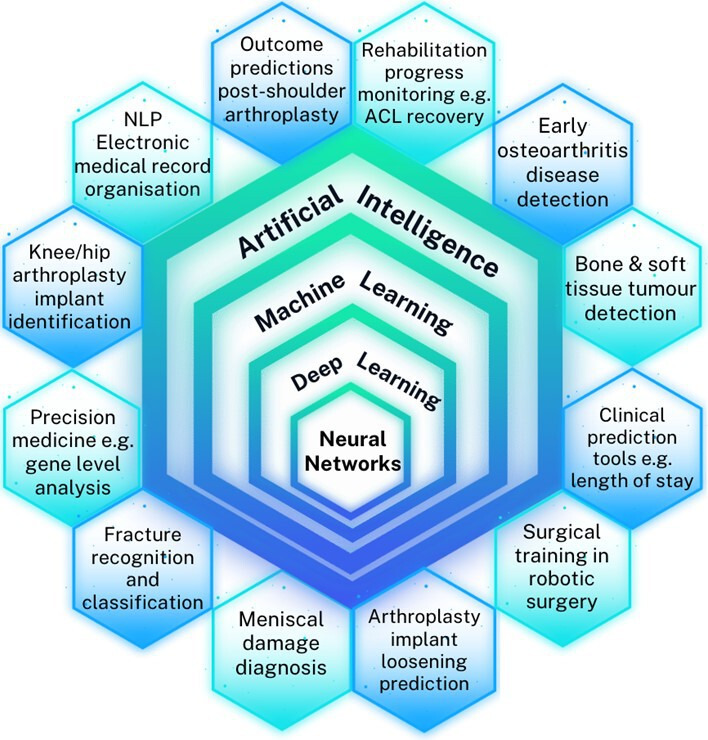
The use of artificial intelligence (AI) is rapidly growing across many domains, of which the medical field is no exception. AI is an umbrella term defining the practical application of algorithms to generate useful output, without the need of human cognition. Owing to the expanding volume of patient information collected, known as 'big data', AI is showing promise as a useful tool in healthcare research and across all aspects of patient care pathways. Practical applications in orthopaedic surgery include: diagnostics, such as fracture recognition and tumour detection; predictive models of clinical and patient-reported outcome measures, such as calculating mortality rates and length of hospital stay; and real-time rehabilitation monitoring and surgical training. However, clinicians should remain cognizant of AI's limitations, as the development of robust reporting and validation frameworks is of paramount importance to prevent avoidable errors and biases. The aim of this review article is to provide a comprehensive understanding of AI and its subfields, as well as to delineate its existing clinical applications in trauma and orthopaedic surgery. Furthermore, this narrative review expands upon the limitations of AI and future direction.
Overview
The claims and statistics of this paper haven’t been checked yet.
Run the check — free, no account needed. It reads the open-access text and checks the sources it cites.
Integrity signals
Registry
Cites
Statistics
Figures
Verification
Claims the paper makes
The claims and statistics of this paper haven’t been checked yet.
Run the check — free, no account needed. It reads the open-access text and checks the sources it cites.
Claims other papers make about this one
Each is checked against this paper’s own text: does it say what the citing paper says it does?
In the citing paper
“Ethical concerns regarding data privacy, the potential for misinformation, and the need for regular content updates remain significant challenges for AI applications in orthopaedics [18].”
From Comparative Efficacy of ChatGPT and DeepSeek in Addressing Patient Queries on Gonarthrosis and Total Knee Arthroplasty (2025) · cites this paper as [18]
Self-check
Percentages, sums and reported differences re-computed from the paper’s own numbers.
The self-check needs the paper’s full text.
Citations
Cites
Convolutional neural networks: an overview and application in radiology
Yamashita, R., Nishio, M., Do, R. K. G., & Togashi, K. (2018) · Insights into Imaging · doi:10.1007/s13244-018-0639-9 · Cited by 4,682
Artificial intelligence in surgery: promises and perils
Hashimoto, D. A., Rosman, G., Rus, D., & Meireles, O. R. (2018) · Annals of Surgery · doi:10.1097/sla.0000000000002693 · Cited by 1,468
Definition of Periprosthetic Joint Infection
Parvizi, J., & Gehrke, T. A. (2014) · The Journal of Arthroplasty · doi:10.1016/j.arth.2014.03.009 · Cited by 916
Minimum information about clinical artificial intelligence modeling: the MI-CLAIM checklist.
Norgeot, B., Quer, G., Beaulieu-Jones, B. K., Torkamani, A., Dias, R., Gianfrancesco, M., Arnaout, R., Kohane, I. S., Saria, S., Topol, E., et al. (2020) · Nature Medicine · doi:10.1038/s41591-020-1041-y · Cited by 665
A standardized method for assessment of elbow function
Research Committee, A. S. A. E. S., Graham J.W King, M., Robin R Richards, M., Joseph D Zuckerman, M., Ralph Blasier, M., Charles Dillman, M., Richard J Friedman, M., Gary M Gartsman, M., Joseph P Iannotti, M., J.Patrick Murnahan, M., et al. (1999) · Journal of Shoulder and Elbow Surgery · doi:10.1016/s1058-2746(99)90159-3 · Cited by 286
Artificial Intelligence and Orthopaedics
Myers, T. G., Ramkumar, P. N., Ricciardi, B. F., Urish, K. L., Kipper, J., & Ketonis, C. (2020) · Journal of Bone and Joint Surgery · doi:10.2106/jbjs.19.01128 · Cited by 254
Leung, K., Zhang, B., Tan, J., Shen, Y., Geras, K. J., Babb, J. S., Cho, K., Chang, G. A., & Deniz, C. M. (2020) · Radiology · doi:10.1148/radiol.2020192091 · Cited by 251
The Digital Twin in Medicine: A Key to the Future of Healthcare?
Sun, T., He, X., Song, X., Shu, L., & Li, Z. (2022) · Frontiers in Medicine · doi:10.3389/fmed.2022.907066 · Cited by 213
Ramkumar, P. N., Haeberle, H. S., Ramanathan, D., Cantrell, W. A., Navarro, S. M., Mont, M. A., Bloomfield, M. R., & Patterson, B. M. (2019) · The Journal of Arthroplasty · doi:10.1016/j.arth.2019.05.021 · Cited by 209
Langerhuizen, D. W. G., Janssen, S. J., Mallee, W. H., van den Bekerom, M. P. J., Ring, D., Kerkhoffs, G. M. M. J., Jaarsma, R. L., & Doornberg, J. N. (2019) · Clinical Orthopaedics and Related Research · doi:10.1097/corr.0000000000000848 · Cited by 197
Artificial Intelligence in Musculoskeletal Imaging: Current Status and Future Directions
Gyftopoulos, S., Lin, D. J., Knöll, F., Doshi, A. M., Rodrigues, T. C., & Recht, M. P. (2019) · American Journal of Roentgenology · doi:10.2214/ajr.19.21117 · Cited by 170
Pranata, Y. D., Wang, K.-C., Wang, J., Idram, I., Lai, J., Liu, J., & Hsieh, I.-H. (2019) · Computer Methods and Programs in Biomedicine · doi:10.1016/j.cmpb.2019.02.006 · Cited by 159
Harris, A. H. S., Kuo, A. C., Weng, Y., Trickey, A. W., Bowe, T. R., & Giori, N. J. (2019) · Clinical Orthopaedics and Related Research · doi:10.1097/corr.0000000000000601 · Cited by 147
Olczak, J., Pavlopoulos, J., Prijs, J., IJpma, F. F. A., Doornberg, J. N., Lundström, C. F., Hedlund, J., & Gordon, M. (2021) · Acta Orthopaedica · doi:10.1080/17453674.2021.1918389 · Cited by 145
Current Concepts in Alignment in Total Knee Arthroplasty
Karasavvidis, T., Moldenhauer, C. A. P., Haddad, F. S., Hirschmann, M. T., Pagnano, M. W., & Vigdorchik, J. M. (2023) · The Journal of Arthroplasty · doi:10.1016/j.arth.2023.01.060 · Cited by 134
Self-citationChang, J. S., Kayani, B., Wallace, C. N., & Haddad, F. S. (2021) · The Bone & Joint Journal · doi:10.1302/0301-620x.103b.bjj-2020-0940.r1 · Cited by 131
Self-citationBorjali, A., Chen, A. F., Muratoglu, O. K., Morid, M. A., & Varadarajan, K. M. (2020) · Journal of Orthopaedic Research® · doi:10.1002/jor.24617 · Cited by 123
Kayani, B., Tahmassebi, J. E., Ayuob, A., Konan, S., Oussedik, S. I., & Haddad, F. S. (2020) · The Bone & Joint Journal · doi:10.1302/0301-620x.103b1.bjj-2020-0602.r2 · Cited by 122
Self-citationApplications of artificial intelligence in orthopaedic surgery
Farhadi, F., Barnes, M. R., Sugito, H. R., Sin, J. M., Henderson, E. R., & Levy, J. (2022) · Frontiers in Medical Technology · doi:10.3389/fmedt.2022.995526 · Cited by 117
Close, A. J., Robertson, C., Rushton, S. P., Shirley, M., Vale, L. D., Ramsay, C. R., & Pickard, R. S. (2013) · European Urology · doi:10.1016/j.eururo.2013.02.040 · Cited by 116
Advancing Surgical Education: The Use of Artificial Intelligence in Surgical Training
Guerrero, D. T., Asaad, M., Rajesh, A., Hassan, A. M., & Butler, C. E. (2022) · The American Surgeon · doi:10.1177/00031348221101503 · Cited by 116
Mehta, S. J., Hume, E. L., Troxel, A. B., Reitz, C., Norton, L. A., Lacko, H., McDonald, C., Freeman, J. D., Marcus, N., Volpp, K. G. M., et al. (2020) · JAMA Network Open · doi:10.1001/jamanetworkopen.2020.28328 · Cited by 108
Artificial intelligence in orthopedic surgery: evolution, current state and future directions
Kurmis, A. P., & Ianunzio, J. R. (2022) · Arthroplasty · doi:10.1186/s42836-022-00112-z · Cited by 105
Assuring the long-term total joint arthroplasty
Kayani, B., Konan, S., Thakrar, R. R., Huq, S. S., & Haddad, F. S. (2019) · The Bone & Joint Journal · doi:10.1302/0301-620x.101b1.bjj-2018-0377.r1 · Cited by 100
Self-citationKim, J., Arvind, V., Oermann, E. K., Kaji, D. A., Ranson, W. A., Ukogu, C. O., Hussain, A. K., Caridi, J. M., & Cho, S. K.-W. (2018) · Spine Deformity · doi:10.1016/j.jspd.2018.03.003 · Cited by 98
Rajan, P. V., Khlopas, A., Klika, A., Molloy, R., Krebs, V., & Piuzzi, N. S. (2022) · Journal of the American Academy of Orthopaedic Surgeons · doi:10.5435/jaaos-d-21-00309 · Cited by 98
Femoral neck fracture detection in X-ray images using deep learning and genetic algorithm approaches
Beyaz, S. (2020) · Joint Diseases and Related Surgery · doi:10.5606/ehc.2020.72163 · Cited by 96
The learning curve of robotic-arm assisted acetabular cup positioning during total hip arthroplasty
Kayani, B., Konan, S., Huq, S. S., Ibrahim, M. S., Ayuob, A., & Haddad, F. S. (2019) · Hip International · doi:10.1177/1120700019889334 · Cited by 94
Self-citationAdvances and innovations in total hip arthroplasty
Fontalis, A., Epinette, J.-A., Thaler, M. R., Zagra, L., Khanduja, V., & Haddad, F. S. (2021) · SICOT-J · doi:10.1051/sicotj/2021025 · Cited by 92
Self-citationTransfusion after total knee arthroplasty can be predicted using the machine learning algorithm
Jo, C., Ko, S., Shin, W. C., Han, H., Lee, M. C., Ko, T., & Ro, D. H. (2019) · Knee Surgery Sports Traumatology Arthroscopy · doi:10.1007/s00167-019-05602-3 · Cited by 91
Kumar, V., Roche, C. P., Overman, S. S., Simovitch, R. W., Flurin, P.-H., Wright, T. W., Zuckerman, J. D., Routman, H. D., & Teredesai, A. M. (2020) · Clinical Orthopaedics and Related Research · doi:10.1097/corr.0000000000001263 · Cited by 91
Artificial intelligence in knee arthroplasty: current concept of the available clinical applications
Batailler, C., Shatrov, J. G., Sappey‐Marinier, E., Servıen, E., Parratte, S., & Lustıg, S. (2022) · Arthroplasty · doi:10.1186/s42836-022-00119-6 · Cited by 91
Langerhuizen, D. W. G., Bulstra, A. E. J., Janssen, S. J., Ring, D., Kerkhoffs, G. M. M. J., Jaarsma, R. L., & Doornberg, J. N. (2020) · Clinical Orthopaedics and Related Research · doi:10.1097/corr.0000000000001318 · Cited by 85
Fontalis, A., Kayani, B., Asokan, A. K., Haddad, I. C., Tahmassebi, J. E., Konan, S., Oussedik, S. I., & Haddad, F. S. (2022) · Journal of Bone and Joint Surgery · doi:10.2106/jbjs.22.00167 · Cited by 85
Self-citationRouzrokh, P., Ramazanian, T., Wyles, C. C., Philbrick, K. A., Cai, J. C., Taunton, M. J., Kremers, H. M., Lewallen, D. G., & Erickson, B. J. (2021) · The Journal of Arthroplasty · doi:10.1016/j.arth.2021.02.028 · Cited by 80
Karnuta, J. M., Churchill, J. L., Haeberle, H. S., Nwachukwu, B. U., Taylor, S. A., Ricchetti, E. T., & Ramkumar, P. N. (2020) · Journal of Shoulder and Elbow Surgery · doi:10.1016/j.jse.2020.04.009 · Cited by 68
Artificial intelligence for image analysis in total hip and total knee arthroplasty
Gurung, B. B., Liu, P., Harris, P., Sagi, A., Field, R. E., Sochart, D. H., Tucker, K., & Asopa, V. (2022) · The Bone & Joint Journal · doi:10.1302/0301-620x.104b8.bjj-2022-0120.r2 · Cited by 67
Park, C.-W., Oh, S. J., Kim, K., Jang, M. C., Kim, I. S., Lee, Y.-K., Chung, M. J., Cho, B. H., & Seo, S.-W. (2022) · PLoS ONE · doi:10.1371/journal.pone.0264140 · Cited by 64
Artificial intelligence in orthopedic surgery
Han, X., & Tian, W. (2019) · Chinese Medical Journal · doi:10.1097/cm9.0000000000000479 · Cited by 62
Artificial Intelligence in Sports Medicine: Could GPT-4 Make Human Doctors Obsolete?
Cheng, K., Guo, Q., He, Y., Lu, Y., Xie, R., Li, C., & Wu, H. (2023) · Annals of Biomedical Engineering · doi:10.1007/s10439-023-03213-1 · Cited by 59
Fu, S., Wyles, C. C., Osmon, D. R., Carvour, M. L., Sagheb, E., Ramazanian, T., Kremers, W. K., Lewallen, D. G., Berry, D. J., Sohn, S., et al. (2020) · The Journal of Arthroplasty · doi:10.1016/j.arth.2020.07.076 · Cited by 56
Wei, C., Quan, T., Wang, K. Y., Gu, A., Fassihi, S. C., Kahlenberg, C. A., Malahias, M., Liu, J., Thakkar, S. C., Valle, A. G. D., et al. (2021) · The Bone & Joint Journal · doi:10.1302/0301-620x.103b8.bjj-2020-1013.r2 · Cited by 55
Hirvasniemi, J., Gielis, W. P., Arbabı, S., Agricola, R., van Spil, W. E., Arbabi, V., & Weinans, H. (2019) · Osteoarthritis and Cartilage · doi:10.1016/j.joca.2019.02.796 · Cited by 52
Carmo, L. O. E., van den Merkhof, A., Olczak, J., Gordon, M., Jutte, P. C., Jaarsma, R. L., IJpma, F. F. A., Doornberg, J. N., & Prijs, J. (2021) · Bone & Joint Open · doi:10.1302/2633-1462.210.bjo-2021-0133 · Cited by 52
Kumar, V., Schoch, B. S., Allen, C. M. B., Overman, S., Teredesai, A. M., Aibinder, W. R., Parsons, M., Watling, J. P., Ko, J.-W. K., Gobbato, B. B., et al. (2021) · Journal of Shoulder and Elbow Surgery · doi:10.1016/j.jse.2021.10.032 · Cited by 49
Kumar, V., Patel, S., Baburaj, V., Vardhan, A., Singh, P. K., & Vaishya, R. (2022) · Journal of Orthopaedics · doi:10.1016/j.jor.2022.08.020 · Cited by 48
Breteler, M. J. M., Numan, L., Ruurda, J. P. H., van Hillegersberg, R., van der Horst, S., Dohmen, D., van Rossum, M., & Kalkman, C. J. (2020) · JMIR Perioperative Medicine · doi:10.2196/21705 · Cited by 47
Artificial Intelligence in the Management of Anterior Cruciate Ligament Injuries
Corban, J. P. A. H., Lorange, J.-P., Laverdière, C., Khoury, J., Rachevsky, G., Burman, M. L., & Martineau, P. A. (2021) · Orthopaedic Journal of Sports Medicine · doi:10.1177/23259671211014206 · Cited by 47
Kunze, K. N., Orr, M. N., Krebs, V. E., Bhandari, M., & Piuzzi, N. S. (2022) · Bone & Joint Open · doi:10.1302/2633-1462.31.bjo-2021-0123.r1 · Cited by 42
Siemionow, K., Katchko, K., Lewicki, P., & Luciano, C. J. (2020) · Journal of Craniovertebral Junction and Spine · doi:10.4103/jcvjs.jcvjs_48_20 · Cited by 41
Artificial intelligence in arthroplasty
Purnomo, G., Yeo, S.-J., & Liow, M. H. L. (2021) · Arthroplasty · doi:10.1186/s42836-021-00095-3 · Cited by 39
Archer, H., Reine, S., Alshaikhsalama, A. M., Wells, J. E., Kohli, A., Vazquez, L. C., Hummer, A., DiFranco, M. D., Ljuhar, R., Xi, Y., et al. (2022) · Bone & Joint Open · doi:10.1302/2633-1462.311.bjo-2022-0125.r1 · Cited by 39
Functional implant positioning in total hip arthroplasty and the role of robotic-arm assistance
Fontalis, A., Raj, R. D., Kim, W. J., Gabr, A., Glod, F., Foissey, C., Kayani, B., Putzeys, P., & Haddad, F. S. (2022) · International Orthopaedics · doi:10.1007/s00264-022-05646-0 · Cited by 36
Self-citationThe language of knee alignment
MacDessi, S. J., Oussedik, S. I., Abdel, M. P., Victor, J. M. K., Pagnano, M. W., & Haddad, F. S. (2023) · The Bone & Joint Journal · doi:10.1302/0301-620x.105b2.bjj-2023-00028 · Cited by 36
Self-citationNguyen, T. P., Chae, D., Park, S., & Yoon, J. (2021) · Computers in Biology and Medicine · doi:10.1016/j.compbiomed.2021.104298 · Cited by 34
Innocenti, B., Radyul, Y., & Bori, E. (2022) · Applied Sciences · doi:10.3390/app122110775 · Cited by 34
Concerns surrounding application of artificial intelligence in hip and knee arthroplasty
Polisetty, T. S., Jain, S., Pang, M., Karnuta, J. M., Vigdorchik, J. M., Nawabi, D. H., Wyles, C. C., & Ramkumar, P. N. (2022) · The Bone & Joint Journal · doi:10.1302/0301-620x.104b12.bjj-2022-0922.r1 · Cited by 32
Natural Language Processing and Its Use in Orthopaedic Research
Wyatt, J. M., Booth, G. J., & Goldman, A. H. (2021) · Current Reviews in Musculoskeletal Medicine · doi:10.1007/s12178-021-09734-3 · Cited by 31
Comparison of tibial alignment parameters based on clinically relevant anatomical landmarks
Jang, S. J., Kunze, K. N., Brilliant, Z. R., Henson, M., Mayman, D. J., Jerabek, S. A., Vigdorchik, J. M., & Sculco, P. K. (2022) · Bone & Joint Open · doi:10.1302/2633-1462.310.bjo-2022-0082.r1 · Cited by 30
Not the Last Word: ChatGPT Can’t Perform Orthopaedic Surgery
Bernstein, J. (2023) · Clinical Orthopaedics & Related Research · doi:10.1097/corr.0000000000002619 · Cited by 29
Machine Learning and Internet of Things Enabled Monitoring of Post-Surgery Patients: A Pilot Study
Alsareii, S. A., Raza, M., Alamri, A. M., AlAsmari, M. Y., Irfan, M., Khan, U. F., & Awais, M. (2022) · Sensors · doi:10.3390/s22041420 · Cited by 29
Farrow, L., Zhong, M., Ashcroft, G. P., Anderson, L., & Meek, R. M. D. (2021) · The Bone & Joint Journal · doi:10.1302/0301-620x.103b12.bjj-2021-0851.r1 · Cited by 28
Al-Hourani, K., Tsang, S.-T. J., & Simpson, A. H. R. W. (2021) · Bone and Joint Research · doi:10.1302/2046-3758.1012.bjr-2021-0452.r1 · Cited by 25
McDonnell, J. M., Evans, S., McCarthy, L., Temperley, H. C., Waters, C., Ahern, D. P., Cunniffe, G. M., Morris, S. F., Synnott, K. A., Birch, N. C., et al. (2021) · The Bone & Joint Journal · doi:10.1302/0301-620x.103b9.bjj-2021-0192.r1 · Cited by 24
Deep learning approach for survival prediction for patients with synovial sarcoma
Han, I., Kim, J. H., Park, H., Kim, H., & Seo, S. W. (2018) · Tumor Biology · doi:10.1177/1010428318799264 · Cited by 22
AI MSK clinical applications: orthopedic implants
Yi, P. H., Mutasa, S., & Fritz, J. M. (2021) · Skeletal Radiology · doi:10.1007/s00256-021-03879-5 · Cited by 20
Artificial intelligence and computer vision in orthopaedic trauma
Prijs, J., Liao, Z., Ashkani‐Esfahani, S., Olczak, J., Gordon, M., Jayakumar, P., Jutte, P. C., Jaarsma, R. L., IJpma, F. F. A., & Doornberg, J. N. (2022) · The Bone & Joint Journal · doi:10.1302/0301-620x.104b8.bjj-2022-0119.r1 · Cited by 20
Baessler, A. M., Brolin, T. J., Azar, F. M., Sen, Ś., Chang, M., Falkner, D., Zmistowski, B. M., Routman, H. D., Namdari, S., Gulotta, L. V., et al. (2021) · Journal of Shoulder and Elbow Surgery · doi:10.1016/j.jse.2021.06.007 · Cited by 19
Artificial intelligence and surgical innovation: lower limb arthroplasty
Magan, A. A., Kayani, B., Chang, J. S., Roussot, M. A., Moriarty, P., & Haddad, F. S. (2020) · British Journal of Hospital Medicine · doi:10.12968/hmed.2020.0309 · Cited by 18
Self-citationDeep learning in orthopaedic research
Vigdorchik, J. M., Jang, S. J., Taunton, M. J., & Haddad, F. S. (2022) · The Bone & Joint Journal · doi:10.1302/0301-620x.104b8.bjj-2022-0416 · Cited by 18
Self-citationSoldozy, S., Young, S., Yağmurlu, K., Norat, P., Sokolowski, J. D., Park, M. S., Jane, J. A., & Syed, H. R. (2020) · Clinical Neurology and Neurosurgery · doi:10.1016/j.clineuro.2020.106152 · Cited by 16
Lavanchy, J. L., Zindel, J., Kirtac, K., Twick, I., Hosgor, E., Candinas, D., & Beldi, G. (2021) · Scientific Reports · doi:10.1038/s41598-021-88175-x · Cited by 15
Borjali, A., Chen, A. F., Muratoglu, O. K., Morid, M. A., & Varadarajan, K. M. (2019) · arXiv (Cornell University) · doi:10.48550/arxiv.1912.00943 · Cited by 13
A New Approach to Orthopedic Surgery Planning Using Deep Reinforcement Learning and Simulation
Ackermann, J., Wieland, M. J., Hoch, A., Ganz, R., Snedeker, J. G., Oswald, M. R., Pollefeys, M., Zingg, P. O., Esfandiari, H., & Fürnstahl, P. (2021) · Lecture notes in computer science · doi:10.1007/978-3-030-87202-1_52 · Cited by 12
Deep Learning-Based MRI in Diagnosis of Fracture of Tibial Plateau Combined with Meniscus Injury
Xie, X., Li, Z., Bai, L., Zhou, R., Li, C., Jiang, X., Zuo, J., & Qi, Y. (2021) · Scientific Programming · doi:10.1155/2021/9935910 · Cited by 12
Medical Image Computing and Computer Assisted Intervention – MICCAI 2021
de Bruijne, M., Cattin, P. C., Cotin, S., Padoy, N., Speidel, S., Zheng, Y., & Essert, C. (2021) · Lecture notes in computer science · doi:10.1007/978-3-030-87202-1 · Cited by 12
‘Robosurgeons vs. robosceptics’: can we afford robotic technology or can we afford not to?
Sandhu, J. (2018) · Journal of Clinical Urology · doi:10.1177/2051415818812300 · Cited by 6
Research works printed but not linked: 1
- Kim KM , Yefimova M , Lin FV , Jopling JK , Hansen EN . A Home-Recovery Surgical Care Model Using AI-Driven Measures of Activities of Daily Living . NEJM Catal . 2022 . 10.1056/CAT.22.0081 . https://catalyst.nejm.org/doi/full/10.1056/CAT.22.0081 ( date last accessed 23 June 2023 ). · DOI
Cited by
Sorted by citations
Artificial intelligence: revolutionizing robotic surgery: review
Iftikhar, M., Saqib, M., Zareen, M., & Mumtaz, H. (2024) · Annals of Medicine and Surgery · doi:10.1097/ms9.0000000000002426 · Cited by 161
ChatGPT and large language models in orthopedics: from education and surgery to research
Chatterjee, S., Bhattacharya, M., Pal, S., Lee, S., & Chakraborty, C. (2023) · Journal of Experimental Orthopaedics · doi:10.1186/s40634-023-00700-1 · Cited by 85
Prospective applications of bioactive materials in orthopedic therapies: A review
Liang, W., Zhou, C., Bai, J., Zhang, H., Long, H., Jiang, B., Wang, J., Huang, X., Zhang, H., & Zhao, J. (2024) · Heliyon · doi:10.1016/j.heliyon.2024.e36152 · Cited by 45
AI in Orthopedic Research: A Comprehensive Review
Mısır, A., & Yuce, A. (2025) · Journal of Orthopaedic Research® · doi:10.1002/jor.26109 · Cited by 46
Applications of artificial intelligence for adolescent idiopathic scoliosis: mapping the evidence
Goldman, S. N., Hui, A. T., Choi, S., Mbamalu, E., Tirabady, P., Eleswarapu, A. S., Gómez, J. A., Alvandi, L. M., & Fornari, E. D. (2024) · Spine Deformity · doi:10.1007/s43390-024-00940-w · Cited by 40
Metadata
- Authors
- Lisacek-Kiosoglous, A. B., Powling, A. S., Fontalis, A., Gabr, A., Mazomenos, E., & Haddad, F. S.
- Affiliations
- University College Hospital (GB)
- Wellcome / EPSRC Centre for Interventional and Surgical Sciences (GB)
- Corresponding author
- Fontalis, Andreas
- ORCID
- Venue
- Bone & Joint Research
- Published
- 2023-07-10
- Volume
- 12
- Issue
- 7
- Pages
- 447-454
- ISSN
- 2046-3758 (ISSN-L)
- PMC
- PMC10329876
- OpenAlex
- W4383683017
- Cited by
- 184
- References
- 77
- Citations by year
- 2026: 56 · 2025: 75 · 2024: 43 · 2023: 10
- FWCI
- 7.35
- Type
- journal article
- Language
- en
- Open access
- gold
- doi.org
- Licence
- Locations
- Bone and Joint Research (publishedVersion, cc-by-nc-nd)
- PubMed Central (publishedVersion, cc-by-nc-nd)
- PubMed (publishedVersion)
- UCL Discovery (University College London) (submittedVersion, cc-by-nc-nd)
- DOAJ (DOAJ: Directory of Open Access Journals) (submittedVersion, cc-by-sa)
- Funders
- Wellcome Trust (203145/Z/16/Z)
- Alexander S. Onassis Public Benefit Foundation
- Wellcome / EPSRC Centre for Interventional and Surgical Sciences (203145Z/16/Z)
- Engineering and Physical Sciences Research Council (203145/Z/16/Z)
- Topics
- Health Sciences › Medicine › Health Informatics › Artificial Intelligence in Healthcare and Education
- Physical Sciences › Computer Science › Artificial Intelligence › Artificial Intelligence Applications
- Physical Sciences › Engineering › Biomedical Engineering › Medical Imaging and Analysis
- Keywords
- artificial intelligence, orthopedic surgery, trauma surgery, fracture detection, cancer detection, prediction model, mortality prediction, length of hospital stay, patient-reported outcomes, rehabilitation monitoring, surgical training, algorithmic bias, validation framework, big data
About these checks
Registry, retraction, Cites and statistics results are computed, not judged, with one exception: a printed reference that no index lists is read once by a model before it counts as a citation error. Claims are extracted by a model and kept only when their quote appears verbatim in the text; each cited source is then checked, with a model’s help, for whether it says what the claim relies on. Those verdicts can be wrong — read the claim’s quote and the cited source before relying on one.
Statistics and arithmetic are recomputed, not judged.
Confidence bands are shown only for fields calibrated on our annotated test set. None is calibrated yet, so no band is shown.
What counts as a claim ›How we measure confidence ›How we check this ›
Are you an author, or do you see a problem with this page? Request a review
