

Jericho. From the Neolithic to the Bronze and Iron Ages: The Urban Diversity
Open accessThe DOI matches its Crossref record; 30 of the 30 references it cites were found in a registry or an index; none of the 102 sources its claims cite is checked for support yet.
Abstract
Sixteen seasons (1997-2022) of excavations and restorations at Tell es-Sultan/Jericho by \nSapienza University of Rome and the Palestinian MoTA-DACH revealed new data on the \nhistory and archaeology of this renowned site of Palestine. A contextual approach reveals \nthe basic contribution that such a long-lived settlement may provide for the interpretation \nand conceptualization of Levantine archaeology. Human community vs environment, social \norganization vs cognitive interpretation of life and afterlife, dynamics of exploitation and \nlandscape modeling vs adaptation and cultural invention. All these fields of investigation \nare touched by the archaeological research at the site. When history makes its appearance, \nand sources support our historical reconstruction, the retrieval of Egyptian items as well as \nthe possible identification of the Canaanite name of the city, Ruha, may help in disentangling \nits complex history passing through foreign influence in Palestinian Bronze Age. Last \nbut not least, the joint Italian-Palestinian Expedition testifies to a cooperation which resisted \nsince 1997, opposing the overall political trend which emphasizes differences and confrontation, \nclaiming for a shared, autonomous and authoritative Cultural Heritage.
Overview
CoChat Summary
TL;DR
This synthesis of 16 excavation and restoration seasons at Tell es-Sultan/Jericho traces the site’s long occupational history from the Neolithic through the Iron Age, emphasizing repeated urban transformations and diversity. It argues that Jericho’s spring, oasis, and strategic position shaped cycles of urbanization, collapse, and re-urbanization, with Egyptian and broader Levantine connections.
Key findings
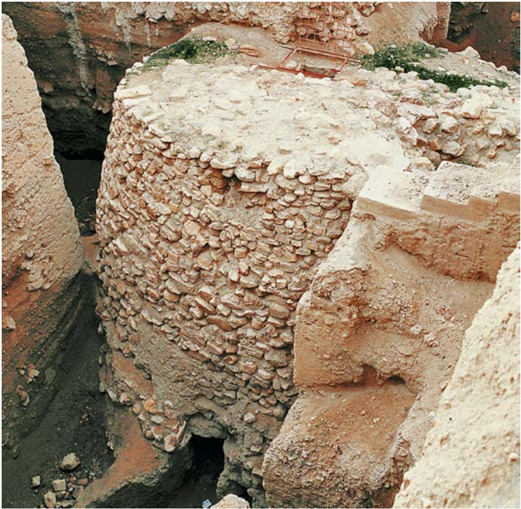
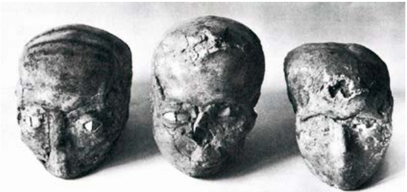
- Pre-Pottery Neolithic Jericho was a 4-hectare village with communal buildings including the Round Tower and a “town-wall”; more than 500 people lived there in the 9th millennium BC, growing to at least 2,000 individuals by the end of PPNA (7,500 BC). Plastered skulls, specialized flint industry, and obsidian exchange reaching Anatolia are cited as evidence of social complexity and long-distance connections.
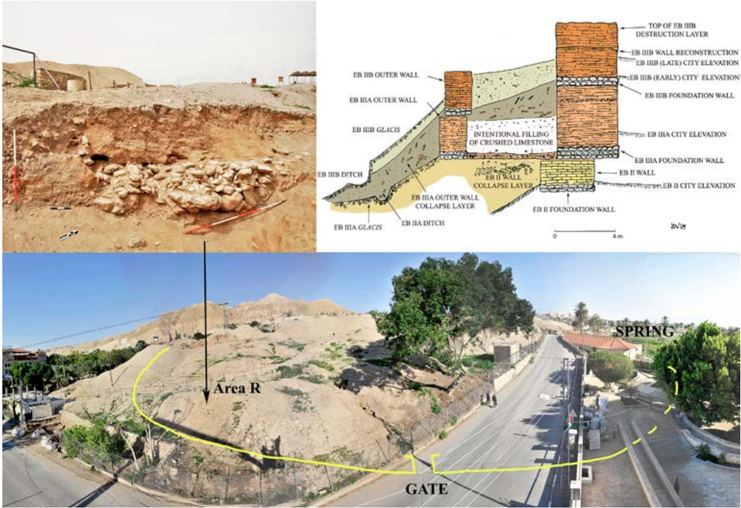
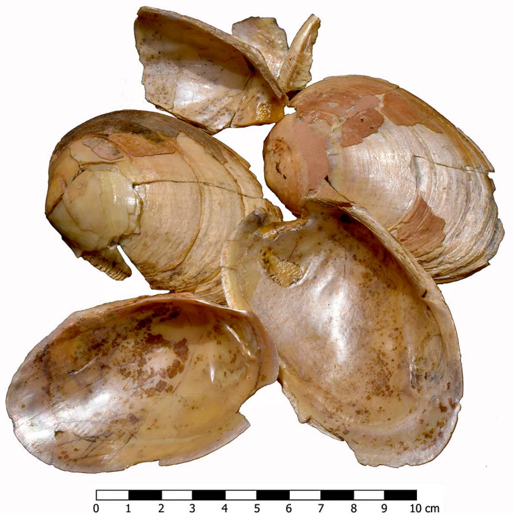
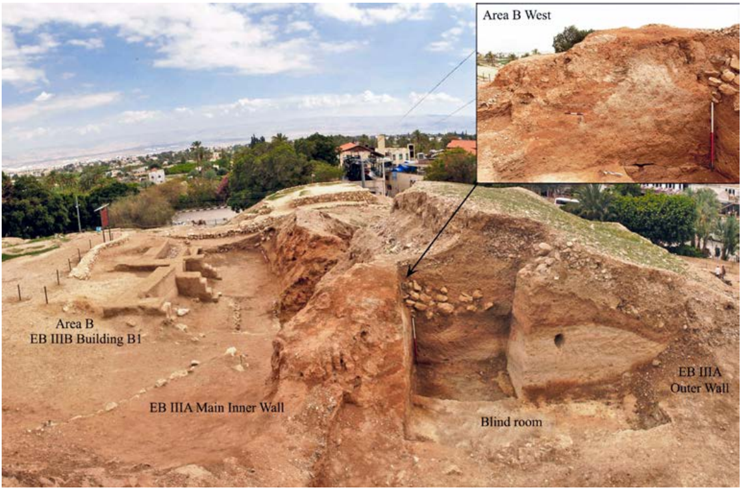
- Early Bronze Age Jericho developed from an EB I hamlet into an EB II city with a solid city-wall, terraced quarters, a temple, and a main gate; five mother-of-pearl shells from the Nile were found in an EB IIA cache. The EB II city ended suddenly due to a violent earthquake around 2700 BC. EB III rebuilt and doubled the fortifications, added a palace, and produced finds including a copper axe and dagger, a potter’s wheel, two fragmentary Egyptian palettes, and a marble mace-head; this urban phase collapsed in the mid-24th century BC due to an enemy attack.
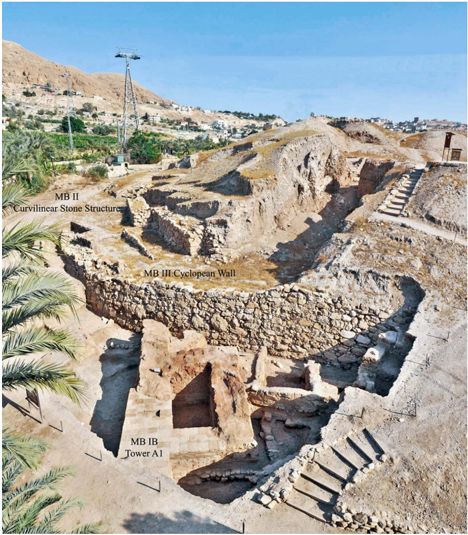
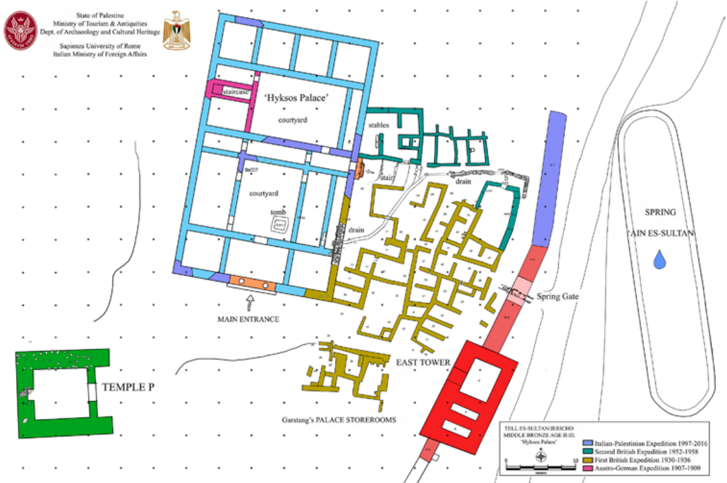
- Middle Bronze Age re-urbanization occurred in the 20th century BC and was attributed to Amorites; Jericho became the capital of a city-state. The MB II–III temple P was a “Migdol”/long-room temple with very high and thick walls (2.2 m). A scarab (TS.99.G.500) mentions the “Administrator of Jericho” (Adjmer Ruha), and another scarab bears the prenomen of Pharaoh Hotep-ib-ra; the city was destroyed in the second half of the 16th century BC, with radiocarbon dates fixing the event between 1550 and 1520 cal BC.
- In the Late Bronze Age, Jericho recovered as a town with weaker fortifications, the “Middle Building,” and a cuneiform tablet testifying to a chancellery and administration. By the 9th century BC, Iron Age Jericho was again a walled city with a tripartite public building, the “Hilani”; a double-winged royal stamp on a jar handle may indicate inclusion in the administration of the Kingdom of Judah in the 7th–6th centuries BC.
Methods
- Design: contextual synthesis of 16 seasons of excavations and restorations at Tell es-Sultan/Jericho by Sapienza University of Rome and the Palestinian MoTA-DACH, incorporating earlier British excavations (1955–1958) and Italian-Palestinian work (1997–2020).
- Data or sample: Tell es-Sultan/Jericho, 7 km north of the Dead Sea and 270 m below sea level, in the oasis formed by the Spring of Ain es-Sultan; the paper covers periods from the Mesolithic/Pre-Pottery Neolithic through the Iron Age.
- Main analysis: period-by-period contextual and stratigraphic reconstruction integrating architecture, material culture, trade items, and radiocarbon dates, such as the MB destruction dated between 1550 and 1520 cal BC.
Limitations
- The paper does not state limitations.
- Evident from the text: it is a broad synthetic overview rather than a full excavation report, and many details and interpretations depend on cited prior publications.
- Evident from the text: some historical identifications and event attributions are hedged as possible or suggested, including the Canaanite name Ruha, Egyptian connections, and the attribution of the MB destruction to Ahmose or Amenhotep I.
Model-written summary. Check it against the paper before relying on it.
Integrity signals
Registry
Cites
Statistics
Figures
Verification
Claims the paper makes
0 Valid · 1 Not valid · 56 Not checked · 18 Own results and interpretations
A result the paper states — it cites no source for it, so there is none to check. The quote shows it is in the paper.
In the paper
“Sixteen seasons of excavations and restorations at Tell es-Sultan/Jericho by Sapienza University of Rome and the Palestinian MoTA-DACH revealed new data on the history and archaeology of this renowned site of Palestine.”
§ Jericho. From the Neolithic to the Bronze and Iron Ages: The Urban Diversity > Abstract
plainstates a causeSingle case- Asserted: passes — The authors put it forward as true.
- Checkable: passes — It can be checked against evidence.
- Load-bearing: passes — The paper’s conclusions depend on it.
- Based: passes — The paper gives a reason why it holds.
None of the sources cited for this claim could be matched to a paper, so there is nothing to check it against.
In the paper
“At the beginning of the 3 rd millennium BC, Jericho underwent a major transformation with the erection of a solid city-wall made of yellowish bricks set upon a two courses-thick stone foundations (Nigro 2010a: 11-38;2010b: 461-463;Gallo 2019: 119-124).”
§ Jericho. From the Neolithic to the Bronze and Iron Ages: The Urban Diversity > Early Bronze II (Sultan IIIb, 3000-2700 BC): rise of a city
What the sources say
- Not matchedcites Nigro 2010a
More than one paper fits this citation.
- Not matchedcites Nigro 2010b
More than one paper fits this citation.
- Not matchedcites Gallo 2019
An author–year citation the paper’s reference list doesn’t settle. We don’t search these by name.
plain- Asserted: passes — The authors put it forward as true.
- Checkable: passes — It can be checked against evidence.
- Load-bearing: unclear — It is unclear whether the paper’s conclusions depend on it.
- Based: passes — The paper gives a reason why it holds.
- Not matched
In the paper
“Tomb A testifies to the emergence of a leader, buried in primary deposition in a distinguished posture with raised arms and his mace in between the legs (Garstang 1932: 19-22, pl. VII:5).”
§ Jericho. From the Neolithic to the Bronze and Iron Ages: The Urban Diversity > Early Bronze I (Sultan IIIa1, 3500-3000 BC): path to urbanization
What the sources say
- Not matchedcites Garstang 1932
An author–year citation the paper’s reference list doesn’t settle. We don’t search these by name.
plainstates a causeSingle case- Asserted: passes — The authors put it forward as true.
- Checkable: passes — It can be checked against evidence.
- Load-bearing: unclear — It is unclear whether the paper’s conclusions depend on it.
- Based: passes — The paper gives a reason why it holds.
- Not matched
None of the sources cited for this claim could be matched to a paper, so there is nothing to check it against.
In the paper
“These transformations were accompanied by a development of the material culture, visible in pottery making and in the emergence of copper tools and weapons (Nigro 2014b: 71;2014c).”
§ Jericho. From the Neolithic to the Bronze and Iron Ages: The Urban Diversity > Early Bronze II (Sultan IIIb, 3000-2700 BC): rise of a city
What the sources say
- Not matchedcites Nigro 2014b
More than one paper fits this citation.
- Not matchedcites Nigro 2014c
More than one paper fits this citation.
plainstates an association- Asserted: passes — The authors put it forward as true.
- Checkable: passes — It can be checked against evidence.
- Load-bearing: unclear — It is unclear whether the paper’s conclusions depend on it.
- Based: passes — The paper gives a reason why it holds.
- Not matched
None of the sources cited for this claim have been checked yet.
In the paper
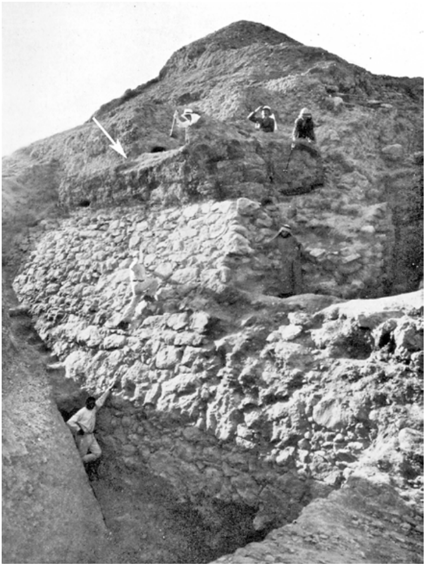
“They were re-built twice in MB II by adding a rampart made of intermingled strata of earth and crushed limestone, and a stone retaining wall (CSS) at the bottom of the latter (Nigro et al. 2011: 581-584, figs. 13-14;Nigro 2020a: 196-199).”
§ Jericho. From the Neolithic to the Bronze and Iron Ages: The Urban Diversity > Middle Bronze Age (Sultan IV, 2000-1500 BC): the urban rebirth
What the sources say
- Not checked yetcites Nigro et al. 2011
- Not matchedcites Nigro 2020a
More than one paper fits this citation.
plain- Asserted: passes — The authors put it forward as true.
- Checkable: passes — It can be checked against evidence.
- Load-bearing: unclear — It is unclear whether the paper’s conclusions depend on it.
- Based: passes — The paper gives a reason why it holds.
23 more claims
Create a free account to see all 75 claims and to verify the 17 references still open.
- It may state two separate claims as one. 40
- Probably not a substantial claim. 4
- The quote only partly states this claim. 3
Citations
Cites
Ritual and Ceremony at Neolithic Ain Ghazal (Jordan)
Rollefson, G. O. (1983) · Paléorient · doi:10.3406/paleo.1983.4339 · Cited by 99
Cuneiform in Canaan: Cuneiform Sources from the Land of Israel in Ancient Times
Horowitz, W., Oshima, T. M., & Sanders, S. L. (2018) · Cited by 86
Goren, Y., Goring-Morris, A. N., & Segal, I. (2001) · Journal of Archaeological Science · doi:10.1006/jasc.1999.0573 · Cited by 69
Egypt and Canaan during the Middle Bronze Age
Bietak, M. (1991) · Bulletin of the American Schools of Oriental Research · doi:10.2307/1357163 · Cited by 59
The Neolithic of the southern Levant
Twiss, K. C. (2007) · Evolutionary Anthropology: Issues, News, and Reviews · doi:10.1002/evan.20113 · Cited by 47
Kuijt, I. (2001) · Archaeological Papers of the American Anthropological Association · doi:10.1525/ap3a.2001.10.1.80 · Cited by 36
Some Notes on the History of Jericho in the Second Millennium. B.C
Kenyon, K. M. (1951) · Palestine Exploration Quarterly · doi:10.1179/peq.1951.83.2.101 · Cited by 35
Camels, Copper and Donkeys in the Early Iron Age of the Southern Levant: Timna Revisited
Grigson, C. (2012) · Levant · doi:10.1179/175638012x13285409187919 · Cited by 34
Bruins, H. J., & Van Der Plight, J. (1995) · Radiocarbon · doi:10.1017/s0033822200030666 · Cited by 29
Jericho and the Chronology of Palestine in the Early Bronze Age: a Radiometric Re-Assessment
Nigro, L., Calcagnile, L., Yasin, J., Gallo, E., & Quarta, G. (2018) · Radiocarbon · doi:10.1017/rdc.2018.76 · Cited by 26
Self-citationSHA‘AR HAGOLAN AND NEW INSIGHTS ON NEAR EASTERN PROTO-HISTORIC URBAN CONCEPTS
Ben‐Shlomo, D., & Garfınkel, Y. (2009) · Oxford Journal of Archaeology · doi:10.1111/j.1468-0092.2009.00324.x · Cited by 25
PPNA Jericho: a Socio-political Perspective
Naveh, D. (2003) · Cambridge Archaeological Journal · doi:10.1017/s0959774303000052 · Cited by 24
Jericho : die ergebnisse der ausgrabungen
Sellin, E., & Watzinger, C. (1973) · Digital Library of the University of Innsbruck (University of Innsbruck) · Cited by 23
Proceedings of the 12th International Congress on the Archaeology of the Ancient Near East
Giacosa, G., Guidetti, M., & Mariani, E. (2023) · Harrassowitz Verlag eBooks · doi:10.13173/9783447119030 · Cited by 11
Tell es-Sultan 2015: A Pilot Project for Archaeology in Palestine
Nigro, L. (2016) · Near Eastern Archaeology · doi:10.5615/neareastarch.79.1.0004 · Cited by 10
Self-citationJericho in the Late Bronze Age
Cartledge, T. W., & Bieńkowski, P. (1988) · Journal of Biblical Literature · doi:10.2307/3267830 · Cited by 8
Nigro, L., Montanari, D., Mura, F., Yasine, J., & Rinaldi, T. (2018) · Palestine Exploration Quarterly · doi:10.1080/00310328.2018.1425957 · Cited by 8
Self-citationNIGRO, L. (2009) · IRIS Research product catalog (Sapienza University of Rome) · Cited by 8
Self-citation(2009) · IRIS Research product catalog (Sapienza University of Rome) · Cited by 5
Self-citationNigro, L. (2017) · IRIS Research product catalog (Sapienza University of Rome) · Cited by 5
Self-citationThe Walls of Jericho. The Marston-Melchett Expedition of 1931
Garsta, J. (1931) · Palestine Exploration Quarterly · doi:10.1179/peq.1931.63.4.186 · Cited by 4
EGYPTIAN AND EGYPTIANIZING OBJECTS FROM EB I-III TELL ES-SULTAN/ANCIENT JERICHO
Sala, M. (2012) · Vicino Oriente · doi:10.53131/vo2724-587x2012_14 · Cited by 3
Metal Weapons and Social Differentiation at Bronze Age Tell es-Sultan
Montanari, D. (2020) · Archaeopress Publishing Ltd eBooks · doi:10.2307/j.ctvwh8bss.12 · Cited by 3
When the walls tumble down Jericho : rise and collapse of an Early Bronze Age Palestinian city
Nigro, L. (2009) · IRIS Research product catalog (Sapienza University of Rome) · Cited by 1
Self-citationA Turtle Dove Rhyton from the “Hyksos Palace” at Tell es-Sultan, Ancient Jericho
Nigro, L. (2019) · Zaphon eBooks · doi:10.2307/jj.18654695.38 · Cited by 1
Self-citationFiaccavento, C., & Gallo, E. (2020) · Digging Up Jericho · doi:10.2307/j.ctvwh8bss.17
(2007)
(1986)
(2011) · IRIS Research product catalog (Sapienza University of Rome)
Self-citation
Research works printed but not linked: 9
- Benz, M. 2010 Beyond Death -the Construction of Social Identities at the Transition from Foraging to Farming. In: M. Benz (ed.), The Principle of Sharing. Segregation and Construction of Social Identities at the Transition from Foraging to Farming (Studies in Early Near Eastern Production, Subsistence and Environment 14), Berlin, 240-276.
- Bourke, S. 2012 The Six Canaanite Temples of Tabaqat Falil: Excavating Pella's 'Fortress' Temple (1994- 2009). In: J. Kamlah and H. Michelau (eds.), Temple Building and Temple Cult: Architecture and Cultic Paraphernalia of Temples in the Levant (2-1. mill. B.C.E.). Proceedings of a Conference on the Occasion of the 50 th Anniversary of the Institute of Biblical Archaeology at the University of Tübingen (28-30 May 2010) (Abhandlungen des Deutschen Palästina-Verins 41), Wiesbaden, 159-201.
- Cohen, S. L. 2012 Weaponry and Warrior Burials: Patterns of Disposal and Social Change in the Southern Levant. In: R. Matthews and J. Curtis (eds.), Proceedings of the 7 th ICAANE, 12-16 April 2010, the British Museum and UCL, London, 307-320.
- Gallo, E. 2019 Tell es-Sultan/Ancient Jericho in the Early Bronze Age I-III: a Population Estimate. In: E. Gallo (ed.), Conceptualizing Urban Experiences Tell es-Sultan and Tall al-Ḥammām Early Bronze cities across the Jordan (ROSAPAT 13), Rome, 109-133.
- Marchetti, N. 2003 A Century of Excavations on the Spring Hill at Tell es-Sultan, Ancient Jericho: A Reconstruction of its Stratigraphy. In: M. Bietak (ed.), The Synchronisation of Civilisations in the Eastern Mediterranean in the Second Millennium B.C. Proceedings of the SCIEM 2000 - Euroconference, Haindorf 2 nd of May -7 th of May 2001, Vienna, 295-321.
- Massafra, A. 2014 The End of the Middle Bronze Age in Southern Levant: Was Sharuhen the Only City Conquered by Ahmose? In: L. Nigro (ed.), Overcoming Catastrophes. Essays on Disastrous Agents Characterization and Resilience Strategies in Pre-Classical Southern Levant (ROSAPAT 11), Rome, 185-203.
- 2019b Jericho and the Dead Sea. Life and Resilience. In: M. Peilstöcker and S. Wolfram (eds.), Life at the Dead Sea. Proceedings of the International Conference held at the State Museum of archaeology Chemnitz (smac), February 21-24, 2018, Chemnitz (Ägypten und Altes Testament 96), Münster, 139-156. 2020a The Italian-Palestinian Expedition to Tell es-Sultan, Ancient Jericho (1997-2015): Archaeology and Valorisation of Material and Immaterial Heritage. In: R. T. Sparks, B. Finlayson, B. Wagemakers and J. M. Briffa (eds.), Digging Up Jericho. Past, Present and Future, Oxford, 175-214.
- 2020b Tell es-Sultan/Jericho in the Early Bronze Age III: Apogee of an Unusual "Palatial Society" in Palestine. In: S. Richard (ed.), New Horizon on the Study of the Early Bronze III and Early Bronze IV of the Levant, University Park, PA 2020, 195-212.
- Stager, L. E. 1999 The Fortress-Temple at Shechem and the "House of El, Lord of the Covenant". In: P. H. Williams Jr. and T. Herbert (eds.), Realia Dei: Essays in Archaeology and Biblical Interpretation in Honor of Edward F. Campbell Jr. at His Retirement, Atlanta, 228-249.
Cited by
الهودلية, ص. ح. (2025) · المجلة العربية للعلوم و نشر الأبحاث · doi:10.26389/ajsrp.d151025 · Cited by 1
Metadata
- Authors
- Nigro, L.
- Corresponding author
- Nigro, Lorenzo
- ORCID
- Nigro, Lorenzo
- Venue
- Proceedings of the 12th International Congress on the Archaeology of the Ancient Near East
- Publisher
- Harrassowitz Verlag
- Published
- 2023
- Pages
- 399-414
- OpenAlex
- W4375818234
- Cited by
- 1
- References
- 30
- Citations by year
- 2025: 1
- FWCI
- 1.98
- Type
- book chapter
- Language
- en
- Open access
- hybrid
- dx.doi.org
- Licence
- Locations
- Harrassowitz Verlag eBooks (publishedVersion, cc-by-sa)
- IRIS Research product catalog (Sapienza University of Rome) (submittedVersion, cc-by-sa)
- Topics
- Social Sciences › Arts and Humanities › Archeology (arts and humanities) › Ancient Mediterranean Archaeology and History
- Social Sciences › Arts and Humanities › Religious studies › Biblical Studies and Interpretation
- Social Sciences › Arts and Humanities › Archeology (arts and humanities) › Ancient Near East History
- Keywords
- Jericho, Tell es-Sultan, Neolithic, Bronze Age, Iron Age, Levantine archaeology, urban settlement, social organization, afterlife beliefs, landscape modeling, cultural adaptation, Egyptian influence, cultural heritage
About these checks
Registry, retraction, Cites and statistics results are computed, not judged, with one exception: a printed reference that no index lists is read once by a model before it counts as a citation error. Claims are extracted by a model and kept only when their quote appears verbatim in the text; each cited source is then checked, with a model’s help, for whether it says what the claim relies on. Those verdicts can be wrong — read the claim’s quote and the cited source before relying on one.
A language model drew the claims from the paper on 2026-11-23, under version 3 of the claim definition (model deepseek-v4.1-flash, prompt extract-v3).
A second model labelled each claim on 2026-11-23 (model jev-1.13-20260917, definition revision gold-guideline-v0.2).
Statistics and arithmetic are recomputed, not judged.
Confidence bands are shown only for fields calibrated on our annotated test set. None is calibrated yet, so no band is shown.
What counts as a claim ›How we measure confidence ›How we check this ›
Are you an author, or do you see a problem with this page? Request a review
Data sources
Bibliographic data: Semantic Scholar, OpenAlex, Crossref.
Contains information from the Semantic Scholar Academic Graph Datasets, made available under the ODC Attribution License (ODC-BY 1.0).
Semantic Scholar’s data is described in: Kinney, R., et al. (2023). The Semantic Scholar Open Data Platform. arXiv:2301.10140.
