

Should police have access to genetic genealogy databases? Capturing the Golden State Killer and other criminals using a controversial new forensic technique
Open accessThe DOI matches its Crossref record; 11 of the 11 references it cites were found in a registry or an index; none of the 33 sources its claims cite is checked for support yet.
Abstract
On April 24, 2018, a suspect in California's notorious Golden State Killer cases was arrested after decades of eluding the police. Using a novel forensic approach, investigators identified the suspect by first identifying his relatives using a free, online genetic database populated by individuals researching their family trees. In the wake of the case, media outlets reported privacy concerns with police access to personal genetic data generated by or shared with genealogy services. Recent data from 1,587 survey respondents, however, provide preliminary reason to question whether such concerns have been overstated. Still, limitations on police access to genetic genealogy databases in particular may be desirable for reasons other than current public demand for them.
Overview
CoChat Summary
TL;DR
This PLOS Biology perspective uses the Golden State Killer arrest to examine police access to genetic genealogy databases and reports a May 2018 MTurk survey of 1,587 US adults. It finds majority support for police searches of genetic genealogy sites and DTC customer data, especially for violent crimes, while arguing that limits may still be warranted because nonconsenting relatives and false leads can be harmed.
Key findings
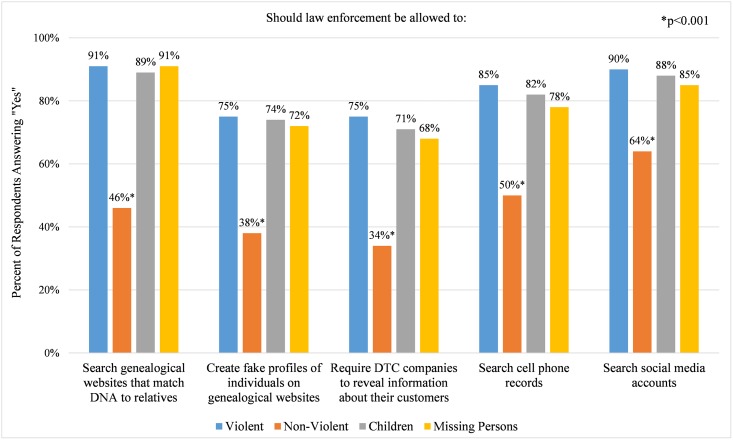
- In the 1,587-respondent survey, 79% supported police searches of genetic websites that identify genetic relatives, 62% supported disclosure of DTC genetic testing customer information to police, and 65% supported police creation of fake profiles on genealogy websites.
- Support was significantly higher (all p < 0.05) for identifying perpetrators of violent crimes (80%), perpetrators of crimes against children (78%), or missing persons (77%) than for identifying perpetrators of nonviolent crimes (39%).
- Females were significantly more likely to support these police activities than males (β = 0.051, p < 0.001); age, race/ethnicity, annual household income, DTC testing purchase, genealogy website use, crime victimization/arrest/conviction, and law enforcement employment were not independent predictors (all p > 0.05).
- The paper reports the same pattern for police access to cell phone records and social media accounts, and notes GEDmatch’s updated privacy policy permits law enforcement searches for violent crimes defined as homicide and sexual assault.
Methods
- A 20-item online survey was distributed in May 2018 via Amazon Mechanical Turk to US adults aged 18 or older, who were paid US$0.25; N = 1,587. Methods, survey, and raw data are in S1 Text, S2 Text, and S1 Data.
- The survey assessed perspectives on police access to genetic genealogy websites and DTC genetic testing customer information, plus cell phone records and social media accounts; a multivariate model tested predictors of support for police activities to solve violent crimes.
- Analyses reported descriptive percentages, respondent characteristics (Table 1), regression coefficients (Table 2), and support by investigative purpose (Fig 1).
Limitations
- Stated: MTurk respondents were younger than national statistics (median age category 23–36 vs 37 nationally); 59% reported personal/family victimization vs 2016 NCVS estimates of 1.3% violent victimization and 8.8% household property victimization (lifetime/family vs annual/household measures); 24% reported personal/family law enforcement employment vs approximately 1% of the US population in protective service occupations; findings may not be generalizable and further research is needed.
- Stated: the survey did not describe false leads from genetic genealogy matches and was conducted soon after DeAngelo’s arrest; future qualitative research should probe family members of genetic genealogy database participants.
- Evident/paper notes: the sample was 71.2% non-Hispanic white and only 11.9% had purchased DTC genetic testing, so results may not represent more diverse populations; the cross-sectional, self-report MTurk sample may differ in unmeasured ways, such as online comfort, though the paper cites mixed evidence on this point.
Model-written summary. Check it against the paper before relying on it.
Integrity signals
Registry
Cites
Statistics
Figures
Verification
Claims the paper makes
0 Valid · 0 Not valid · 25 Not checked · 30 Own results and interpretations
A result the paper reports from its own data — it cites no other source for it, so there is none to check. The quote shows it is in the paper.
In the paper
“Among the 1,587 respondents (Table 1), the majority supported police searches of genetic websites that identify genetic relatives (79%) and disclosure of DTC genetic testing customer information to police (62%), as well as the creation of fake profiles of individuals by police on genealogy websites (65%) (Fig 1).”
§ Should police have access to genetic genealogy databases? Capturing the Golden State Killer and other criminals using a controversial new forensic technique > Probing public opinion
plainn = 1,587- Asserted: passes — The authors put it forward as true.
- Checkable: passes — It can be checked against evidence.
- Load-bearing: passes — The paper’s conclusions depend on it.
- Based: passes — The paper gives a reason why it holds.
A result the paper reports from its own data — it cites no other source for it, so there is none to check. The quote shows it is in the paper.
In the paper
“Females were significantly more likely to support these police activities than males (β = 0.051, p < 0.001).”
§ Should police have access to genetic genealogy databases? Capturing the Golden State Killer and other criminals using a controversial new forensic technique > Probing public opinion
plainstates an association- Asserted: passes — The authors put it forward as true.
- Checkable: passes — It can be checked against evidence.
- Load-bearing: unclear — It is unclear whether the paper’s conclusions depend on it.
- Based: passes — The paper gives a reason why it holds.
A result the paper reports from its own data — it cites no other source for it, so there is none to check. The quote shows it is in the paper.
In the paper
“Among the 1,587 respondents (Table 1), the majority supported police searches of genetic websites that identify genetic relatives (79%) and disclosure of DTC genetic testing customer information to police (62%), as well as the creation of fake profiles of individuals by police on genealogy websites (65%) (Fig 1).”
§ Should police have access to genetic genealogy databases? Capturing the Golden State Killer and other criminals using a controversial new forensic technique > Probing public opinion
plainn = 1,587- Asserted: passes — The authors put it forward as true.
- Checkable: passes — It can be checked against evidence.
- Load-bearing: unclear — It is unclear whether the paper’s conclusions depend on it.
- Based: passes — The paper gives a reason why it holds.
A result the paper reports from its own data — it cites no other source for it, so there is none to check. The quote shows it is in the paper.
In the paper
“In addition, the majority of respondents (59%) reported that they or family members had been victims of crimes.”
§ Should police have access to genetic genealogy databases? Capturing the Golden State Killer and other criminals using a controversial new forensic technique > Developing policy parameters
plain- Asserted: passes — The authors put it forward as true.
- Checkable: passes — It can be checked against evidence.
- Load-bearing: unclear — It is unclear whether the paper’s conclusions depend on it.
- Based: passes — The paper gives a reason why it holds.
15 more claims
Create a free account to see all 55 claims and to verify the 33 references still open.
- It may state two separate claims as one. 14
- Probably not a substantial claim. 27
Self-check
Percentages, sums and reported differences re-computed from the paper’s own numbers.
Each contradiction between two passages listed here was confirmed by an independent check.
Rated minor: it would not touch a result — a value no result rests on, a p-value that stays on the same side of the significance level, or a conflict that is clerical, resolved elsewhere in the paper, or outside its own findings.
In the paper
“| Age | −0.011 | 0.030 | 0.727 | −0.70–0.049 |”
§ Should police have access to genetic genealogy databases? Capturing the Golden State Killer and other criminals using a controversial new forensic technique > Probing public opinion
Reported -0.011 · recomputed -0.3255
Rated minor: it would not touch a result — a value no result rests on, a p-value that stays on the same side of the significance level, or a conflict that is clerical, resolved elsewhere in the paper, or outside its own findings.
In the paper
§ Should police have access to genetic genealogy databases? Capturing the Golden State Killer and other criminals using a controversial new forensic technique > Probing public opinion
“| Age | −0.011 | 0.030 | 0.727 | −0.70–0.049 |”
§ Should police have access to genetic genealogy databases? Capturing the Golden State Killer and other criminals using a controversial new forensic technique > Probing public opinion
“| Characteristic | Unstandardized β | Standardized β | p-value | 95% confidence interval |”
Citations
Cites
Amazon's Mechanical Turk: A New Source of Inexpensive, Yet High-Quality, Data?
Buhrmester, M., Kwang, T., & Gosling, S. D. (2011) · Perspectives on Psychological Science · doi:10.1177/1745691610393980 · Cited by 9,996
GINA, Genetic Discrimination, and Genomic Medicine
Green, R. C., Lautenbach, D., & McGuire, A. L. (2015) · New England Journal of Medicine · doi:10.1056/nejmp1404776 · Cited by 151
Self-citationGenealogy databases and the future of criminal investigation
Ram, N., Guerrini, C. J., & McGuire, A. L. (2018) · Science · doi:10.1126/science.aau1083 · Cited by 88
Self-citationAPPLaUD: access for patients and participants to individual level uninterpreted genomic data
on behalf of the Participant Values Task Team of the Global Alliance for Genomics and Health, Thorogood, A., Bobe, J., Prainsack, B., Middleton, A., Scott, E., Nelson, S., Corpas, M., Bonhomme, N., Rodriguez, L. L., et al. (2018) · Human Genomics · doi:10.1186/s40246-018-0139-5 · Cited by 50
Nelson, S. C., & Fullerton, S. M. (2018) · Journal of Genetic Counseling · doi:10.1007/s10897-018-0217-9 · Cited by 37
Consumer use and response to online third‐party raw DNA interpretation services
Wang, C., Cahill, T. J., Parlato, A., Wertz, B., Zhong, Q., Cunningham, T. N., & Cummings, J. J. (2018) · Molecular Genetics & Genomic Medicine · doi:10.1002/mgg3.340 · Cited by 36
Are we ready for direct-to-consumer genetic testing?
Burton, A. (2015) · The Lancet Neurology · doi:10.1016/s1474-4422(15)70003-7 · Cited by 22
Pereira, S., Robinson, J. O., Peoples, H. A., Gutierrez, A. M., Majumder, M. A., McGuire, A. L., & Rothstein, M. A. (2017) · PLOS ONE · doi:10.1371/journal.pone.0184525 · Cited by 15
Self-citationRelative Doubt: Familial Searches of DNA Databases
Murphy, E. (2010) · Michigan Law Review · doi:10.36644/mlr.109.3.relative · Cited by 4
(2014) · Symposium On Usable Privacy and Security
Cited by
Privacy protections to encourage use of health-relevant digital data in a learning health system
McGraw, D., & Mandl, K. D. (2021) · npj Digital Medicine · doi:10.1038/s41746-020-00362-8 · Cited by 243
Genetic genealogy for cold case and active investigations
Greytak, E. M., Moore, C., & Armentrout, S. L. (2019) · Forensic Science International · doi:10.1016/j.forsciint.2019.03.039 · Cited by 178
Developments in forensic DNA analysis
Haddrill, P. R. (2021) · Emerging Topics in Life Sciences · doi:10.1042/etls20200304 · Cited by 153
Kennett, D. (2019) · Forensic Science International · doi:10.1016/j.forsciint.2019.05.016 · Cited by 136
Forensic genealogy, bioethics and the Golden State Killer case
Wickenheiser, R. A. (2019) · Forensic Science International Synergy · doi:10.1016/j.fsisyn.2019.07.003 · Cited by 128
Metadata
- Authors
- Guerrini, C. J., Robinson, J. O., Petersen, D., & McGuire, A. L.
- Affiliations
- Baylor College of Medicine (US)
- Corresponding author
- Guerrini, Christi J.
- Venue
- PLOS Biology
- Publisher
- Public Library of Science (PLoS)
- Published
- 2018-10-02
- Volume
- 16
- Issue
- 10
- Pages
- e2006906
- ISSN
- 1544-9173 (ISSN-L)
- 1545-7885
- PMC
- PMC6168121
- OpenAlex
- W2894752870
- Semantic Scholar
- 0128bbfcaa43b6de1f8e39c2009a55d96db9248a
- Cited by
- 168
- References
- 11
- Citations by year
- 2026: 13 · 2025: 13 · 2024: 17 · 2023: 23 · 2022: 25 · 2021: 23 · 2020: 36 · 2019: 16 · 2018: 1
- FWCI
- 8.63
- Type
- journal article
- Language
- en
- Open access
- gold
- doi.org
- Licence
- Locations
- PLoS Biology (publishedVersion, cc-by)
- Europe PMC (PubMed Central) (publishedVersion, cc-by)
- PubMed Central (publishedVersion, cc-by)
- PubMed (publishedVersion)
- RePEc: Research Papers in Economics (submittedVersion)
- DOAJ (DOAJ: Directory of Open Access Journals) (submittedVersion)
- Figshare (submittedVersion, cc-by)
- Funders
- U.S. Department of Labor
- National Institutes of Health
- National Human Genome Research Institute (K01HG009355, R01HG008918)
- Bureau of Justice Statistics
- Topics
- Life Sciences › Biochemistry, Genetics and Molecular Biology › Genetics › Forensic and Genetic Research
- Social Sciences › Law › Criminal Law and Evidence
- Social Sciences › Law › Law, Rights, and Freedoms
- Keywords
- privacy concerns, genetic privacy, forensic identification
- MeSH terms
- Adolescent, Adult, California, Female, Genealogy and Heraldry, Humans, Male, Pedigree, Surveys and Questionnaires, Police, Databases, Nucleic Acid, Genetic Privacy, Forensic Genetics, Young Adult, Criminals
About these checks
Registry, retraction, Cites and statistics results are computed, not judged, with one exception: a printed reference that no index lists is read once by a model before it counts as a citation error. Claims are extracted by a model and kept only when their quote appears verbatim in the text; each cited source is then checked, with a model’s help, for whether it says what the claim relies on. Those verdicts can be wrong — read the claim’s quote and the cited source before relying on one.
A language model drew the claims from the paper on 2026-11-24, under version 3 of the claim definition (model deepseek-v4.1-flash, prompt extract-v3).
A second model labelled each claim on 2026-11-24 (model jev-1.13-20260917, definition revision gold-guideline-v0.2).
Statistics and arithmetic are recomputed, not judged.
Confidence bands are shown only for fields calibrated on our annotated test set. None is calibrated yet, so no band is shown.
What counts as a claim ›How we measure confidence ›How we check this ›
Are you an author, or do you see a problem with this page? Request a review
How to cite
Cite CoChat for the checks on this page, and the paper for its own findings.
- This page
- CoChat. (2026). Citation check: Should police have access to genetic genealogy databases? Capturing the Golden State Killer and other criminals using a controversial new forensic technique. https://app.cochat.ai/papers/10.1371/journal.pbio.2006906
- The paper
- Guerrini, C. J., Robinson, J. O., Petersen, D., & McGuire, A. L. (2018). Should police have access to genetic genealogy databases? Capturing the Golden State Killer and other criminals using a controversial new forensic technique. PLOS Biology. https://doi.org/10.1371/journal.pbio.2006906
Data sources
Bibliographic data: Semantic Scholar, OpenAlex, Crossref.
Contains information from the Semantic Scholar Academic Graph Datasets, made available under the ODC Attribution License (ODC-BY 1.0).
Semantic Scholar’s data is described in: Kinney, R., et al. (2023). The Semantic Scholar Open Data Platform. arXiv:2301.10140.
