

Usability and feasibility of a cognitive-behavioral mobile app for ADHD in adults
Open accessThe DOI matches its Crossref record; 39 of the 39 references it cites were found in a registry or an index.
Abstract
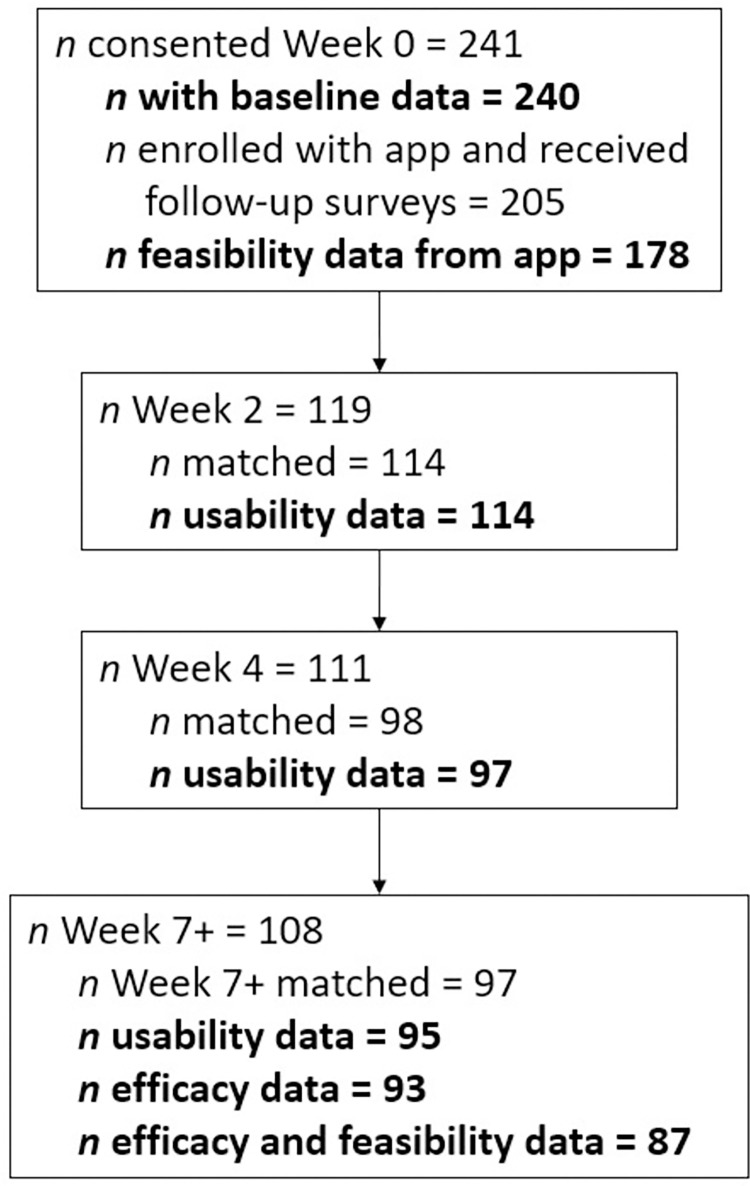
OBJECTIVE: Cognitive-behavioral therapy (CBT) has growing evidence of efficacy for Attention-Deficit/Hyperactivity Disorder (ADHD) in adults. Mobile health apps are promising tools for delivering scalable CBT. In a 7-week open study of Inflow, a CBT-based mobile app, we assessed usability and feasibility to prepare for a randomized controlled trial (RCT). METHOD: 240 adults recruited online completed baseline and usability assessments at 2 (n = 114), 4 (n = 97) and after 7 weeks (n = 95) of Inflow use. 93 participants self-reported ADHD symptoms and impairment at baseline and 7 weeks. RESULTS: Participants rated Inflow's usability favorably, used the app a median of 3.86 times per week, and a majority of those using the app for 7 weeks self-reported decreases in ADHD symptoms and impairment. CONCLUSION: Inflow demonstrated usability and feasibility among users. An RCT will determine whether Inflow is associated with improvement among more rigorously assessed users and beyond non-specific factors.
Overview
The claims and statistics of this paper haven’t been checked yet.
Free: it reads the open-access text and checks the first 5 claims that cite a source we can check. Create a free account to check every claim.
Integrity signals
Registry
Cites
Statistics
Figures
Verification
Claims the paper makes
The claims and statistics of this paper haven’t been checked yet.
Free: it reads the open-access text and checks the first 5 claims that cite a source we can check. Create a free account to check every claim.
Claims other papers make about this one
Each is checked against this paper’s own text: does it say what the citing paper says it does?
The source backs part of the claim, not all of it — or backs it for a different population, condition or comparison.
In the citing paper
“Overall, this type of research indicate that such means of delivery are accepted and perceived as user-friendly (Knouse et al., 2022), but that issues of content and engagement are important to consider (Kenter et al., 2022; Nordby et al., 2021).”
From A study protocol of a randomized controlled study of internet-based cognitive behavioral therapy for adult attention deficit hyperactivity disorder (2023) · cites this paper as Knouse et al., 2022
Experimental — accuracy not yet measuredThe source backs part of the claim, not all of it — or backs it for a different population, condition or comparison.
In the citing paper
“Patient adherence may also be improved by providing evidence-based solutions such as 24/7 access to educational information and resources, personalized support, and targeted interventions and skills training via technology (eg, apps or websites) [21,35] in the comfort of their own homes [20,30].”
From A Digital Mental Health Support Program for Depression and Anxiety in Populations With Attention-Deficit/Hyperactivity Disorder: Feasibility and Usability Study (2023) · cites this paper as [35]
Experimental — accuracy not yet measured
Self-check
Percentages, sums and reported differences re-computed from the paper’s own numbers.
The self-check needs the paper’s full text.
Citations
Cites
Lakens, D. (2013) · Frontiers in Psychology · doi:10.3389/fpsyg.2013.00863 · Cited by 10,303
Kessler, R. C., Adler, L., Barkley, R., Biederman, J., Conners, C. K., Demler, O., Faraone, S. V., Greenhill, L. L., Howes, M. J., Secnik, K., et al. (2006) · American Journal of Psychiatry · doi:10.1176/ajp.2006.163.4.716 · Cited by 3,886 · cited 1×
“population [3], ADHD in adulthood is associated with substantial individual and societal economic costs [4] and even reduced estimated life expectancy [5].”
BackgroundEysenbach, G. (2005) · Journal of Medical Internet Research · doi:10.2196/jmir.7.1.e11 · Cited by 2,524 · cited 1×
“And, while dropout during clinical trials is not a new problem, it is one that certainly reflects the “real world” of both traditional therapy and mHealth interventions [44].”
BackgroundFARAONE, S. V., BIEDERMAN, J., & MICK, E. (2006) · Psychological Medicine · doi:10.1017/s003329170500471x · Cited by 2,267 · cited 1×
“Attention-Deficit/Hyperactivity Disorder (ADHD) is a neurodevelopmental disorder characterized by frequent and impairing inattention and/or hyperactivity/impulsivity that begins in childhood but continues to cause problems into adulthood for about 2/3 of people diagnosed [1].”
BackgroundWhat is a pilot or feasibility study? A review of current practice and editorial policy
Arain, M., Campbell, M. J., Cooper, C. L., & Lancaster, G. A. (2010) · BMC Medical Research Methodology · doi:10.1186/1471-2288-10-67 · Cited by 1,483 · cited 13×
“As a feasibility study, the current work has a number of limitations, some of which are out- lined in the preceding discussion of issues to address in a future RCT.”
MethodInfluentialThe mHealth App Usability Questionnaire (MAUQ): Development and Validation Study
Zhou, L., Bao, J., Setiawan, I. M. A., Saptono, A., & Parmanto, B. (2019) · JMIR mHealth and uHealth · doi:10.2196/11500 · Cited by 675
Meyerowitz-Katz, G., Ravi, S., Arnolda, L., Feng, X., Maberly, G., & Astell-Burt, T. (2020) · Journal of Medical Internet Research · doi:10.2196/20283 · Cited by 561 · cited 1×
“In past studies of app-based interventions for chronic disease, the average dropout rate was 43% [41].”
BackgroundCognitive-behavioral therapy for ADHD in medication-treated adults with continued symptoms
Safren, S. A., Otto, M. W., Sprich, S., Winett, C. L., Wilens, T. E., & Biederman, J. (2005) · Behaviour Research and Therapy · doi:10.1016/j.brat.2004.07.001 · Cited by 519 · cited 1×
“However, these medications do not work for every adult with ADHD and even adults who experience a positive response to these medications may continue to experience clinically significant symptoms and impairment in need of intervention [8].”
BackgroundSafren, S. A., Sprich, S., Mimiaga, M. J., Surman, C., Knouse, L., Groves, M., & Otto, M. W. (2010) · JAMA · doi:10.1001/jama.2010.1192 · Cited by 394
Self-citationFaraone, S. V., & Glatt, S. J. (2010) · The Journal of Clinical Psychiatry · doi:10.4088/jcp.08m04902pur · Cited by 387 · cited 1×
“Stimulant medications have demonstrated efficacy in the treatment of adult ADHD [6,7].”
Background
Research works printed but not linked: 2
- Barkley RA. Barkley functional impairment scale. New York: Guilford Press; 2011.
- IBM SPSS Statistics for Windows. Armonk, NY: IBM Corp.;
Cited by
Clinical practice guidelines for the care of girls and women with Turner syndrome.
Gravholt, C. H., Andersen, N. H., Christin-Maitre, S., Davis, S. M., Duijnhouwer, A., Gawlik, A., Maciel-Guerra, A. T., Gutmark-Little, I., Fleischer, K., Hong, D., et al. (2024) · European Journal of Endocrinology · doi:10.1093/ejendo/lvae050 · Cited by 224
Selaskowski, B., Reiland, M., Schulze, M., Aslan, B., Kannen, K., Wiebe, A., Wallbaum, T., Boll, S., Lux, S., Philipsen, A., et al. (2023) · BJPsych Open · doi:10.1192/bjo.2023.573 · Cited by 29
Gabarrón, E., Denecke, K., & López–Campos, G. (2025) · BMC Psychiatry · doi:10.1186/s12888-025-06825-0 · Cited by 37
“Digital technologies offer promising solutions by adapting and translating existing tools, such as cognitive behavioral therapy [64].”
A decade of apps for ADHD management: a scoping review
Hernández-Capistrán, J., Alor‐Hernández, G., Sánchez-Morales, L. N., & Machorro-Cano, I. (2025) · Behaviour and Information Technology · doi:10.1080/0144929x.2025.2461225 · Cited by 20
“One such study was conducted by Knouse et al. (2022) developed a self-help application rooted in Cognitive Behavioral Therapy (CBT) principles, aimed to assist individuals in symptom management while fostering a sense of social connection and support from peers undergoing similar challenges.”
Tsirmpas, C., Nikolakopoulou, M., Kaplow, S., Andrikopoulos, D., Fatouros, P., Kontoangelos, K., & Papageorgiou, C. (2023) · JMIR Formative Research · doi:10.2196/48362 · Cited by 11
“Furthermore, as many patients with ADHD prefer a nonpharmacological option to manage their symptoms [20,35], digital mental health interventions may offer a viable solution to meet their treatment needs.”
BackgroundGudka, R., McGlynn, E., Lister, K., Shaw, N., Pitchforth, E., Mughal, F., French, B., Ward, J. H., Newlove‐Delgado, T., & Price, A. (2025) · European Child & Adolescent Psychiatry · doi:10.1007/s00787-025-02676-y · Cited by 22
Zhang, S., Pan, M.-R., Zhang, L., Li, H., Zhao, M., Dong, M., Si, F., Liu, L., Wang, Y., & Qian, Q.-J. (2025) · Psychiatry Research · doi:10.1016/j.psychres.2025.116352 · Cited by 15
Seery, C., Cochrane, R. H., Mulcahy, M., Kilbride, K., Wrigley, M., & Bramham, J. (2025) · Internet Interventions · doi:10.1016/j.invent.2025.100807 · Cited by 7
“…interventions (Pedersen et al., 2024), studies evaluating psychoeducational smartphone apps for ADHD have mostly relied on self-report scales to explore usability and attrition to indicate acceptability or feasibility of the app (Knouse et al., 2022; Jang et al., 2021; Selaskowski et al., 2022).”
InfluentialPatrickson, B., Shams, L., Fouyaxis, J., Strobel, J. E., Schubert, K. O., Musker, M., & Bidargaddi, N. P. (2024) · International Journal of Environmental Research and Public Health · doi:10.3390/ijerph21050582 · Cited by 10
“As in previous studies [26,27,30,31], health practitioners acknowledged the complexity of the ADHD treatment context.”
ResultForsström, D., Oscarsson, M., Buhrman, M., & Rozental, A. (2023) · Internet Interventions · doi:10.1016/j.invent.2023.100652 · Cited by 6
Deshmukh, R. (2025) · Biannual Conference of the Italian SIGCHI Chapter (CHItaly) · doi:10.1145/3750069.3750114 · Cited by 10
Kasturiratna, K. T. A. S., Hartanto, A., Lee, A. K., Koh, C. J., & Majeed, N. M. (2025) · Computers in Human Behavior Reports · doi:10.1016/j.chbr.2025.100703 · Cited by 6
Bridging the Gap: Digital CBT for Adults Managing ADHD Challenges
Antshel, K. M., McBride, H., & Knouse, L. E. (2025) · Journal of Attention Disorders · doi:10.1177/10870547251384462 · Cited by 3
“In a study of an app based on CBT, Knouse et al. (2022) conducted a 7 weeks open pilot trial of a CBT-based mHealth app designed to provide psychoeducation to adults with ADHD and guide them in implementing new behavioral and cognitive skills to reduce ADHD-related problems in daily life.”
InfluentialSelf-citationDigital health technologies for adults with ADHD: a scoping review
Schofield, F. J., Wilkie, S., Nielsen, E. E., Brigden, A., Jones, M. W., & Isotalus, H. (2026) · Frontiers in Digital Health · doi:10.3389/fdgth.2026.1746732 · Cited by 4
“DHTs were most frequently deployed as part of a guided program (52, 54, 57, 58, 64–67, 71–74, 76, 77), with fewer examples of DHTs used as a self-guided tool (53, 55, 56, 59, 60, 63, 69, 70, 75), or as companion apps that accompanied traditional face-to-face therapies (61, 62, 68).”
Apps for ADHD Management: A Scoping ReviewPreprint
Hernández-Capistrán, J., Alor‐Hernández, G., Sánchez-Morales, L. N., & Machorro-Cano, I. (2023) · Research Square · doi:10.21203/rs.3.rs-3459907/v1 · Cited by 2
Feasibility, Usability and Acceptability of InflowPreprint
Hu, X., Knouse, L. E., Isaacs, S., & Epstein, L. (2021) · doi:10.17605/osf.io/qa26m
Self-citationHermeneutical injustice in CBT: towards an enactivist paradigm in psychiatric practice
Onstad, J. W. (2026) · Philosophical Psychology · doi:10.1080/09515089.2025.2604598 · Cited by 1
Zinnow, T., Retz, W., Kaiser, A., Sobanski, E., Brandeis, D., D’Amelio, R., Davydenko, S., Ethofer, T., Ehlis, A., Fallgatter, A. J., et al. (2026) · Psychotherapy and Psychosomatics · doi:10.1159/000551307
Metadata
- Authors
- Knouse, L. E., Hu, X., Sachs, G., & Isaacs, S.
- Affiliations
- University of Richmond (US)
- Corresponding author
- Knouse, Laura E.
- ORCID
- Knouse, Laura E.
- Venue
- PLOS Digital Health
- Publisher
- Public Library of Science (PLoS)
- Published
- 2022-08-15
- Volume
- 1
- Issue
- 8
- Pages
- e0000083
- ISSN
- 2767-3170 (ISSN-L)
- PMC
- PMC9931323
- OpenAlex
- W4291907541
- Cited by
- 18
- References
- 39
- Citations by year
- 2026: 3 · 2025: 8 · 2024: 2 · 2023: 4
- FWCI
- 3.09
- Type
- journal article
- Language
- en
- Open access
- gold
- doi.org
- Licence
- Locations
- PLOS Digital Health (publishedVersion, cc-by)
- PubMed Central (publishedVersion, cc-by)
- PubMed (publishedVersion)
- DOAJ (DOAJ: Directory of Open Access Journals) (submittedVersion)
- Funders
- University of Richmond (Arts and Sciences Faculty Summer Fellowship)
- Topics
- Social Sciences › Psychology › Applied Psychology › Digital Mental Health Interventions
- Health Sciences › Medicine › Psychiatry and Mental health › Attention Deficit Hyperactivity Disorder
- Health Sciences › Health Professions › General Health Professions › Mobile Health and mHealth Applications
- Keywords
- adult ADHD, cognitive behavioral therapy, mobile health apps, usability, feasibility, digital mental health interventions, ADHD symptom reduction
About these checks
Registry, retraction, Cites and statistics results are computed, not judged, with one exception: a printed reference that no index lists is read once by a model before it counts as a citation error. Claims are extracted by a model and kept only when their quote appears verbatim in the text; each cited source is then checked, with a model’s help, for whether it says what the claim relies on. Those verdicts can be wrong — read the claim’s quote and the cited source before relying on one.
Statistics and arithmetic are recomputed, not judged.
Confidence bands are shown only for fields calibrated on our annotated test set. None is calibrated yet, so no band is shown.
What counts as a claim ›How we measure confidence ›How we check this ›
Are you an author, or do you see a problem with this page? Request a review
Data sources
Bibliographic data: Semantic Scholar, OpenAlex, Crossref.
Contains information from the Semantic Scholar Academic Graph Datasets, made available under the ODC Attribution License (ODC-BY 1.0).
Semantic Scholar’s data is described in: Kinney, R., et al. (2023). The Semantic Scholar Open Data Platform. arXiv:2301.10140.
