

Insulin resistance in the offspring of parents with type 2 diabetes.
Open accessThe DOI matches its Crossref record; 14 of the 14 references it cites were found in a registry or an index.
Abstract
Wagenmakers discusses the paper by Petersen and colleagues on insulin resistance in young lean individuals and its association with reduced phosphate transport into muscle cells and impaired mitochondrial energy generation in muscle.
Overview
The claims and statistics of this paper haven’t been checked yet.
Free: it reads the open-access text and checks the first 5 claims that cite a source we can check. Create a free account to check every claim.
Integrity signals
Registry
Cites
Statistics
Figures
Verification
Claims the paper makes
The claims and statistics of this paper haven’t been checked yet.
Free: it reads the open-access text and checks the first 5 claims that cite a source we can check. Create a free account to check every claim.
Claims other papers make about this one
Each is checked against this paper’s own text: does it say what the citing paper says it does?
The source backs part of the claim, not all of it — or backs it for a different population, condition or comparison.
In the citing paper
“Furthermore, the observed reduction in basal ATP production in insulin-resistant offspring of T2DM patients (27) may also be the result of impaired insulin signaling affecting insulin-dependent mitochondrial process (28, 29)”
From Physical activity is the key determinant of skeletal muscle mitochondrial function in type 2 diabetes (2012) · cites this paper as [29]
Experimental — accuracy not yet measured
Self-check
Percentages, sums and reported differences re-computed from the paper’s own numbers.
The self-check needs the paper’s full text.
Citations
Cites
Impaired Mitochondrial Activity in the Insulin-Resistant Offspring of Patients with Type 2 Diabetes
Petersen, K. F., Dufour, S., Befroy, D., Garcia, R., & Shulman, G. I. (2004) · New England Journal of Medicine · doi:10.1056/nejmoa031314 · Cited by 2,193 · cited 3×
“They suggest that their combined observations point to a general mitochondrial dysfunction that impairs the ability of the mitochondria to synthesise ATP and oxidise fatty acids (FAs) at the normal resting rate, both in the basal overnight-fasted condition and after stimulation by insulin [2,3].”
Yu, C., Chen, Y., Cline, G. W., Zhang, D., Zong, H., Wang, Y., Bergeron, R., Kim, J. K., Cushman, S. W., Cooney, G. J., et al. (2002) · Journal of Biological Chemistry · doi:10.1074/jbc.m200958200 · Cited by 1,561 · cited 1×
“Such accumulation of triglycerides and FA metabolites has been repeatedly observed, both in skeletal muscle of obese individuals [4,5] with a reduced insulin sensitivity and in the muscle of healthy individuals given IR by the infusion of lipid emulsions and heparin [6].”
Itani, S. I., Ruderman, N. B., Schmieder, F., & Boden, G. (2002) · Diabetes · doi:10.2337/diabetes.51.7.2005 · Cited by 1,390 · cited 1×
“The mitochondrial dysfunction is hypothesised to lead to a reduced ability to oxidise FAs and to the accumulation of triglycerides and FA metabolites (fatty AcylCoA, diacylglycerols, and ceramides). Such accumulation of triglycerides and FA metabolites has been repeatedly observed, both in skeletal muscle of obese ind…”
Skeletal Muscle Fiber Type: Influence on Contractile and Metabolic Properties
Zierath, J. R., & Hawley, J. A. (2004) · PLoS Biology · doi:10.1371/journal.pbio.0020348 · Cited by 518 · cited 1×
“Regular exercise and training should be considered interventions to correct the reduction in insulin-induced muscle ATP turnover. Endurance exercise performed three to four times per week may lead to more than 5-fold increases in the mitochondrial density (concentration) of a previously sedentary muscle [”
Vincent, M. A., Clerk, L. H., Lindner, J. R., Klibanov, A. L., Clark, M. G., Rattigan, S., & Barrett, E. J. (2004) · Diabetes · doi:10.2337/diabetes.53.6.1418 · Cited by 438 · cited 2×
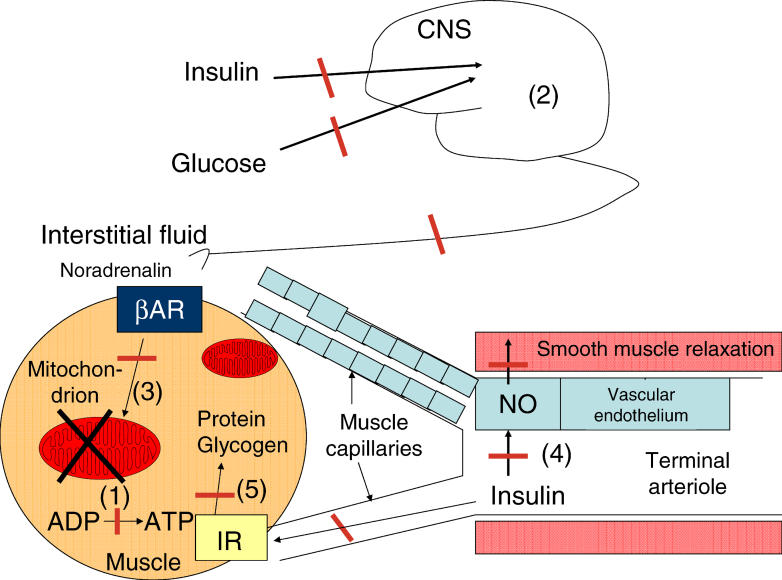
“Recently, it has also been shown that insulin infusions lead to increases in blood fl ow through capillaries that surround the skeletal muscle fi bres, both in healthy humans and rats [10–12].”
Petersen, K. F., Dufour, S., & Shulman, G. I. (2005) · PLoS Medicine · doi:10.1371/journal.pmed.0020233 · Cited by 308
Free Fatty Acid Impairment of Nitric Oxide Production in Endothelial Cells Is Mediated by IKKβ
Kim, F., Tysseling, K. A., Rice, J., Pham, M., Haji, L., Gallis, B. M., Baas, A. S., Paramsothy, P., Giachelli, C. M., Corson, M. A., et al. (2005) · Arteriosclerosis, Thrombosis, and Vascular Biology · doi:10.1161/01.atv.0000160549.60980.a8 · Cited by 307 · cited 1×
“This binding leads to activation of the insulin signalling cascade in the endothelial cells and to nitric oxide production [11–13].”
Physiologic Hyperinsulinemia Enhances Human Skeletal Muscle Perfusion by Capillary Recruitment
Coggins, M., Lindner, J., Rattigan, S., Jahn, L., Fasy, E., Kaul, S., & Barrett, E. (2001) · Diabetes · doi:10.2337/diabetes.50.12.2682 · Cited by 259 · cited 1×
“Recently, it has also been shown that insulin infusions lead to increases in blood flow through capillaries that surround the skeletal muscle fibres, both in healthy humans and rats [”
Thermic effect of food and sympathetic nervous system activity in humans
Tappy, L. (1996) · Reproduction Nutrition Development · doi:10.1051/rnd:19960405 · Cited by 177 · cited 3×
“It has also been suggested [9] that insulin, via unidentifi ed receptors, most probably located in the central nervous system, may stimulate muscle sympathetic nerve activity and facultative thermogenesis.”
The Thermic Effect of Food and Obesity: A Critical Review
de Jonee, L., & Bray, G. A. (1997) · Obesity Research · doi:10.1002/j.1550-8528.1997.tb00584.x · Cited by 173 · cited 3×
“Total energy expenditure in human tissues can be roughly broken down in three components: (1) obligatory energy expenditure required to perform cell maintenance and survival functions and maintain cell and body temperatures at 37 °C, (2) adaptive energy expenditure induced by nutrient ingestion, and (3) energy expendi…”
Cited by
Clark, M. G. (2008) · American Journal of Physiology-Endocrinology and Metabolism · doi:10.1152/ajpendo.90477.2008 · Cited by 190
De Feyter, H. M., van den Broek, N. M. A., Praet, S. F. E., Nicolay, K., van Loon, L. J. C., & Prompers, J. J. (2008) · European Journal of Endocrinology · doi:10.1530/eje-07-0756 · Cited by 116
“However, as commented by Short et al. (24) and Wagenmakers ( 25 ), the lower ATP synthesis rates in insulin-resistant subjects could actually be caused by”
Backgroundvan Tienen, F. H. J., Praet, S. F. E., de Feyter, H. M., van den Broek, N. M., Lindsey, P. J., Schoonderwoerd, K. G. C., de Coo, I. F. M., Nicolay, K., Prompers, J. J., Smeets, H. J. M., et al. (2012) · The Journal of Clinical Endocrinology & Metabolism · doi:10.1210/jc.2011-3454 · Cited by 111
Integration of the metabolic and cardiovascular effects of exercise
Wagenmakers, A. J. M., van Riel, N. A. W., Frenneaux, M. P., & Stewart, P. M. (2006) · Essays in Biochemistry · doi:10.1042/bse0420193 · Cited by 51
“muscle ATP turnover that has recently been observed in the offspring of type 2 diabetic parents [11,12].”
BackgroundSelf-citationVan den Broek, N. M. A., Ciapaite, J., De Feyter, H. M. M. L., Houten, S. M., Wanders, R. J. A., Jeneson, J. A. L., Nicolay, K., & Prompers, J. J. (2010) · The FASEB Journal · doi:10.1096/fj.09-143842 · Cited by 50
van den Broek, N. M. A., Čiapaitė, J., Nicolay, K., & Prompers, J. J. (2010) · American Journal of Physiology-Cell Physiology · doi:10.1152/ajpcell.00200.2010 · Cited by 44
“The lower ATP synthesis rates in resting muscle of insulin-resistant subjects (38, 39) could actually reflect a normal regulatory response to a lower energy demand caused by impaired insulin signaling rather than an impairment of intrinsic mitochondrial function (1, 26, 51, 65).”
BackgroundGraded occlusion of perfused rat muscle vasculature decreases insulin action
Vollus, G., Bradley, E. A., Roberts, M. K., Newman, J. M. B., Richards, S. M., Rattigan, S., Barrett, E. J., & Clark, M. G. (2007) · Clinical Science · doi:10.1042/cs20060311 · Cited by 19
Biomolecular Mechanisms of Cardiorenal Protection with Sodium-Glucose Co-Transporter 2 Inhibitors
Prandi, F. R., Barone, L., Lecis, D., Belli, M., Sergi, D., Milite, M., Lerakis, S., Romeo, F., & Barillà, F. (2022) · Biomolecules · doi:10.3390/biom12101349 · Cited by 12
“The onset of insulin resistance typically begins years before diabetes and even before prediabetes [6].”
BackgroundLiu, R., Christoffel, K. K., Brickman, W. J., Liu, X., Gadgil, M. D., Wang, G., Zimmerman, D., Chen, Q., Wang, B., Li, Z., et al. (2014) · Diabetes Research and Clinical Practice · doi:10.1016/j.diabres.2014.04.014 · Cited by 9
“Both ß-cell dysfunction and insulin resistance can be detected long before type 2 diabetes and pre-diabetes (PDM) within individuals with a family history of diabetes [2].”
BackgroundLi, M., Zhang, H.-P., Cheng, Y., Sun, L., Chen, S., Duan, X., Xian, C., Wu, S., & Yin, H. (2025) · BMC Cardiovascular Disorders · doi:10.1186/s12872-025-05112-w · Cited by 8
Mitochondria DNA Polymorphism and Type 2 Diabetes Mellitus
Park, J. H. (2009) · Korean Diabetes Journal · doi:10.4093/kdj.2009.33.5.373 · Cited by 2
Studies of the interaction between diabetes family history, exercise, adiposity and metabolic health
Barwell, N. D. (2010) · Enlighten: Theses (The University of Glasgow) · Cited by 1
Obesity and endothelial dysfunction : mechanisms, method development and interventions.
Cerri, E. (2010) · University of Birmingham Institutional Research Archive (University of Birmingham) · Cited by 1
Mitochondrial adaptations in insulin resistant muscle
Broek, N. N. (2010) · TU/e Research Portal · doi:10.6100/ir684831
Metadata
- Authors
- Wagenmakers, A. J. M.
- Affiliations
- University of Birmingham (GB)
- Corresponding author
- Wagenmakers, Anton J. M
- Venue
- PLoS Medicine
- Publisher
- Public Library of Science (PLoS)
- Published
- 2005-09-27
- Volume
- 2
- Issue
- 9
- Pages
- e289
- ISSN
- 1549-1277 (ISSN-L)
- 1549-1676
- PMC
- PMC1236795
- OpenAlex
- W1992517932
- Cited by
- 14
- References
- 14
- Citations by year
- 2025: 1 · 2022: 1 · 2014: 1 · 2012: 1
- FWCI
- 1.15
- Type
- journal article
- Language
- en
- Open access
- gold
- doi.org
- Licence
- cc-by
- Locations
- PLoS Medicine (publishedVersion, cc-by)
- Europe PMC (PubMed Central) (publishedVersion, cc-by)
- PubMed Central (publishedVersion, cc-by)
- PubMed (publishedVersion)
- Liverpool John Moores University (submittedVersion, other-oa)
- DOAJ (DOAJ: Directory of Open Access Journals) (submittedVersion, cc-by-sa)
- University of Birmingham Research Portal (University of Birmingham) (submittedVersion, other-oa)
- Topics
- Health Sciences › Medicine › Pediatrics, Perinatology and Child Health › Birth, Development, and Health
- Health Sciences › Medicine › Endocrinology, Diabetes and Metabolism › Diabetes, Cardiovascular Risks, and Lipoproteins
- Life Sciences › Biochemistry, Genetics and Molecular Biology › Molecular Biology › Metabolism, Diabetes, and Cancer
- Keywords
- insulin resistance, type 2 diabetes, offspring of diabetic parents, skeletal muscle
- MeSH terms
- Adenosine Triphosphate, Diabetes Mellitus, Type 2, Humans, Insulin, Insulin Resistance, Mitochondria, Muscle, Oxidative Phosphorylation, Glucose Clamp Technique, Muscle, Skeletal, Genetic Predisposition to Disease, Heredity
About these checks
Registry, retraction, Cites and statistics results are computed, not judged, with one exception: a printed reference that no index lists is read once by a model before it counts as a citation error. Claims are extracted by a model and kept only when their quote appears verbatim in the text; each cited source is then checked, with a model’s help, for whether it says what the claim relies on. Those verdicts can be wrong — read the claim’s quote and the cited source before relying on one.
Statistics and arithmetic are recomputed, not judged.
Confidence bands are shown only for fields calibrated on our annotated test set. None is calibrated yet, so no band is shown.
What counts as a claim ›How we measure confidence ›How we check this ›
Are you an author, or do you see a problem with this page? Request a review
Data sources
Bibliographic data: Semantic Scholar, OpenAlex, Crossref.
Contains information from the Semantic Scholar Academic Graph Datasets, made available under the ODC Attribution License (ODC-BY 1.0).
Semantic Scholar’s data is described in: Kinney, R., et al. (2023). The Semantic Scholar Open Data Platform. arXiv:2301.10140.
