

Randomized, controlled intervention trial of male circumcision for reduction of HIV infection risk: the ANRS 1265 Trial.
Open accessThe DOI matches its Crossref record; 35 of the 35 references it cites were found in a registry or an index.
Abstract
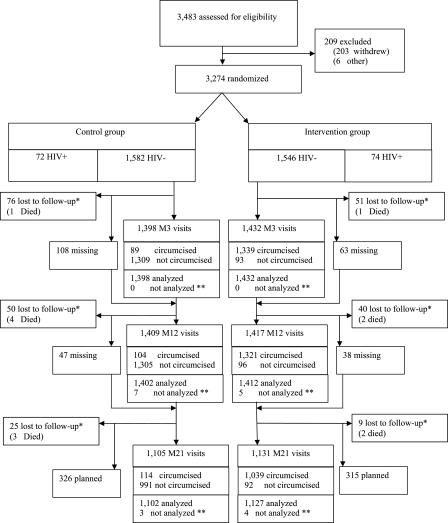
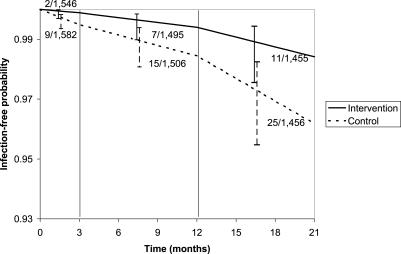
BACKGROUND: Observational studies suggest that male circumcision may provide protection against HIV-1 infection. A randomized, controlled intervention trial was conducted in a general population of South Africa to test this hypothesis. METHODS AND FINDINGS: A total of 3,274 uncircumcised men, aged 18-24 y, were randomized to a control or an intervention group with follow-up visits at months 3, 12, and 21. Male circumcision was offered to the intervention group immediately after randomization and to the control group at the end of the follow-up. The grouped censored data were analyzed in intention-to-treat, univariate and multivariate, analyses, using piecewise exponential, proportional hazards models. Rate ratios (RR) of HIV incidence were determined with 95% CI. Protection against HIV infection was calculated as 1 - RR. The trial was stopped at the interim analysis, and the mean (interquartile range) follow-up was 18.1 mo (13.0-21.0) when the data were analyzed. There were 20 HIV infections (incidence rate = 0.85 per 100 person-years) in the intervention group and 49 (2.1 per 100 person-years) in the control group, corresponding to an RR of 0.40 (95% CI: 0.24%-0.68%; p < 0.001). This RR corresponds to a protection of 60% (95% CI: 32%-76%). When controlling for behavioural factors, including sexual behaviour that increased slightly in the intervention group, condom use, and health-seeking behaviour, the protection was of 61% (95% CI: 34%-77%). CONCLUSION: Male circumcision provides a degree of protection against acquiring HIV infection, equivalent to what a vaccine of high efficacy would have achieved. Male circumcision may provide an important way of reducing the spread of HIV infection in sub-Saharan Africa. (Preliminary and partial results were presented at the International AIDS Society 2005 Conference, on 26 July 2005, in Rio de Janeiro, Brazil.).
Overview
The claims and statistics of this paper haven’t been checked yet.
Free: it reads the open-access text and checks the first 5 claims that cite a source we can check. Create a free account to check every claim.
Integrity signals
Registry
Cites
Statistics
Figures
Verification
Claims the paper makes
The claims and statistics of this paper haven’t been checked yet.
Free: it reads the open-access text and checks the first 5 claims that cite a source we can check. Create a free account to check every claim.
Claims other papers make about this one
Each is checked against this paper’s own text: does it say what the citing paper says it does?
The cited source says what the claim attributes to it.
In the citing paper
“Male circumcision has been found to reduce the susceptibility to heterosexually acquired HIV infection by over 60%.10-12”
From Rapid Training and Implementation of the Pollock Technique, a Safe, Effective Newborn Circumcision Procedure, in a Low-Resource Setting (2015) · cites this paper as [11]
The cited source says what the claim attributes to it.
In the citing paper
“Three randomized, controlled trials performed in regions of sub-Saharan Africa, where generalized HIV epidemics involving predominantly heterosexual transmission were occurring, demonstrated that male circumcision reduces the risk for HIV acquisition among men by 50%–60% (63–65).”
From Sexually Transmitted Infections Treatment Guidelines, 2021 (2021) · cites this paper as [65]
Self-check
Percentages, sums and reported differences re-computed from the paper’s own numbers.
The self-check needs the paper’s full text.
Citations
Cites
Discrete sequential boundaries for clinical trials
GORDON LAN, K. K., & DEMETS, D. L. (1983) · Biometrika · doi:10.1093/biomet/70.3.659 · Cited by 2,310 · cited 1×
“0095, as determined by the Lan-DeMets alphaspending function method [19].”
MethodDiscrete Sequential Boundaries for Clinical Trials
Lan, K. K. G., & DeMets, D. L. (1983) · Biometrika · doi:10.2307/2336502 · Cited by 2,310
Cameron, D. W., D'Costa, L., Maitha, G., Cheang, M., Piot, P., Simonsen, J. N., Ronald, A., Gakinya, M., Ndinya-Achola, J. O., Brunham, R., et al. (1989) · The Lancet · doi:10.1016/s0140-6736(89)90589-8 · Cited by 753
Weiss, H. A., Quigley, M. A., & Hayes, R. J. (2000) · AIDS · doi:10.1097/00002030-200010200-00018 · Cited by 671
The Analysis of Rates Using Poisson Regression Models
Frome, E. L. (1983) · Biometrics · doi:10.2307/2531094 · Cited by 463
Prentice, C. R. M., & Forbes, C. D. (1974) · The Lancet · doi:10.1016/s0140-6736(74)91780-2 · Cited by 413
The Analysis of Rates and of Survivorship Using Log-Linear Models
Holford, T. R. (1980) · Biometrics · doi:10.2307/2529982 · Cited by 377
Grosskurth, H., Gray, R., Hayes, R., Mabey, D., & Wawer, M. (2000) · The Lancet · doi:10.1016/s0140-6736(00)02336-9 · Cited by 313
Patterson, B. K., Landay, A., Siegel, J. N., Flener, Z., Pessis, D., Chaviano, A., & Bailey, R. C. (2002) · The American Journal of Pathology · doi:10.1016/s0002-9440(10)64247-2 · Cited by 305
How does male circumcision protect against HIV infection?
Szabo, R. (2000) · BMJ · doi:10.1136/bmj.320.7249.1592 · Cited by 285
Research works printed but not linked: 1
- 15. Department of Health National HIV and syphilis antenatal sero-prevalence survey in South Africa 2003 2003 Pretoria (South Africa) Department of Health 18
Cited by
Items 901–1,000 of 1,002
Uthman, O. A., Popoola, T. A., Yahaya, I., Uthman, M. M. B., & Aremu, O. (2011) · Value in Health · doi:10.1016/j.jval.2010.10.011 · Cited by 23
DeCelles, J., Hershow, R. B., Kaufman, Z. A., Merrill, K. G., Kombandeya, T., Chaibva, C., Ross, D. A., & Harrison, A. D. (2016) · JAIDS Journal of Acquired Immune Deficiency Syndromes · doi:10.1097/qai.0000000000001172 · Cited by 23
Clinical trials using the Shang Ring device for male circumcision in Africa: a review.
Barone, M. A., Li, P. S., Awori, Q. D., Lee, R. K., & Goldstein, M. (2014) · PubMed Central · doi:10.3978/j.issn.2223-4683.2014.01.09 · Cited by 25
Kim, H. H., & Goldstein, M. (2008) · Nature Clinical Practice Urology · doi:10.1038/ncpuro1279 · Cited by 23
Sahasrabuddhe, V. V., & Vermund, S. H. (2007) · Infectious Disease Clinics of North America · doi:10.1016/j.idc.2007.03.005 · Cited by 23
MacPhail, C. L., Sayles, J. N., Cunningham, W. E., & Newman, P. A. (2012) · Qualitative Health Research · doi:10.1177/1049732311431944 · Cited by 23
Circumcision as a lifetime vaccination with many benefits
Schoen, E. J. (2007) · The Journal of Men s Health and Gender · doi:10.1016/j.jmhg.2007.05.005 · Cited by 23
Gebremedhin, S. (2010) · African Journal of Reproductive Health · Cited by 22
Lau, F. K., Jayakumar, S., & Sgaier, S. K. (2015) · BMC Public Health · doi:10.1186/s12889-015-2135-1 · Cited by 22
Male Circumcision and HIV Prevention: Looking to the Future
Brooks, R. A., Etzel, M. A., Klosinski, L. E., Leibowitz, A. A., Sawires, S. R., Szekeres, G., Weston, M., & Coates, T. J. (2009) · AIDS and Behavior · doi:10.1007/s10461-009-9523-4 · Cited by 22
Male circumcision in Slovenia: results from a national probability sample survey
Klavs, I., & Hamers, F. F. (2007) · Sexually Transmitted Infections · doi:10.1136/sti.2007.027524 · Cited by 22
The challenge of defining standards of prevention in HIV prevention trials
Philpott, S. M., Heise, L., McGrory, E., Paxton, L. A., Hankins, C. A., & Trials, T. P. I. T. 2. G. C. O. S. O. P. I. H. P. (2010) · Journal of Medical Ethics · doi:10.1136/jme.2010.037176 · Cited by 22
Fiamma, A., Lissouba, P., Oliver, A. E., Singh, B., Laeyendecker, O. B., Quinn, T. C., Taljaard, D., & Auvert, B. (2010) · BMC Infectious Diseases · doi:10.1186/1471-2334-10-137 · Cited by 22
Self-citationDoes HIV Exploit the Inflammatory Milieu of the Male Genital Tract for Successful Infection?
Esra, R. T., Olivier, A. J., Passmore, J.-A. S., Jaspan, H. B., Harryparsad, R., & Gray, C. M. (2016) · Frontiers in Immunology · doi:10.3389/fimmu.2016.00245 · Cited by 23
Mbonye, M. K., Kuteesa, M. O., Seeley, J., Levin, J. B., Weiss, H. A., & Kamali, A. (2016) · African Journal of AIDS Research · doi:10.2989/16085906.2016.1179652 · Cited by 22
Kalichman, S. C., Mathews, C., Kalichman, M. O., Eaton, L. A., & Nkoko, K. (2018) · Global Public Health · doi:10.1080/17441692.2018.1427277 · Cited by 22
Luseno, W. K., Rennie, S., & Gilbertson, A. (2021) · International Journal of Impotence Research · doi:10.1038/s41443-021-00484-x · Cited by 22
Mugwanya, K. K., Baeten, J. M., Joloba, M. L., Katabira, E. T., Celum, C., Tisch, D. J., & Whalen, C. C. (2010) · AIDS and Behavior · doi:10.1007/s10461-010-9696-x · Cited by 22
Chikutsa, A., Ncube, A. C., & Mutsau, S. (2015) · Reproductive Health · doi:10.1186/s12978-015-0001-3 · Cited by 22
The Impact of Male Circumcision on HIV Transmission
Doyle, S. M., Kahn, J. G., Hosang, N., & Carroll, P. R. (2009) · The Journal of Urology · doi:10.1016/j.juro.2009.09.030 · Cited by 22
HIV interactions with dendritic cells: has our focus been too narrow?
Donaghy, H., Wilkinson, J. C., & Cunningham, A. L. (2006) · Journal of Leukocyte Biology · doi:10.1189/jlb.0306158 · Cited by 24
Melesse, D. Y., Shafer, L. A., Shaw, S. Y., Thompson, L. H., Achakzai, B. K., Furqan, S., Reza, T. E., Emmanuel, F., & Blanchard, J. (2016) · Medicine · doi:10.1097/md.0000000000003085 · Cited by 22
Carrasco, M., Grund, J. M., Davis, S. M., Ridzon, R., Mattingly, M., Wilkinson, J., Kasdan, B., Kiggundu, V. L., & Njeuhmeli, E. (2018) · AIDS Care · doi:10.1080/09540121.2018.1453921 · Cited by 22
Hoffman, J., Arendse, K. D., Larbi, C., Johnson, N., & Vivian, L. M. H. (2015) · Global Public Health · doi:10.1080/17441692.2015.1014825 · Cited by 22
Kanyago, S., Riding, D. M., Mutakooha, E., Alcides Lopez de la, O., & Siedner, M. J. (2013) · JAIDS Journal of Acquired Immune Deficiency Syndromes · doi:10.1097/qai.0b013e3182965d67 · Cited by 22
DeCastro, B. J., Gurski, J. L., & Peterson, A. C. (2010) · Urology · doi:10.1016/j.urology.2010.02.021 · Cited by 22
Giami, A., Perrey, C., Mendonça, A. L. D. O., & de Camargo, K. R. (2015) · Global Public Health · doi:10.1080/17441692.2014.998697 · Cited by 22
Does Male Circumcision Prevent HIV Infection?
Siegfried, N. (2005) · PLoS Medicine · doi:10.1371/journal.pmed.0020393 · Cited by 22
Pragmatic choices : research, politics and AIDS control in Uganda
Kinsman, F. J. (2003) · UvA-DARE (University of Amsterdam) · Cited by 22
Microbicides: A new hope for HIV prevention
Sk, G., & Nutan, N. (2011) · The Indian Journal of Medical Research · doi:10.4103/0971-5916.92639 · Cited by 21
Bajunirwe, F., Tumwebaze, F. P., Abongomera, G., Akakimpa, D., Kityo, C. M., & Mugyenyi, P. N. (2016) · BMC Research Notes · doi:10.1186/s13104-016-2024-4 · Cited by 21
Waltmann, A., Thomas, C., & Duncan, J. A. (2022) · Current Opinion in Infectious Diseases · doi:10.1097/qco.0000000000000893 · Cited by 21
Traditional male circumcision and the risk for HIV transmission among men: a systematic review
Asa, G. A., Fauk, N. K., & Ward, P. (2023) · BMJ Open · doi:10.1136/bmjopen-2023-072118 · Cited by 21
The Role of Circumcision in Preventing STIs
Morris, B. J., & Castellsagué, X. (2011) · Springer eBooks · doi:10.1007/978-3-642-14663-3_54 · Cited by 21
Dermatopathology of the foreskin: an institutional experience of over 400 cases
Piecoro, D. W., Papalas, J. A., Selim, M. A., & Vollmer, R. T. (2012) · Journal of Cutaneous Pathology · doi:10.1111/cup.12032 · Cited by 21
Mind the gap: An empirical study of post‐trial access in HIV biomedical prevention trials
Haire, B. G., & Jordens, C. F. C. (2013) · Developing World Bioethics · doi:10.1111/dewb.12039 · Cited by 22
Male Foreskin and Oncogenic Human Papillomavirus Infection in Men and their Female Partners
Tobian, A. A. R., & Gray, R. H. (2011) · Future Microbiology · doi:10.2217/fmb.11.59 · Cited by 21
Siegler, A. J., Mbwambo, J. K. K., & DiClemente, R. J. (2012) · AIDS and Behavior · doi:10.1007/s10461-012-0262-6 · Cited by 21
The HIV epidemic and prevention response in Tigrai, Ethiopia: a synthesis at sub-national level
Barnabas, G. A., Pegurri, E., Haile-Selassie, H., Naamara, W., & Zemariam, S. (2014) · BMC Public Health · doi:10.1186/1471-2458-14-628 · Cited by 21
HIV models to inform health policy
Stover, J. (2011) · Current Opinion in HIV and AIDS · doi:10.1097/coh.0b013e328343ac05 · Cited by 21
Hill, P., Tynan, A., Law, G., Millan, J., Browne, K. C., Sauk, J., Kupul, M., Kelly‐Hanku, A., Siba, P., Kaldor, J. M., et al. (2011) · AIDS Care · doi:10.1080/09540121.2011.592812 · Cited by 21
Bärnighausen, T., & Tanser, F. C. (2009) · HIV Therapy · doi:10.2217/hiv.09.33 · Cited by 22
Feldacker, C., Bochner, A. F., Murenje, V., Makunike-Chikwinya, B., Holec, M. M., Xaba, S., Balachandra, S., Mandisarisa, J., Sidile-Chitimbire, V., Barnhart, S., et al. (2018) · PLoS ONE · doi:10.1371/journal.pone.0203292 · Cited by 21
Adverse events in a large‐scale VMMC programme in Tanzania: findings from a case series analysis
Hellar, A. M., Plotkin, M., Lija, G., Mwanamsangu, A. H., Mkungume, S., Christensen, A., Mushi, J., Machaku, M. D., Maokola, T., Mlanga, E., et al. (2019) · Journal of the International AIDS Society · doi:10.1002/jia2.25369 · Cited by 21
Voluntary medical male circumcision and HIV in Zambia: expectations and observations
Garenne, M., & Matthews, A. P. (2019) · Journal of Biosocial Science · doi:10.1017/s0021932019000634 · Cited by 21
Using Social Networks to Understand and Overcome Implementation Barriers in the Global HIV Response
Harling, G., & Tsai, A. C. (2019) · JAIDS Journal of Acquired Immune Deficiency Syndromes · doi:10.1097/qai.0000000000002203 · Cited by 21
Update on male circumcision: Prevention success and challenges ahead
Johnson, K. E., & Quinn, T. C. (2008) · Current Infectious Disease Reports · doi:10.1007/s11908-008-0040-9 · Cited by 21
Nachega, J. B., Uthman, O. A., Mills, E. J., & Quinn, T. C. (2012) · Journal of AIDS & Clinical Research · doi:10.4172/2155-6113.s4-007 · Cited by 21
Odoyo‐June, E., Rogers, J. H., Jaoko, W. G., & Bailey, R. C. (2011) · JAIDS Journal of Acquired Immune Deficiency Syndromes · doi:10.1097/qai · Cited by 21
Nevin, P. E., Pfeiffer, J. T., Kibira, S. P. S., Lubinga, S. J., Mukose, A. D., & Babigumira, J. B. (2015) · PLoS ONE · doi:10.1371/journal.pone.0145543 · Cited by 21
Rueda, S. T., Wambura, M., Weiss, H. A., Plotkin, M., Kripke, K. E., Chilongani, J., Mahler, H. R., Kuringe, E., Makokha, M., Hellar, A. M., et al. (2018) · JAIDS Journal of Acquired Immune Deficiency Syndromes · doi:10.1097/qai.0000000000001682 · Cited by 21
Blaizot, S., Riche, B., Maman, D., Mukui, I., Kirubi, B., Étard, J.-F., & Écochard, R. (2015) · PLoS ONE · doi:10.1371/journal.pone.0130387 · Cited by 21
Kitara, D. L., Ocero, A., Lanyero, J., & Ocom, F. (2013) · Pan African Medical Journal · doi:10.11604/pamj.2013.15.100.2338 · Cited by 21
Downs, J. A., Fuunay, L. D., Fuunay, M., Mbago, M., Mwakisole, A. H., Peck, R. N., & Downs, D. J. (2013) · BMJ Open · doi:10.1136/bmjopen-2013-002802 · Cited by 21
Advances in the prevention of heterosexual transmission of HIV/AIDS among women in the United States
Chen, N. E., Meyer, J. P., & Springer, S. A. (2011) · Infectious Disease Reports · doi:10.4081/idr.2011.e6 · Cited by 22
Kort, R. (2010) · Journal of the International AIDS Society · doi:10.1186/1758-2652-13-s1-s5 · Cited by 21
L'approche expérimentale du J-Pal en économie du développement : un tournant épistémologique?
Favereau, J. (2014) · theses.fr (ABES) · doi:10.70675/cdfb7112z7c51z4bb6z9e19zaa68eb1094bc · Cited by 21
(2009) · HRB National Drugs Library (Health Research Board) · Cited by 21
Ong, J. J., Unemo, M., Molina, J., Miranda, A. E., Seib, K. L., Mello, M. B., Doherty, M. C., Johnson, C., Delany‐Moretlwe, S., & Fairley, C. K. (2025) · EClinicalMedicine · doi:10.1016/j.eclinm.2025.103198 · Cited by 20
Wynn, A., Bristow, C., Ross, D., Schenker, I. I., & Klausner, J. D. (2015) · BMC Health Services Research · doi:10.1186/s12913-015-0904-2 · Cited by 20
Ochieng, W. O., Young, M. R., & Bailey, R. C. (2013) · PLoS ONE · doi:10.1371/journal.pone.0053380 · Cited by 20
Penile Measurements in Tanzanian Males: Guiding Circumcision Device Design and Supply Forecasting
Chrouser, K. L., Bazant, E., Jin, L. X., Kileo, B., Plotkin, M., Adamu, T., Curran, K., & Koshuma, S. (2013) · The Journal of Urology · doi:10.1016/j.juro.2013.02.3200 · Cited by 20
Acceptability of Male Circumcision Among Adolescent Boys and their Parents, Botswana
Jayeoba, O., Dryden‐Peterson, S., Okui, L. A., Smeaton, L. M., Magetse, J., Makori, L., Modikwa, V., Mogodi, M. S., Plank, R. M., & Lockman, S. (2011) · AIDS and Behavior · doi:10.1007/s10461-011-9929-7 · Cited by 20
Treatment-for-prevention: clinical considerations
Lockman, S., & Sax, P. E. (2012) · Current Opinion in HIV and AIDS · doi:10.1097/coh.0b013e32834fcf6b · Cited by 20
Shumba, K., & Lubombo, M. (2017) · African Journal of AIDS Research · doi:10.2989/16085906.2017.1337040 · Cited by 20
Gray, C. M., O’Hagan, K. L., Lorenzo-Redondo, R., Olivier, A. J., Amu, S., Chigorimbo‐Murefu, N. T. L., Harryparsad, R., Sebaa, S., Maziya, L., Dietrich, J. J., et al. (2019) · Mucosal Immunology · doi:10.1038/s41385-019-0209-6 · Cited by 20
Garber, D. A., Adams, D. R., Guenthner, P. C., Mitchell, J. M., Kelley, K., Schoofs, T., Gazumyan, A., Nason, M., Seaman, M. S., McNicholl, J. M., et al. (2020) · Nature Communications · doi:10.1038/s41467-020-16928-9 · Cited by 20
Frisch, M., & Simonsen, J. (2021) · European Journal of Epidemiology · doi:10.1007/s10654-021-00809-6 · Cited by 20
Nkambule, R., Philip, N. M., Reid, G. A., Mnisi, Z., Nuwagaba‐Biribonwoha, H., Ao, T. T., Ginindza, C., Duong, Y. T., Patel, H., Saito, S., et al. (2021) · PLoS ONE · doi:10.1371/journal.pone.0260892 · Cited by 20
Feldman, D. A. (2008) · University Press of Florida eBooks · doi:10.5744/florida/9780813032535.003.0001 · Cited by 20
Maibvise, C., & Mavundla, T. R. (2014) · African Journal of AIDS Research · doi:10.2989/16085906.2014.952652 · Cited by 20
Male Circumcision and HIV Status Among Latino Immigrant MSM in New York City
Reisen, C. A., Zea, M. C., Poppen, P. J., & Bianchi, F. T. (2007) · Journal of LGBT Health Research · doi:10.1080/15574090802263421 · Cited by 20
Random Modelling of Contagious Diseases
Demongeot, J., Hansen, O., Hessami, H., Jannot, A., Mintsa, J., Rachdi, M., & Taramasco, C. (2013) · Acta Biotheoretica · doi:10.1007/s10441-013-9176-6 · Cited by 20
Matthews, L. T., Sibeko, S., Mansoor, L. E., Yende‐Zuma, N., Bangsberg, D. R., & Karim, Q. A. (2013) · PLoS ONE · doi:10.1371/journal.pone.0056400 · Cited by 20
Feldblum, P. J., Latka, M. H., Lombaard, J., Chetty-Makkan, C. M., Chen, P., Sexton, C. J., & Fischer, S. (2012) · BMJ Open · doi:10.1136/bmjopen-2011-000626 · Cited by 20
Darby, R. J. L., & Howe, R. S. V. (2011) · Australian and New Zealand Journal of Public Health · doi:10.1111/j.1753-6405.2011.00761.x · Cited by 20
Moodley, K., Rossouw, T. M., Staunton, C., & Colvin, C. J. (2016) · BMC Medical Ethics · doi:10.1186/s12910-016-0109-1 · Cited by 20
HIV risk perception and behavior among medically and traditionally circumcised males in South Africa
Zungu, N. P., Simbayi, L. C., Mabaso, M., Evans, M., Zuma, K. K., Ncitakalo, N., & Sifunda, S. (2016) · BMC Public Health · doi:10.1186/s12889-016-3024-y · Cited by 20
PrEP Implementation Science: State-of-the-Art and Research Agenda
Cáceres, C. F., Mayer, K. H., Baggaley, R. C., & O’Reilly, K. (2015) · Journal of the International AIDS Society · doi:10.7448/ias.18.4.20527 · Cited by 20
Njeuhmeli, E., Opuni, M., Schnure, M., Tchuenche, J. M., Stegman, P., Gold, E., Kiggundu, V. L., Parks, N., Ahanda, K. S., Carrasco, M., et al. (2017) · Clinical Infectious Diseases · doi:10.1093/cid/cix969 · Cited by 20
An inquiry into the uneven distribution of women’s HIV infection in rural Malawi
Poulin, M. J., & Muula, A. S. (2011) · Demographic Research · doi:10.4054/demres.2011.25.28 · Cited by 20
Prevention of the sexual transmission of HIV‐1: preparing for success
Cohen, M. S., Kaleebu, P., & Coates, T. J. (2008) · Journal of the International AIDS Society · doi:10.1186/1758-2652-11-4 · Cited by 20
Letter to the Editor: Male circumcision and the risk of HIV infection in men who have sex with men
Fankem, S. L. M., Wiysonge, C. S., & Hankins, C. A. (2007) · International Journal of Epidemiology · doi:10.1093/ije/dym203 · Cited by 20
An Equilibrium Model of the African HIV/AIDS Epidemic
Greenwood, J., Kircher, P., Santos, C., & Tertilt, M. (2013) · National Bureau of Economic Research · doi:10.3386/w18953 · Cited by 20
Reed, J. B., Patel, R. R., & Baggaley, R. C. (2018) · International Journal of STD & AIDS · doi:10.1177/0956462418787896 · Cited by 19
Shezi, M. H., Tlou, B., & Naidoo, S. (2023) · BMC Public Health · doi:10.1186/s12889-023-15228-3 · Cited by 19
Zani, B., Pienaar, E. D., Oliver, J., & Siegfried, N. (2011) · PLoS ONE · doi:10.1371/journal.pone.0028759 · Cited by 19
Male Circumcision and HIV Risk Behavior Among University Students in Northern Nigeria
Iliyasu, Z., Abubakar, I. S., Sani, I. H., Jibo, A. M., Karaye, I. M., Salihu, H. M., & Aliyu, M. H. (2012) · American Journal of Men s Health · doi:10.1177/1557988312456698 · Cited by 19
Tynan, A., Vallely, A. J., Kelly‐Hanku, A., Kupul, M., Neo, J., Trumb, R. N., Aeno, H., Law, G., Milan, J., Siba, P., et al. (2013) · Human Resources for Health · doi:10.1186/1478-4491-11-7 · Cited by 20
Piloting PrePex for Adult and Adolescent Male Circumcision in South Africa – Pain Is an Issue
Lebina, L., Taruberekera, N., Milovanovic, M., Hatzold, K., Mhazo, M., Nhlapo, C., Tshabangu, N. C., Manentsa, M., Kazangarare, V., Makola, M., et al. (2015) · PLoS ONE · doi:10.1371/journal.pone.0138755 · Cited by 19
Voluntary medical male circumcision in resource-constrained settings
Tobian, A. A. R., Adamu, T., Reed, J. B., Kiggundu, V. L., Yazdi, Y., & Njeuhmeli, E. (2015) · Nature Reviews Urology · doi:10.1038/nrurol.2015.253 · Cited by 19
Molecular Microbiology: Diagnostic Principles and Practice, Third Edition
Opota, O., Jaton, K., Prod’hom, G., & Greub, G. (2016) · doi:10.1128/9781555819071 · Cited by 22
Manyaapelo, T., Nyembezi, A., Ruiter, R. A. C., van den Borne, B. H. P., Sifunda, S., & Reddy, P. S. (2017) · International Journal of Environmental Research and Public Health · doi:10.3390/ijerph14040339 · Cited by 19
Anderson, S., Ghys, P. D., Ombam, R., & Hallett, T. B. (2017) · Journal of the International AIDS Society · doi:10.1002/jia2.25020 · Cited by 19
State-Level Public Insurance Coverage and Neonatal Circumcision Rates
Navia, M. Z., Jacobson, D. L., Balmert, L. C., Rosoklija, I., Holl, J. L., Davis, M. M., & Johnson, E. K. (2020) · PEDIATRICS · doi:10.1542/peds.2020-1475 · Cited by 19
Use of agent-based simulations to design and interpret HIV clinical trials
Cuadros, D. F., Abu-Raddad, L. J., Awad, S. F., & García-Ramos, G. (2014) · Computers in Biology and Medicine · doi:10.1016/j.compbiomed.2014.03.008 · Cited by 19
Plummer, M. L., Watson‐Jones, D., Lees, S. S., Baisley, K. J., Matari, S., Changalucha, J. M., Clayton, T. C., Mugeye, K., Tanton, C., Weiss, H. A., et al. (2010) · AIDS Care · doi:10.1080/09540120903202889 · Cited by 19
Biomedical HIV prevention research and epidemic control in Thailand: two sides of the same coin
van Griensven, F., Phanuphak, N., & Srithanaviboonchai, K. (2014) · Sexual Health · doi:10.1071/sh13119 · Cited by 19
Teerawattananon, Y., McQueston, K., Glassman, A. L., Yothasamut, J., & Myint, C. Y. (2013) · Globalization and Health · doi:10.1186/1744-8603-9-35 · Cited by 19
HIV/AIDS, life expectancy, and the opportunity cost model of civil war
Kustra, T. (2017) · Journal of Conflict Resolution · doi:10.1177/0022002716628281 · Cited by 16
“…clinical trials to test male circumcision’s effectiveness had to be stopped early on ethical grounds because interim results showed circumcision to be sufficiently effective that denying it to the control group was considered immoral (Auvert et al. 2005; Bailey et al. 2007; Gray et al. 2007).”
Background
Metadata
- Authors
- Auvert, B., Taljaard, D., Lagarde, E., Sobngwi-Tambekou, J., Sitta, R., & Puren, A.
- Affiliations
- Inserm (FR)
- National Institute for Communicable Diseases (ZA)
- Corresponding author
- Auvert, Bertran
- Venue
- PLoS Medicine
- Publisher
- Public Library of Science (PLoS)
- Published
- 2005-10-25
- Volume
- 2
- Issue
- 11
- Pages
- e298
- ISSN
- 1549-1277 (ISSN-L)
- 1549-1676
- PMC
- PMC1262556
- OpenAlex
- W2115373328
- Cited by
- 2,451
- References
- 35
- Citations by year
- 2026: 27 · 2025: 27 · 2024: 34 · 2023: 47 · 2022: 55 · 2021: 84 · 2020: 84 · 2019: 91 · 2018: 88 · 2017: 121 · 2016: 169 · 2015: 149 · 2014: 180 · 2013: 223 · 2012: 204
- FWCI
- 120.78
- Type
- journal article
- Language
- en
- Update notices
- correction (2006-05-30)
- Open access
- gold
- doi.org
- Locations
- PLoS Medicine (publishedVersion, cc-by)
- PubMed Central (publishedVersion, cc-by)
- PubMed (publishedVersion)
- HAL (submittedVersion, other-oa)
- RePEc: Research Papers in Economics (submittedVersion)
- DOAJ (DOAJ: Directory of Open Access Journals) (submittedVersion, cc-by-sa)
- Figshare (submittedVersion, cc-by)
- Funders
- Sidaction
- Medical Research Council
- Topics
- Health Sciences › Medicine › Surgery › Genital Health and Disease
- Health Sciences › Medicine › Infectious Diseases › HIV/AIDS Research and Interventions
- Health Sciences › Medicine › Public Health, Environmental and Occupational Health › Female Genital Mutilation/Cutting Issues
- Keywords
- male circumcision, HIV-1 prevention, HIV incidence, HIV prevention, young men, condom use, sexual behavior, health-seeking behavior, HIV transmission reduction, sub-Saharan Africa
- MeSH terms
- Adolescent, Adult, Circumcision, Male, Humans, Male, Sexual Behavior, South Africa, Urban Population, Health Behavior, HIV-1, HIV Infections, Treatment Outcome, Condoms
About these checks
Registry, retraction, Cites and statistics results are computed, not judged, with one exception: a printed reference that no index lists is read once by a model before it counts as a citation error. Claims are extracted by a model and kept only when their quote appears verbatim in the text; each cited source is then checked, with a model’s help, for whether it says what the claim relies on. Those verdicts can be wrong — read the claim’s quote and the cited source before relying on one.
Statistics and arithmetic are recomputed, not judged.
Confidence bands are shown only for fields calibrated on our annotated test set. None is calibrated yet, so no band is shown.
What counts as a claim ›How we measure confidence ›How we check this ›
Are you an author, or do you see a problem with this page? Request a review
Data sources
Bibliographic data: Semantic Scholar, OpenAlex, Crossref.
Contains information from the Semantic Scholar Academic Graph Datasets, made available under the ODC Attribution License (ODC-BY 1.0).
Semantic Scholar’s data is described in: Kinney, R., et al. (2023). The Semantic Scholar Open Data Platform. arXiv:2301.10140.
