

The DOI matches its Crossref record; 32 of the 33 references it cites were found in a registry or an index.
Event Rates, Hospital Utilization, and Costs Associated with Major Complications of Diabetes: A Multicountry Comparative Analysis
Open accessAbstract
BACKGROUND: Diabetes imposes a substantial burden globally in terms of premature mortality, morbidity, and health care costs. Estimates of economic outcomes associated with diabetes are essential inputs to policy analyses aimed at prevention and treatment of diabetes. Our objective was to estimate and compare event rates, hospital utilization, and costs associated with major diabetes-related complications in high-, middle-, and low-income countries. METHODS AND FINDINGS: Incidence and history of diabetes-related complications, hospital admissions, and length of stay were recorded in 11,140 patients with type 2 diabetes participating in the Action in Diabetes and Vascular Disease (ADVANCE) study (mean age at entry 66 y). The probability of hospital utilization and number of days in hospital for major events associated with coronary disease, cerebrovascular disease, congestive heart failure, peripheral vascular disease, and nephropathy were estimated for three regions (Asia, Eastern Europe, and Established Market Economies) using multiple regression analysis. The resulting estimates of days spent in hospital were multiplied by regional estimates of the costs per hospital bed-day from the World Health Organization to compute annual acute and long-term costs associated with the different types of complications. To assist, comparability, costs are reported in international dollars (Int$), which represent a hypothetical currency that allows for the same quantities of goods or services to be purchased regardless of country, standardized on purchasing power in the United States. A cost calculator accompanying this paper enables the estimation of costs for individual countries and translation of these costs into local currency units. The probability of attending a hospital following an event was highest for heart failure (93%-96% across regions) and lowest for nephropathy (15%-26%). The average numbers of days in hospital given at least one admission were greatest for stroke (17-32 d across region) and heart failure (16-31 d) and lowest for nephropathy (12-23 d). Considering regional differences, probabilities of hospitalization were lowest in Asia and highest in Established Market Economies; on the other hand, lengths of stay were highest in Asia and lowest in Established Market Economies. Overall estimated annual hospital costs for patients with none of the specified events or event histories ranged from Int$76 in Asia to Int$296 in Established Market Economies. All complications included in this analysis led to significant increases in hospital costs; coronary events, cerebrovascular events, and heart failure were the most costly, at more than Int$1,800, Int$3,000, and Int$4,000 in Asia, Eastern Europe, and Established Market Economies, respectively. CONCLUSIONS: Major complications of diabetes significantly increase hospital use and costs across various settings and are likely to impose a high economic burden on health care systems.
Overview
The claims and statistics of this paper haven’t been checked yet.
Run the check — free, no account needed. It reads the open-access text and checks the sources it cites.
Integrity signals
Registry
Cites
Statistics
Figures
Verification
Claims the paper makes
The claims and statistics of this paper haven’t been checked yet.
Run the check — free, no account needed. It reads the open-access text and checks the sources it cites.
Claims other papers make about this one
Each is checked against this paper’s own text: does it say what the citing paper says it does?
In the citing paper
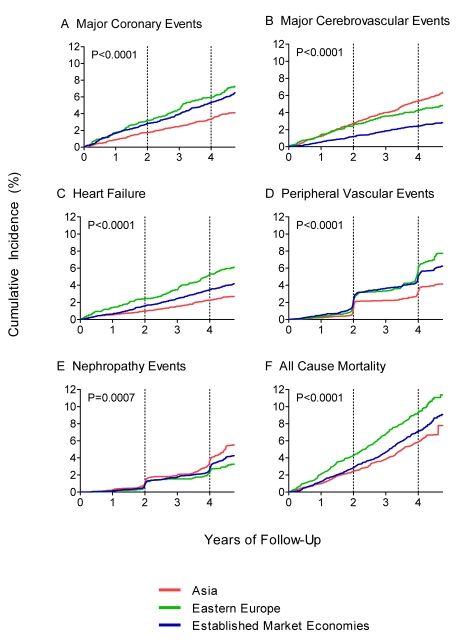
“A study has found that the risk of diabetic kidney disease is much higher in Asian countries than in Western countries due to different economic outcomes (100).”
From Diabetes and Sarcopenic Obesity: Pathogenesis, Diagnosis, and Treatments (2020) · cites this paper as [100]
In the citing paper
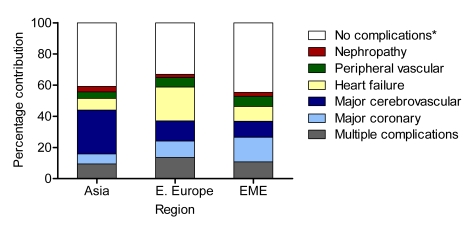
“Interestingly, a study has indicated that patients with T2D in Asian countries have a lower risk of coronary diseases than those from eastern Europe or Established Market Economies (100).”
From Diabetes and Sarcopenic Obesity: Pathogenesis, Diagnosis, and Treatments (2020) · cites this paper as [100]
Self-check
Percentages, sums and reported differences re-computed from the paper’s own numbers.
The self-check needs the paper’s full text.
Citations
Cites
(2001) · RePEc: Research Papers in Economics · Cited by 27,577
Longitudinal data analysis using generalized linear models
LIANG, K.-Y., & ZEGER, S. L. (1986) · Biometrika · doi:10.1093/biomet/73.1.13 · Cited by 18,550
Wild, S., Roglic, G., Green, A., Sicree, R., & King, H. (2004) · Diabetes Care · doi:10.2337/diacare.27.5.1047 · Cited by 15,297
Intensive blood glucose control and vascular outcomes in patients with type 2 diabetes
(2008) · New England Journal of Medicine · doi:10.1056/nejmoa0802987 · Cited by 7,397
Everitt, B. S. (2001) · Psychology Press eBooks · doi:10.4324/9781410605542-11 · Cited by 6,877
Multilevel and Longitudinal Modeling Using Stata
Rabe-Hesketh, S., & Skrondal, A. (2005) · Biometrics · doi:10.1111/j.1541-0420.2006.00588_16.x · Cited by 4,626
Economic Costs of Diabetes in the U.S. in 2002
American Diabetes Association (2003) · Diabetes Care · doi:10.2337/diacare.26.3.917 · Cited by 4,147
Disease control priorities in developing countries
(2006) · Choice Reviews Online · doi:10.5860/choice.44-0343 · Cited by 3,636
(2016) · Human Rights Documents online · doi:10.1163/2210-7975_hrd-9841-2014001 · Cited by 1,579
Lifetime risk for diabetes mellitus in the United States
Narayan, K. M. V. (2003) · JAMA · doi:10.1001/jama.290.14.1884 · Cited by 1,515
Research works printed but not linked: 1
- RJ Rubin, 1994, Health expenditures for people with diabetes mellitus, 1992., J Clin Endocrinol Metab, 78, 809A, 10.1210/jcem.78.4.8157701 · DOI
Cited by
Sorted by citations
Global aetiology and epidemiology of type 2 diabetes mellitus and its complications
Zheng, Y., Ley, S. H., & Hu, F. B. (2018) · Nature Reviews Endocrinology · doi:10.1038/nrendo.2017.151 · Cited by 5,697
Ronald, C. W., & Chan, J. C. N. (2013) · Annals of the New York Academy of Sciences · doi:10.1111/nyas.12098 · Cited by 841
The Lancet Commission on diabetes: using data to transform diabetes care and patient lives
Chan, J. C. N., Lim, L.-L., Wareham, N. J., Shaw, J. E., Orchard, T. J., Zhang, P., Lau, E. S. H., Eliasson, B., Kong, A. P. S., Ezzati, M., et al. (2020) · The Lancet · doi:10.1016/s0140-6736(20)32374-6 · Cited by 793
Self-citationDiabetic vascular diseases: molecular mechanisms and therapeutic strategies
Li, Y., Liu, Y., Liu, S., Gao, M., Wang, W., Chen, K., Huang, L., & Liu, Y. (2023) · Signal Transduction and Targeted Therapy · doi:10.1038/s41392-023-01400-z · Cited by 799
Epidemiology of diabetes and diabetic complications in China
Ronald, C. W. (2018) · Diabetologia · doi:10.1007/s00125-018-4557-7 · Cited by 501
Metadata
- Authors
- Clarke, P. M., Glasziou, P., Patel, A., Chalmers, J., Woodward, M., Harrap, S. B., Salomon, J. A., & on behalf of the ADVANCE Collaborative Group
- Affiliations
- The University of Sydney (AU)
- University of Oxford (GB)
- The University of Melbourne (AU)
- Harvard University (US)
- Corresponding author
- Clarke, Philip M.
- ORCID
- Venue
- PLoS Medicine
- Publisher
- Public Library of Science (PLoS)
- Published
- 2010-02-23
- Volume
- 7
- Issue
- 2
- Pages
- e1000236
- ISSN
- 1549-1277 (ISSN-L)
- 1549-1676
- PMC
- PMC2826379
- OpenAlex
- W2015835669
- Cited by
- 159
- References
- 33
- Citations by year
- 2026: 2 · 2025: 5 · 2024: 11 · 2023: 4 · 2022: 15 · 2021: 8 · 2020: 15 · 2019: 12 · 2018: 7 · 2017: 6 · 2016: 16 · 2015: 9 · 2014: 14 · 2013: 12 · 2012: 10
- FWCI
- 25.66
- Type
- journal article
- Language
- en
- Open access
- gold
- doi.org
- Locations
- PLoS Medicine (publishedVersion, cc-by)
- PubMed Central (publishedVersion, cc-by)
- PubMed (publishedVersion)
- Minerva Access (University of Melbourne) (submittedVersion, cc-by)
- Digital Access to Scholarship at Harvard (DASH) (Harvard University) (submittedVersion, cc-by)
- RePEc: Research Papers in Economics (submittedVersion)
- DOAJ (DOAJ: Directory of Open Access Journals) (submittedVersion, cc-by-sa)
- Figshare (submittedVersion, cc-by)
- Funders
- Pfizer
- AstraZeneca
- GlaxoSmithKline
- Sanofi
- University of Sydney
- Servier
- Medical Research Council
- National Health and Medical Research Council (211086, 358395, 571122)
- Topics
- Social Sciences › Economics, Econometrics and Finance › Economics and Econometrics › Health Systems, Economic Evaluations, Quality of Life
- Health Sciences › Medicine › Endocrinology, Diabetes and Metabolism › Diabetes, Cardiovascular Risks, and Lipoproteins
- Health Sciences › Medicine › Endocrinology, Diabetes and Metabolism › Diabetes Treatment and Management
- Keywords
- type 2 diabetes, diabetes complications, hospital utilization, hospital costs, length of hospital stay, hospitalization rates, coronary disease, cerebrovascular disease, heart failure, peripheral vascular disease, diabetic nephropathy, international dollars, regional cost comparison, economic burden of diabetes, ADVANCE study, cost calculator, low- and middle-income countries, high-income countries, Asia, Eastern Europe
- MeSH terms
- Aged, Diabetes Mellitus, Type 2, Health Expenditures, Female, Hospitalization, Humans, Male, Middle Aged, Cost of Illness
About these checks
Registry, retraction, Cites and statistics results are computed, not judged, with one exception: a printed reference that no index lists is read once by a model before it counts as a citation error. Claims are extracted by a model and kept only when their quote appears verbatim in the text; each cited source is then checked, with a model’s help, for whether it says what the claim relies on. Those verdicts can be wrong — read the claim’s quote and the cited source before relying on one.
Statistics and arithmetic are recomputed, not judged.
Confidence bands are shown only for fields calibrated on our annotated test set. None is calibrated yet, so no band is shown.
What counts as a claim ›How we measure confidence ›How we check this ›
Are you an author, or do you see a problem with this page? Request a review
