

The DOI matches its Crossref record; 53 of the 54 references it cites were found in a registry or an index.
Markers of Dysglycaemia and Risk of Coronary Heart Disease in People without Diabetes: Reykjavik Prospective Study and Systematic Review
Open accessAbstract
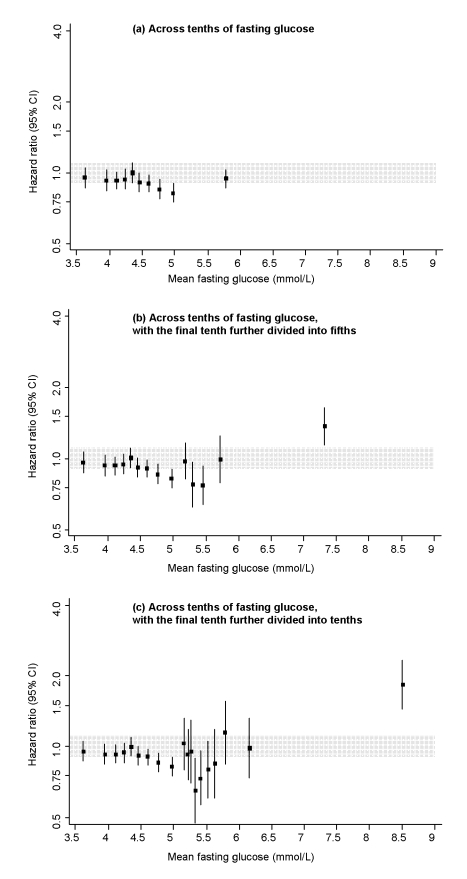
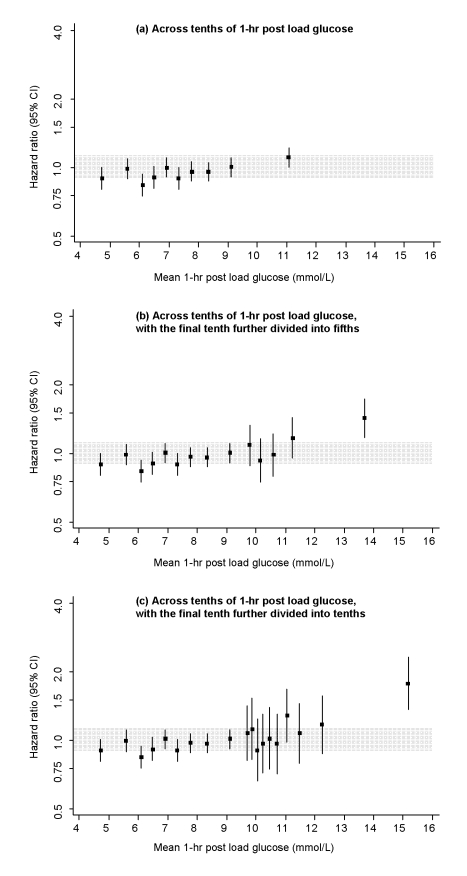
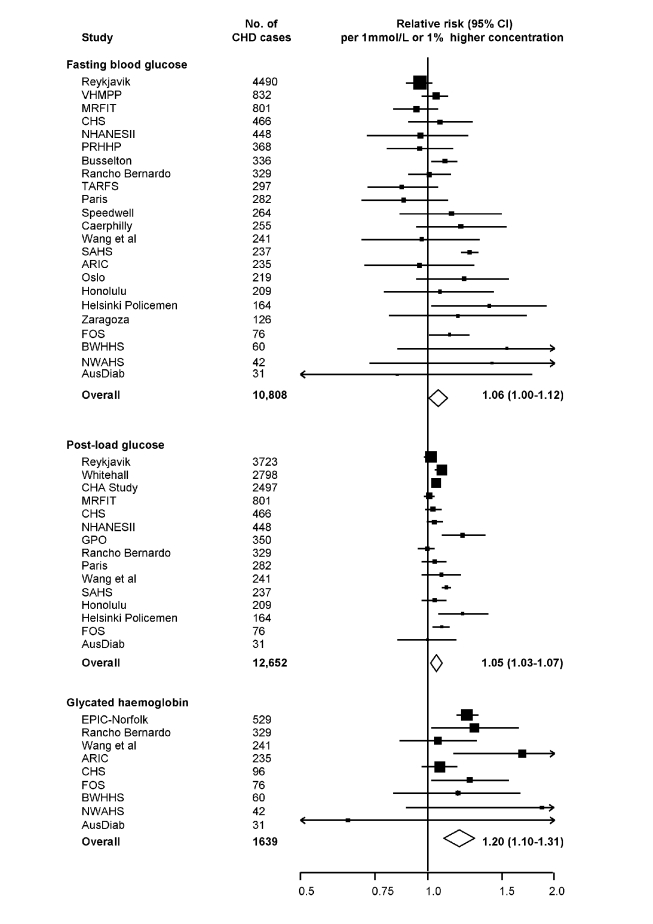
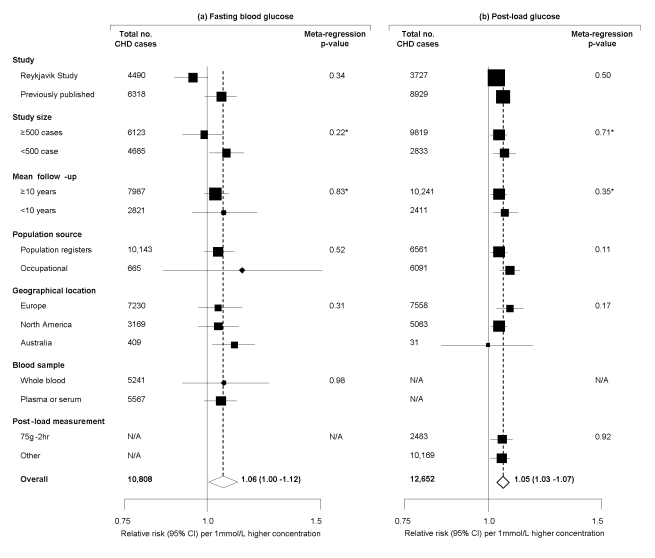
BACKGROUND: Associations between circulating markers of dysglycaemia and coronary heart disease (CHD) risk in people without diabetes have not been reliably characterised. We report new data from a prospective study and a systematic review to help quantify these associations. METHODS AND FINDINGS: Fasting and post-load glucose levels were measured in 18,569 participants in the population-based Reykjavik study, yielding 4,664 incident CHD outcomes during 23.5 y of mean follow-up. In people with no known history of diabetes at the baseline survey, the hazard ratio (HR) for CHD, adjusted for several conventional risk factors, was 2.37 (95% CI 1.79-3.14) in individuals with fasting glucose > or = 7.0 mmol/l compared to those < 7 mmol/l. At fasting glucose values below 7 mmol/l, adjusted HRs were 0.95 (0.89-1.01) per 1 mmol/l higher fasting glucose and 1.03 (1.01-1.05) per 1 mmol/l higher post-load glucose. HRs for CHD risk were generally modest and nonsignificant across tenths of glucose values below 7 mmol/l. We did a meta-analysis of 26 additional relevant prospective studies identified in a systematic review of Western cohort studies that recorded fasting glucose, post-load glucose, or glycated haemoglobin (HbA(1c)) levels. In this combined analysis, in which participants with a self-reported history of diabetes and/or fasting blood glucose > or = 7 mmol/l at baseline were excluded, relative risks for CHD, adjusted for several conventional risk factors, were: 1.06 (1.00-1.12) per 1 mmol/l higher fasting glucose (23 cohorts, 10,808 cases, 255,171 participants); 1.05 (1.03-1.07) per 1 mmol/l higher post-load glucose (15 cohorts, 12,652 cases, 102,382 participants); and 1.20 (1.10-1.31) per 1% higher HbA(1c) (9 cohorts, 1639 cases, 49,099 participants). CONCLUSIONS: In the Reykjavik Study and a meta-analysis of other Western prospective studies, fasting and post-load glucose levels were modestly associated with CHD risk in people without diabetes. The meta-analysis suggested a somewhat stronger association between HbA(1c) levels and CHD risk.
Overview
The claims and statistics of this paper haven’t been checked yet.
Run the check — free, no account needed. It reads the open-access text and checks the sources it cites.
Integrity signals
Registry
Cites
Statistics
Figures
Verification
Claims the paper makes
The claims and statistics of this paper haven’t been checked yet.
Run the check — free, no account needed. It reads the open-access text and checks the sources it cites.
Claims other papers make about this one
Each is checked against this paper’s own text: does it say what the citing paper says it does?
In the citing paper
“Whether it is the basal or the challenged blood glucose level that is more important for atherogenesis, average glucose levels, indexed by HbA1c concentration, predict incident coronary disease at least as well as fasting and postload glucose, though there are comparatively few prospective studies of HbA1c.89”
From Prediabetes: a high-risk state for diabetes development (2012) · cites this paper as [89]
In the citing paper
“A recent individual-level evidence from prospective studies suggests that fasting hyperglycaemia (figure 3), postload glucose, and A1c are all robust predictors of vascular mortality86,88,89 and, according to multivariable adjusted analyses, these associations are independent of vascular risk factors, such as obesity, blood pressure, triglyceride and lipoproteins.84,85,87”
From Prediabetes: a high-risk state for diabetes development (2012) · cites this paper as [89]
Self-check
Percentages, sums and reported differences re-computed from the paper’s own numbers.
The self-check needs the paper’s full text.
Citations
Cites
Measuring inconsistency in meta-analyses
Higgins, J. P. T., Thompson, S. G., Deeks, J. J., & Altman, D. G. (2003) · BMJ · doi:10.1136/bmj.327.7414.557 · Cited by 63,139
Bias in meta-analysis detected by a simple, graphical test
Egger, M., Smith, G. D., Schneider, M., & Minder, C. (1997) · BMJ · doi:10.1136/bmj.315.7109.629 · Cited by 56,722
Follow-up report on the diagnosis of diabetes mellitus
The Expert Committee on the Diagnosis and Classification of Diabetes Mellitus* (2003) · Diabetes Care · doi:10.2337/diacare.26.11.3160 · Cited by 3,784
Beckman, J. A., Creager, M. A., & Libby, P. (2002) · JAMA · doi:10.1001/jama.287.19.2570 · Cited by 2,765
The Metabolic Syndrome: Time for a Critical Appraisal
Kahn, R., Buse, J. B., Ferrannini, E., & Stern, M. P. (2005) · Diabetes Care · doi:10.2337/diacare.28.9.2289 · Cited by 2,400
Coutinho, M., Gerstein, H. C., Wang, Y., & Yusuf, S. (1999) · Diabetes Care · doi:10.2337/diacare.22.2.233 · Cited by 1,685
Guidelines on diabetes, pre-diabetes, and cardiovascular diseases: executive summary
Rydén, L., Standl, E., Bartnik, M., den Berghe, G. V., Betteridge, J. D., de Boer, M., Cosentino, F., Jönsson, B., Laakso, M., Malmberg, K., et al. (2007) · European Heart Journal · doi:10.1093/eurheartj/ehl260 · Cited by 1,644
Glucose Tolerance and Cardiovascular Mortality: Comparison of Fasting and 2-Hour Diagnostic Criteria
(2001) · Archives of Internal Medicine · doi:10.1001/archinte.161.3.397 · Cited by 1,371
A RAPID PHOTOELECTRIC METHOD FOR THE DETERMINATION OF GLUCOSE IN BLOOD AND URINE
Hoffman, W. S. (1937) · Journal of Biological Chemistry · doi:10.1016/s0021-9258(18)74360-3 · Cited by 1,283
American Diabetes Association (2003) · Diabetes Care · doi:10.2337/diacare.26.2007.s106 · Cited by 1,037
Research works printed but not linked: 2
- WHO consultation report. Definition, diagnosis and classification of diabetes mellitus and its complications., WHO/NCD/NCS/, 91.2
- RR Holman, 2007, A new era in the secondary prevention of CVD in prediabetes - the Acarbose Cardiovascular Evaluation (ACE) trial., Diab Vasc Dis Res, 4, S40
Cited by
Sorted by citations
The Emerging Risk Factors Collaboration (2010) · The Lancet · doi:10.1016/s0140-6736(10)60484-9 · Cited by 5,125
Prediabetes: a high-risk state for diabetes development
Tabák, A. G., Herder, C., Rathmann, W., Brunner, E. J., & Kivimäki, M. (2012) · The Lancet · doi:10.1016/s0140-6736(12)60283-9 · Cited by 2,958
Definition, Classification and Diagnosis of Diabetes, Prediabetes and Metabolic Syndrome
Punthakee, Z., Goldenberg, R., & Katz, P. (2018) · Canadian Journal of Diabetes · doi:10.1016/j.jcjd.2017.10.003 · Cited by 1,011
Definition, Classification and Diagnosis of Diabetes, Prediabetes and Metabolic Syndrome
Goldenberg, R., & Punthakee, Z. (2013) · Canadian Journal of Diabetes · doi:10.1016/j.jcjd.2013.01.011 · Cited by 635
Hooper, L., Kay, C., Abdelhamid, A., Kroon, P. A., Cohn, J. S., Rimm, E. B., & Cassidy, A. (2012) · The American Journal of Clinical Nutrition · doi:10.3945/ajcn.111.023457 · Cited by 610
Metadata
- Authors
- Sarwar, N., Aspelund, T., Eiriksdottir, G., Gobin, R., Seshasai, S. R. K., Forouhi, N. G., Sigurdsson, G., Danesh, J., & Gudnason, V.
- Affiliations
- University of Cambridge (GB)
- University of Iceland (IS)
- MRC Epidemiology Unit (GB)
- Corresponding author
- Sarwar, Nadeem
- ORCID
- Venue
- PLoS Medicine
- Publisher
- Public Library of Science (PLoS)
- Published
- 2010-05-25
- Volume
- 7
- Issue
- 5
- Pages
- e1000278
- ISSN
- 1549-1277 (ISSN-L)
- 1549-1676
- PMC
- PMC2876150
- OpenAlex
- W1992852296
- Cited by
- 175
- References
- 54
- Citations by year
- 2026: 1 · 2025: 7 · 2024: 2 · 2023: 11 · 2022: 9 · 2021: 9 · 2020: 9 · 2019: 8 · 2018: 12 · 2017: 10 · 2016: 12 · 2015: 15 · 2014: 16 · 2013: 18 · 2012: 15
- FWCI
- 2.46
- Type
- journal article
- Language
- en
- Open access
- gold
- doi.org
- Locations
- PLoS Medicine (publishedVersion, cc-by)
- PubMed Central (publishedVersion, cc-by)
- PubMed (publishedVersion)
- St George's Online Research Archive (St George's University of London) (acceptedVersion)
- RePEc: Research Papers in Economics (submittedVersion)
- DOAJ (DOAJ: Directory of Open Access Journals) (submittedVersion, cc-by-sa)
- Figshare (submittedVersion, cc-by)
- Funders
- Pfizer
- GlaxoSmithKline
- Wellcome Trust
- British Heart Foundation (RG/08/014/24067)
- Bupa Foundation
- European Commission
- Cambridge Trust
- Evelyn Trust
- Gates Cambridge Trust
- Medical Research Council
- National Heart, Lung, and Blood Institute
- Topics
- Health Sciences › Medicine › Endocrinology, Diabetes and Metabolism › Diabetes, Cardiovascular Risks, and Lipoproteins
- Health Sciences › Medicine › Endocrinology, Diabetes and Metabolism › Diet, Metabolism, and Disease
- Health Sciences › Medicine › Endocrinology, Diabetes and Metabolism › Diabetes Management and Research
- Keywords
- dysglycemia, coronary artery disease, fasting blood glucose, post-load glucose, HbA1c, non-diabetic individuals, cardiovascular risk, hyperglycemia, prediabetes, Reykjavik Study, HbA1c thresholds
- MeSH terms
- Adult, Blood Glucose, Coronary Disease, Diabetes Mellitus, Fasting, Female, Glycated Hemoglobin, Humans, Hyperglycemia, Male, Middle Aged, Prospective Studies, Reference Values, Risk Factors, Biomarkers
About these checks
Registry, retraction, Cites and statistics results are computed, not judged, with one exception: a printed reference that no index lists is read once by a model before it counts as a citation error. Claims are extracted by a model and kept only when their quote appears verbatim in the text; each cited source is then checked, with a model’s help, for whether it says what the claim relies on. Those verdicts can be wrong — read the claim’s quote and the cited source before relying on one.
Statistics and arithmetic are recomputed, not judged.
Confidence bands are shown only for fields calibrated on our annotated test set. None is calibrated yet, so no band is shown.
What counts as a claim ›How we measure confidence ›How we check this ›
Are you an author, or do you see a problem with this page? Request a review
