

The DOI matches its Crossref record; 53 of the 55 references it cites were found in a registry or an index.
Strategies for Increasing Recruitment to Randomised Controlled Trials: Systematic Review
Open accessAbstract
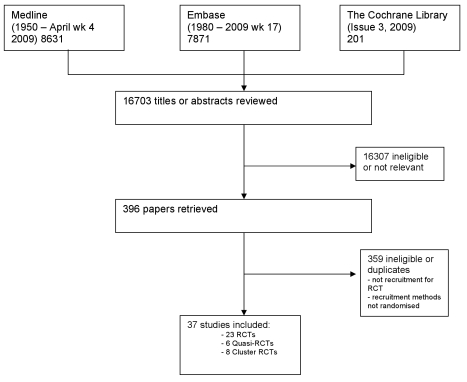
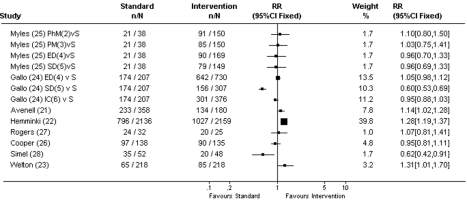
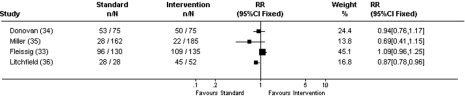
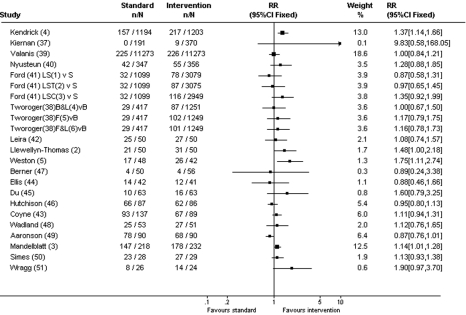
BACKGROUND: Recruitment of participants into randomised controlled trials (RCTs) is critical for successful trial conduct. Although there have been two previous systematic reviews on related topics, the results (which identified specific interventions) were inconclusive and not generalizable. The aim of our study was to evaluate the relative effectiveness of recruitment strategies for participation in RCTs. METHODS AND FINDINGS: A systematic review, using the PRISMA guideline for reporting of systematic reviews, that compared methods of recruiting individual study participants into an actual or mock RCT were included. We searched MEDLINE, Embase, The Cochrane Library, and reference lists of relevant studies. From over 16,000 titles or abstracts reviewed, 396 papers were retrieved and 37 studies were included, in which 18,812 of at least 59,354 people approached agreed to participate in a clinical RCT. Recruitment strategies were broadly divided into four groups: novel trial designs (eight studies), recruiter differences (eight studies), incentives (two studies), and provision of trial information (19 studies). Strategies that increased people's awareness of the health problem being studied (e.g., an interactive computer program [relative risk (RR) 1.48, 95% confidence interval (CI) 1.00-2.18], attendance at an education session [RR 1.14, 95% CI 1.01-1.28], addition of a health questionnaire [RR 1.37, 95% CI 1.14-1.66]), or a video about the health condition (RR 1.75, 95% CI 1.11-2.74), and also monetary incentives (RR1.39, 95% CI 1.13-1.64 to RR 1.53, 95% CI 1.28-1.84) improved recruitment. Increasing patients' understanding of the trial process, recruiter differences, and various methods of randomisation and consent design did not show a difference in recruitment. Consent rates were also higher for nonblinded trial design, but differential loss to follow up between groups may jeopardise the study findings. The study's main limitation was the necessity of modifying the search strategy with subsequent search updates because of changes in MEDLINE definitions. The abstracts of previous versions of this systematic review were published in 2002 and 2007. CONCLUSION: Recruitment strategies that focus on increasing potential participants' awareness of the health problem being studied, its potential impact on their health, and their engagement in the learning process appeared to increase recruitment to clinical studies. Further trials of recruitment strategies that target engaging participants to increase their awareness of the health problems being studied and the potential impact on their health may confirm this hypothesis. Please see later in the article for the Editors' Summary.
Overview
The claims and statistics of this paper haven’t been checked yet.
Run the check — free, no account needed. It reads the open-access text and checks the sources it cites.
Integrity signals
Registry
Cites
Statistics
Figures

Verification
Claims the paper makes
The claims and statistics of this paper haven’t been checked yet.
Run the check — free, no account needed. It reads the open-access text and checks the sources it cites.
Claims other papers make about this one
Each is checked against this paper’s own text: does it say what the citing paper says it does?
In the citing paper
“Different recruitment methods can substantially affect the number and type of trial participants recruited206 309 312 313 and can incur different costs.314 315 316”
From SPIRIT 2025 explanation and elaboration: updated guideline for protocols of randomised trials (2025) · cites this paper as [312]
Self-check
Percentages, sums and reported differences re-computed from the paper’s own numbers.
The self-check needs the paper’s full text.
Citations
Cites
Cochrane Handbook for Systematic Reviews of Interventions: Cochrane Book Series
(2008) · doi:10.1002/9780470712184 · Cited by 25,048
Evidence based medicine: what it is and what it isn't
Sackett, D. L., Rosenberg, W. M. C., Gray, J. A. M., Haynes, R. B., & Richardson, W. S. (1996) · BMJ · doi:10.1136/bmj.312.7023.71 · Cited by 15,769
Health Belief Model and Personal Health Behavior
Becker, M. H. (1976) · Medical Entomology and Zoology · Cited by 3,065
The Health Belief Model and Sick Role Behavior
Becker, M. H. (1974) · Health Education Monographs · doi:10.1177/109019817400200407 · Cited by 2,327
Recruiting Minorities Into Clinical Trials Toward a Participant-Friendly System
Swanson, G. M., & Ward, A. J. (1995) · JNCI Journal of the National Cancer Institute · doi:10.1093/jnci/87.23.1747 · Cited by 558
Recruitment for controlled clinical trials: Literature summary and annotated bibliography
Lovato, L., Hill, K., Hertert, S., Hunninghake, D. B., & Probstfield, J. L. (1997) · Controlled Clinical Trials · doi:10.1016/s0197-2456(96)00236-x · Cited by 400
Which clinical studies provide the best evidence?
Barton, S. (2000) · BMJ · doi:10.1136/bmj.321.7256.255 · Cited by 384
Increasing recruitment to randomised trials: a review of randomised controlled trials
Watson, J. M., & Torgerson, D. J. (2006) · BMC Medical Research Methodology · doi:10.1186/1471-2288-6-34 · Cited by 333
Simes, R. J., Tattersall, M. H. N., Coates, A., Raghavan, D., Solomon, H. J., & Smartt, H. (1986) · BMJ · doi:10.1136/bmj.293.6554.1065 · Cited by 202
Coyne, C. A., Xu, R., Raich, P. C., Plomer, K., Dignan, M., Wenzel, L. B., Fairclough, D. L., Habermann, T. M., Schnell, L., Quella, S. K., et al. (2003) · Journal of Clinical Oncology · doi:10.1200/jco.2003.07.022 · Cited by 198
Strategies to improve recruitment to research studies
Mapstone, J., Elbourne, D. R., & Roberts, I. (2007) · Cochrane Database of Systematic Reviews · doi:10.1002/14651858.mr000013.pub3 · Cited by 194
Halpern, S. D., Karlawish, J. H., Casarett, D., Berlin, J. A., & Asch, D. A. (2004) · Archives of Internal Medicine · doi:10.1001/archinte.164.7.801 · Cited by 192
Parents' attitudes to children's participation in randomized controlled trials
Caldwell, P. H. Y., Butow, P. N., & Craig, J. C. (2003) · The Journal of Pediatrics · doi:10.1067/mpd.2003.192 · Cited by 190
Self-citationAaronson, N. K., Visser-Pol, E., Leenhouts, G., Muller, M. J., van der Schot, A. C., van Dam, F. S. A. M., Keus, R. B., Koning, C. C. E., Huinink, W. W. T. B., van Dongen, J. A., et al. (1996) · Journal of Clinical Oncology · doi:10.1200/jco.1996.14.3.984 · Cited by 184
Kimmick, G. G., Peterson, B. L., Kornblith, A. B., Mandelblatt, J. S., Johnson, J. L., Wheeler, J., Heinze, R., Cohen, H. J., & Muss, H. B. (2005) · Journal of Clinical Oncology · doi:10.1200/jco.2005.01.222 · Cited by 127
Evaluating the benefits of a patient information video during the informed consent process
Weston, J. A., Hannah, M., & Downes, J. (1997) · Patient Education and Counseling · doi:10.1016/s0738-3991(96)00968-8 · Cited by 124
Welton, A. J., Vickers, M. R., Cooper, J. A., Meade, T. W., & Marteau, T. M. (1999) · BMJ · doi:10.1136/bmj.318.7191.1114 · Cited by 114
Ford, M. E., Havstad, S. L., & Davis, S. D. (2004) · Clinical Trials · doi:10.1191/1740774504cn029oa · Cited by 91
Presenting clinical trial information: a comparison of methods
Llewellyn‐Thomas, H. A., Thiel, E. C., Sem, F. W. C., & Harrison-Woermke, D. (1995) · Patient Education and Counseling · doi:10.1016/0738-3991(94)00705-q · Cited by 91
Cooper, K. G., Grant, A., & Garratt, A. (1997) · BJOG An International Journal of Obstetrics & Gynaecology · doi:10.1111/j.1471-0528.1997.tb11005.x · Cited by 87
Avenell, A., GRANT, A. M., McGee, M., McPherson, G. C., Campbell, M., McGee, M. A., & RECORD Trial Management Group (2004) · Clinical Trials · doi:10.1191/1740774504cn053oa · Cited by 87
Hutchison, C., Cowan, C., McMahon, T. J., & Paul, J. (2007) · British Journal of Cancer · doi:10.1038/sj.bjc.6603943 · Cited by 85
Martinson, B. C., Lazovich, D., Lando, H. A., Perry, C. L., McGovern, P. G., & Boyle, R. G. (2000) · Preventive Medicine · doi:10.1006/pmed.2000.0762 · Cited by 85
Easterbrook, P., & Matthews, D. R. (1992) · Journal of the Royal Society of Medicine · doi:10.1177/014107689208500206 · Cited by 82
Impediments to recruitment in the Canadian National Breast Screening Study: Response and resolution
Baines, C. J. (1984) · Controlled Clinical Trials · doi:10.1016/0197-2456(84)90119-3 · Cited by 80
Who can best recruit to randomized trials?
Donovan, J., Peters, T. J., Noble, S., Powell, P. H., Gillatt, D. A., Oliver, S. E., Lane, J. A., Neal, D. E., & Hamdy, F. C. (2003) · Journal of Clinical Epidemiology · doi:10.1016/s0895-4356(03)00083-0 · Cited by 77
Rogers, C. G., Tyson, J. E., Kennedy, K. A., Broyles, R. S., & Hickman, J. F. (1998) · The Journal of Pediatrics · doi:10.1016/s0022-3476(98)70347-6 · Cited by 70
Ellis, P., Butow, P. N., & Tattersall, M. H. N. (2002) · Annals of Oncology · doi:10.1093/annonc/mdf255 · Cited by 68
Informed versus randomised consent to clinical trials
Gallo, C., Perrone, F., Placido, S. D., & Giusti, C. (1995) · The Lancet · doi:10.1016/s0140-6736(95)91741-1 · Cited by 66
Fleissig, A., Jenkins, V. A., & Fallowfield, L. J. (2001) · European Journal of Cancer · doi:10.1016/s0959-8049(00)00415-9 · Cited by 63
An Educational Video to Increase Clinical Trials Enrollment among Lung Cancer Patients
Du, W., Mood, D., Gadgeel, S. M., & Simon, M. S. (2008) · Journal of Thoracic Oncology · doi:10.1097/jto.0b013e31815e8bb2 · Cited by 62
Recruitment of Hispanic women to the Women's Health Initiative
Larkey, L., Staten, L. K., Ritenbaugh, C., Hall, R. A., Buller, D. B., Bassford, T. L., & Altimari, B. R. (2002) · Controlled Clinical Trials · doi:10.1016/s0197-2456(02)00190-3 · Cited by 61
Using direct mail to recruit hispanic adults into a dietary intervention: An experimental study
Kiernan, M., Phillips, K., Fair, J. M., & King, A. C. (2000) · Annals of Behavioral Medicine · doi:10.1007/bf02895172 · Cited by 60
Tworoger, S. S., Yasui, Y., Ulrich, C. M., Nakamura, H., LaCroix, K., Johnston, R., & McTiernan, A. (2002) · PubMed · Cited by 57
Is the future for clinical trials internet-based? A cluster randomized clinical trial
Litchfield, J., Freeman, J., Schou, H., Elsley, M., Fuller, R., & Chubb, B. (2005) · Clinical Trials · doi:10.1191/1740774505cn069oa · Cited by 56
Liénard, J.-L., Quinaux, E., Fabre, E., Piedbois, P., Jouhaud, A., Decoster, G., & Buyse, M. E. (2006) · Clinical Trials · doi:10.1177/1740774506070807 · Cited by 49
Patient Recruitment: US Perspective
Walson, P. D. (1999) · PEDIATRICS · doi:10.1542/peds.104.s3.619 · Cited by 48
Wragg, J. A., Robinson, E. J., & Lilford, R. J. (2000) · Social Science & Medicine · doi:10.1016/s0277-9536(99)00477-3 · Cited by 46
Mandelblatt, J. S., KAUFMAN, E., Sheppard, V. B., Pomeroy, J., Kavanaugh, J. L., Cañar, J., PALLANDRE, L., Cullen, J. W., & Huerta, E. E. (2004) · Preventive Medicine · doi:10.1016/j.ypmed.2004.09.004 · Cited by 44
Mailing Strategies and Costs of Recruiting Heavy Smokers in CARET, a Large Chemoprevention Trial
VALANIS, B. G., Blank, J. D., & Glass, A. G. (1998) · Controlled Clinical Trials · doi:10.1016/s0197-2456(97)00027-5 · Cited by 44
Clinical Research and the Noninstitutional Elderly: A Model for Subject Recruitment
Leader, M. A., & Neuwirth, E. (1978) · Journal of the American Geriatrics Society · doi:10.1111/j.1532-5415.1978.tb01951.x · Cited by 43
Monaghan, H., Richens, A., Colman, S., Currie, R., Girgis, S. T., Jayne, K., Neal, B. C., & Patel, A. A. (2006) · Contemporary Clinical Trials · doi:10.1016/j.cct.2006.06.004 · Cited by 41
Nystuen, P., & Hagen, K. B. (2004) · Journal of Clinical Epidemiology · doi:10.1016/j.jclinepi.2003.12.015 · Cited by 41
A randomized controlled trial comparing quantitative informed consent formats
Simelt, D. L., & Feussner, J. R. (1991) · Journal of Clinical Epidemiology · doi:10.1016/0895-4356(91)90129-w · Cited by 41
Myles, P. S., Fletcher, H. E., Cairo, S., Madder, H., McRae, R., Cooper, J., Devonshire, D., Hunt, J. O., Richardson, J., Machlin, H., et al. (1999) · Anesthesiology · doi:10.1097/00000542-199910000-00016 · Cited by 37
Blinding decreased recruitment in a prevention trial of postmenopausal hormone therapy
Hemminki, E., Hovi, S., Veerus, P., Sevón, T., Tuimala, R. J., Rahu, M., & Hakama, M. (2004) · Journal of Clinical Epidemiology · doi:10.1016/j.jclinepi.2004.04.009 · Cited by 34
Kendrick, D., Watson, M., Dewey, M., & Woods, A. J. (2001) · Journal of Epidemiology & Community Health · doi:10.1136/jech.55.11.845 · Cited by 24
Recruitment in a primary care trial on smoking cessation.
WADLAND, W. C., Hughes, Walker, R. H. S., Bronson, D. L., & Fenwick, J. W. (1990) · PubMed · Cited by 24
Extending Acute Trials to Remote Populations
Leira, E. C. C., Ahmed, A., Lamb, D. L., Olalde, H. M., Callison, R. C., Torner, J. C., & Adams, H. P. (2009) · Stroke · doi:10.1161/strokeaha.108.530204 · Cited by 21
Miller, N. L., Markowitz, J. C., Kocsis, J. H., Leon, A. C., Brisco, S. T., & Garno, J. L. (1999) · Journal of Psychiatric Research · doi:10.1016/s0022-3956(98)00045-4 · Cited by 20
Berner, E. S., Partridge, E. E., & Baum, S. K. (1997) · PubMed · doi:10.1080/08858199709528466 · Cited by 18
Pighills, A., Torgerson, D. J., & Sheldon, T. (2009) · Journal of Clinical Epidemiology · doi:10.1016/j.jclinepi.2009.01.017 · Cited by 17
Research works printed but not linked: 3
- P Caldwell, 2002, Strategies for recruitment to RCTs: a systematic review of controlled trials and observational studies.
- P Caldwell, 2007, Systematic review of strategies for enhancing recruitment of participants for randomised controlled trials.
- E Quinaux, 2003, Impact of monitoring visits on patient recruitment and data quality: case study of a phase IV trial in oncology., Control Clin Trials, 24, 99S
Cited by
Sorted by citations
SPIRIT 2013 explanation and elaboration: guidance for protocols of clinical trials
Chan, A.-W., Tetzlaff, J. M., Gotzsche, P. C., Altman, D. G., Mann, H., Berlin, J. A., Dickersin, K., Hrobjartsson, A., Schulz, K. F., Parulekar, W. R., et al. (2013) · BMJ · doi:10.1136/bmj.e7586 · Cited by 6,251
Bonevski, B., Randell, M., Paul, C. L., Chapman, K. L., Twyman, L., Bryant, J., Brozek, I., & Hughes, C. (2014) · BMC Medical Research Methodology · doi:10.1186/1471-2288-14-42 · Cited by 1,495
Treweek, S. P., Lockhart, P., Pitkethly, M., Cook, J. A., Kjeldstrøm, M., Johansen, M., Taskila, T. K., Sullivan, F., Wilson, S., Jackson, C. M., et al. (2013) · BMJ Open · doi:10.1136/bmjopen-2012-002360 · Cited by 625
Strategies to improve recruitment to randomised trials
Treweek, S., Pitkethly, M., Cook, J., Fraser, C., Mitchell, E., Sullivan, F., Jackson, C., Taskila, T. K., & Gardner, H. (2018) · Cochrane Database of Systematic Reviews · doi:10.1002/14651858.mr000013.pub6 · Cited by 521
Joseph, P. D., Craig, J. C., & Caldwell, P. H. Y. (2013) · British Journal of Clinical Pharmacology · doi:10.1111/bcp.12305 · Cited by 424
Self-citation
Metadata
- Authors
- Caldwell, P. H. Y., Hamilton, S., Tan, A., & Craig, J. C.
- Affiliations
- The University of Sydney (AU)
- Children's Hospital at Westmead (AU)
- Corresponding author
- Caldwell, Patrina H. Y.
- Venue
- PLoS Medicine
- Publisher
- Public Library of Science (PLoS)
- Published
- 2010-11-09
- Volume
- 7
- Issue
- 11
- Pages
- e1000368
- ISSN
- 1549-1277 (ISSN-L)
- 1549-1676
- PMC
- PMC2976724
- OpenAlex
- W2121847763
- Cited by
- 307
- References
- 55
- Citations by year
- 2026: 6 · 2025: 19 · 2024: 19 · 2023: 28 · 2022: 24 · 2021: 23 · 2020: 19 · 2019: 18 · 2018: 27 · 2017: 21 · 2016: 18 · 2015: 22 · 2014: 13 · 2013: 22 · 2012: 18
- FWCI
- 2.31
- Type
- journal article
- Language
- en
- Open access
- gold
- doi.org
- Locations
- PLoS Medicine (publishedVersion, cc-by)
- PubMed Central (publishedVersion, cc-by)
- PubMed (publishedVersion)
- RePEc: Research Papers in Economics (publishedVersion)
- DOAJ (DOAJ: Directory of Open Access Journals) (submittedVersion, cc-by-sa)
- Funders
- University of Sydney
- Topics
- Health Sciences › Medicine › Public Health, Environmental and Occupational Health › Ethics in Clinical Research
- Physical Sciences › Mathematics › Statistics and Probability › Statistical Methods in Clinical Trials
- Social Sciences › Decision Sciences › Statistics, Probability and Uncertainty › Meta-analysis and systematic reviews
- Keywords
- randomized controlled trials, clinical trial participation, participant awareness, financial incentives, trial design, informed consent, loss to follow-up, mock trial, health education
- MeSH terms
- Humans, Patient Education as Topic, Randomized Controlled Trials as Topic, Sample Size
About these checks
Registry, retraction, Cites and statistics results are computed, not judged, with one exception: a printed reference that no index lists is read once by a model before it counts as a citation error. Claims are extracted by a model and kept only when their quote appears verbatim in the text; each cited source is then checked, with a model’s help, for whether it says what the claim relies on. Those verdicts can be wrong — read the claim’s quote and the cited source before relying on one.
Statistics and arithmetic are recomputed, not judged.
Confidence bands are shown only for fields calibrated on our annotated test set. None is calibrated yet, so no band is shown.
What counts as a claim ›How we measure confidence ›How we check this ›
Are you an author, or do you see a problem with this page? Request a review
